Web3 Projects with Cash Flow: Is Token Issuance an Amplifier or a Burden?

比推Published on 2026-02-24Last updated on 2026-02-24

Abstract

The article "The Next Stop for Tokens: Does a Project with Cash Flow Really Need to Issue a Token?" explores whether Web3 projects with existing cash flow should issue tokens. It argues that while token generation events (TGEs) can act as accelerators by attracting global attention and liquidity, they often become liabilities due to the burdens of market making, exchange negotiations, and price management. Short-term token prices are influenced by liquidity, attention, and token distribution, but long-term value depends on value capture mechanisms. Projects like Hyperliquid demonstrate successful value capture by linking protocol revenue to token buybacks, whereas many others fail to align token value with real usage or revenue. The author suggests that the future of tokens may lie in the "machine economy," where agents use crypto for micropayments and automated settlements, as seen in protocols like x402. Ultimately, TGEs should serve as network lubricants rather than exit strategies, with stricter regulations potentially separating equity-based financing from token-based utility. The industry must eliminate low-quality projects to allow robust infrastructure to emerge.

Written by: @0xBenniee

Original title: The Next Stop for Tokens: Does a Project with Cash Flow Really Need to Issue a Token?


Token issuance is no longer the only solution: For teams with clear cash flow, channels, and compliance paths, TGE is not a mandatory option.

Short- to medium-term prices are primarily driven by three factors: liquidity, attention, and token distribution structure.

The long-term value of a token depends on value capture; how value is captured is crucial to the token's long-term value.

The next stop for tokens may be the "machine economy": Payments between Agents and native protocols like x402, promoting pay-per-call and profit-sharing based on contributions.

This article is inspired by @DrPayFi (Co-founder of Huma.Finance)'s response to the author's question:

Q:

Over the past year, Huma has built a complete Payfi infrastructure network. However, tokens in the ecosystem often limit project development. For example, issued tokens are essentially liabilities and place retail investors as counterparties. Not all stakeholders can benefit, and the team must invest significant effort in market cap management or token distribution.

Of course, during TGE, no early participants were disadvantaged, which seems out of place in a market where "no one looks at the long term."

Detailed reply as follows:
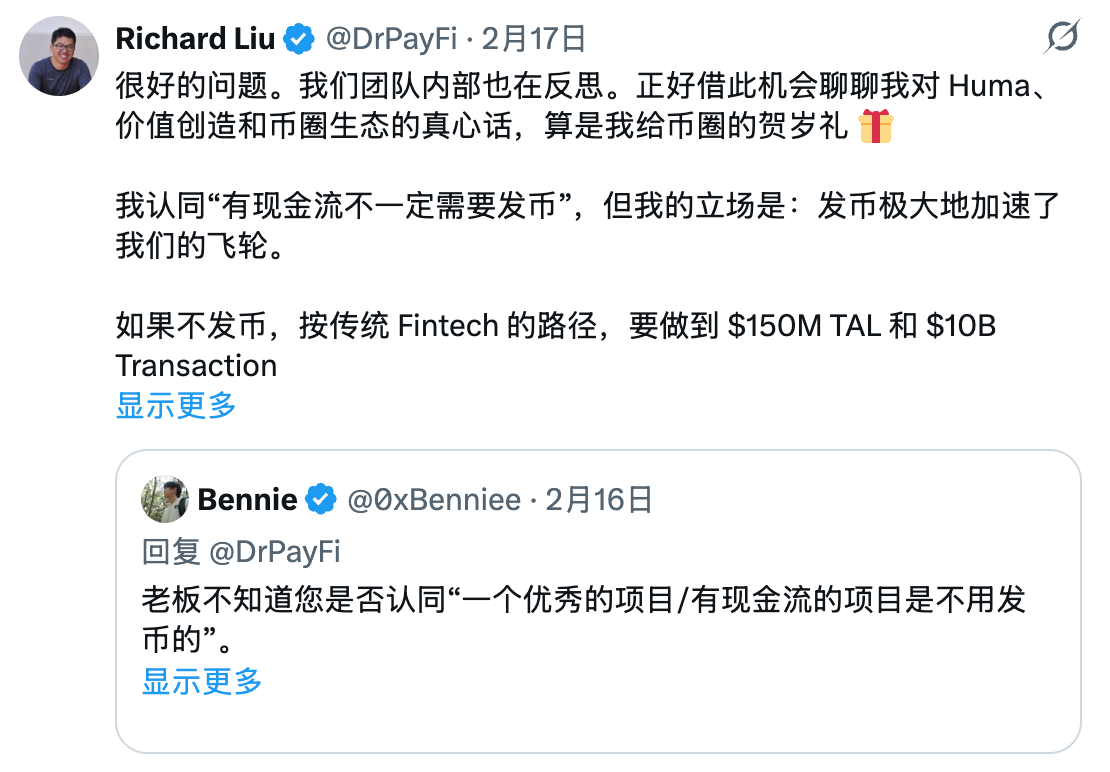
First, TGE is a harvesting sickle for some projects with no substance, but for long-term projects, it may be an "accelerator"

This was a recurring topic at Consensus: For the vast majority of projects with stable cash flow, token issuance may not be the more profitable choice, and often the disadvantages outweigh the benefits.

Once TGE begins, the team must not only focus on product development and growth but also manage additional external variables such as price expectation management, liquidity structure and market-making arrangements, complex communications with exchanges, and market sentiment fluctuations. These uncertainties continuously consume organizational attention and may even affect product节奏 and strategic decisions.

- What is an "accelerator"?

In the Payfi network, compared to traditional Fintech growth paths that rely more on licenses, channels, and regional networks, scaling liquidity and quickly converting it into TAL (Total Active Liquidity) that can be genuinely used typically requires more time.

TGE provides a more efficient "global distribution and attention aggregation" mechanism: Unlike the门槛 and geographical limitations of stock market listings, tokens allow global users to participate, hold, and trade绑定 to network growth through DEX/CEX from anywhere, providing additional momentum for ecological collaboration and growth flywheels. To some extent, this helps projects gain user attention faster and increase real user growth.

- What is a "sickle"?

Conversely, for projects without products or users, TGE → selling tokens becomes the only way to exit or profit. By repeatedly pumping and dumping, they can simply extract liquidity from the market and exit.

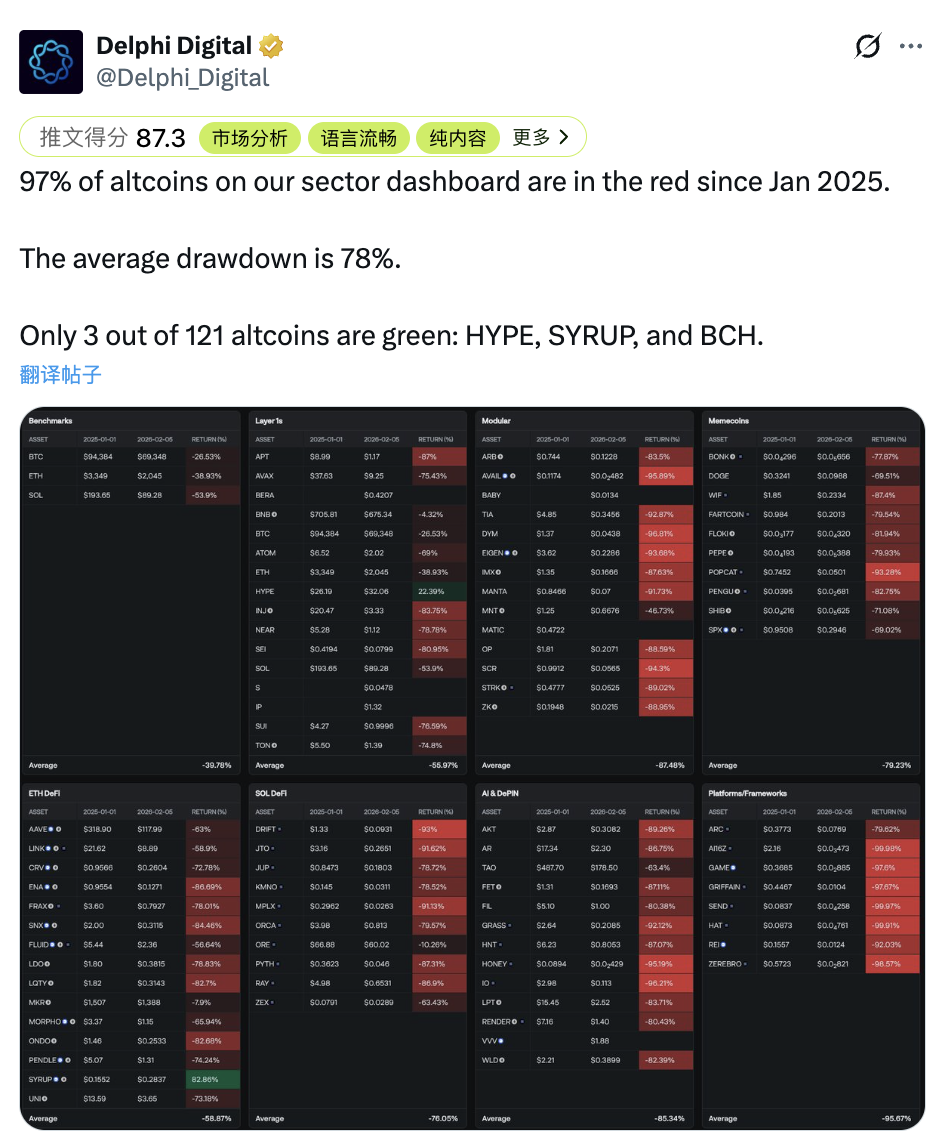
More残酷的是, this is not an exception but the norm in the current market. Over the past year, the vast majority of newly issued tokens have experienced significant pullbacks, with 97% of tokens shrinking by an average of 78% in price. As market liquidity becomes thinner and exits rely more on secondary markets, this "blood-sucking" secondary market strategy becomes more frequent, effective, and irreversible.
Factors determining token price after TGE and potential external benefits

Currently, Crypto projects still have some structural issues, such as the long-term mismatch between "exit channels" and "external growth."
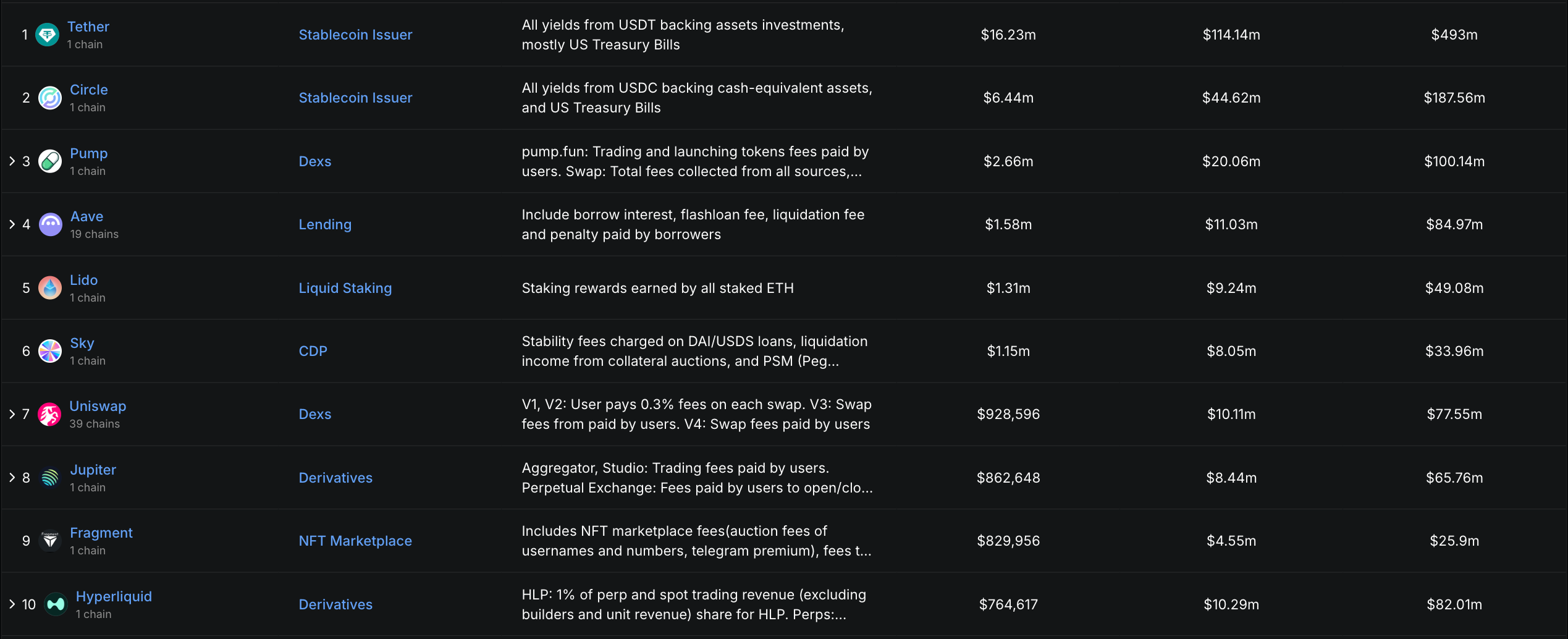
On one hand, the supply side of public chains and projects is长期 "over-issued," but the market's capital size and on-chain transaction intensity are insufficient to support continuously rising FDV/market cap. Most projects struggle to form stable, scalable protocol revenue solely through their products, let alone use this cash flow to消化 future large unlocking pressures.

Taking DeFiLlama's统计口径 as an example, only 6 protocols had protocol revenue exceeding $1M in the past 24 hours, and only 49 had protocol revenue exceeding $5M in the past 30 days. This means that relying solely on protocol revenue often cannot support excessively high valuations,更难承接 the supply impact of tokens during subsequent unlocking cycles.

On the other hand, factors such as market makers, exchanges, and users also play highly uncertain roles in token prices. When early capital exits rely more on secondary markets, prices are naturally dominated by interested parties.

Apart from early VCs who can still exit partially through mergers and acquisitions or follow-up financing, more projects, when cash flow is not yet formed and financing windows are tightening, tend to shift financing functions to secondary markets: through phased unlocking and so-called "reasonable减持," they transfer the already scarce market liquidity from retail investors to the project side.

In the short term, this can keep projects afloat, but in the long run, it pushes the market into a negative cycle, eventually evolving into an irreversible development of "bad money driving out good."

This corresponds to what @ChaseWang mentioned in an interview: in the current environment, the short- to medium-term trends of many assets often revolve around the following three variables:

- Liquidity: Whether there is money in the market, the willingness/risk appetite to buy, and whether there are more attractive alternative assets determine the upper limit of price increases.

- Traffic (attention): The spread by top KOLs,投放 by agencies and channel resources, and the concentration of retail attention often determine the amplitude of short-term fluctuations.

- Token distribution structure: The size of the circulating supply after TGE, token distribution, the unlocking and release节奏 of token economics, and arrangements around liquidity.

The thinner the liquidity, the more the market relies on narratives and prices; the more it relies on prices, the more it damages user and long-term capital confidence, eventually evolving into a筹码博弈 between projects and retail investors.

But in reality, projects, retail investors, and exchanges are not天然对立面. The common interest of all three parties is to maximize the "upper limit & imagination of the leader," attract incremental capital and real-use scenarios from outside, rather than repeatedly PVP in存量资金, treating the secondary market as an endless ATM.

Flowing water does not compete to be first; it competes to be endless.

Product value and value capture

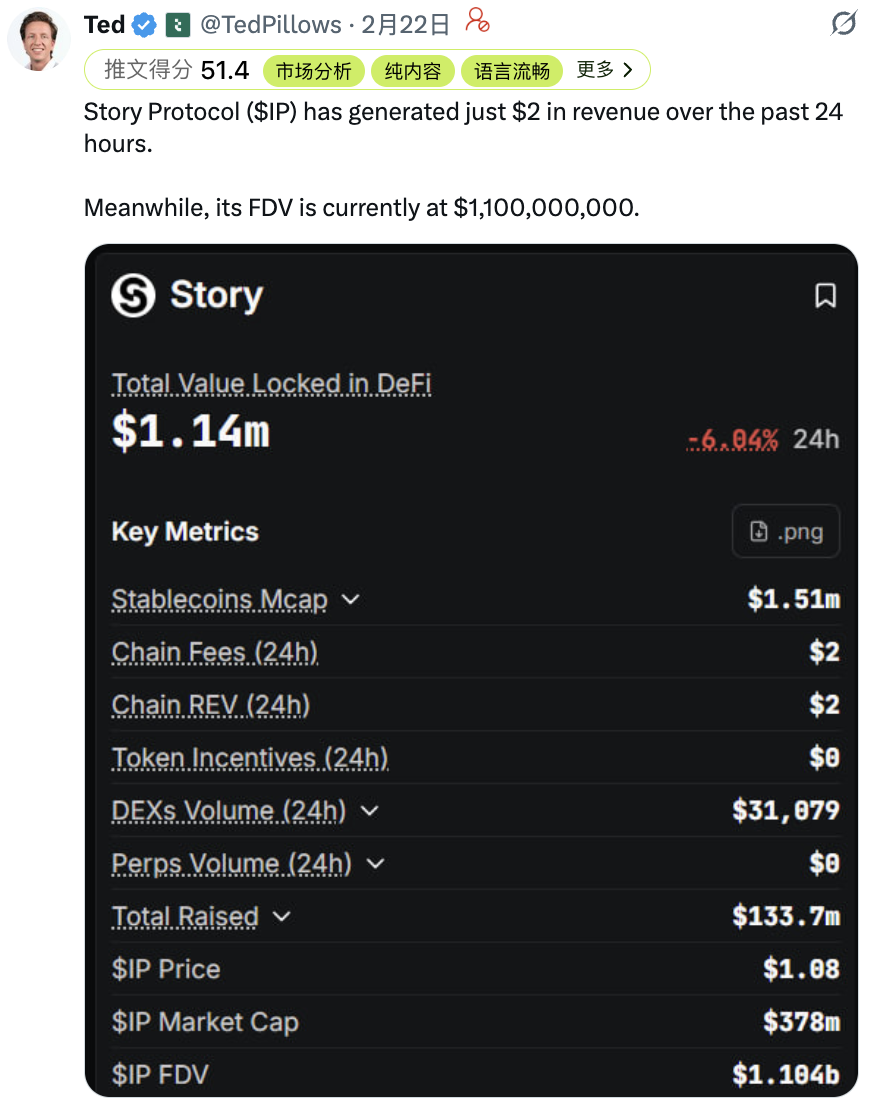
Many projects do have "product value," but the value does not feed back into the Token.

Returning to today's topic, you will find a more counterintuitive fact: a project not issuing a token does not mean it is not great. For example, @Pumpfun proved that "product value" itself can be established in Web3, but whether the project's token can be priced long-term depends on value capture: without a clear回流机制, token value can often only be supported by sentiment and token distribution structure.

A typical positive example is Hyperliquid. Its "token value capture" is widely recognized by the market: real revenue generated by the protocol → forms continuous buy-side回流 (e.g., buyback mechanisms) → directly binds token value to trading activity. The more active the trading and the more revenue, the stronger the token's承接力, and the clearer the pricing anchor.

Conversely, common counterexamples usually fall into three structures:

  1. The product has revenue, but the token price does not reflect it: The money earned by the protocol stays with the team/company/channel side. The token itself is only responsible for "governance voting" or "narrative performance." Value回流 is absent, and long-term pricing can only rely on sentiment.

  2. The token has incentives, but no real demand/users: Data (TVL/trading volume looks good) is inflated through high inflation subsidies, but once incentives are removed, data plummets, leaving only unlocking and selling pressure.

  3. Using the secondary market as a financing and exit channel: When the project's cash flow is not yet sustainable, it chooses to use the secondary market to bear financing pressure. The token becomes the project's "liability side," and the pricing logic gradually degenerates into a筹码博弈.
So, where is the future path?

If the "path" of traditional payments in the past is understood as a major breakthrough that solved geographical isolation: enabling people and merchants, banks and banks to complete trusted settlements under unified rules even thousands of miles apart. Then the next twenty years' main theme may shift from "people paying people" to "programs paying for programs." Payments between Agents using Crypto will become a new high-frequency transaction form.

If we turn the timeline back to 2006, Mastercard completed its IPO on May 24, 2006, at $39.00 per share. At that time, it was更多的是被视为 a traditional financial infrastructure for "bank card networks/clearing processing."
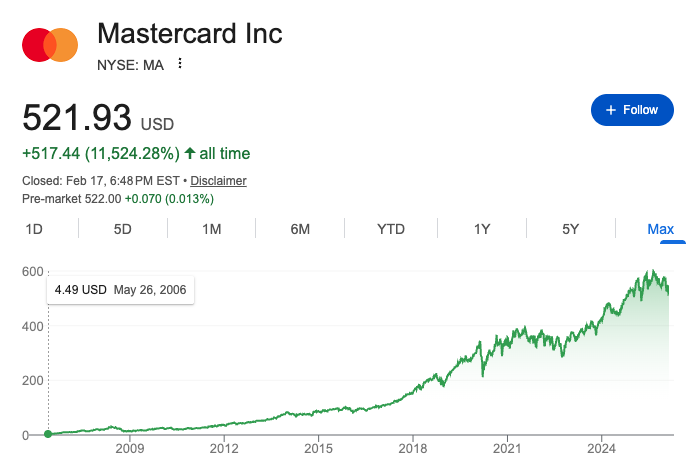
Today, Mastercard's network connectivity covers 210+ countries and regions, with 150M+ merchant acceptance networks and 3.5B+ circulating cards. Mastercard implemented a 10:1 stock split in January 2014. At the current price of approximately $521.93, investors holding Mastercard stock have achieved 134-fold growth over the past 20 years.

What about crypto? Blockchain may not be born solely for transfers between humans; it is more like a settlement language prepared for the next generation of automation.

In the future Agent economy, the payment demand for API calls will likely become a new high-frequency scenario: Agents will not only exchange information and tasks but also engage in "pay-per-use, instant settlement" around data, models, computing power, and service calls. Experiments like Clawbot, which allows Agents to transfer money to each other to "earn," are already验证 the feasibility of this path to some extent.
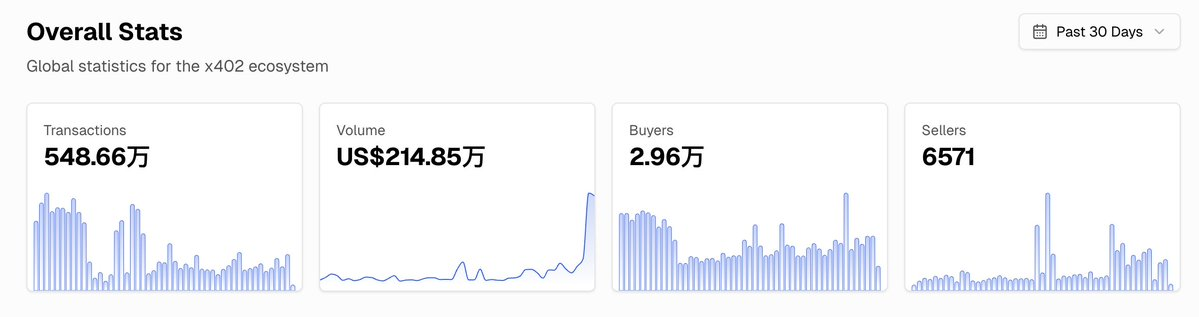
Precisely because of this, the 24/7 efficient settlement, programmable funds, and traceable ledger provided by blockchain have the opportunity to become a more universal payment base for the future robot society.

In the next stage, retail investors need not place all their hopes on TGE. Increasing regulation is not necessarily the end of tokens but更像是在逼 the industry to separate two things: financing and exit, returning to the more replicable path of equity/IPOs; Tokens should return to what they are supposed to do (on-chain incentives, node collaboration, resource allocation).

Meanwhile, TGE may still exist, but it should more be the "lubricant" of the network. Especially in the future Agent economy, tokens叠加 protocols like x402 that embed payment into HTTP may become infrastructure for pay-per-call and profit-sharing based on contributions.

Final thoughts

It is undeniable that we are in a colder/more残酷 four-year cycle.阵痛 is inevitable, just like the body's self-protection expelling toxins. The industry also needs to squeeze out the toxins in the system (bubbles, Scams,劣质项目). If劣币 are not驱逐,真正的基础设施 can hardly be seen. At present, we are更像 sitting on a high-speed train. The scenery outside the window is changing, the people around us may change, but our direction has never changed.

I would like to end with a quote from Richard: "The current winter is like the bursting of the Internet bubble in 2000. It清洗的是一众不靠谱的 .com, leaving behind Amazon and Google. Regulation will挤掉骗局, and the protocols that truly solve problems will reshape the global financial infrastructure in the next 5 years."

If we had the chance to go back to those days, would we have the courage and cognition to catch unicorns like Amazon and Google? If the next cycle is a game for institutions, then all past patterns will be reshuffled. By the time the new格局 arrives, I hope we can still be at the table.


Twitter:https://twitter.com/BitpushNewsCN

Bitpush TG Discussion Group:https://t.me/BitPushCommunity

Bitpush TG Subscription: https://t.me/bitpush

Original link:https://www.bitpush.news/articles/7614006

Related Questions

QFor a Web3 project with stable cash flow, is issuing a token an amplifier or a burden?

AIt can be a burden. While TGE (Token Generation Event) can act as an accelerator by providing global distribution and attention aggregation, it also forces the team to manage price expectations, liquidity, and market volatility, which can drain organizational focus and harm product development. For projects with clear cash flow, channels, and compliance, TGE is not a necessity and may be more detrimental than beneficial.

QWhat are the key factors that influence the short to medium-term price of a token?

AShort to medium-term token prices are primarily driven by three factors: liquidity (the amount of money and risk appetite in the market), attention (driven by KOLs, marketing, and散户 focus), and tokenomics/chip structure (the circulating supply, distribution, and unlock schedule).

QWhat is the fundamental requirement for a token's long-term value?

AThe long-term value of a token depends on value capture. The token must have a clear mechanism to capture the value generated by the protocol's product or service, such as through revenue sharing or buybacks, rather than relying solely on speculation or情绪.

QAccording to the article, what is a potential future use case for tokens and blockchain technology?

AThe future may lie in the 'machine economy' or 'Agent economy,' where tokens facilitate payments between autonomous agents (AIs or programs) for services like API calls, data, or compute power. Protocols like x402 could enable pay-per-call, contribution-based settlement natively on the blockchain.

QWhat is a common structural problem cited for crypto projects that leads to a negative cycle?

AA key structural problem is the long-term mismatch between 'exit channels' and 'external growth.' There is an oversupply of projects and tokens, but market liquidity and real on-chain transaction volume are insufficient to support high valuations. This pushes projects to use the secondary market as a financing tool, creating a negative cycle of selling pressure that harms散户 investors and market confidence.

Related Reads

Gary Yang: Agent Economy and AI Submicroeconomics

**Title:** Agent Economy and AI Sub-Microeconomics - Gary Yang **Summary:** Following the AI singularity, the pace of evolution has accelerated rapidly, creating new generational disparities in technological advancement globally. While many regions are still grappling with single-agent bottlenecks, Silicon Valley has moved ahead into the next dimension: the Agent Economy and A2A ecosystems. The article outlines six key areas of this emerging paradigm: 1. **AI Payment Competition & H2A Bottlenecks:** A fierce battle for AI Agent payment protocol standards is underway (e.g., MPP, x402). However, most current efforts remain Human-to-Agent (H2A), essentially grafting AI onto traditional human-centric commerce, which creates a non-AI-native bottleneck. The true potential lies in Agent-to-Agent (A2A) autonomous economies. 2. **Agent Economy & the Inevitable A2A Trend:** The Agent Economy is defined by autonomous AI Agents creating, exchanging, and capitalizing value as independent economic actors. The A2A ecosystem describes their interactions. This represents the next major investment frontier, akin to the early days of e-commerce or DeFi, but with faster iteration and an AI-native, efficiency-first perspective that often diverges from human needs. 3. **AI Protocol vs. Crypto Protocol:** AI Protocols are the foundational rules for Agent interaction in an open network (communication, discovery, collaboration), akin to the governance and economic laws of the AI world. Currently, they focus on communication and weak boundaries, unlike Crypto Protocols which emphasize asset rights and clear ownership. While they appear different due to political-economic factors and legacy system constraints, their eventual convergence into a unified Digital Protocol system is seen as inevitable, driven by first principles. 4. **AI Agent Sub-Microeconomics & Biological Analogy:** AI Agent economics differ fundamentally from human economics: higher frequency/lower value transactions, energy/value direct correlation, efficiency-driven (not emotional) decisions, task-oriented (not consumption-oriented) behavior, and near-zero organizational/communication costs. A powerful analogy frames the Agent economy as a biological system: the LLM is the nucleus, the Agent harness is the cytoplasm, the Agent itself is a cell, its communication protocol is the cell membrane, and external tools (Skills, Prompts) are the extracellular environment. 5. **The Inevitability of AIFi & FinChip:** AIFi (AI Finance) represents the financial system where AI-native value within the Agent economy is tokenized and exchanged. Unlike TradFi/DeFi where value resides *in* finance, in AIFi, value originates *in* AI, and finance becomes its form. This shift is enabled by Agents taking over value discovery. FinChip (Financial Chip) is introduced as a key infrastructure—a fusion of AI autonomy and crypto smart contracts—forming intelligent financial assets to power the future A2A economy. 6. **AI-Native as a Paradigm Shift:** Adopting AI is not akin to "Internet+". It requires AI-Native thinking—designing systems based on first principles, the shortest energy-value path, and maximum efficiency. This abstract, counter-intuitive logic poses a significant, ongoing challenge for all practitioners, as effective, generalized upgrade methodologies will be slow to emerge in this rapidly evolving landscape.

链捕手23m ago

Gary Yang: Agent Economy and AI Submicroeconomics

链捕手23m ago

From 'The Big Short' to San Francisco: The Revelry and Dizziness Within the AI Bubble

From "The Big Short" to San Francisco: The Frenzy and Dizziness in the AI Bubble The article captures the intense, frenetic atmosphere in San Francisco, the epicenter of the current AI boom. Drawing a parallel to the "smell of money" from *The Big Short*, the author observes a city gripped by a singular status game centered entirely on AI and technology. This manifests in a palpable, caffeine-fueled anxiety ("people are shaking"), rampant comparison using vanity metrics like funding rounds, and pervasive "Big Bubble Behavior." The piece explores the city's stark contrasts: its dystopian streets versus beautiful vistas, and the disconnect between the doomsday concerns of some AI researchers and the optimistic, growth-focused "GTM" teams. It critiques the obsession with "math genius" founders as the new ticket to outsized returns, akin to scouting sports prodigies. Referencing economic historian Carlota Perez's "frenzy phase" and Karl Polanyi's "double movement," the author frames the boom as a period where financial speculation detaches from fundamentals, with society potentially becoming subordinate to a new economic force driven by "geniuses in data centers." Ultimately, while acknowledging the unprecedented wealth creation and party-like energy, the article concludes with cautionary advice: when the music is playing, you should dance, but don't get drunk. The core reminder is to stay grounded, avoid distorted judgment, and maintain perspective amidst the euphoria.

marsbit24m ago

From 'The Big Short' to San Francisco: The Revelry and Dizziness Within the AI Bubble

marsbit24m ago

Is AI Creating a New Class of 'Information Poor'?

AI is generating a new kind of "information poverty." The core issue isn't that AI denies answers to the poor; it's that it provides abundant, cheap, and plausible-sounding answers to everyone. This availability shifts the true scarcity from obtaining answers to possessing the **judgment to evaluate them** and the access to turn them into real-world opportunities. New information poverty thus describes those who have AI tools and outputs, but lack the complementary skills, authorization, and contextual experience to critically assess and act on them. Research reveals a multi-layered divide: access to AI is stratified by income and platform design (e.g., premium vs. free, embedded tools). In workplaces, usage heavily favors higher-paid, more experienced, or formally trained employees, with AI often automating entry-level tasks that were traditional stepping stones. Crucially, the heaviest users are often mid-career professionals whose existing expertise allows them to effectively judge and leverage AI outputs, while novices risk over-relying on them without building judgment. While controlled experiments show AI can significantly boost low-skilled workers' performance, real-world adoption and benefit are constrained by unequal social and organizational structures. Historically, general-purpose technologies first reward those with existing complementary capital. AI, by affecting judgment-based work, may accelerate and deepen this initial inequality gap, even if it narrows over decades. The danger lies in the illusion of competence it creates, potentially stunting the very critical thinking needed in an era where judgment is paramount.

marsbit58m ago

Is AI Creating a New Class of 'Information Poor'?

marsbit58m ago

Jensen Huang 'Saves' South Korean Stock Market: Locks In SK Hynix Memory, Chip Shortage to Continue

On June 5th, South Korea's stock market experienced a sharp decline, with major chipmakers like Samsung and SK Hynix dropping nearly 10%. Amidst the turmoil, NVIDIA CEO Jensen Huang's visit to Seoul played a dramatic role in boosting market sentiment. Following a dinner meeting with SK Group Chairman Chey Tae-won and SK Hynix CEO Kwak Noh-Jung, Huang confirmed that NVIDIA's new Vera CPU will utilize SK Hynix DRAM. The companies announced a multi-year technical partnership to co-develop next-generation memory for NVIDIA's AI infrastructure, covering products from data centers to personal AI and robotics. This collaboration extends beyond memory supply. SK Hynix is integrating NVIDIA's AI and Omniverse platform into its own semiconductor design and manufacturing processes, including computational lithography and creating digital twins of its fabrication plants for autonomous operation. While strengthening ties with SK Hynix, NVIDIA is diversifying its supply chain for the upcoming HBM4 memory, with Samsung, SK Hynix, and Micron all certified as suppliers for its Vera Rubin platform. Despite this, Huang warned that the global chip shortage, driven by relentless demand from AI factory construction, is expected to persist for several years across the entire supply chain. His visit underscores NVIDIA's systematic effort to deepen integration with South Korea's broader tech industry.

marsbit1h ago

Jensen Huang 'Saves' South Korean Stock Market: Locks In SK Hynix Memory, Chip Shortage to Continue

marsbit1h ago

Nasdaq Plunges 4.2% in a Single Day: Does "Black Friday" Burst the U.S. Stock Market Bubble?

The Nasdaq plunged 4.18% on June 5, 2026, its worst single-day drop in over a year, as a much stronger-than-expected US jobs report triggered fears of economic overheating and delayed Federal Reserve interest rate cuts. The selloff, centered on high-valuation tech and AI stocks like Nvidia and Broadcom, spread across major indices. The article examines whether this signals a market top. The strong May non-farm payrolls data, nearly double expectations, pushed bond yields higher, directly hurting rate-sensitive tech stocks. This exposed vulnerabilities in the crowded AI trade, where valuations had soared on narratives of infinite growth, despite emerging signs of slowing order momentum and corporate AI monetization challenges. Prior to the drop, market indicators flashed warning signs: historically high valuations (e.g., Shiller CAPE ratio near 39.5), extreme bullish sentiment, and high levels of leverage. Technical charts showed key support levels being breached. Wall Street is divided on the outlook. Bears, citing risks of "stagflation" and AI bubble comparisons to the dot-com era, warn of a potential significant correction. Bulls view the drop as a healthy correction within a bull market, underpinned by a strong economy and expected corporate earnings growth of around 7% in 2026. The immediate future hinges on upcoming key events: the May CPI inflation data and the mid-June FOMC meeting. Their outcomes will critically shape market expectations for the Fed's rate path. The article concludes that conditions for a major market top are aligning, marking a fragile transition from narrative-driven gains to a phase demanding validation from macroeconomic data and corporate fundamentals. Caution is advised.

marsbit1h ago

Nasdaq Plunges 4.2% in a Single Day: Does "Black Friday" Burst the U.S. Stock Market Bubble?

marsbit1h ago

Trading

Spot
Futures

Hot Articles

How to Buy FLOW

Welcome to HTX.com! We've made purchasing Flow (FLOW) simple and convenient. Follow our step-by-step guide to embark on your crypto journey.Step 1: Create Your HTX AccountUse your email or phone number to sign up for a free account on HTX. Experience a hassle-free registration journey and unlock all features.Get My AccountStep 2: Go to Buy Crypto and Choose Your Payment MethodCredit/Debit Card: Use your Visa or Mastercard to buy Flow (FLOW) instantly.Balance: Use funds from your HTX account balance to trade seamlessly.Third Parties: We've added popular payment methods such as Google Pay and Apple Pay to enhance convenience.P2P: Trade directly with other users on HTX.Over-the-Counter (OTC): We offer tailor-made services and competitive exchange rates for traders.Step 3: Store Your Flow (FLOW)After purchasing your Flow (FLOW), store it in your HTX account. Alternatively, you can send it elsewhere via blockchain transfer or use it to trade other cryptocurrencies.Step 4: Trade Flow (FLOW)Easily trade Flow (FLOW) on HTX's spot market. Simply access your account, select your trading pair, execute your trades, and monitor in real-time. We offer a user-friendly experience for both beginners and seasoned traders.

3.2k Total ViewsPublished 2024.03.29Updated 2026.06.02

How to Buy FLOW

Discussions

Welcome to the HTX Community. Here, you can stay informed about the latest platform developments and gain access to professional market insights. Users' opinions on the price of FLOW (FLOW) are presented below.

活动图片