Wall Street Takes Over Bitcoin and Stablecoins, But Where Are the Real Profit Opportunities for Retail Investors?

marsbitPublished on 2026-05-27Last updated on 2026-05-27

Abstract

Wall Street is taking over Bitcoin and stablecoins, but where can retail investors really make money now? The common narrative is that Wall Street's dominance via ETFs and regulated stablecoins has structurally ended the era of easy 100x returns from altcoins. While this is true for Bitcoin and stablecoins, which are becoming traditional financial products, it's only half the story. Other crypto sectors are failing for their own reasons. GameFi is largely dead, with 93% of projects failed. NFTs are at multi-year lows with most collections losing all value. Memecoins persist but overwhelmingly benefit insiders and whales at the expense of late retail buyers. These sectors aren't being consumed by TradFi; they've exhausted their growth narratives. The real opportunities for retail in the next 6-12 months lie elsewhere: 1. **Prediction Markets:** Platforms like Polymarket have seen explosive growth (21x in a year) with a genuine, active retail user base. The utility of forecasting events provides sustainable demand beyond mere speculation. 2. **DeFi Yield:** While the era of 1000% APY farms is over, sustainable yields of 4-8% are available through liquid staking, regulated stablecoin platforms, and RWA lending. 3. **Select Altcoins:** If Bitcoin breaks its all-time high, a selective altcoin season could emerge. The favorable bets would be on ETH, assets within the Base and Solana ecosystems with real users, and asymmetric opportunities in AI-crypto and DePIN presales. Th...

Author: stacy_muur

Compiled by: Baihua Blockchain

This is a story currently circulating about cryptocurrency, and almost every analyst says the same thing: Wall Street is taking over, ETFs and stablecoins are attracting funds into traditional finance, and the era of "easy money" where buying any altcoin could yield 10-100x returns has structurally ended.

But this story only captures half of what's actually happening.

Bitcoin and stablecoins are indeed becoming Wall Street products, but the rest of the cryptocurrency space is not being swallowed up along with them. Some of it is simply self-destructing, while others, quietly, are becoming the best places for retail investors to genuinely make money in the next six to twelve months. The real problem is that most people are looking at the wrong market sectors when trying to find their footing.

Bitcoin and Stablecoins Now Belong to Wall Street

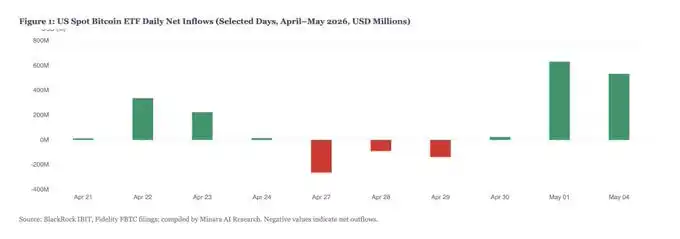
Bitcoin ETFs have attracted $59 billion since their launch. Institutions are buying more Bitcoin daily than is being mined. MicroStrategy alone holds over 800,000 BTC.

Stablecoins are even more consolidated. Their supply reached $3.15 trillion in Q1. They now account for 75% of all crypto trading volume. Once the CLARITY Act passes, regulated banks will issue them directly.

This is real. This is permanent. And this is absolutely no longer where retail investors can earn 10x or 100x returns. Buying Bitcoin through your brokerage account gives you clean, stable exposure. The kind of crazy, outsized profits that defined past cycles—those airdrops, presales, and liquidity mining—don't exist inside this TradFi shell.
GameFi, NFTs, and Memecoins are Self-Destructing

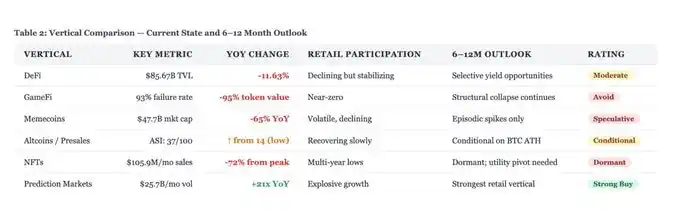
GameFi is essentially over. Roughly 93% of projects have failed, and Axie Infinity, the poster child of the 2021 bull run, has seen its daily active users collapse from a peak of 2.7 million to about 5,500 today. GameFi didn't lose to Wall Street. It lost to its own mechanism design. "Play-to-earn" only works as long as there is a constant influx of new users to pay the earnings of earlier users, and the moment growth stops, the entire token economy implodes.

NFTs are at multi-year lows. Monthly sales in March 2026 fell to $105.9 million, the lowest reading for that market since April 2021. While a handful of blue-chip collections still trade, the vast majority of NFTs have lost almost all value and are essentially illiquid. The narratives that were supposed to drive long-term adoption—NFTs as digital identity and NFTs as in-game assets—never truly materialized at scale.

Memecoins refuse to die completely, but the math is now stacked against retail. This sector still produces short, sharp rallies. Its total market cap surged 23% in a single week earlier this year. But the real question is who is trading them. On-chain data shows that KOLs and whales account for the vast majority of volume, meaning the average retail investor buying late into a viral pump is basically giving their money to early insiders.

None of these three categories are being eaten by anything. They've simply run out of new users to attract, and the narratives that fueled their 2021 explosions have lost their power. The TradFi integration is a fundamentally different problem that requires a fundamentally different answer.
Where Retail Can Actually Win Right Now

1. Prediction Markets

Prediction markets have built the strongest retail user base in crypto. Polymarket's monthly trading volume exploded from $1.2 billion in 2025 to $25.7 billion in March 2026. That's a 21x growth in a year. It has over 1.29 million active wallets. Most users trade under $10,000, meaning it's genuinely retail, not disguised institutions.

People are also participating more deeply. The average active days per user increased from 2.5 days to 9.9 days. They aren't just hitting and quitting.

Why does this work when memecoins are flaming out? Because prediction markets have utility beyond gambling. People want to know what happens next in the world. The data itself has value beyond trading. This demand doesn't burn out like memecoin demand does. Bernstein predicts that by year-end, prediction markets will see $240 billion in annual trading volume, reaching $1 trillion by 2030.

2. DeFi Yield

DeFi TVL (Total Value Locked) has held a line. It's down from peaks but stabilizing. The KelpDAO security incident in April hurt sentiment, but the yield infrastructure itself works fine.

Actual yield available right now:

  • Liquid Staking: 4-8% APY

  • Stablecoin yield on regulated platforms: 5-8%

  • RWA (Real World Asset)-backed lending

This isn't 2020 anymore. Those crazy 1000% APY farms are gone. What's left is smaller, more sustainable, and accessible yield for normal people. That's a better deal than it sounds.

3. If Bitcoin Breaks Out, There's Still Hope for Altcoins

The Altcoin Season Index is currently at 37. It needs to hit 75 for a true altcoin season. We're not there yet.

If Bitcoin breaks its all-time high in Q3, the index will likely move. If that happens, the most advantageous positions are ETH, Base ecosystem tokens, and Solana ecosystem assets with real users. If you can handle the due diligence, AI-crypto and DePIN (Decentralized Physical Infrastructure Networks) presales have asymmetric upside potential.

Note, this is positioning, not a guarantee.

What Will Actually Happen

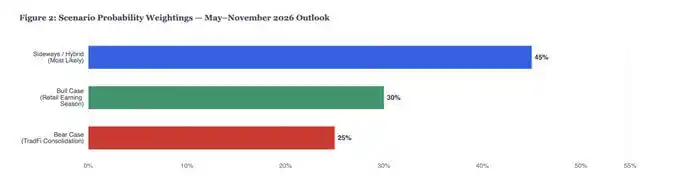
Three prediction scenarios for the next six months:

  • Bull Case: 30% probability. The Fed cuts rates, Bitcoin breaks $110k, the CLARITY Act passes. All of these are possible. But all of them need to happen at the same time. That's the hard part.

  • Sideways Grind: 45% probability. Bitcoin trades between $70k - $95k. Prediction markets keep growing. DeFi holds steady. Altcoins move on specific news, not collective pumps.

  • Bear Case: 25% probability. Inflation roars back, the Fed hikes, Bitcoin slides to $50k-$60k. Retail money flows into ETFs, and everything else bleeds.

The honest read is that the most likely outcome is not a massive retail bull market. It's a sideways market where what you pick matters far more than what the market does. This is completely different from the last two cycles.
How to Actually Play This

  1. Put your time into prediction markets. This is currently the only growing vertical in crypto that is retail. Real users are showing up, they're returning regularly, and the platforms have uses beyond trading, meaning this growth is going to stick.

  2. Use DeFi for stable yield, not for moonshots. Liquid staking pays 4-8%, regulated stablecoin yield pays 5-8%. These returns are small, but they're reliable, and you can earn them without taking on massive risk.

  3. Only buy altcoins that have real users behind them. Stick to tokens in the Ethereum and Solana ecosystems that have actual products people are using. Do not expect to buy a basket of random altcoins and ride an altseason wave, because that play is dead this cycle.

  4. Stay away from GameFi, random NFTs, and new memecoins. These assets are not getting a fix in the next six to twelve months. The problem isn't the market cycle, it's that the mechanics of these things were broken from the start, so waiting won't solve it.

The Core Takeaway

The "TradFi is eating crypto" story explains Bitcoin and stablecoins. But it doesn't explain why GameFi, NFTs, and memecoins are dying. Those things are dying for their own reasons. And it misses the sectors of the market that are actually growing—the places where prediction markets, DeFi yield, and curated altcoins live.

The era of 100x returns from buying any altcoin is over. What's left is a market that is more niche, more selective, and more demanding. You have to actually understand what you're investing in.

For those who can do that, the next six to twelve months aren't the end. They're just a different version of making money in crypto.


Trending Cryptos

Related Questions

QWhat is the main argument of the article regarding the current state of cryptocurrency?

AThe article argues that while Bitcoin and stablecoins are being absorbed by Wall Street (e.g., through ETFs and regulated banks), the era of easy 10-100x returns on random altcoins is over. However, opportunities still exist for retail investors in specific, growing areas like prediction markets, DeFi yields, and selective altcoins with real user bases, while sectors like GameFi, NFTs, and most memecoins are failing due to inherent design flaws.

QAccording to the article, what are the three areas where retail investors can currently find real opportunities?

AThe three areas are: 1) Prediction markets (e.g., Polymarket), which are experiencing massive user and volume growth. 2) DeFi yields, offering sustainable, single-digit returns from activities like liquid staking and stablecoin lending. 3) Selective altcoins from ecosystems like Ethereum and Solana that have genuine products and users, with potential upside if Bitcoin breaks out.

QWhy does the author believe GameFi, NFTs, and most memecoins are failing?

AThe author believes these sectors are failing due to their own internal design flaws, not because of Wall Street's influence. GameFi's 'play-to-earn' model collapses without constant new users. NFTs have lost most of their value and trading activity as adoption narratives failed. Most memecoins benefit insiders and whales, leaving average retail investors at a severe disadvantage and prone to losses.

QWhat is the most likely market scenario for the next six months according to the article's predictions?

AThe most likely scenario (45% probability) is a range-bound market where Bitcoin trades between $70k and $95k. In this environment, prediction markets continue growing, DeFi remains stable, and altcoin movements are driven by specific news rather than a broad-based 'altseason.' Success depends more on specific asset selection than overall market direction.

QWhat is the article's final core message or conclusion for retail investors?

AThe core conclusion is that the era of making 100x returns by buying any altcoin is structurally over. The remaining market is more niche, selective, and demanding. To succeed, investors must focus on areas with real growth (prediction markets, sustainable DeFi yields) and altcoins with genuine utility and users, while avoiding flawed sectors like GameFi and most memecoins. Understanding what you invest in is now crucial.

Related Reads

Bitcoin Mining Farms Are Becoming AI Factories

Bitcoin mines are transforming into AI factories. This shift is driven by the convergence of three key assets from the previous crypto cycle: infrastructure, talent, and capital. Crypto mining companies like Crusoe, CoreWeave, and Bitdeer are repurposing their core competency—securing power, land, and grid connections in remote locations—to build data centers for AI clients. These firms are signing multi-billion dollar, long-term contracts with companies like Anthropic, AWS, and Microsoft, as AI's demand for reliable, high-capacity compute surpasses the profitability of Bitcoin mining. Simultaneously, crypto entrepreneurs and engineers are applying their skills to new AI ventures. Examples include OpenSea's co-founder launching OpenRouter (an AI model aggregator), and former Coinbase engineers building Fal.ai (a generative media infrastructure platform). Their experience in building scalable, global software networks translates effectively to the AI space. Furthermore, capital accumulated during the crypto boom is now fueling AI. Figures like Jed McCaleb (co-founder of Ripple) funded Voltage Park, a large-scale GPU cloud provider. Notably, some crypto investments, like FTX's early bets on Anthropic and Cursor, have generated astronomical paper returns, demonstrating how high-risk crypto capital flowed into AI before it became mainstream. The transition is not just about repurposing hardware, but about redirecting critical resources—power infrastructure, distributed systems expertise, and venture funding—to the next technological frontier: artificial intelligence.

链捕手9m ago

Bitcoin Mining Farms Are Becoming AI Factories

链捕手9m ago

Morpho Launches Fixed-Rate Product Midnight: Lenders and Borrowers Set Their Own Rates, Ending the Era of Interest Rate Models

Morpho Launches Fixed-Rate Product Midnight: Lenders and Borrowers Set Their Own Rates, Ending the Era of Algorithmic Interest Models On-chain lending has grown to $60 billion but remains minuscule compared to traditional finance's $200 trillion annual credit volume. Morpho identifies the lack of fixed rates and maturity dates as key bottlenecks. Institutions need predictability, not the passive floating rates set by algorithmic models. Midnight allows lenders and borrowers to directly quote rates, set terms, and become price makers, not takers. Fixed-rate lending is now viable due to cheaper, faster blockchains and the entry of institutions demanding control and certainty over returns, costs, and duration. Morpho Blue previously gave users control over risk; Midnight adds control over interest rates. Past attempts at on-chain fixed-rate lending failed primarily because they were built on top of floating-rate pools (creating unpredictability) or lacked sufficient active participants. Midnight avoids these pitfalls as a standalone primitive with fixed rates at its core, built upon Morpho Blue's existing large and active user base. Midnight offers distinct value: institutions gain predictable term structures and full control; fintech companies can offer tailored fixed-rate products; lenders/borrowers achieve predictability and efficiency; and curators can now differentiate by configuring both risk and interest rates. Morpho Midnight is not a replacement for Morpho Blue. The Morpho network will now feature two complementary market structures: floating-rate/open-term (Blue) for flexibility and fixed-rate/fixed-term (Midnight) for predictability. Liquidity can flow between them. The launch will be gradual, prioritizing security. Initially, it will support direct lending on Base network with one trading pair (cbBTC/USDC) and limited maturity dates. Advanced features like auto-rollovers will be introduced later.

marsbit10m ago

Morpho Launches Fixed-Rate Product Midnight: Lenders and Borrowers Set Their Own Rates, Ending the Era of Interest Rate Models

marsbit10m ago

human.tech Launches Clean SDK for Privacy-First Web3 Apps

human.tech has launched the Clean SDK, a toolkit enabling developers to build privacy-first Web3 applications with transparent accountability. Released alongside Aztec's version 5, the SDK provides components for integrating zero-knowledge identity verification, sanctions screening, and private transactions, without developers handling sensitive user data or building compliance infrastructure from scratch. It uses zero-knowledge proofs and programmable verification to allow apps to confirm user legitimacy and sanctions compliance while keeping identities confidential. The first application built on the SDK, Shield, a privacy bridge to Aztec, also launched. It allows users to transfer assets privately while proving a unique human is behind each transfer and that funds have passed sanctions checks, as verified by a May 2026 audit. The SDK offers three core verification techniques: Proof of Innocence (sanctions screening against 23 sources), Proof of Personhood (simpler verification via Human Passport), and Proof of Clean Hands (higher-assurance zero-knowledge government ID checks). This allows apps to authenticate users and transactions without exposing personal data. Designed for Aztec builders, the SDK lets developers add programmable privacy to decentralized apps, eliminating the need to create their own verification and ZK infrastructure. Shield demonstrates its practical use for private bridges, but the SDK aims to enable a wider ecosystem of private, accountable financial apps and services. The launch addresses growing demand for infrastructure that balances privacy and accountability. The SDK avoids traditional identity databases, storing encrypted data off-chain, screening at both entry and exit points, and including a gated disclosure mechanism for legal requests. human.tech's products, including the Clean SDK, focus on using zero-knowledge technology to enable verifiable personhood and privacy in digital systems.

TheNewsCrypto46m ago

human.tech Launches Clean SDK for Privacy-First Web3 Apps

TheNewsCrypto46m ago

Unlocking $100 Million in Liquidity? Pump.fun's New Policy Tests the 5-Minute Pump Technique

Pump.fun, a popular meme coin launchpad, has introduced a new standard mechanism called BOOST. It aims to address a significant capital efficiency issue: when a newly launched token graduates from its initial bonding curve to a liquidity pool (LP), roughly 20% of its liquidity becomes permanently locked as "dead liquidity," estimated to waste over $100 million annually. Instead of locking these funds permanently, BOOST repurposes them. Upon a token's migration, approximately 20% of the settlement funds (e.g., 17.6 SOL or ~$2516 USDC) are used to buy back the token on the open market over a 5-minute period via a Time-Weighted Average Price (TWAP) mechanism. All purchased tokens are immediately burned. This creates a brief, systematic buy pressure immediately after migration, potentially generating a short-term price surge ("pump") while permanently reducing the token's circulating supply. The goal is to enhance the immediate post-launch trading experience, potentially increasing trader retention and sustainable protocol revenue, which funds ongoing token buybacks. However, concerns exist that this artificial 5-minute boost could lower the barrier for launching low-quality tokens and lead to steeper price crashes once the buy pressure stops, if followed by large sell-offs. The feature automatically applies to tokens migrating after July 21, 2024, but not to previously migrated tokens or those launched via the Mayhem AI Agent lab.

marsbit54m ago

Unlocking $100 Million in Liquidity? Pump.fun's New Policy Tests the 5-Minute Pump Technique

marsbit54m ago

Trading

Spot

Hot Articles

What is $BITCOIN

DIGITAL GOLD ($BITCOIN): A Comprehensive Analysis Introduction to DIGITAL GOLD ($BITCOIN) DIGITAL GOLD ($BITCOIN) is a blockchain-based project operating on the Solana network, which aims to combine the characteristics of traditional precious metals with the innovation of decentralized technologies. While it shares a name with Bitcoin, often referred to as “digital gold” due to its perception as a store of value, DIGITAL GOLD is a separate token designed to create a unique ecosystem within the Web3 landscape. Its goal is to position itself as a viable alternative digital asset, although specifics regarding its applications and functionalities are still developing. What is DIGITAL GOLD ($BITCOIN)? DIGITAL GOLD ($BITCOIN) is a cryptocurrency token explicitly designed for use on the Solana blockchain. In contrast to Bitcoin, which provides a widely recognized value storage role, this token appears to focus on broader applications and characteristics. Notable aspects include: Blockchain Infrastructure: The token is built on the Solana blockchain, known for its capacity to handle high-speed and low-cost transactions. Supply Dynamics: DIGITAL GOLD has a maximum supply capped at 100 quadrillion tokens (100P $BITCOIN), although details regarding its circulating supply are currently undisclosed. Utility: While precise functionalities are not explicitly outlined, there are indications that the token could be utilized for various applications, potentially involving decentralized applications (dApps) or asset tokenization strategies. Who is the Creator of DIGITAL GOLD ($BITCOIN)? At present, the identity of the creators and development team behind DIGITAL GOLD ($BITCOIN) remains unknown. This situation is typical among many innovative projects within the blockchain space, particularly those aligning with decentralized finance and meme coin phenomena. While such anonymity may foster a community-driven culture, it intensifies concerns about governance and accountability. Who are the Investors of DIGITAL GOLD ($BITCOIN)? The available information indicates that DIGITAL GOLD ($BITCOIN) does not have any known institutional backers or prominent venture capital investments. The project seems to operate on a peer-to-peer model focused on community support and adoption rather than traditional funding routes. Its activity and liquidity are primarily situated on decentralized exchanges (DEXs), such as PumpSwap, rather than established centralized trading platforms, further highlighting its grassroots approach. How DIGITAL GOLD ($BITCOIN) Works The operational mechanics of DIGITAL GOLD ($BITCOIN) can be elaborated on based on its blockchain design and network attributes: Consensus Mechanism: By leveraging Solana’s unique proof-of-history (PoH) combined with a proof-of-stake (PoS) model, the project ensures efficient transaction validation contributing to the network's high performance. Tokenomics: While specific deflationary mechanisms have not been extensively detailed, the vast maximum token supply implies that it may cater to microtransactions or niche use cases that are still to be defined. Interoperability: There exists the potential for integration with Solana’s broader ecosystem, including various decentralized finance (DeFi) platforms. However, the details regarding specific integrations remain unspecified. Timeline of Key Events Here is a timeline that highlights significant milestones concerning DIGITAL GOLD ($BITCOIN): 2023: The initial deployment of the token occurs on the Solana blockchain, marked by its contract address. 2024: DIGITAL GOLD gains visibility as it becomes available for trading on decentralized exchanges like PumpSwap, allowing users to trade it against SOL. 2025: The project witnesses sporadic trading activity and potential interest in community-led engagements, although no noteworthy partnerships or technical advancements have been documented as of yet. Critical Analysis Strengths Scalability: The underlying Solana infrastructure supports high transaction volumes, which could enhance the utility of $BITCOIN in various transaction scenarios. Accessibility: The potential low trading price per token could attract retail investors, facilitating wider participation due to fractional ownership opportunities. Risks Lack of Transparency: The absence of publicly known backers, developers, or an audit process may yield skepticism regarding the project's sustainability and trustworthiness. Market Volatility: The trading activity is heavily reliant on speculative behavior, which can result in significant price volatility and uncertainty for investors. Conclusion DIGITAL GOLD ($BITCOIN) emerges as an intriguing yet ambiguous project within the rapidly evolving Solana ecosystem. While it attempts to leverage the “digital gold” narrative, its departure from Bitcoin's established role as a store of value underscores the need for a clearer differentiation of its intended utility and governance structure. Future acceptance and adoption will likely depend on addressing the current opacity and defining its operational and economic strategies more explicitly. Note: This report encompasses synthesised information available as of October 2023, and developments may have transpired beyond the research period.

973 Total ViewsPublished 2025.05.13Updated 2025.05.13

What is $BITCOIN

Discussions

Welcome to the HTX Community. Here, you can stay informed about the latest platform developments and gain access to professional market insights. Users' opinions on the price of BTC (BTC) are presented below.

活动图片