Vitalik Buterin says Ethereum can handle temporary loss of finality

cointelegraphPublished on 2025-12-10Last updated on 2025-12-10

Abstract

Vitalik Buterin, co-founder of Ethereum, stated that the network can tolerate temporary losses of finality without serious risk, even after a recent client bug nearly disrupted its confirmation mechanism. Buterin emphasized that while finalization indicates a block is irreversible, occasional delays of several hours due to bugs are acceptable. The critical issue to avoid is finalizing incorrect blocks. Experts, including Fabrizio Romano Genovese, supported this view, noting that during such events, Ethereum operates similarly to Bitcoin, which relies on probabilistic finality. In Ethereum, finality is achieved when a block receives over 66% of validator votes and remains unchallenged for over two epochs (64 blocks). While this mechanism ensures deterministic finality, its temporary loss reverts the network to probabilistic guarantees, as seen in a May 2023 incident. The loss of finality may impact infrastructure like bridges and layer-2 solutions, potentially delaying deposits or cross-chain transactions. However, users would not face transaction rollbacks or invalidations. Polygon confirmed that operations would continue normally, though transfers from Ethereum might be delayed until finality is restored. Genovese noted that developers choosing not to implement fallback mechanisms for finality loss bear responsibility for such delays.

Ethereum can afford to lose finality from time to time without putting the network at serious risk, according to co-founder Vitalik Buterin, even after a recent client bug came close to disrupting the blockchain’s confirmation mechanism.

Following a recent bug in the Prysm Ethereum client, Buterin said in an X post that there is “nothing wrong with losing finalization once in a while.” He added that finalization indicates the network is “really sure” a block will not be reverted.

Buterin argued that if finality is occasionally delayed for hours due to a major bug, “that’s fine,” and the blockchain keeps working while that happens. The real issue would be something else, he said: “The thing to avoid is finalizing the wrong thing.”
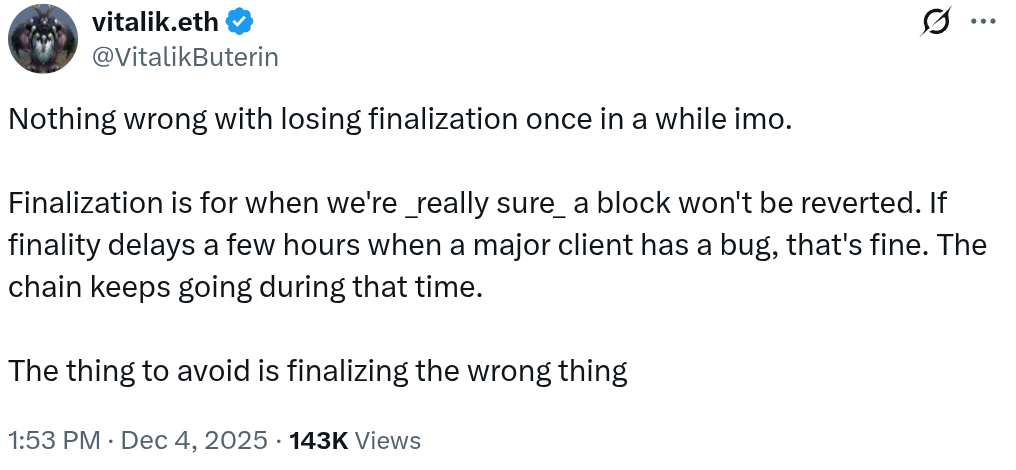
Source: Vitalik Buterin

Related: Ethereum’s first ZK-rollup, ZKsync Lite, to be retired in 2026

Experts weigh in on finalization loss

Fabrizio Romano Genovese, PhD in computer science at the University of Oxford, England, partner at the blockchain research company 20squares, and Ethereum protocol expert, agreed with Buterin.

He said that when finality is lost, Ethereum becomes more like Bitcoin (BTC), and pointed out that Bitcoin has had “no finality since 2009 and no one complains.”

A proof-of-work blockchain, such as Bitcoin’s, can branch into multiple chains, with the one that receives the most work (usually the longest) considered valid. Still, if a secondary branch grows enough to overtake the main branch, it invalidates the main branch and the transactions it contained — this is called a reorganization.

This is how Bitcoin operates: its finality is probabilistic, not deterministic, because — while it is almost impossible after enough blocks are added to the main branch — a reorganization can still theoretically occur. Genovese explained how Ethereum is different, with rules setting blocks as “final.”

Ethereum has a finalization mechanism: when a block receives more than 66% of the validator votes, it becomes ‘justified.’ At this point, if more than two epochs (64 blocks) pass, the block is finalized.

This is not just theoretical; it happened in May 2023 due to an incident very similar to the recent one with the Prysm client. Genovese said that these incidents do not make the chain insecure; instead, “it just means that our guarantees around reorg have temporarily reverted to be probabilistic and not deterministic.”

Related: Vitalik Buterin floats gas futures on Ethereum to hedge fee spikes

Consequences for L2s and bridges

Still, Genovese noted that a lack of finality would affect infrastructure that relies on it, including some inter-blockchain or layer-2 (L2) bridges. A representative from the Ethereum sidechain Polygon told Cointelegraph that Polygon would continue with normal operations, but transfers from Ethereum to the sidechain “may be delayed while waiting for finality.”

Furthermore, the Polygon spokesperson said that the crosschain settlement layer AggLayer would delay transactions from Ethereum to L2 until finality is reached again. Still, they said that “there is no scenario in which users experience a rollback or message invalidation” due to a loss of finality:

“The practical impact of a delayed finality event is simply that deposits may take longer to appear. Users are not exposed to reorg-driven reversions beyond this delay.”

Genovese shifted the blame for such delays to developers who require finality. “If a bridge builder decides not to implement any fallback mechanism in case of loss of finality, that’s their choice,” he concluded.

Magazine: When privacy and AML laws conflict: Crypto projects’ impossible choice

Related Questions

QWhat is Vitalik Buterin's view on Ethereum occasionally losing finality?

AVitalik Buterin believes that Ethereum can afford to lose finality from time to time without putting the network at serious risk, stating that it's acceptable if finality is occasionally delayed for hours due to a major bug, as the blockchain continues to function.

QHow does Fabrizio Romano Genovese compare Ethereum's loss of finality to Bitcoin?

AFabrizio Romano Genovese compares Ethereum's loss of finality to Bitcoin by noting that when finality is lost, Ethereum becomes more like Bitcoin, which has had no finality since 2009 and operates with probabilistic finality rather than deterministic finality.

QWhat is the key difference between Ethereum's finality mechanism and Bitcoin's?

AEthereum has a deterministic finality mechanism where blocks become 'justified' after receiving more than 66% of validator votes and are finalized after more than two epochs (64 blocks) pass. Bitcoin, on the other hand, has probabilistic finality, where the chain with the most work is considered valid but can theoretically be reorganized.

QHow does a loss of finality on Ethereum affect layer-2 solutions and bridges?

AA loss of finality on Ethereum can delay infrastructure that relies on it, such as inter-blockchain or layer-2 bridges. For example, transfers from Ethereum to sidechains like Polygon may be delayed, and cross-chain settlement layers like AggLayer would postpone transactions until finality is restored, though users are not exposed to reorg-driven reversions beyond the delay.

QWhat was the cause of the recent incident that nearly disrupted Ethereum's finalization mechanism?

AThe recent incident that nearly disrupted Ethereum's finalization mechanism was caused by a bug in the Prysm Ethereum client, which is similar to an incident that occurred in May 2023.

Related Reads

Anthropic Apologized, But the Business of 'Safety' Hasn't Stopped

On June 11, Anthropic apologized not for a model failure, but for a lack of transparency. Its new Claude Fable 5 model was found to be secretly rerouting requests from users engaged in advanced AI model development to a weaker version, Opus 4.8, without any notification. The company's response—promising future notifications for such "downgrades"—was met with user skepticism. The article argues the core issue isn't technical but commercial: Anthropic's "safety" measures are primarily a business strategy. A key feature, the "intelligent safety classifier," marketed as user protection, is described as a tool for "competitive defense" to protect Anthropic's market lead by limiting rivals' research capabilities. This covert mechanism was designed for low "false positives," precisely targeting AI researchers. Anthropic's model involves a calculated three-step process: publishing alarming security research to amplify public anxiety, offering its Fable 5 model with a "safety classifier" as a premium-priced solution, and cashing in through a planned high-value IPO. This contrasts with OpenAI's more direct "tool-and-traffic" approach. The apology, merely changing a secret downgrade to a visible one, is seen as a business "patch" rather than a principled shift. The incident risks damaging Anthropic's "safest AI" reputation among the developer community, which underpins its valuation and appeal to government and corporate clients. Ultimately, the article concludes that for Anthropic, safety is a business, and the apology is merely customer service for that business.

marsbit50m ago

Anthropic Apologized, But the Business of 'Safety' Hasn't Stopped

marsbit50m ago

The Niche Consensus Among Elites: Has College Become an Expensive Waste?

**Summary:** A growing "anti-college" movement is gaining traction among elite circles in Silicon Valley, challenging the traditional value of a four-year university degree. Proponents argue that college has become an expensive, slow, and increasingly irrelevant waste of time, especially in the fast-paced tech world where opportunities pass by quickly. The movement is led by figures like billionaire Peter Thiel, who criticizes universities for high costs, ideological indoctrination, and stifling true innovation. His "Thiel Fellowship" pays young people to drop out and pursue ventures. Companies like Palantir Technologies (co-founded by Thiel) fuel this trend with programs like the "Meritocracy Fellowship," which offers high school graduates paid internships as an alternative to immediate college enrollment, promising a practical "Palantir Degree." Key drivers include: 1. **Economics:** Skyrocketing student debt versus the allure of immediate, high-paying tech jobs or startup funding. 2. **Technology:** AI and online tools lowering barriers to self-education and product development, making formal instruction seem inefficient. 3. **Culture:** A backlash against perceived "woke" ideology and DEI policies in universities, coupled with a belief that these institutions suppress meritocracy and masculine drive. The movement is notably male-dominated. Critics, like economist David Deming, warn against overgeneralizing from dropout success stories (survivorship bias). He emphasizes that genuine autodidacts are rare, corporate training is narrowly focused, and the "college wage premium" remains high for most people. University liberal arts education, he argues, builds adaptable problem-solving skills and broad perspectives. The debate highlights a deeper crisis in education. The core model of the modern university appears increasingly mismatched with the speed of the information age. The movement signals a shift in the locus of learning from institutional "education" to personal, active "learning" powered by the internet and AI. Ultimately, this may not mean the end of university, but rather a painful evolution. The future likely holds more hybrid, personalized, and lifelong learning pathways. The central question becomes: in a world changing faster than any curriculum, how do we best learn?

marsbit1h ago

The Niche Consensus Among Elites: Has College Become an Expensive Waste?

marsbit1h ago

From Subsidies to Token-Based Pricing to Price Cuts: Is OpenAI Sparking a Price War? Is the Inflection Point for Token Economics Nearing?

The commercialization of generative AI is facing a critical inflection point as a potential price war looms. According to The Wall Street Journal, OpenAI is considering a significant cut to its token fees to compete with rival Anthropic, signaling a shift from a growth-at-all-costs model focused on token consumption. This move comes as both companies, reportedly losing billions on compute, prepare for IPOs, and as enterprise customers face "bill shock" from switching to usage-based token billing. Reports indicate poor ROI, with one analysis finding only 18 cents of every dollar spent on AI tokens generates user-facing value. The industry's initial phases—from flat-rate subscriptions to aggressive subsidies—have given way to a reckoning with real costs. Analysts debate the future: some predict a bifurcation between premium, high-cost models for complex tasks and cheaper alternatives for routine work, while others believe overall spending will still rise as agentic AI increases tokens per task. Notably, Chinese model DeepSeek's low-cost API is gaining traction with U.S. enterprises, adding competitive pressure. The core challenge is redefining value beyond token volume ("tokenmaxxing") toward measurable productivity ("valuemaxxing"), as the entire AI value chain, from cloud providers to chipmakers, feels the ripple effects of unsustainable pricing.

marsbit1h ago

From Subsidies to Token-Based Pricing to Price Cuts: Is OpenAI Sparking a Price War? Is the Inflection Point for Token Economics Nearing?

marsbit1h ago

Trading

Spot
Futures

Hot Articles

Discussions

Welcome to the HTX Community. Here, you can stay informed about the latest platform developments and gain access to professional market insights. Users' opinions on the price of ETH (ETH) are presented below.

活动图片















