VeryAI Raises $10M to Launch Palm-Scan Identity Verification on Solana

TheNewsCryptoPublished on 2026-03-13Last updated on 2026-03-13

Abstract

VeryAI has raised $10 million in a seed funding round led by Polychain Capital, with participation from Berggruen Institute and Anagram. The company is launching a hardware-free palm-scan identity verification system to combat AI-generated fraud and deepfakes. The system uses smartphone cameras to capture palm biometrics, claiming a false acceptance rate of 1 in 10 million for one hand and 1 in 100 trillion for both hands. Built on Solana, the platform uses Zero Knowledge Proofs and the Solana Attestation Service to ensure privacy and interoperability. VeryAI aims to provide businesses like crypto exchanges and fintech companies with a secure, private, and accessible identity verification solution.

VeryAI, a Proof of Reality platform that focuses on verifying human identifty in an AI-driven digital world, made the announcement today that it has secured a seed investment round of ten million dollars. Polychain Capital is the lead investor in this round, while Berggruen Institute and Anagram are also participating. Additionally, the financing coincides with the introduction of the business’s first product, which is a hardware-free palm scan verification system meant to address the rising hazards of AI-generated identities and deepfakes. This round represents the first time that the company has completed a capital raise.

Existing authentication methods, such as facial recognition, CAPTCHAs, and two-factor codes, are experiencing growing constraints as the generation of synthetic information gets more straightforward. The amount of time that it takes for attackers to penetrate systems has grown by 22 percent since 2023, with breaches now happening in an average of 48 minutes. This information comes from data collected by stakeholders in the industry.

The method that VeryAI employs is based on palm biometrics, which is a kind of identification that is not only very unique but also seldom disclosed to the general public. By using the camera of a smartphone, the system is able to acquire palm scans without the need for any specific gear. When it comes to validating a single hand, the business claims that their verification model has a false acceptance rate of around one in ten million. This is in contrast to the approximately one in one million rate that many face recognition systems have. It is estimated that the rate of false acceptance drops to around one in one hundred trillion when both hands are utilized.

“Privacy is a human right. But deepfakes and synthetic content present weaknesses that current systems simply can’t keep up with. VeryAI is restoring trust in identity verification by replacing outdated methods with solutions that are accurate, private and frictionless,” said Zach Meltzer, founder and CEO of VeryAI. “Having helped build identity solutions for millions of crypto users, from KYC and reputation scores to ZK Protocols and credential systems, I’ve seen both their value and their limits in the face of AI-driven fraud. VeryAI is building the future of identity verification.”

With its business-to-business (B2B) approach, VeryAI makes it possible for cryptocurrency exchanges, fintech businesses, and other platforms to include palm verification into their authentication systems. The company charges its partners depending on the number of monthly account verifications. The device is meant to function using the cameras included on regular smartphones, which makes identification verification more accessible to a wider audience.

VeryAI, which is built on Solana, is able to accurately record palm-scan identity registrations on the blockchain while taking advantage of the network’s rapid finality and cheap transaction costs. In addition to being a co-founder of Solana, Anatoly Yakovenko is also an angel investor in the project.

Both Zero Knowledge Proofs (ZKP) and the Solana Attestation Service (SAS) are used by the platform in order to provide support for privacy and interoperability. These technologies enable users to authenticate their identity across decentralized apps without disclosing any personal data associated with them. Additionally, VeryAI is using the ZK compression technique that is used by Light Protocol. This technology saves just the state roots on-chain, while verifying the compressed state off-chain. This allows VeryAI to cut storage costs while still ensuring security.

After the verification process is finished, the system will provide an identification that cannot be traced. This identifier will demonstrate that an activity took place without establishing a connection to a particular person. It has been said by the corporation that it does not preserve palm photos, but rather it keeps irreversible feature representations that cannot be rebuilt.

Chief Executive Officer Zach Meltzer, who was previously responsible for scaling Galxe to more than 6,000 partners and 34 million users while working on identity systems such as KYC frameworks and credential infrastructure, and Chief Science Officer Hua Yang, a researcher in palm biometrics who has more than 50 publications and patents, are both members of VeryAI’s leadership team.

“Every major platform, whether in finance, crypto, or social media, is grappling with the risks of AI-driven fraud,” said Olaf Carlson-Wee of Polychain Capital. “VeryAI’s palm verification technology closes that gap with accuracy, privacy and accessibility that no other biometric identity solution has yet to match. This is the foundation for a new standard of trust online.”

In addition, VeryAI has appointed Matthew Groh, who is currently serving as an assistant professor at the Kellogg School of Management at Northwestern University and Principal Investigator of the Human-AI Collaboration Lab, to the position of advisor. With the goal of enhancing human resistance to deepfakes and enhancing the identification of synthetic media, the business is beginning a research cooperation with the university.

VeryAI’s Proof of Reality platform will be expanded with the financing, and more tools will be developed to differentiate between identities produced by artificial intelligence and those established by human users who can be verified.


TagsAltcoinBlockchain

Trending Cryptos

Related Questions

QWhat is the main product launched by VeryAI with its $10M seed funding?

AVeryAI launched a hardware-free palm scan verification system designed to address the risks of AI-generated identities and deepfakes.

QWhich company led the seed investment round for VeryAI?

APolychain Capital was the lead investor in the seed funding round.

QHow does VeryAI's palm verification system achieve a low false acceptance rate?

AThe system has a false acceptance rate of about one in ten million for a single hand and one in one hundred trillion when both hands are used, due to the uniqueness and privacy of palm biometrics.

QOn which blockchain is VeryAI built, and what advantages does it provide?

AVeryAI is built on Solana, leveraging its fast finality and low transaction costs to record palm-scan identity registrations on the blockchain.

QWhat privacy technologies does VeryAI use to protect user data during identity verification?

AVeryAI uses Zero Knowledge Proofs (ZKP) and the Solana Attestation Service (SAS) to enable authentication without disclosing personal data, and it stores irreversible feature representations instead of actual palm images.

Related Reads

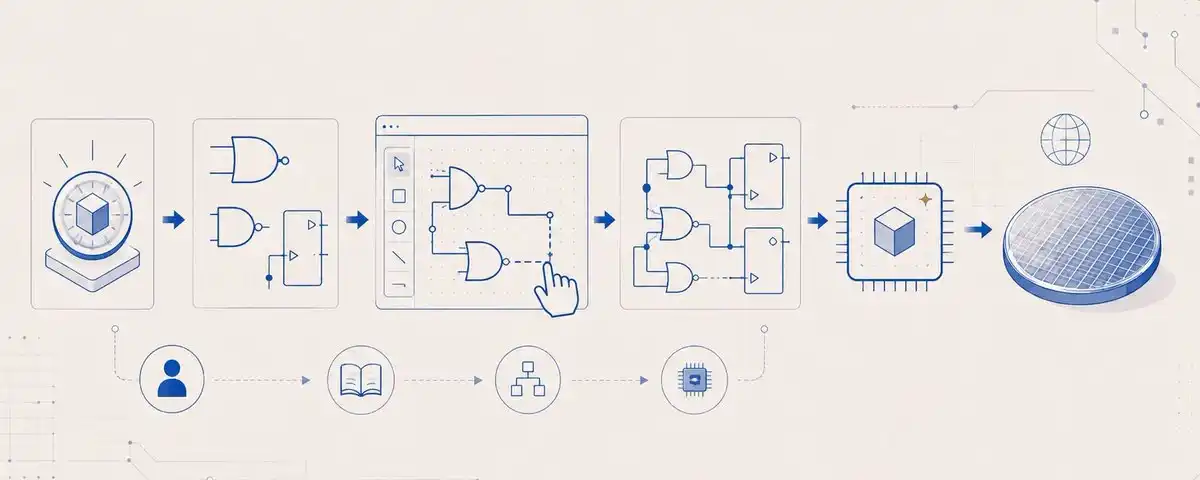
From Minting to Tape-Out: A First-Timer’s Guide to TapeOut

Title: From Mint to Tapeout: A First-Timer’s Guide to TapeOut **Summary:** This guide provides a risk-conscious, step-by-step introduction to TapeOut, a platform where users can mint logic components (NAND, LATCH) and use them to "tape out" on-chain circuits. It emphasizes a fundamental shift in mindset: instead of focusing first on prices or speculation, users should first understand how to use the platform's core functionality. The recommended path begins with preparation: use a separate, low-fund wallet on BNB Smart Chain for experimentation. The first step is to choose a "Processor"—the foundational unit for components and circuits—by examining its details (supply, mintage, creator) rather than chasing trends. If a Processor has remaining supply, users can mint a small number of components. The guide stresses that minting acquires specific components for a specific processor, not a generic asset. For sold-out Processors, trading occurs on an order book market. Users must carefully understand order prices, quantities, and the 1% fee, and always verify transactions on a block explorer. The core "play" experience is in the Canvas, where users can build and test logic circuits without a wallet. Before proceeding to tapeout—the irreversible, on-chain act of finalizing a circuit which consumes components—users must verify their design, component costs, and target processor. After taping out a circuit, the guide encourages users to interact with it, for example by calling its functions via BscScan's read contract feature, completing the "components -> circuit -> verification" loop. It concludes with critical safety checks to perform before any wallet signature, and cautions against misinterpreting demo pages (like the "on-chain BTC miner") as profit-generating services. The goal is to approach TapeOut as a hands-on lesson in on-chain logic, minimizing financial risk while learning its unique mechanics.

marsbit3m ago

From Minting to Tape-Out: A First-Timer’s Guide to TapeOut

marsbit3m ago

Wall Street Analyst Predicts SpaceX Stock Price Drop to $75

A Wall Street analyst from Phillip Securities, Glenn Tumm, has issued a "Sell" recommendation for SpaceX stock (SPCX), maintaining a 12-month price target of $75. This implies a potential 46.6% drop from the current price of $140.50. The bearish outlook is based on the company's significant capital expenditures, reliance on temporary cloud service contracts, and customer concentration in its AI services, suggesting a need for longer-term commitments to support its valuation. This stance contrasts sharply with the broader Wall Street consensus. An average of 31 analysts polled by TipRanks sets a 12-month price target of $232.35, implying 64% upside, with the highest forecast at $800 and the lowest at $75. The report follows SpaceX's impressive Q2 2026 results, where total revenue surged 92% year-over-year to $7.8 billion. Starlink subscriber count doubled to 12 million, driving communications revenue up 66% to $4.3 billion. AI-related revenue skyrocketed 247% to $2.6 billion, fueled by new cloud services and infrastructure deals. Despite the strong earnings, SPCX shares fell over 4% in the last 24 hours, reducing the company's market cap to $1.9 trillion. The stock had initially jumped over 17% post-earnings but faced resistance near $149. The analyst concludes that SpaceX's future trajectory hinges on securing more long-term contracts with its AI and Starlink customers. Success could validate Wall Street's bullish forecasts, while failure may render the recent stock rebound temporary.

cryptonews.ru50m ago

Wall Street Analyst Predicts SpaceX Stock Price Drop to $75

cryptonews.ru50m ago

Trading

Spot

Hot Articles

Discussions

Welcome to the HTX Community. Here, you can stay informed about the latest platform developments and gain access to professional market insights. Users' opinions on the price of SOL (SOL) are presented below.

活动图片