US Senate Targets Fall 2026 Release for Crypto Tax Bill Amid CLARITY Act Push

TheNewsCryptoPublished on 2026-06-24Last updated on 2026-06-24

Abstract

U.S. Senators are targeting Fall 2026 for the potential release of a dedicated cryptocurrency tax bill. Senator Steve Daines revealed that Republicans have already developed a framework for the legislation, which aligns closely with recent crypto tax proposals from the House of Representatives. The Senate Finance Committee's move is driven by growing congressional interest in establishing clearer tax rules for virtual assets, addressing areas like staking rewards and mining. Concurrently, lawmakers continue to prioritize the broader Digital Asset Market CLARITY Act, which passed the Senate Banking Committee with bipartisan support. This act aims to create comprehensive regulations and define federal regulatory authority over cryptocurrencies. Over 200 industry groups are advocating for its passage, arguing that regulatory clarity will boost innovation and investment. Market observers view the tax bill and the CLARITY Act as complementary efforts to build a more complete regulatory framework for digital assets. While neither proposal has been finalized, the legislative activity signals accelerating progress in U.S. crypto regulation.

U.S. Lawmakers continue to advance digital asset regulations as the Senate moves closer to introducing dedicated cryptocurrency tax legislation. Senator Steve Daines revealed that Republican senators had already developed the framework. During an interview with Bloomberg Tax, Sen. Steve Daines said, “sooner rather than later”. He also said, “We’ve put together a framework,” Which means Congress has developed a framework for deliberation and discussion. Although Daines did not reveal any further information, he added that the plan is very similar to recent cryptocurrency tax bills proposed by the House of Representatives.
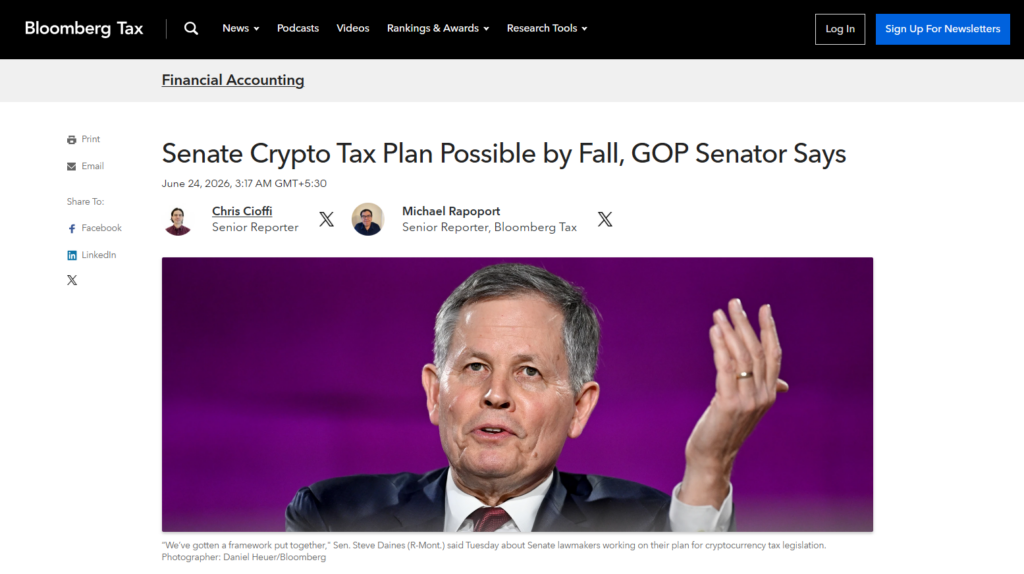
Source: Bloomberg Tax

Growing congressional interest in clearer tax rules for virtual assets prompted the Senate to develop the proposal. The Senate Finance Committee has previously discussed cryptocurrency tax legislation. Especially during hearings on staking rewards, mining, and other issues associated with the reporting of digital assets.

Additionally, several drafts of cryptocurrency tax legislation have been proposed in the House of Representatives, including by the House Ways and Means Committee. The legislation deals with such issues as staking, mining, decentralized finance operations, stablecoin transactions, and others.

CLARITY Act Still the Top Priority

While the Senate is moving forward with its tax proposal, the lawmakers are still discussing the Digital Asset Market CLARITY Act. This act aims at building an all-encompassing regulation for cryptocurrencies and defining regulatory authority for both federal authorities. The Senate Banking Committee passed this bill via a 15-9 bipartisan vote. Although the Senate is awaiting other provisions, the act is already under discussion.

Meanwhile, industry groups remain advocates for the bill, with over 200 cryptocurrency companies calling on the Senate leadership to put the bill up for a vote. They say that clear regulations will spur innovation and investments in the US digital assets market.

Regulatory Clarity Is Still at the Top of the Agenda

Both projects will be followed by market players because taxation and regulation are always crucial for the crypto business and investors. It is believed that the tax provision of the Senate and the CLARITY Act are complementary moves that aim at creating a more complete framework for digital assets. Despite the fact that neither of the projects has been finally approved yet, the activity of Congress demonstrates that the development of legislation for cryptocurrencies is gaining pace. It may be quite interesting for the next few months.

Highlighted Crypto News:

Ripple Secures Preliminary MiCA Approval in Luxembourg for Europe-Wide Expansion

TagsBlockchainBloombergClarity ACTCrypto Taxcrypto taxationSenatorU.SU.S Congress

Trending Cryptos

Related Questions

QWhat is the target release timeline for the US Senate's crypto tax bill, according to the article?

AThe US Senate is targeting a Fall 2026 release for its cryptocurrency tax bill.

QAccording to Senator Steve Daines, what stage has Congress reached regarding the crypto tax framework?

AAccording to Senator Steve Daines, Congress has developed a framework for the cryptocurrency tax legislation for deliberation and discussion.

QWhat is the main goal of the Digital Asset Market CLARITY Act mentioned in the article?

AThe main goal of the CLARITY Act is to build an all-encompassing regulation for cryptocurrencies and define regulatory authority for federal authorities.

QWhy are market players closely following both the Senate's tax proposal and the CLARITY Act?

AMarket players are closely following both projects because taxation and regulation are crucial for the crypto business and investors, and these moves aim to create a more complete framework for digital assets.

QHow did the industry show its support for the CLARITY Act, as per the article?

AOver 200 cryptocurrency companies called on the Senate leadership to put the CLARITY Act up for a vote, advocating that clear regulations will spur innovation and investments in the US digital assets market.

Related Reads

The Full Story of How Crypto Unicorn Blockstream Is Mired in Serious Fraud Allegations

This article details serious allegations of fraud against Bitcoin infrastructure company Blockstream, founded by Bitcoin pioneer Adam Back. In June 2024, investigative account NatInfoSec published a report accusing Blockstream's mining note (BMN) program of potentially operating a multi-billion dollar scheme with Ponzi-like characteristics. The core allegations focus on Blockstream Mining Notes (BMNs), which offer investors fixed annual yields up to approximately 20% from Bitcoin mining. NatInfoSec's investigation raises several key issues: 1. **Suspicious Hashrate & Payout Capacity**: The analysis suggests Blockstream would need 20-45 EH/s of mining power to cover its BMN obligations, but its public dashboard shows only around 15 EH/s. Furthermore, no verifiable public evidence (e.g., grid connection records, import data) was found to support the massive mining operation required. 2. **Questionable Payout Source**: The BMN contract allows Blockstream to use Bitcoin from *any source* (Substitute Performance BTC) to fulfill investor payouts, raising concerns that payouts may not come from actual mining revenue. 3. **High-Risk, Fixed Returns**: Offering ~20% fixed yields in the volatile, cyclical Bitcoin mining industry is viewed as highly unusual and requires clear explanation. 4. **Undisclosed Criminal Record of Key Figure**: Christopher William Cook, a key figure in Blockstream's mining operations and CEO of spin-off Exacore, was found to have a federal felony conviction for mail fraud in 2008, a fact not disclosed in BMN offering documents. His background was also allegedly embellished. 5. **Potential Contagion to BSTR SPAC**: Questions were raised about whether these liabilities and Cook's record should have been disclosed in the SEC filings for Bitcoin Standard Treasury Company (BSTR), a separate Adam Back-associated firm planning a SPAC merger. The crypto community is divided. BitMEX Research validated Cook's criminal record and expressed concern over the high yields but found other evidence lacking or misleading, noting the legal separation between BMN, Blockstream, and BSTR. Blockstream defenders, like Samson Mow, argue the mining is real. Critics, however, emphasize the lack of independent, verifiable proof of the mining operation's scale and the true source of investor payouts. The article concludes that BMN remains shrouded in key unanswered questions regarding its actual size, the verifiability of its underlying mining assets and payouts, the source of its high yields, and the full role and disclosure concerning Chris Cook. Blockstream had not issued a comprehensive response at the time of writing.

marsbit8h ago

The Full Story of How Crypto Unicorn Blockstream Is Mired in Serious Fraud Allegations

marsbit8h ago

Trading

Spot
Futures

Hot Articles

How to Buy PUSH

Welcome to HTX.com! We've made purchasing Push Protocol (PUSH) simple and convenient. Follow our step-by-step guide to embark on your crypto journey.Step 1: Create Your HTX AccountUse your email or phone number to sign up for a free account on HTX. Experience a hassle-free registration journey and unlock all features.Get My AccountStep 2: Go to Buy Crypto and Choose Your Payment MethodCredit/Debit Card: Use your Visa or Mastercard to buy Push Protocol (PUSH) instantly.Balance: Use funds from your HTX account balance to trade seamlessly.Third Parties: We've added popular payment methods such as Google Pay and Apple Pay to enhance convenience.P2P: Trade directly with other users on HTX.Over-the-Counter (OTC): We offer tailor-made services and competitive exchange rates for traders.Step 3: Store Your Push Protocol (PUSH)After purchasing your Push Protocol (PUSH), store it in your HTX account. Alternatively, you can send it elsewhere via blockchain transfer or use it to trade other cryptocurrencies.Step 4: Trade Push Protocol (PUSH)Easily trade Push Protocol (PUSH) on HTX's spot market. Simply access your account, select your trading pair, execute your trades, and monitor in real-time. We offer a user-friendly experience for both beginners and seasoned traders.

3.8k Total ViewsPublished 2024.03.29Updated 2026.06.02

How to Buy PUSH

Discussions

Welcome to the HTX Community. Here, you can stay informed about the latest platform developments and gain access to professional market insights. Users' opinions on the price of PUSH (PUSH) are presented below.

活动图片