Earlier this month, the U.S. Office of the Comptroller of the Currency (OCC) granted World Liberty Financial preliminary conditional approval to establish a federally chartered national trust bank to issue, redeem, and custody USD1, the dollar-backed stablecoin it launched last year.
The Wall Street Journal disclosed the ownership structure behind this bank on Thursday.
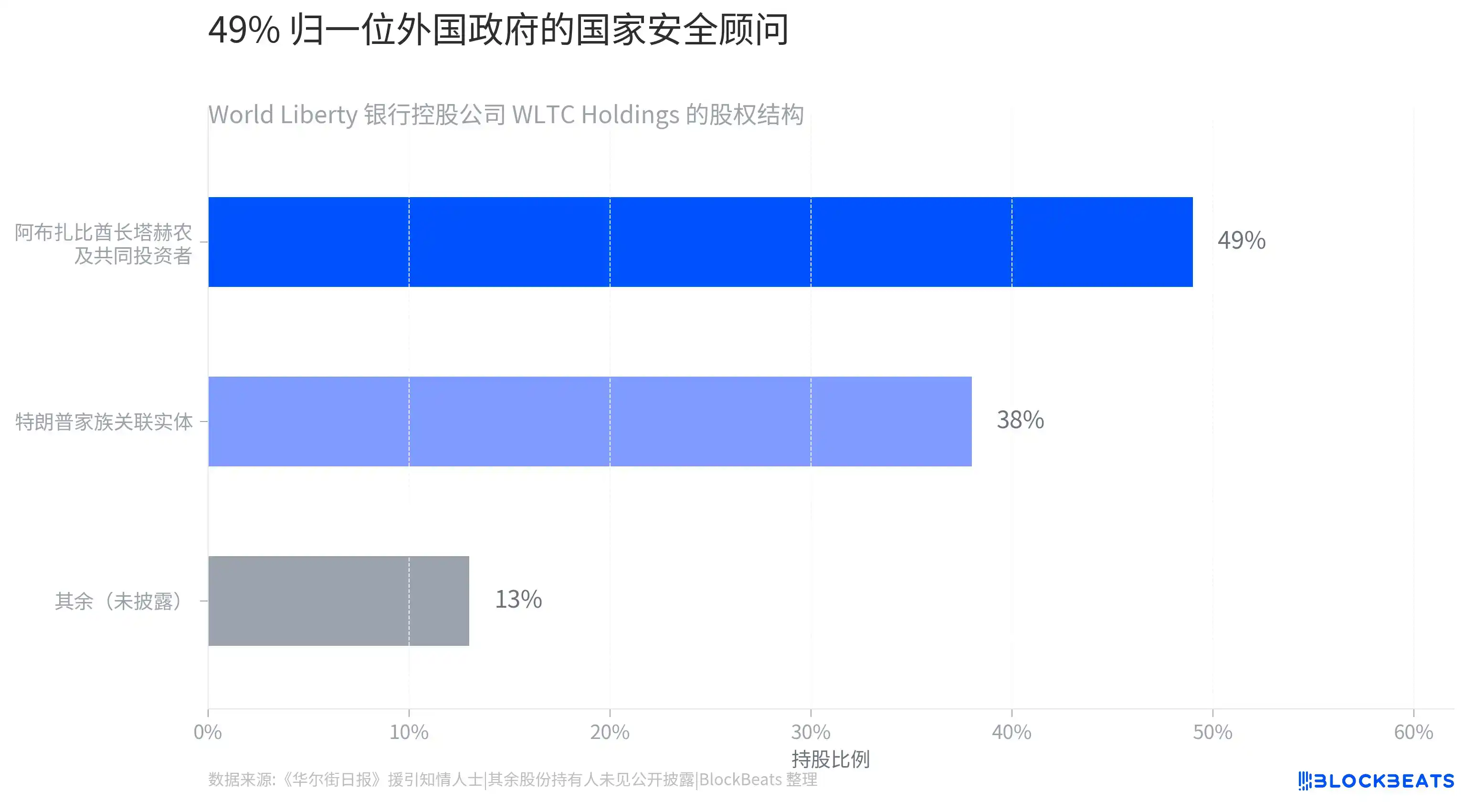
The largest shareholder is Sheikh Tahnoon bin Zayed al Nahyan, a member of the Abu Dhabi royal family, and his co-investors. Through an entity called StringZ Holding RSC, they hold 49% of the bank's holding company, WLTC Holdings.
Entities linked to the Trump family hold 38%.
Who is Tahnoon? He is the National Security Advisor of the United Arab Emirates and a brother of the country's President. He oversees a financial empire exceeding $1.3 trillion, with funds coming from both his personal wealth and state coffers. In Western media reports, he is sometimes referred to as the "Spy Sheikh."
This Isn't His First Appearance on This Chain
In January 2025, four days before Trump's inauguration, Tahnoon and co-investors invested $500 million into World Liberty Financial through an entity called Aryam Investment 1, acquiring a 49% stake in the company. That deal was not disclosed at the time and was only exposed by The Wall Street Journal this January.
According to the President's latest financial disclosure, $263 million of that money flowed to Trump family entities.
Democratic lawmakers and legal experts criticized it directly at the time: a senior foreign government official holding significant ownership in a company belonging to a U.S. President-elect was unprecedented.
Now, the same 49% appears in an institution about to receive a U.S. federal bank charter. The shareholder structure of the bank holding company is the same as that of World Liberty itself, except Tahnoon's side uses a different entity to hold the shares.
What Exactly Will This Bank Do?
It is not a traditional bank; a trust charter generally does not allow taking deposits or making loans. What it can do is: hold assets for clients nationwide and facilitate faster payment settlements.
Specifically for World Liberty, this charter allows it to issue USD1 directly and custody the dollar assets backing the stablecoin itself. These two tasks are currently handled by partner BitGo, an independent trust bank that holds USD1's reserves and keeps a portion of the interest.
This is the core of the business.
USD1 currently has a market capitalization of $4 billion. World Liberty states that the dollars backing it are invested in U.S. Treasury bonds and other cash equivalents, generating an estimated $150 million in interest annually.
Previously, this interest had to be shared with BitGo. With its own bank, it won't.
And the logic is self-reinforcing: the more USD1 in circulation, the larger the reserves, the greater the interest income. Therefore, World Liberty says the mission of this trust bank is to drive the "mainstream adoption" of USD1 while offering new services to customers, such as charging fees to custody their cryptocurrency.
After the OCC approval, World Liberty CEO Zach Witkoff said the company's ambition is "to build the most trusted and widely used digital dollar in the world." He is the son of Steve Witkoff, the U.S. Middle East envoy.
The Legal Gateway for This Charter Was Signed by the President Himself
World Liberty only began the process of setting up the bank after July 2025, the month the President signed the Genius Act.
This law did one key thing: it allowed approved stablecoin companies to directly hold the reserve assets backing their tokens.
Before this, World Liberty had to rely on a third party like BitGo. After this, it can do it itself, as long as it obtains a federal charter. It applied in January of this year and received preliminary conditional approval on August 14.
The Genius Act also stipulates that U.S.-issued dollar-pegged stablecoins must be backed by specific assets, including U.S. Treasury securities maturing in 93 days or less. Treasury Secretary Besant previously cited a prediction that stablecoins could grow into a market approaching $4 trillion and has written that "this could lower the government's borrowing costs."
In other words, the stablecoin track has clear fiscal significance for this administration; it creates new buyers for U.S. Treasury debt. And one of the companies running furthest ahead on this track belongs to the President's family.
The Same Regulator, Several Other Decisions This Summer
The OCC has approved a series of national bank charters for crypto companies in recent months, with Ripple and Circle both receiving preliminary approvals. The current Comptroller, Jonathan Gould, was appointed by Trump last year.
But there were also rejections.
In early August, the OCC rejected Dutch fintech company Bunq's application for a national bank charter, citing significant regulatory and compliance concerns. In mid-August, Zerohash, which provides crypto infrastructure for Morgan Stanley's E*Trade, had its trust bank application returned, citing material deficiencies; it subsequently resubmitted with a narrower business scope, with a public comment period ending September 17.
Regarding World Liberty's application, the OCC's letter stated: "This preliminary conditional approval is based on a comprehensive evaluation of all information available to the OCC, including statements and commitments made in the application and by representatives of the bank." Final approval is contingent on meeting a series of "pre-opening requirements" and passing a final examination.
A World Liberty spokesperson said OCC career staff reviewed the application "for compliance with statutory, regulatory, and policy requirements and factors governing bank approvals." The company did not comment on the shareholder structure behind its bank.
An OCC official said application reviews are handled by career staff and that the agency "consulted with multiple experienced career government ethics officials" to ensure the process "complies with all government ethics standards and policies."
There's Another Sum of Money
Tahnoon's $500 million is not the only controversial funding entering this company.
Earlier this month, The New York Times reported that a businessman named Guren "Bobby" Zhou invested a total of $100 million into World Liberty through a new company called Aqua 1, becoming one of the largest buyers of the company's tokens.
Two years ago, he was a failed hardwood flooring retailer in the UK, under investigation for money laundering there, and presided over the collapse of a small crypto startup.
Under World Liberty's policy, up to $75 million of that money was allocated to a company controlled by the President and his three sons, while also benefiting the Witkoff family.
On July 19, the day of the World Cup final, Zhou and Zach Witkoff sat together in a luxury box at the stadium in New Jersey.
What Remains to Be Seen
The bank has not yet opened. It must first meet the conditions set by the OCC and pass a final examination.
What is already certain is: if it opens, an institution 49% owned by a senior foreign government official and 38% owned by the President's family will hold the full reserves of a dollar stablecoin, invest them into U.S. Treasury bonds, and take all the interest.