This Year's Graduates, Trapped in Countless 'Online Assessments'

marsbitPublished on 2026-08-20Last updated on 2026-08-20

Abstract

This Year's Graduates, Trapped in Endless "Online Assessments" After years of standardized exams, new graduates face a new hurdle: a seemingly endless series of online evaluations to enter the job market. Over 60% of large and mid-sized companies now incorporate online tests into their campus recruitment, increasingly using AI for screening and even initial interviews. For graduates like Yang Liu, daily life revolves around practicing for these assessments—covering professional skills, aptitude tests (similar to civil service exams), and personality quizzes. The pressure is immense, with a record 12.22 million graduates in 2025 and fierce competition for limited positions. Even securing an internship often requires passing multiple rounds of tests, some involving complex tasks like producing full industry reports using specific AI tools. From an HR perspective, these rigorous screenings are a necessary tool to manage overwhelming application volumes and identify candidates with the right learning ability, logic, and resilience. Some insiders acknowledge the process also acts as a "compliance test" to filter for stable, adaptable candidates. However, many graduates feel the tests are often irrelevant to the actual job and serve merely as a bulk-filtering mechanism. This has spawned a grey market catering to graduate anxiety. Services range from selling leaked question banks and AI-powered cheating tools to high-priced "full-process tutoring" packages promising to secure of...

Entrance exams for junior high, high school, college, postgraduate studies... After countless exams, fresh graduates are finally ready to knock on the door of their ideal careers, only to find an endless array of assessments still waiting for them.

Relevant data shows that over 60% of large and medium-sized enterprises incorporate online written tests into their campus recruitment processes. Furthermore, with the widespread adoption of AI, most of these assessments no longer require HR personnel to grade them personally; AI directly screens the results, and even interviews can be conducted by AI.

Academic qualifications and internship experience are no longer the ticket to an interview; whether you can pass the aptitude tests, personality tests, and AI video interviews now determines if you have the qualification to be seen.

To cope with these assessments, many job seekers jokingly call themselves suffering from 'assessment anxiety' on social media. The prevailing belief is that most online tests are unrelated to the actual work of the position and are merely tools for companies to screen candidates en masse. But no one can avoid them.

For countless young people, the daily routine of job hunting has ultimately become an endless cycle of mass applications, practicing test questions, being a mere participant, getting eliminated, and applying again.

This issue of 'Micro-Story' will delve into the job seekers trapped by these assessments.

Here are their real stories:

Trapped in Endless Tests

Since submitting her graduation thesis in April, 25-year-old Yangliu has spent several hours every day practicing test questions, listening to lectures, reviewing answer strategies, and sometimes even recording videos of herself on her phone to check the effect.

Don't get it wrong—she is not preparing for civil service or graduate school entrance exams. Every set of questions she practices is for one thing only: dealing with the massive wave of online assessments for the upcoming autumn recruitment.

Every July and August is the core window period for autumn campus recruitment, also the time when job-seeking activity is most concentrated throughout the year.

Data shows that in 2025 alone, 12.22 million college graduates entered the job market. Over 31% of fresh graduates submitted more than 20 resumes in the initial stage of their job search, and 42% of previous-year graduates reported being invited by companies to take assessments after submitting their resumes.

Facing a massive influx of resumes, simple academic screening and initial resume filtering are no longer sufficient to meet companies' recruitment pace. Nowadays, not only state-owned enterprises, central enterprises, and leading internet giants but almost all large-scale enterprises have made online application (resume submission) and participating in written tests or assessments mandatory steps before interviews. Some companies have even started using AI interviews.
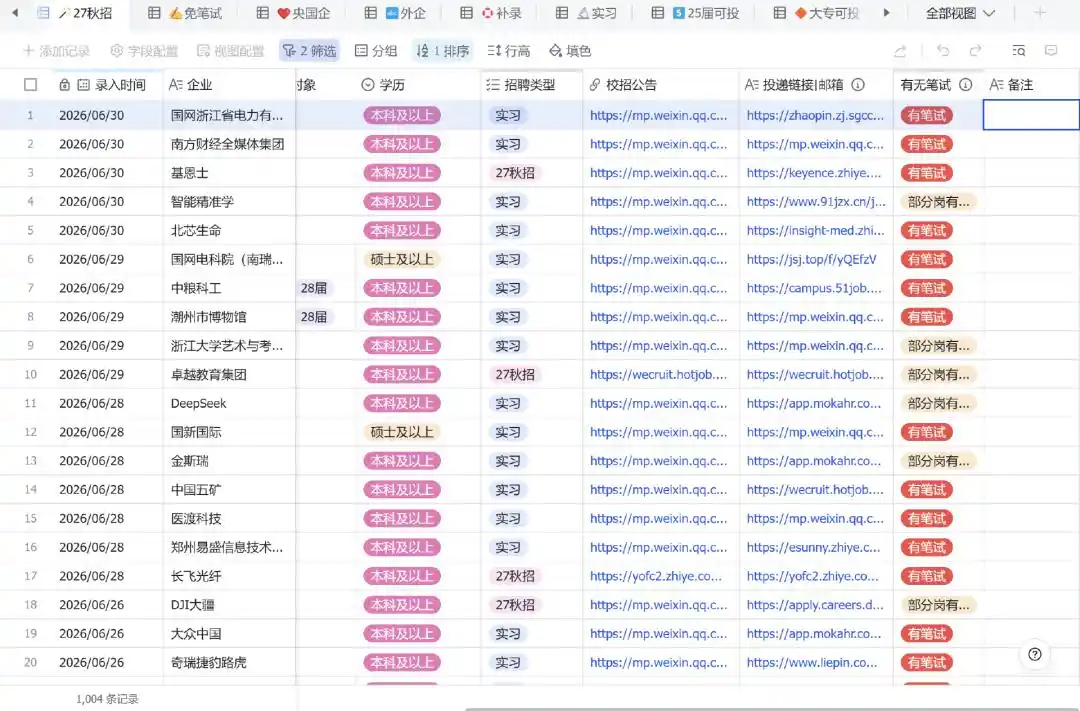
Image | Some companies explicitly mention a written test phase in related online autumn recruitment information

"AI interviews use algorithms to observe the candidate's body language and emotional changes, analyze their verbal logic, and finally, AI screens whether they proceed to the next stage," Yangliu explained. Some AI interviews are very strict; uncoordinated body movements or wandering eyes might be flagged as 'cheating.'

Besides AI interviews, written tests have also become more difficult than before. Some sections have time limits, and they might even suddenly ask you about specific details of certain company projects.

To improve her answer accuracy and efficiency, Yangliu had to prepare on multiple fronts—even though she graduated from a 211 university, her degree is not a significant advantage in the job market. "Without hardcore professional barriers, I can only rely on mass applications, taking many assessments, and trying widely, using quantity to exchange for probability."

Yangliu's senior used a similar strategy, applying to over 100 positions, taking more than 20 written tests, and finally finding a job. "This year, there are even more graduates, so the situation might be more severe," Yangliu said.

Currently, company written tests are mainly divided into three categories: position-specific professional ability tests, general aptitude tests similar to civil service exams, and personality tests used to screen for specific traits.
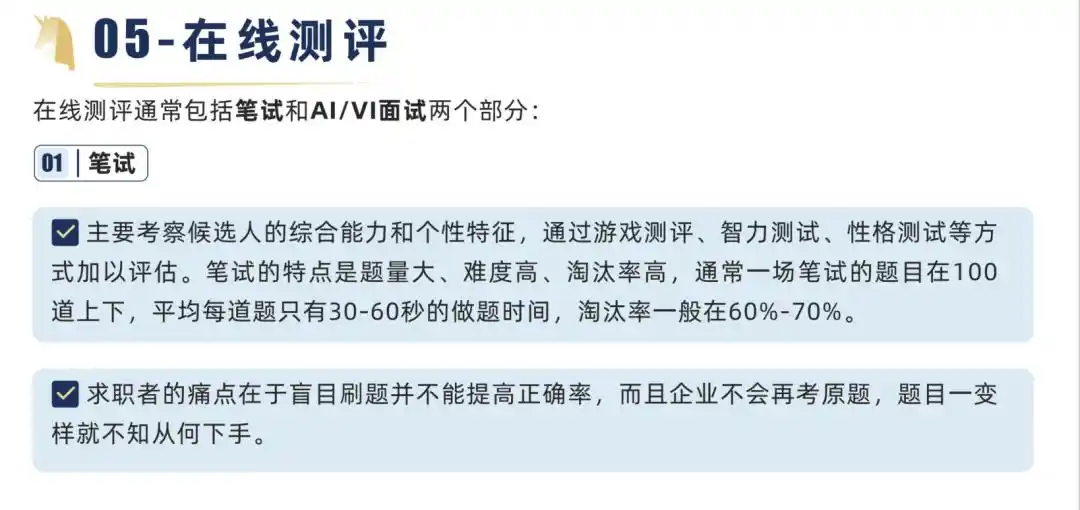
Image | Introduction to online assessments by a certain career service agency

These three question types are randomly combined with varying difficulty levels, so one can only rely on advance preparation as a safety net.

Her senior summarized a preparation formula: Professional questions are closely related to the business and are the most difficult; you can only accumulate problem-solving ideas by analyzing industry cases. Aptitude test questions have no shortcuts; only massive practice makes perfect. For personality tests, you cannot answer freely; you must simulate repeatedly to align with the workplace's core expectations for employee resilience, ambition, and stability.

In a way, this is also the job-seeking path for all current graduates: To not miss any opportunity, the vast majority of graduates choose to apply in bulk. The cost of mass applications is being swept along by countless online assessments.

Xu Wang, who just secured a summer internship offer, feels similarly. "Nowadays, even finding a summer internship requires participating in multiple assessments."

In the past two years, the number of internship positions in the market has shrunk by over 15%, while the number of applications has surged dramatically. The competition of 'many monks, little gruel' is intensifying.

To gain an advantage, starting in February this year, Xu Wang threw himself wholeheartedly into assessment preparation. By June, he had submitted over 120 applications, triggering 32 written test invitations.

After screening out some positions, Xu Wang took on 21 tests and ultimately secured 7 internship offers.

In contrast, Li Xin, an international student from the UK, was less fortunate. In the same timeframe, she submitted 15 internship applications, 12 triggered written assessments, and only 1 progressed to the interview stage.

"The written tests contain many obscure professional terms and comprehensive assessments that require long periods of thought," Li Xin said. The most mentally exhausting one required her to use a designated AI tool to answer continuously for three hours and independently complete a logically sound, data-rich, and comprehensive industry research report.

In the past, such tasks might only be undertaken independently by professionals with 3-5 years of experience. Now, they have become written test questions for newcomers.

Thinking they could escape over a decade of exam-driven competition after leaving school, they never expected that the first step into the workplace would be entering an even denser, harsher, and more inescapable cage of exams.

"Our generation seems to be born to be exam-taking tools," Li Xin often jokes.

"You Could Also See It as a Compliance Test"

Compared to school exams, pre-employment tests are more like a never-ending, answerless 'compliance test' that consumes you endlessly.

In one written test, Li Xin spent over two hours answering professional questions related to data maintenance and merchant operation optimization for a Key Account position at an internet company. However, the system wouldn't reveal her score or accuracy; she could only wait to see if anyone would notify her within two days.

After entering the interview, Li Xin was surprised to find that the interviewer didn't ask any business-related questions at all. All the questions revolved around her personal experience: "Your undergraduate internship experience isn't vertical enough. Why? Didn't you know what you wanted to do back then? How can I be sure you're passionate about this position?"

Towards the end of the interview, the HR representative was even more direct: "Aside from you being a local, I don't see any traits in your experience that fit this position."

Ultimately, Li Xin 'failed' the interview. The reason given was 'not a good match.'

This left Li Xin puzzled: "If they could tell I wasn't a good match for this position during the resume screening phase, why set up so many steps, keep me until the interview, and then tell me I'm not suitable?"

However, from the perspective of companies and HR, setting up these complex hurdles to challenge applicants is also a helpless move under the imbalance of market supply and demand.

Chen Chen, an HR professional with years of experience at a major internet company, explained that hiring fresh graduates carries higher risks than experienced hires. Most people's resumes are relatively simple and don't reveal their logical ability, learning ability, or resilience when facing actual work problems. Therefore, they can only screen through complex question design.

At the same time, the逐年暴涨 skyrocketing number of fresh graduates each year has infinitely lowered companies' tolerance for hiring mistakes. The number of graduates in 2026 is approximately 12.7 million, with graduates from top-tier 985 and 211 universities alone reaching the hundreds of thousands. In stark contrast, all the leading internet companies in China combined offer only about 25,000 summer internship positions per year.

Image | Scene from the 2026 Heilongjiang Talent Week

"This means that even if only one-third of the students from 985 and 211 schools intend to apply for internet summer internships, at least 300,000 people will be competing. Assuming each person applies for an average of 10 positions, that's 3 million resumes to process."

Chen Chen stated that without these assessment stages, companies simply wouldn't have a way to screen candidates in bulk.

Furthermore, with rising labor costs and the widespread adoption of AI, many companies themselves have entered an era of improving efficiency and tightening budgets. Even experienced employees face constant optimization and layoff risks, so companies are even more cautious about hiring new employees.

"We still hire fresh graduates now, but the graduates we bring in all have at least 2-3 internship experiences lasting around 3 months each, equivalent to the level of newcomers with 1-2 years of experience in the past," Chen Chen said.

This also means that pure newcomers are no longer welcome in the industry.

"Once we hire a newcomer who cannot quickly adapt or perform in the role, our recruitment department gets complaints from the business units and faces warnings or performance deductions," Chen Chen explained. To avoid recruitment risks and improve efficiency, companies can only continuously raise the hiring bar, increase the difficulty of written tests, and use high-intensity assessments to select the best from the best.

Therefore, Chen Chen doesn't deny the term 'compliance test.' "If you can't withstand these pre-employment tests during the job search, it will be very difficult to establish yourself in the future workplace. The written test itself is also a low-cost way to screen out potential hires who are more emotionally stable and compliant."

Moreover, for companies, compared to headhunting, written tests are relatively inexpensive.

"Having 200 people take a written test for one position costs less than half of what a headhunter charges. For the company, the written test is almost a zero-cost, zero-risk, high-return screening solution for newcomers."

As newcomers increase, positions decrease, and patience for training newcomers diminishes, the vicious cycle of assessment competition has become an unsolvable industry norm.

Struggling with All Their Might to 'Land' a Job

As pre-employment assessments become increasingly competitive, gray-market demands have also emerged. A commercialized gray industry chain, attached to job-seeking assessments and specifically serving fresh graduates' exam needs, has begun to permeate the entire graduation-season job market.

In major job-seeking communities and social media platforms, some people specifically compile and aggregate 'positions without written tests' lists. Such compilation posts are always traffic goldmines, instantly being saved, forwarded, and bookmarked by graduates upon release.
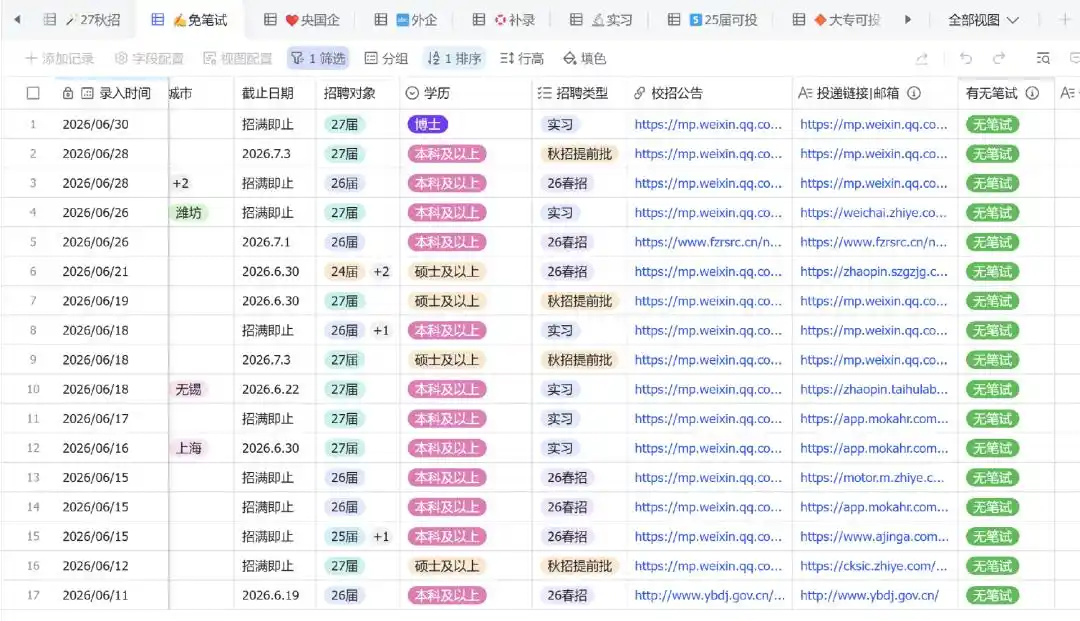
Image | In reality, the number of companies explicitly stating 'no written test' is extremely scarce in recruitment.

"Some people openly sell access to related positions at fixed prices," Chen Chen said, having seen people openly claim in their social media circles that they could secure state-owned enterprise jobs for a fee of 150,000 RMB. "But as things get stricter now, such things are mostly scams or only lead to outsourcing jobs."

Since the vast majority of job seekers can't avoid the written test stage, corresponding businesses have emerged: from test question banks and AI-powered answering services to guaranteed pass packages and full-process job-seeking guidance, each layer feeding on graduates' anxiety.

Li Xin tried buying a question bank.

When summer internship positions opened, she learned from friends that most companies' assessments rely on mainstream third-party platforms like Beisen, Zhiding, Niuke, and Saima—these platforms have fixed question banks, and the system randomly draws questions to form tests. Even though question types vary, the core test points and answering strategies are traceable.

"Taking the Beisen question bank as an example, I saw online that some say if you score below 50, your resume might be automatically filtered out and not reach the interview selection stage," Li Xin said. After learning this 'unspoken rule,' she felt particularly anxious and ultimately bought a set of Beisen assessment questions online for a low price of 4.9 RMB, claiming to be the 'most comprehensive on the entire internet.'
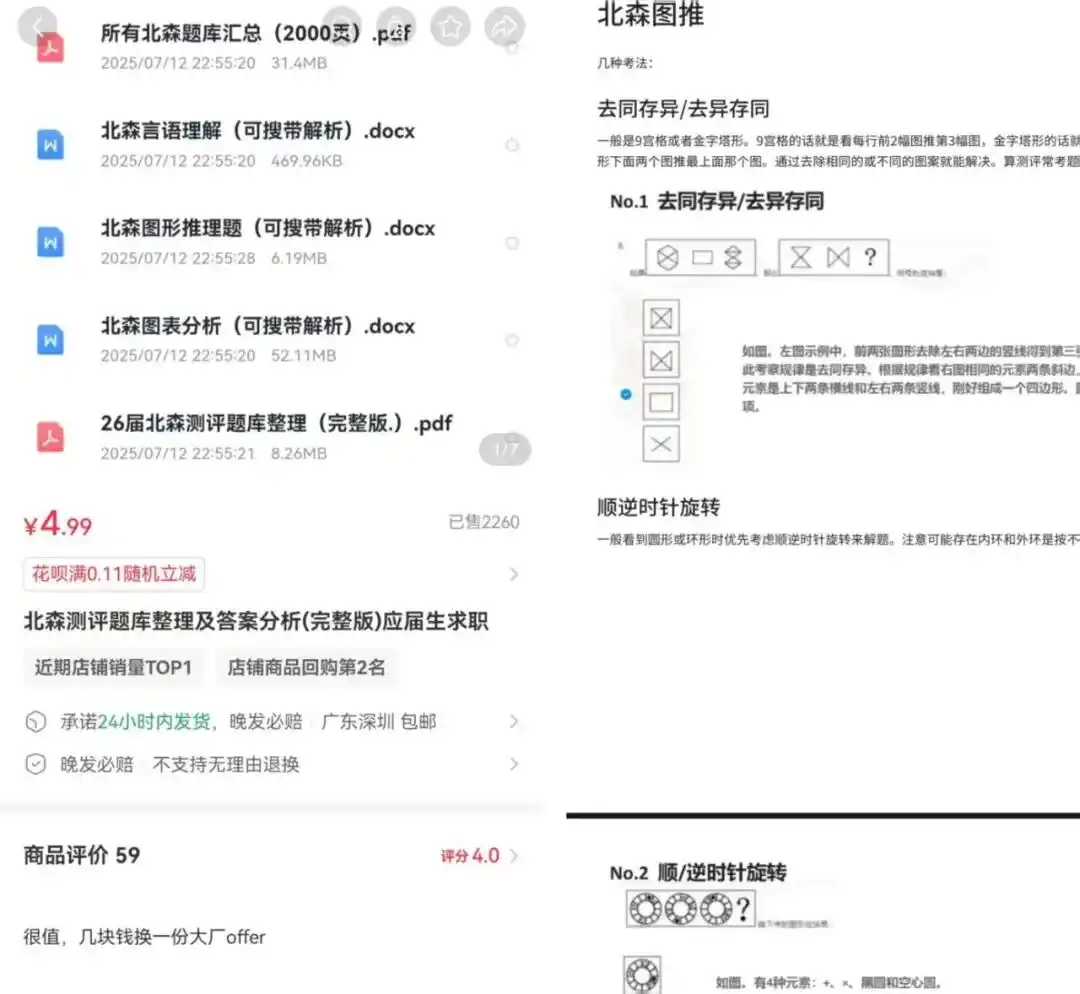
Image | Beisen question bank sold online

The question bank content is all-encompassing, covering past years' real questions, answering技巧 skills, standard answers for personality tests, and quick-solving思路 for aptitude tests. The purchase page showed that this document had already sold over 2,000 copies, meaning at least two thousand anxious graduates like her had clicked 'pay.'

Given mass applications, practicing questions is ultimately a笨办法消耗极大的体力消耗笨办法 that requires significant stamina. The autumn and spring recruitment windows are highly concentrated. A single student often submits hundreds of resumes and faces twenty or thirty assessments in succession. Aptitude tests, situational questions, and personality tests come one after another. No one has the energy to practice all the questions.

Many start taking risks, using AI to search for answers and cheat to提高通过率抬高通过率.

Image | The interviewer's system may display which candidates are suspected of cheating; in Chen Chen's words, he would directly screen out such candidates.

Fresh graduate Xu Wang is very familiar with these tactics—during summer internship recruitment, many of his classmates employed such methods.

"Each company's requirements are different," Xu Wang explained. Many中小企业的线上笔试中小企业的线上笔试 do not require enabling the camera or microphone; the entire test is done on a webpage, with supervision几乎形同虚设几乎形同虚设. Job seekers simply open AI tools, search for answers while answering, and can submit a logically complete答卷答卷 within a few dozen minutes.

Even when facing strict assessments with single-camera or dual-camera全程录像全程录像, the圈子圈子 had long prepared countermeasures: virtual machines, private browsers, device isolation—using technology to bypass system风控风控 and search for answers悄无声息悄无声息.

"There is a cost, though. If detected cheating, it might affect subsequent recruitment," Xu Wang said. Many of his competitors 'went under' this way.

Nevertheless, Chen Chen stated that every year, many job seekers still take the risk and cheat, betting on their luck.

"Even though there's a chance of being flagged for cheating, 'fortune favors the bold,'" some总结道总结道.

Practicing questions and自助作弊自助作弊 are just small-scale actions. To secure a stable and decent job, many middle-class families are willing to spend tens of thousands of RMB to sign up for '全程陪跑全程陪跑' services offered by career agencies.

"Every autumn and spring recruitment peak season, our business immediately booms," said Wang Weijia, who once worked at a career training institution, revealing the industry's引流套路引流套路. During recruitment seasons, a large number of accounts渲染就业焦虑渲染就业焦虑 appear online in batches, most of which are水军账号水军账号 operated by同行同行.

Online题库售卖帖题库售卖帖 and晒单帖晒单帖 are随处可见随处可见,帖子帖子 constantly渲染渲染 'successful上岸上岸 with coaching,' deliberately放大放大 graduates' job-seeking恐慌恐慌, all ultimately paving the way for引流引流 to高价付费业务高价付费业务.

Agencies charge based on company tiers. Guaranteed pass packages for written tests at internet giants, state-owned enterprises, and central enterprises are priced动不动上万动不动上万, "the highest can reach 36,800 RMB." Services bundled include内部内推内部内推, one-on-one远程协助答题远程协助答题, pre-exam真题梳理真题梳理, and even承诺承诺 'full refund if not passed' to打消打消 students' and parents'顾虑顾虑.

Image | A case shared by a career agency, claiming a student landed a Product Manager position at a major internet company through a 43,800 RMB全程陪跑全程陪跑 service.

Wang Weijia observed that the profile of those willing to pay a hefty price is very clear: middle-class families with decent financial means but no industry connections to help their children find jobs. "These parents lack the ability to pull strings for their children. Watching their children fail repeatedly at the written test stage, filled with anxiety, they would rather place a heavy bet just to secure a job entry ticket for their child."

Such衍生服务衍生服务 sell very well. The most popular 'background enhancement' costs around 10,000 RMB. "Simply put, it's paying to have your name listed on project rosters or purchasing short-term paid internships to包装包装 an impressive履历履历 and提高面试通过率提高面试通过率," Wang Weijia explained. Additionally,配套配套面试辅导面试辅导, career choice consultation are generally priced at 500 RMB per hour per subject, and many families are willing to pay this fee.
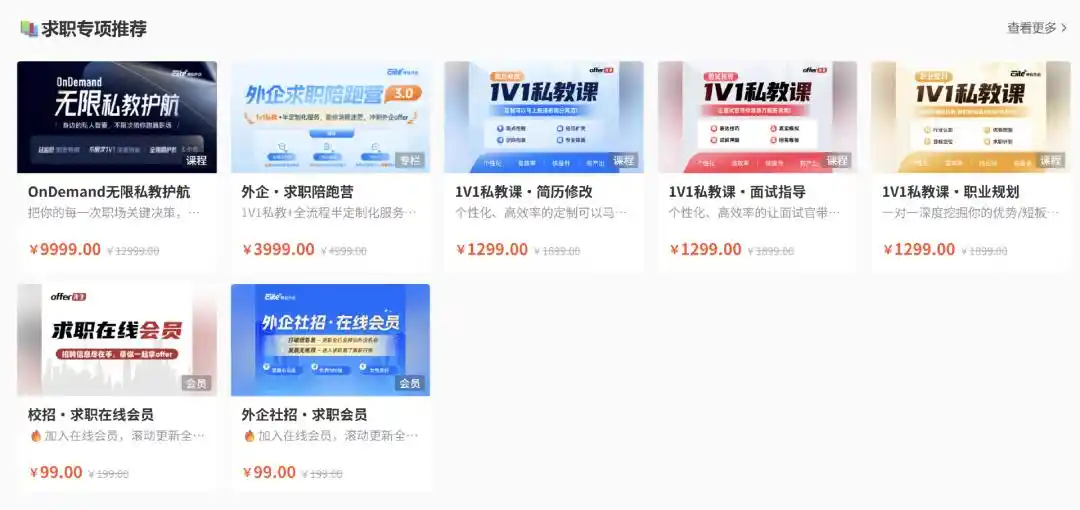
Image | Service pricing of a certain career agency

"Earlier, I found it hard to understand the concept of 'paying to work,' but after seeing more in recent years, I realized such businesses are booming year by year. Even requiring a deposit of several thousand RMB first, customers still keep coming," Wang Weijia感慨感慨.

On one side, companies continuously升级测评难度升级测评难度,抬高筛选门槛抬高筛选门槛, using rigorous assessments to筛选优质人才筛选优质人才,测试新人抗压能力测试新人抗压能力与服从性与服从性. On the other side, fresh graduates疯狂刷题疯狂刷题,付费买题付费买题,借助AI作弊借助AI作弊,购买保过服务购买保过服务, using every means to突破考核壁垒突破考核壁垒 to successfully 'land' a job.

No one wants to陷入无休止的应试内卷陷入无休止的应试内卷, and no one wants to依赖灰色手段求职依赖灰色手段求职. But in a job market with岗位稀缺岗位稀缺,竞争白热化竞争白热化, and淘汰无底线淘汰无底线, everyone is被大势裹挟被大势裹挟,只能被动挣扎只能被动挣扎,全力突围全力突围.

Changed Lives

The白热化白热化的求职考核与招聘节奏,一点一点地掰正了年轻人原本清晰的人生规划.

Yangliu originally had plans to pursue a Ph.D. Her teachers and seniors劝她冷静劝她冷静 time and again: nowadays, the threshold for academic positions in universities is越来越高越来越高, job prospects for humanities Ph.D. holders are狭窄狭窄, and emerging into the job market as a fresh graduate at thirty, with no work履历履历, would only make就业就业 even more被动被动.

After weighing her options several times, she temporarily搁置搁置 her academic理想理想 and plunged into the求职人海求职人海,开始了开始了 one笔试拉锯战笔试拉锯战 after another.

Li Xin originally planned to go to the United States for a one-year master's degree. But she carefully calculated the job-seeking节奏节奏: the one-year U.S. program is short, with graduation in June the following year. The graduation year刚好撞上刚好撞上 autumn recruitment. According to the current recruitment rule where companies lock in candidates a year in advance, she would have to仓促开启仓促开启 job search备战备战 even before setting foot on campus.

To争取喘息的余地争取喘息的余地, she临时改换赛道临时改换赛道, switching her target institutions to the UK. The UK system issues graduation certificates in December each year. Enrolling in 2025 would顺延划为顺延划为 the 2027 graduating class, finally giving herself an额外多出额外多出一整年的缓冲期缓冲期.

Li Xin has a friend who once满怀憧憬满怀憧憬,立志成为一名立志成为一名 free travel blogger. Faced with the现实现实 of连续多月投递无果连续多月投递无果, they最终妥协最终妥协, accepting an internet sales position. In the industry's求职履历求职履历, such positions are not considered优质经历优质经历 and might even become短板短板 for future job changes.

But they had no more挑选余地挑选余地, only hoping to尽快拿到尽快拿到 offer顺利上岸顺利上岸 and早日结束早日结束 the遥遥无期的等待遥遥无期的等待.

To this day, Li Xin still has零 offer零 offer and can only重整心态重整心态,备战备战 the even more竞争激烈的竞争激烈的 autumn recruitment.

She occasionally jokes about the闭环闭环 that has formed: "It's good. Graduates use AI to write theses, companies use AI for assessments, we use AI to search for answers, and then use AI to work after getting in. Everyone is魔法对轰魔法对轰."

This article is from the WeChat public account 'Micro-Story' (ID: xianweigushi), author: Micro-Story Editorial Department

Trending Cryptos

Related Questions

QWhat are the three main types of written assessments that enterprises commonly use in their online recruitment process for graduates?

AThe three main types are: 1) Professional Competency Tests specific to the job position; 2) General Aptitude Tests similar to civil service exams; and 3) Personality Tests used to screen for specific traits.

QWhy do HR professionals from enterprises justify the use of increasingly complex and difficult online assessments in graduate recruitment?

AHR professionals justify the complex assessments due to a severe market imbalance where a massive number of graduates far exceeds the available job positions. These tests allow for efficient bulk screening. Additionally, they serve as a low-cost way to assess a candidate's logical thinking, learning ability, and pressure tolerance, acting as a form of 'compliance test' to find candidates who are more stable and adaptable.

QWhat 'gray industry' practices have emerged in response to the intense competition and prevalence of online assessments?

ASeveral gray industry practices have emerged, including: selling 'written test-free job position lists'; compiling and selling past question banks and answer keys for common testing platforms; using AI tools or technical methods to cheat during online exams; and offering expensive 'full-process job-seeking coaching' services from agencies, which may include paid internships for resume padding, guaranteed interview packages, and one-on-one tutoring.

QAccording to the article, how has the intense job-seeking process impacted the life plans of some graduates mentioned?

AThe intense process has significantly altered their plans. One student (Yang Liu) postponed her PhD aspirations to focus on job hunting. Another (Li Xin) switched her intended study destination from the US to the UK to better align her graduation timeline with the recruitment cycle. A friend of Li Xin's abandoned his dream of being a travel blogger and reluctantly accepted a sales job just to secure an offer.

QWhat is the core irony or 'closed loop' that the graduate Li Xin sarcastically points out regarding the use of AI in the education-to-employment pipeline?

ALi Xin sarcastically points out a 'closed loop' or irony where: graduates use AI to write their theses, enterprises use AI to screen candidates (through assessments and interviews), candidates use AI to search for answers during tests, and finally, once hired, they use AI to perform their jobs. It's a cycle of 'magic against magic' where AI is used at every stage, often to counteract or navigate systems also powered by AI.

Related Reads

Trading

Spot

Hot Articles

What is SONIC

Sonic: Pioneering the Future of Gaming in Web3 Introduction to Sonic In the ever-evolving landscape of Web3, the gaming industry stands out as one of the most dynamic and promising sectors. At the forefront of this revolution is Sonic, a project designed to amplify the gaming ecosystem on the Solana blockchain. Leveraging cutting-edge technology, Sonic aims to deliver an unparalleled gaming experience by efficiently processing millions of requests per second, ensuring that players enjoy seamless gameplay while maintaining low transaction costs. This article delves into the intricate details of Sonic, exploring its creators, funding sources, operational mechanics, and the timeline of significant events that have shaped its journey. What is Sonic? Sonic is an innovative layer-2 network that operates atop the Solana blockchain, specifically tailored to enhance the existing Solana gaming ecosystem. It accomplishes this through a customised, VM-agnostic game engine paired with a HyperGrid interpreter, facilitating sovereign game economies that roll up back to the Solana platform. The primary goals of Sonic include: Enhanced Gaming Experiences: Sonic is committed to offering lightning-fast on-chain gameplay, allowing players and developers to engage with games at previously unattainable speeds. Atomic Interoperability: This feature enables transactions to be executed within Sonic without the need to redeploy Solana programmes and accounts. This makes the process more efficient and directly benefits from Solana Layer1 services and liquidity. Seamless Deployment: Sonic allows developers to write for Ethereum Virtual Machine (EVM) based systems and execute them on Solana’s SVM infrastructure. This interoperability is crucial for attracting a broader range of dApps and decentralised applications to the platform. Support for Developers: By offering native composable gaming primitives and extensible data types - dining within the Entity-Component-System (ECS) framework - game creators can craft intricate business logic with ease. Overall, Sonic's unique approach not only caters to players but also provides an accessible and low-cost environment for developers to innovate and thrive. Creator of Sonic The information regarding the creator of Sonic is somewhat ambiguous. However, it is known that Sonic's SVM is owned by the company Mirror World. The absence of detailed information about the individuals behind Sonic reflects a common trend in several Web3 projects, where collective efforts and partnerships often overshadow individual contributions. Investors of Sonic Sonic has garnered considerable attention and support from various investors within the crypto and gaming sectors. Notably, the project raised an impressive $12 million during its Series A funding round. The round was led by BITKRAFT Ventures, with other notable investors including Galaxy, Okx Ventures, Interactive, Big Brain Holdings, and Mirana. This financial backing signifies the confidence that investment foundations have in Sonic’s potential to revolutionise the Web3 gaming landscape, further validating its innovative approaches and technologies. How Does Sonic Work? Sonic utilises the HyperGrid framework, a sophisticated parallel processing mechanism that enhances its scalability and customisability. Here are the core features that set Sonic apart: Lightning Speed at Low Costs: Sonic offers one of the fastest on-chain gaming experiences compared to other Layer-1 solutions, powered by the scalability of Solana’s virtual machine (SVM). Atomic Interoperability: Sonic enables transaction execution without redeployment of Solana programmes and accounts, effectively streamlining the interaction between users and the blockchain. EVM Compatibility: Developers can effortlessly migrate decentralised applications from EVM chains to the Solana environment using Sonic’s HyperGrid interpreter, increasing the accessibility and integration of various dApps. Ecosystem Support for Developers: By exposing native composable gaming primitives, Sonic facilitates a sandbox-like environment where developers can experiment and implement business logic, greatly enhancing the overall development experience. Monetisation Infrastructure: Sonic natively supports growth and monetisation efforts, providing frameworks for traffic generation, payments, and settlements, thereby ensuring that gaming projects are not only viable but also sustainable financially. Timeline of Sonic The evolution of Sonic has been marked by several key milestones. Below is a brief timeline highlighting critical events in the project's history: 2022: The Sonic cryptocurrency was officially launched, marking the beginning of its journey in the Web3 gaming arena. 2024: June: Sonic SVM successfully raised $12 million in a Series A funding round. This investment allowed Sonic to further develop its platform and expand its offerings. August: The launch of the Sonic Odyssey testnet provided users with the first opportunity to engage with the platform, offering interactive activities such as collecting rings—a nod to gaming nostalgia. October: SonicX, an innovative crypto game integrated with Solana, made its debut on TikTok, capturing the attention of over 120,000 users within a short span. This integration illustrated Sonic’s commitment to reaching a broader, global audience and showcased the potential of blockchain gaming. Key Points Sonic SVM is a revolutionary layer-2 network on Solana explicitly designed to enhance the GameFi landscape, demonstrating great potential for future development. HyperGrid Framework empowers Sonic by introducing horizontal scaling capabilities, ensuring that the network can handle the demands of Web3 gaming. Integration with Social Platforms: The successful launch of SonicX on TikTok displays Sonic’s strategy to leverage social media platforms to engage users, exponentially increasing the exposure and reach of its projects. Investment Confidence: The substantial funding from BITKRAFT Ventures, among others, emphasizes the robust backing Sonic has, paving the way for its ambitious future. In conclusion, Sonic encapsulates the essence of Web3 gaming innovation, striking a balance between cutting-edge technology, developer-centric tools, and community engagement. As the project continues to evolve, it is poised to redefine the gaming landscape, making it a notable entity for gamers and developers alike. As Sonic moves forward, it will undoubtedly attract greater interest and participation, solidifying its place within the broader narrative of blockchain gaming.

2.4k Total ViewsPublished 2024.04.04Updated 2024.12.03

What is SONIC

What is $S$

Understanding SPERO: A Comprehensive Overview Introduction to SPERO As the landscape of innovation continues to evolve, the emergence of web3 technologies and cryptocurrency projects plays a pivotal role in shaping the digital future. One project that has garnered attention in this dynamic field is SPERO, denoted as SPERO,$$s$. This article aims to gather and present detailed information about SPERO, to help enthusiasts and investors understand its foundations, objectives, and innovations within the web3 and crypto domains. What is SPERO,$$s$? SPERO,$$s$ is a unique project within the crypto space that seeks to leverage the principles of decentralisation and blockchain technology to create an ecosystem that promotes engagement, utility, and financial inclusion. The project is tailored to facilitate peer-to-peer interactions in new ways, providing users with innovative financial solutions and services. At its core, SPERO,$$s$ aims to empower individuals by providing tools and platforms that enhance user experience in the cryptocurrency space. This includes enabling more flexible transaction methods, fostering community-driven initiatives, and creating pathways for financial opportunities through decentralised applications (dApps). The underlying vision of SPERO,$$s$ revolves around inclusiveness, aiming to bridge gaps within traditional finance while harnessing the benefits of blockchain technology. Who is the Creator of SPERO,$$s$? The identity of the creator of SPERO,$$s$ remains somewhat obscure, as there are limited publicly available resources providing detailed background information on its founder(s). This lack of transparency can stem from the project's commitment to decentralisation—an ethos that many web3 projects share, prioritising collective contributions over individual recognition. By centring discussions around the community and its collective goals, SPERO,$$s$ embodies the essence of empowerment without singling out specific individuals. As such, understanding the ethos and mission of SPERO remains more important than identifying a singular creator. Who are the Investors of SPERO,$$s$? SPERO,$$s$ is supported by a diverse array of investors ranging from venture capitalists to angel investors dedicated to fostering innovation in the crypto sector. The focus of these investors generally aligns with SPERO's mission—prioritising projects that promise societal technological advancement, financial inclusivity, and decentralised governance. These investor foundations are typically interested in projects that not only offer innovative products but also contribute positively to the blockchain community and its ecosystems. The backing from these investors reinforces SPERO,$$s$ as a noteworthy contender in the rapidly evolving domain of crypto projects. How Does SPERO,$$s$ Work? SPERO,$$s$ employs a multi-faceted framework that distinguishes it from conventional cryptocurrency projects. Here are some of the key features that underline its uniqueness and innovation: Decentralised Governance: SPERO,$$s$ integrates decentralised governance models, empowering users to participate actively in decision-making processes regarding the project’s future. This approach fosters a sense of ownership and accountability among community members. Token Utility: SPERO,$$s$ utilises its own cryptocurrency token, designed to serve various functions within the ecosystem. These tokens enable transactions, rewards, and the facilitation of services offered on the platform, enhancing overall engagement and utility. Layered Architecture: The technical architecture of SPERO,$$s$ supports modularity and scalability, allowing for seamless integration of additional features and applications as the project evolves. This adaptability is paramount for sustaining relevance in the ever-changing crypto landscape. Community Engagement: The project emphasises community-driven initiatives, employing mechanisms that incentivise collaboration and feedback. By nurturing a strong community, SPERO,$$s$ can better address user needs and adapt to market trends. Focus on Inclusion: By offering low transaction fees and user-friendly interfaces, SPERO,$$s$ aims to attract a diverse user base, including individuals who may not previously have engaged in the crypto space. This commitment to inclusion aligns with its overarching mission of empowerment through accessibility. Timeline of SPERO,$$s$ Understanding a project's history provides crucial insights into its development trajectory and milestones. Below is a suggested timeline mapping significant events in the evolution of SPERO,$$s$: Conceptualisation and Ideation Phase: The initial ideas forming the basis of SPERO,$$s$ were conceived, aligning closely with the principles of decentralisation and community focus within the blockchain industry. Launch of Project Whitepaper: Following the conceptual phase, a comprehensive whitepaper detailing the vision, goals, and technological infrastructure of SPERO,$$s$ was released to garner community interest and feedback. Community Building and Early Engagements: Active outreach efforts were made to build a community of early adopters and potential investors, facilitating discussions around the project’s goals and garnering support. Token Generation Event: SPERO,$$s$ conducted a token generation event (TGE) to distribute its native tokens to early supporters and establish initial liquidity within the ecosystem. Launch of Initial dApp: The first decentralised application (dApp) associated with SPERO,$$s$ went live, allowing users to engage with the platform's core functionalities. Ongoing Development and Partnerships: Continuous updates and enhancements to the project's offerings, including strategic partnerships with other players in the blockchain space, have shaped SPERO,$$s$ into a competitive and evolving player in the crypto market. Conclusion SPERO,$$s$ stands as a testament to the potential of web3 and cryptocurrency to revolutionise financial systems and empower individuals. With a commitment to decentralised governance, community engagement, and innovatively designed functionalities, it paves the way toward a more inclusive financial landscape. As with any investment in the rapidly evolving crypto space, potential investors and users are encouraged to research thoroughly and engage thoughtfully with the ongoing developments within SPERO,$$s$. The project showcases the innovative spirit of the crypto industry, inviting further exploration into its myriad possibilities. While the journey of SPERO,$$s$ is still unfolding, its foundational principles may indeed influence the future of how we interact with technology, finance, and each other in interconnected digital ecosystems.

428 Total ViewsPublished 2024.12.17Updated 2024.12.17

What is $S$

What is AGENT S

Agent S: The Future of Autonomous Interaction in Web3 Introduction In the ever-evolving landscape of Web3 and cryptocurrency, innovations are constantly redefining how individuals interact with digital platforms. One such pioneering project, Agent S, promises to revolutionise human-computer interaction through its open agentic framework. By paving the way for autonomous interactions, Agent S aims to simplify complex tasks, offering transformative applications in artificial intelligence (AI). This detailed exploration will delve into the project's intricacies, its unique features, and the implications for the cryptocurrency domain. What is Agent S? Agent S stands as a groundbreaking open agentic framework, specifically designed to tackle three fundamental challenges in the automation of computer tasks: Acquiring Domain-Specific Knowledge: The framework intelligently learns from various external knowledge sources and internal experiences. This dual approach empowers it to build a rich repository of domain-specific knowledge, enhancing its performance in task execution. Planning Over Long Task Horizons: Agent S employs experience-augmented hierarchical planning, a strategic approach that facilitates efficient breakdown and execution of intricate tasks. This feature significantly enhances its ability to manage multiple subtasks efficiently and effectively. Handling Dynamic, Non-Uniform Interfaces: The project introduces the Agent-Computer Interface (ACI), an innovative solution that enhances the interaction between agents and users. Utilizing Multimodal Large Language Models (MLLMs), Agent S can navigate and manipulate diverse graphical user interfaces seamlessly. Through these pioneering features, Agent S provides a robust framework that addresses the complexities involved in automating human interaction with machines, setting the stage for myriad applications in AI and beyond. Who is the Creator of Agent S? While the concept of Agent S is fundamentally innovative, specific information about its creator remains elusive. The creator is currently unknown, which highlights either the nascent stage of the project or the strategic choice to keep founding members under wraps. Regardless of anonymity, the focus remains on the framework's capabilities and potential. Who are the Investors of Agent S? As Agent S is relatively new in the cryptographic ecosystem, detailed information regarding its investors and financial backers is not explicitly documented. The lack of publicly available insights into the investment foundations or organisations supporting the project raises questions about its funding structure and development roadmap. Understanding the backing is crucial for gauging the project's sustainability and potential market impact. How Does Agent S Work? At the core of Agent S lies cutting-edge technology that enables it to function effectively in diverse settings. Its operational model is built around several key features: Human-like Computer Interaction: The framework offers advanced AI planning, striving to make interactions with computers more intuitive. By mimicking human behaviour in tasks execution, it promises to elevate user experiences. Narrative Memory: Employed to leverage high-level experiences, Agent S utilises narrative memory to keep track of task histories, thereby enhancing its decision-making processes. Episodic Memory: This feature provides users with step-by-step guidance, allowing the framework to offer contextual support as tasks unfold. Support for OpenACI: With the ability to run locally, Agent S allows users to maintain control over their interactions and workflows, aligning with the decentralised ethos of Web3. Easy Integration with External APIs: Its versatility and compatibility with various AI platforms ensure that Agent S can fit seamlessly into existing technological ecosystems, making it an appealing choice for developers and organisations. These functionalities collectively contribute to Agent S's unique position within the crypto space, as it automates complex, multi-step tasks with minimal human intervention. As the project evolves, its potential applications in Web3 could redefine how digital interactions unfold. Timeline of Agent S The development and milestones of Agent S can be encapsulated in a timeline that highlights its significant events: September 27, 2024: The concept of Agent S was launched in a comprehensive research paper titled “An Open Agentic Framework that Uses Computers Like a Human,” showcasing the groundwork for the project. October 10, 2024: The research paper was made publicly available on arXiv, offering an in-depth exploration of the framework and its performance evaluation based on the OSWorld benchmark. October 12, 2024: A video presentation was released, providing a visual insight into the capabilities and features of Agent S, further engaging potential users and investors. These markers in the timeline not only illustrate the progress of Agent S but also indicate its commitment to transparency and community engagement. Key Points About Agent S As the Agent S framework continues to evolve, several key attributes stand out, underscoring its innovative nature and potential: Innovative Framework: Designed to provide an intuitive use of computers akin to human interaction, Agent S brings a novel approach to task automation. Autonomous Interaction: The ability to interact autonomously with computers through GUI signifies a leap towards more intelligent and efficient computing solutions. Complex Task Automation: With its robust methodology, it can automate complex, multi-step tasks, making processes faster and less error-prone. Continuous Improvement: The learning mechanisms enable Agent S to improve from past experiences, continually enhancing its performance and efficacy. Versatility: Its adaptability across different operating environments like OSWorld and WindowsAgentArena ensures that it can serve a broad range of applications. As Agent S positions itself in the Web3 and crypto landscape, its potential to enhance interaction capabilities and automate processes signifies a significant advancement in AI technologies. Through its innovative framework, Agent S exemplifies the future of digital interactions, promising a more seamless and efficient experience for users across various industries. Conclusion Agent S represents a bold leap forward in the marriage of AI and Web3, with the capacity to redefine how we interact with technology. While still in its early stages, the possibilities for its application are vast and compelling. Through its comprehensive framework addressing critical challenges, Agent S aims to bring autonomous interactions to the forefront of the digital experience. As we move deeper into the realms of cryptocurrency and decentralisation, projects like Agent S will undoubtedly play a crucial role in shaping the future of technology and human-computer collaboration.

1.1k Total ViewsPublished 2025.01.14Updated 2025.01.14

What is AGENT S

Discussions

Welcome to the HTX Community. Here, you can stay informed about the latest platform developments and gain access to professional market insights. Users' opinions on the price of S (S) are presented below.

活动图片