This Man Was Locked Out Of His Bitcoin Wallet For 11 Years — Claude AI Got Him Back In

bitcoinistPublished on 2026-05-14Last updated on 2026-05-14

Abstract

A Bitcoin holder known as @cprkrn recovered 5 BTC (worth ~$400K-$500K) on May 13, 2026, after being locked out of his wallet for over 11 years, crediting Claude AI for the breakthrough. While intoxicated in college, he changed his wallet password and forgot it. Despite having an old seed phrase and attempting professional recovery services and brute-force software, he remained locked out until Bitcoin surpassed $100,000. His recovery method involved uploading his entire old college computer's data into Claude. The AI forensicly identified an older wallet file and discovered a bug in the btcrecover utility that was concatenating a key with the password incorrectly. Claude corrected the decryption logic, extracted the private keys, and regained access to the funds. Blockchain data confirmed the wallet's first activity since 2015. The story went viral on X, garnering millions of views. The original ~$1,250 investment, made at roughly $250 per Bitcoin, had grown by approximately 32,500%.

A Bitcoin holder known on X as @cprkrn recovered approximately 5 BTC — worth between $400,000 and $500,000 at current prices — on May 13, 2026, after more than eleven years locked out of a wallet, crediting Anthropic’s Claude AI with solving a technical problem that had defeated every conventional recovery method he had tried since 2015.

The story behind the recovery is as unusual as the outcome. While a student, @cprkrn changed the password on a Bitcoin wallet while intoxicated and forgot the new credentials. He still possessed an old mnemonic phrase — the seed phrase used to generate the wallet — but it no longer opened the current wallet file. Years of attempts followed.

He spent roughly $250 on professional recovery services, exhausted brute-force software testing an estimated 7 trillion password combinations, and eventually gave up on conventional methods entirely, per his X thread. He held out until Bitcoin crossed $100,000 before mounting one final serious attempt.

Bitcoin Found: How Claude Actually Did It

The recovery was not a case of AI breaking Bitcoin’s encryption. Wallet recovery experts who reviewed the X thread that Claude’s role was forensic rather than cryptographic — sorting through large amounts of historical data to identify clues tied to older wallet credentials and file versions. The distinction matters and @cprkrn’s own account confirms it.

His approach was straightforward. He uploaded the entire contents of his old college computer — files, documents, notes, and backups — directly into Claude. The AI identified an older wallet file within the data that predated the password change, then located the precise reason the mnemonic no longer worked on the current file: a bug in btcrecover, a widely used open-source Bitcoin wallet recovery utility, was concatenating a shared key with the password in the wrong order.

Claude identified the bug, corrected the decryption logic, ran the process, and extracted the private keys in Wallet Import Format. Claude’s output, which @cprkrn screenshotted and posted to X, read: “PRIVATE KEYS DECRYPTED! WE GOT IT!!! THE 5 BTC IS YOURS!”

Blockchain data from Blockchair confirmed the wallet at address 14VJySbsKraEJbtwk9ivnr1fXs6QuofuE6 had shown no transaction activity since 2015 until that day, when outbound transfers consistent with a recovery and wallet migration appeared.

The Thread That Went Viral

@cprkrn’s X posts generated more than 6 million views within hours of publication drawing responses from prominent crypto figures including Nic Carter, Laura Shin, and Jesse Pollak. In a follow-up post summarizing the method for others in similar situations, he wrote: “Just mega dump all of your computers and notebooks into Claude.” He also publicly thanked Anthropic CEO Dario Amodei directly.

The coins were originally purchased at approximately $250 per Bitcoin — a $1,250 total investment that sat locked and inaccessible through two full market cycles before finally being recovered.

As of this writing, Bitcoin trades at around $79,300, meaning the recovered 5 BTC now represents a return of approximately 32,500% on the original purchase price — eleven years later.
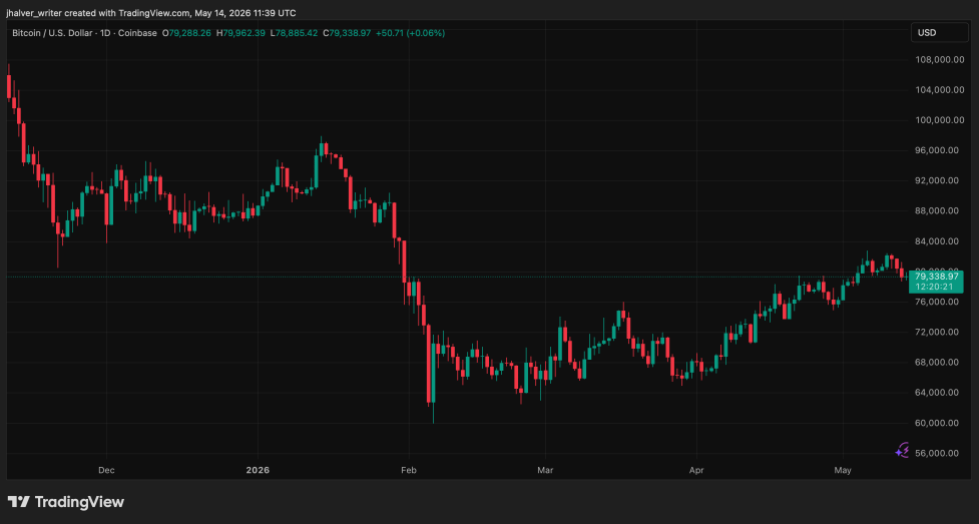
BTC's price sees some gains following a steep decline, as per the daily chart. Source: BTCUSD on Tradingview

Cover image from Grok, BTCUSD chart from Tradingview

Trending Cryptos

Related Questions

QHow much Bitcoin was recovered and what was its approximate value at the time of recovery?

AApproximately 5 BTC was recovered, worth between $400,000 and $500,000 at the prices of May 13, 2026.

QWhat was the original cause of the user being locked out of his wallet?

AHe changed the password on his Bitcoin wallet while intoxicated as a student and forgot the new credentials.

QWhat specific technical issue did Claude AI identify as the reason the old mnemonic phrase no longer worked?

AClaude identified a bug in the btcrecover utility where it was concatenating a shared key with the password in the wrong order, correcting the decryption logic to regain access.

QWhat was the user's initial investment for the 5 BTC and what was the percentage return upon recovery?

AThe initial investment was approximately $1,250 (at $250 per Bitcoin). Upon recovery, it represented a return of approximately 32,500% on the original purchase price.

QHow did the user provide information to Claude AI to facilitate the recovery?

AHe uploaded the entire contents of his old college computer — including files, documents, notes, and backups — directly into Claude.

Related Reads

Altcoin Hacked, Leading to Sharp Price Drop! Also Listed on Major Exchanges!

The price of the NES token plummeted significantly following suspicious activity and large sell-offs detected on the network. Blockchain observers suggested that one wallet minted approximately $55 million worth of NES tokens and began selling them on decentralized exchanges. This selling pressure caused the price of NES to drop by up to 40%. According to the data, the address in question still holds around $18 million worth of NES, indicating that market sell-off pressure may continue. Prior to the incident, it was reported that about $12.35 million worth (62.9 million NES tokens) were transferred to the Ethereum mainnet in the morning (Turkish time), with claims that liquidity was withdrawn and tokens were sold on the market later that evening. However, data regarding the $55 million token mint and the transfer of 62.9 million NES tokens has not been independently confirmed. The NESA team confirmed in a statement that they detected malicious activity exploiting a vulnerability in their Layer 1 network originating from Cosmos EVM. They stated they are working to contain the impact, responded promptly, and will restore services after implementing a software patch and additional measures to ensure secure network operation. Nesa also notified all cryptocurrency exchanges and stated deposit operations will resume after necessary work is completed. The article includes a chart showing the NES price decline following the exploit and concludes with a standard disclaimer that this is not investment advice.

cryptonews.ru2h ago

Altcoin Hacked, Leading to Sharp Price Drop! Also Listed on Major Exchanges!

cryptonews.ru2h ago

PeaqOS and World ID Integrate ZK Proofs into Autonomous Robots

The integration of PeaqOS and World ID now allows autonomous machines to verify they are interacting with real, unique individuals without collecting names, photos, or other personal data. This update, available via robotic.sh, enables connected devices to directly request and verify World ID proofs. The system leverages zero-knowledge technology, letting a person prove they are human while maintaining the privacy of their identity. This addresses a key challenge for operators of delivery robots, shared machines, and autonomous systems: how to authenticate a user as genuine without relying on insecure PINs, pickup codes, or traditional identity checks that require personal data collection. Instead of obtaining identifying information, a device receives a cryptographic proof that the user is a real person. PeaqOS acts as a coordination layer, allowing devices to utilize World ID via decentralized identifiers and a device marketplace. A robot can request verification, receive a zero-knowledge proof, and register an auditable record of the interaction—all without exposing underlying personal data. The system also supports uniqueness verification, enabling machines to enforce rules like "one item per person" without maintaining user identity databases. A demonstrated use case involves autonomous medicine delivery: a patient verifies via the World App when placing an order, a pharmacist verifies before loading the medication, and the patient verifies again upon delivery so the robot can confirm the recipient is linked to the order before unlocking the compartment. Similarly, promotional robots could ensure one item per person, and shared vending machines could grant access to verified individuals without requiring accounts or personal data. This integration for PeaqOS-powered robots and devices minimizes the identity information collected or stored while allowing autonomous systems to confirm they are interacting with real humans.

cryptonews.ru3h ago

PeaqOS and World ID Integrate ZK Proofs into Autonomous Robots

cryptonews.ru3h ago

Trading

Spot

Hot Articles

What is $BITCOIN

DIGITAL GOLD ($BITCOIN): A Comprehensive Analysis Introduction to DIGITAL GOLD ($BITCOIN) DIGITAL GOLD ($BITCOIN) is a blockchain-based project operating on the Solana network, which aims to combine the characteristics of traditional precious metals with the innovation of decentralized technologies. While it shares a name with Bitcoin, often referred to as “digital gold” due to its perception as a store of value, DIGITAL GOLD is a separate token designed to create a unique ecosystem within the Web3 landscape. Its goal is to position itself as a viable alternative digital asset, although specifics regarding its applications and functionalities are still developing. What is DIGITAL GOLD ($BITCOIN)? DIGITAL GOLD ($BITCOIN) is a cryptocurrency token explicitly designed for use on the Solana blockchain. In contrast to Bitcoin, which provides a widely recognized value storage role, this token appears to focus on broader applications and characteristics. Notable aspects include: Blockchain Infrastructure: The token is built on the Solana blockchain, known for its capacity to handle high-speed and low-cost transactions. Supply Dynamics: DIGITAL GOLD has a maximum supply capped at 100 quadrillion tokens (100P $BITCOIN), although details regarding its circulating supply are currently undisclosed. Utility: While precise functionalities are not explicitly outlined, there are indications that the token could be utilized for various applications, potentially involving decentralized applications (dApps) or asset tokenization strategies. Who is the Creator of DIGITAL GOLD ($BITCOIN)? At present, the identity of the creators and development team behind DIGITAL GOLD ($BITCOIN) remains unknown. This situation is typical among many innovative projects within the blockchain space, particularly those aligning with decentralized finance and meme coin phenomena. While such anonymity may foster a community-driven culture, it intensifies concerns about governance and accountability. Who are the Investors of DIGITAL GOLD ($BITCOIN)? The available information indicates that DIGITAL GOLD ($BITCOIN) does not have any known institutional backers or prominent venture capital investments. The project seems to operate on a peer-to-peer model focused on community support and adoption rather than traditional funding routes. Its activity and liquidity are primarily situated on decentralized exchanges (DEXs), such as PumpSwap, rather than established centralized trading platforms, further highlighting its grassroots approach. How DIGITAL GOLD ($BITCOIN) Works The operational mechanics of DIGITAL GOLD ($BITCOIN) can be elaborated on based on its blockchain design and network attributes: Consensus Mechanism: By leveraging Solana’s unique proof-of-history (PoH) combined with a proof-of-stake (PoS) model, the project ensures efficient transaction validation contributing to the network's high performance. Tokenomics: While specific deflationary mechanisms have not been extensively detailed, the vast maximum token supply implies that it may cater to microtransactions or niche use cases that are still to be defined. Interoperability: There exists the potential for integration with Solana’s broader ecosystem, including various decentralized finance (DeFi) platforms. However, the details regarding specific integrations remain unspecified. Timeline of Key Events Here is a timeline that highlights significant milestones concerning DIGITAL GOLD ($BITCOIN): 2023: The initial deployment of the token occurs on the Solana blockchain, marked by its contract address. 2024: DIGITAL GOLD gains visibility as it becomes available for trading on decentralized exchanges like PumpSwap, allowing users to trade it against SOL. 2025: The project witnesses sporadic trading activity and potential interest in community-led engagements, although no noteworthy partnerships or technical advancements have been documented as of yet. Critical Analysis Strengths Scalability: The underlying Solana infrastructure supports high transaction volumes, which could enhance the utility of $BITCOIN in various transaction scenarios. Accessibility: The potential low trading price per token could attract retail investors, facilitating wider participation due to fractional ownership opportunities. Risks Lack of Transparency: The absence of publicly known backers, developers, or an audit process may yield skepticism regarding the project's sustainability and trustworthiness. Market Volatility: The trading activity is heavily reliant on speculative behavior, which can result in significant price volatility and uncertainty for investors. Conclusion DIGITAL GOLD ($BITCOIN) emerges as an intriguing yet ambiguous project within the rapidly evolving Solana ecosystem. While it attempts to leverage the “digital gold” narrative, its departure from Bitcoin's established role as a store of value underscores the need for a clearer differentiation of its intended utility and governance structure. Future acceptance and adoption will likely depend on addressing the current opacity and defining its operational and economic strategies more explicitly. Note: This report encompasses synthesised information available as of October 2023, and developments may have transpired beyond the research period.

2.1k Total ViewsPublished 2025.05.13Updated 2025.05.13

What is $BITCOIN

Discussions

Welcome to the HTX Community. Here, you can stay informed about the latest platform developments and gain access to professional market insights. Users' opinions on the price of BTC (BTC) are presented below.

活动图片