The Market Trades on Expectations, But You're Waiting for Answers

marsbitPublished on 2026-07-03Last updated on 2026-07-03

Abstract

The market trades on expectations, not on waiting for answers. A common misconception is that prices react after data is released. In reality, sensitive capital moves based on anticipated changes in policy, capital flows, and sentiment. Once an expectation forms, prices adjust in advance. For example, if the market expects the Federal Reserve to cut interest rates, assets like gold, growth stocks, or BTC may rise ahead of the actual announcement. When the cut finally happens, the market might show little movement or even pull back—not because the news isn't significant, but because it was already priced in. The same applies to reports like non-farm payrolls. If weak employment data is anticipated, gold and bonds may rally beforehand. When the data confirms the weakness, prices may not rise further, as it merely validates existing expectations. This explains why markets sometimes appear irrational: good news doesn't always lift prices, and bad news doesn't always cause declines. The key is to assess whether an event was already anticipated and whether capital has begun to price it in or is now taking profits. The market is always trading the future, not the present. Price movements reflect bets on what comes next. Therefore, focusing solely on headlines can lead to losses. Instead, investors should ask: Was this news already expected? Is the market still pricing it in, or is it time to cash out? In short, the market doesn't wait for answers—it acts on the future it...

Author: SOL I Don't Understand

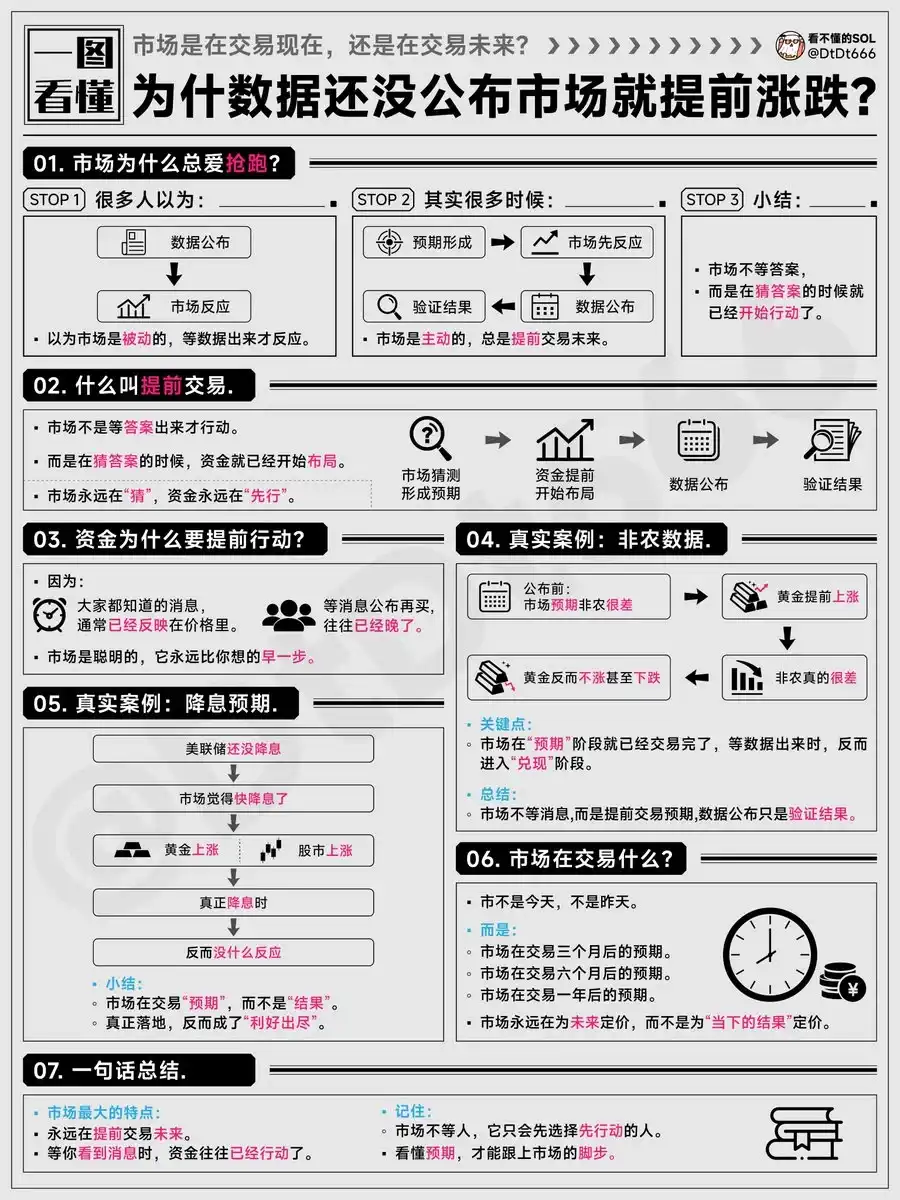
Why does the market often rise or fall before data is even released?

Because the market never trades solely on the "outcome"; more often, it trades on "expectations."

Many people understand the market like this:

Data is released, the market sees it, and then starts reacting.

But the real market often isn't like that.

Truly sensitive capital rarely waits for the answer to come out before acting. It first assesses: How might policy change next, where will capital flow, and how will sentiment shift.

Once expectations form, prices move first.

For example, if the market thinks the Fed is about to cut rates, gold, growth stocks, and BTC might react in advance. But by the time the actual rate cut happens, the market may show little movement, or even pull back.

It's not that the positive news is useless.

It's because that positive news was already traded during the preceding rally.

The same goes for Non-Farm Payroll data.

If before the release, the market already expects employment to weaken, gold and bonds might rise in advance. When the NFP data truly comes out weak, gold might not necessarily continue rising.

Because for the market, this isn't "new information," it's merely "confirmation."

So you often see:

Positive news comes out, but no rise.

Negative news comes out, but no fall.

Many people think the market makes no sense.

Actually, it's not that the market is crazy; it's that the market has already moved ahead of the news.

Where ordinary investors lose money most easily is by only reading news headlines.

Seeing good news, they chase; seeing bad news, they flee.

But the real question should be:

Did the market anticipate this news beforehand?

Has capital already priced it in?

Is this the beginning of pricing it in, or is it the stage of realization?

The market isn't trading today; it is constantly trading the future.

Behind price movements is capital continuously betting on what will happen next.

So when looking at the market, don't just focus on "what happened."

Look more at:

What did people previously think would happen.

Does the current result exceed expectations.

Is capital continuing to price it in, or starting to cash out.

Many market moves seem illogical because you're looking at the result, while the market trades on the deviation from expectations.

To summarize in one sentence:

The market doesn't wait for answers.

The market only chooses, in advance, the future it believes in.

By the time you see the news, capital has often been moving for a long time.
Trending Cryptos

Related Questions

QWhat is the core idea of the article regarding how financial markets work?

AThe article's core idea is that markets trade on expectations of future events, not just on the official results or news when they are announced.

QAccording to the author, why might an asset fail to rise after positive news (e.g., a Fed rate cut) is officially announced?

ABecause the positive expectation was likely already priced into the market beforehand. Traders anticipated the event and acted on it, so the official announcement is just a confirmation, not new information that triggers a new reaction.

QWhat does the term 'expectation gap' or 'expectation differential' refer to in the context of the article?

AIt refers to the difference between what the market was expecting to happen and what actually happens. The market's price movement often reflects this gap, not the raw news itself.

QWhat is a key mistake the article says ordinary investors often make?

AA key mistake is reacting directly to news headlines (buying on good news, selling on bad news) without considering whether that news was already anticipated and 'priced in' by the market.

QWhat should an investor analyze instead of just the news itself, according to the article's conclusion?

AAn investor should analyze the market's prior expectations, whether the actual result exceeded or fell short of those expectations, and whether capital is still pricing in the future event or has begun to take profits ('sell the news').

Related Reads

Zuckerberg Gave the AI Bull Market a Fright

Mark Zuckerberg and Meta inadvertently sent shockwaves through the AI stock market. News that Meta plans to sell its "excess" AI computing power to external clients triggered a trillion-dollar sell-off in AI infrastructure stocks like Nvidia and AMD, while Meta's stock rose. This seemingly simple business move—renting out idle resources—shook a core assumption underpinning the two-year AI bull market: the belief that computing power ("compute") would be perpetually scarce. This scarcity narrative had fueled valuations across the entire supply chain, from GPUs to power suppliers. Meta's motivations are layered: improving hardware utilization during non-peak R&D periods, executing a strategic pivot, and redefining AI infrastructure. Unlike rivals selling APIs, Meta's open-source approach with Llama appears aimed at building an ecosystem where it ultimately profits from the underlying compute, similar to how AWS transformed from Amazon's internal capacity. Meta is essentially offering an integrated "AI factory" service, not just raw GPU rental. The market's fear wasn't Meta selling a few chips, but the signal that GPU supply might become more shareable and efficient, transitioning the industry from a Capex-driven "hoarding" model to an Opex-driven "utilization" model. This could fundamentally reset valuation logic from scarcity to efficiency. While the sell-off reversed somewhat as investors realized this shift is long-term, the direction is set. The move marks a potential inflection point: the era of easy valuation gains from simply buying GPUs may be ending, giving way to an era where operational efficiency and return on AI assets take center stage.

marsbit20m ago

Zuckerberg Gave the AI Bull Market a Fright

marsbit20m ago

Trading

Spot

Hot Articles

Discussions

Welcome to the HTX Community. Here, you can stay informed about the latest platform developments and gain access to professional market insights. Users' opinions on the price of SOL (SOL) are presented below.

活动图片