The CLARITY Act Could Kill Stablecoin Yield – Here Is Where the Money Goes Instead

bitcoinistPublished on 2026-03-25Last updated on 2026-03-25

Abstract

The CLARITY Act's proposed ban on stablecoin yield is causing significant market shift, as evidenced by Circle's (USDC) 18% value drop, erasing $4.6 billion. This legislative move aims to separate stablecoins' dual functions—yield generation and utility—by restricting passive returns. The report argues this won't eliminate yield demand but redirect it to DeFi, tokenized Treasuries, or offshore markets. Meanwhile, stablecoins may evolve into pure utility tools for payments, settlement, and collateral, with on-chain data showing active addresses at all-time highs, indicating sustained capital movement and usage.

The stablecoin market is facing a critical test. Not a market cycle. Not a liquidity event. A legislative one — and the damage is already visible.

An XWIN Research Japan report documents what happened in a single session: Circle, the issuer behind USDC, shed 18% of its market value yesterday, erasing roughly $4.6 billion in a matter of hours. The trigger was not an earnings miss or an exchange collapse. It was a draft amendment — a proposed update to the CLARITY Act that would ban yield on stablecoins entirely.

That one legislative clause, not yet law, not yet finalized, was enough to reprice the entire thesis of what Circle is worth. The market understood the implication before the headlines did.

The report places the price reaction in its proper context: this is not volatility. It is a structural signal. For years, stablecoins operated as dual-purpose instruments — digital dollars for payments and settlement, yield-generating assets for the wallets that held them. That combination was the product. The CLARITY framework, as currently drafted, moves to separate those functions permanently, restricting passive yield while permitting only activity-based rewards.

One draft law. Two functions severed. The model that built USDC into a market cornerstone is now the model under review.

Stablecoin Capital Does Not Disappear. It Relocates.

The report is precise about what is actually at stake beneath the regulatory language: this is a competition for capital, and every participant in the financial system knows it. Banks are not lobbying against stablecoin yield out of principle. They are lobbying because deposit outflows are a solvency concern. Crypto platforms are not defending yield out of ideology. They are defending the incentive structure that keeps liquidity on their platforms. Regulation is the arena. Capital is the prize.

What history tells us — and the report invokes it directly — is that capping yield does not destroy yield demand. It redirects it. When deposit rates were capped in an earlier era, money flowed into money market funds. The same logic applies here. Yield demand will migrate toward DeFi protocols, tokenized Treasuries, or offshore markets that operate outside the CLARITY framework’s reach. The capital will move. It always does.

What remains — and this is the report’s most consequential observation — may be more durable than what is lost. Strip yield from stablecoins and what survives is utility: payments, settlement, collateral, liquidity. They stop being financial products competing with savings accounts and start being infrastructure competing with correspondent banking.
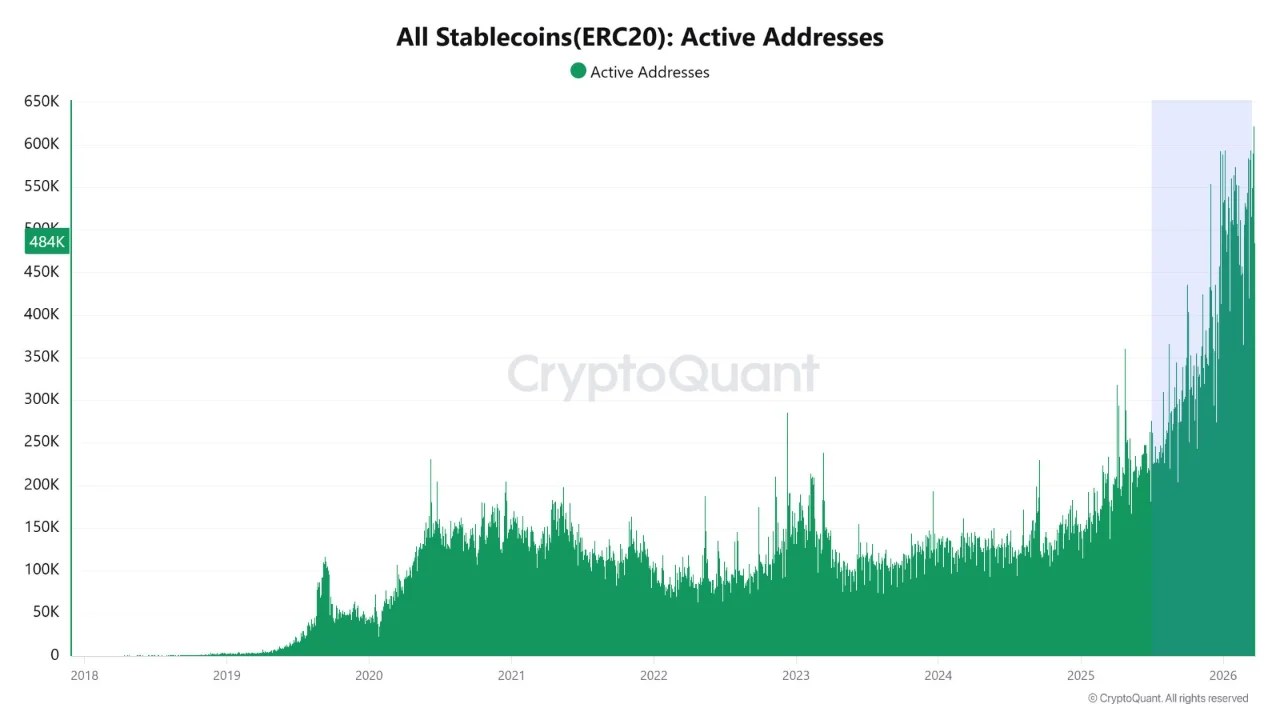
All Stablecoin (ERC20) Active Addresses | Source: CryptoQuant

The on-chain data already reflects this transition. Stablecoin active addresses are at all-time highs. The capital is not idle. It is being used — and if regulation delivers the clarity it promises, that usage curve has further to climb.


Related Questions

QWhat was the immediate market impact of the proposed CLARITY Act amendment on Circle and USDC?

ACircle, the issuer of USDC, lost 18% of its market value in a single session, erasing approximately $4.6 billion in market capitalization.

QAccording to the article, what is the fundamental purpose of the CLARITY Act's proposed restriction on stablecoin yield?

AThe proposed update to the CLARITY Act would ban yield on stablecoins entirely, separating their dual functions by restricting passive yield while permitting only activity-based rewards.

QWhere does the article suggest capital will flow if stablecoin yields are capped by regulation?

AThe article suggests yield demand will migrate toward DeFi protocols, tokenized Treasuries, or offshore markets that operate outside the CLARITY framework's reach, similar to how money flowed into money market funds when deposit rates were capped historically.

QWhat does the article identify as the core utility that will remain for stablecoins if yield is removed?

AIf yield is stripped from stablecoins, their core utility that remains includes payments, settlement, collateral, and liquidity functions, transforming them from financial products into infrastructure competing with correspondent banking.

QWhat on-chain metric does the article cite as evidence that stablecoin capital remains active despite regulatory concerns?

AThe article cites that stablecoin active addresses are at all-time highs, indicating the capital is not idle but is being used, with potential for further growth if regulatory clarity is achieved.

Related Reads

Within Strategy's Framework, STRC's Dividend Yield Remains at 12% as Share Price Stays Below Par Value

Michael Saylor, Executive Chairman of Strategy (MSTR), confirmed that the dividend rate for its STRC perpetual preferred shares will remain at 12.00% through August 2026. The rate has increased from 9% at its July 2025 launch to the current high via a "ratchet" mechanism, which permanently raises the rate by 0.5% whenever the share price falls below $95. This mechanism is intended to push the price back toward its $100 par value and support Strategy's "at-the-market" (ATM) program for issuing new shares to fund Bitcoin purchases. However, the mechanism has not worked as intended. STRC shares closed at $89.46 on July 31, remaining about 10-11% below par value despite the record-high dividend. Competition from rival Strive's higher-yielding SATA securities has pressured demand. The persistent discount has forced Strategy to suspend new STRC issuances via its ATM program, limiting this funding channel for Bitcoin acquisitions. STRC's struggles reflect Bitcoin's own volatility, as the preferred shares historically move in tandem. Analysts have warned the ratchet structure carries long-term, one-way risk. A law firm is investigating Strategy's ability to maintain dividend payments if Bitcoin's price stays low. Retail investors own roughly 83% of outstanding STRC shares, a group seen as prone to panic selling during downturns. In response, Strategy has established financial reserves, including a liquidity cushion covering about 26 months of dividend/interest obligations, and a $2 billion share buyback program alongside a Bitcoin monetization framework, though the company emphasized it is not obligated to sell any Bitcoin.

cryptonews.ru24m ago

Within Strategy's Framework, STRC's Dividend Yield Remains at 12% as Share Price Stays Below Par Value

cryptonews.ru24m ago

Analyst: Bitcoin's Price Will Drop to $60k in August, Then Rebound to $70k

Financial analyst Andrey Poroshin has provided a new forecast for Bitcoin's price dynamics in August. Poroshin, an analyst at the Bitbanker exchange, expects the cryptocurrency market to experience a downturn this month, with prices retesting the $60,000 level due to a lack of supportive macroeconomic catalysts. He noted that the recent US Federal Reserve decision to hold interest rates did not significantly impact the market, while inflation remains above the 2% target. Poroshin stated that Bitcoin is ending July under pressure from moderate volatility and a lack of new macroeconomic stimuli, leading to continued market caution. According to his base scenario, Bitcoin will drop to a range of $60,000 to $62,000 before recovering to $70,000. He pointed out that even $70,000 remains below the cost of mining in the US, which has prompted some miners to shift towards AI data center operations. Poroshin cited the winding down of BitMEX's operations as a potential catalyst for a price rebound, suggesting the exit of weaker players often coincides with market reversals and reduced short-term selling pressure. He believes Bitcoin is currently less susceptible to geopolitical shocks, such as the Iran-US conflict, and does not expect significant market changes in August related to the pending CLARITY Act. Looking ahead, Poroshin forecasts that September will bring more active price fluctuations driven by potential Fed rate decisions and possible discussions or approval of the CLARITY Act.

cryptonews.ru24m ago

Analyst: Bitcoin's Price Will Drop to $60k in August, Then Rebound to $70k

cryptonews.ru24m ago

Trading

Spot
活动图片




