The $300B question – Are stablecoins becoming the backbone of global finance?

ambcryptoPublished on 2026-03-17Last updated on 2026-03-17

Abstract

Stablecoins, with a market exceeding $300 billion, are evolving into a core component of global finance, according to a report by BVNK. They are shifting from trading tools to practical financial infrastructure, with users holding a significant portion of their savings in them and gig workers receiving income through them. A majority of users report that stablecoins have facilitated more international business. While trust in traditional institutions remains, regulatory clarity, such as the U.S. GENIUS Act requiring stablecoins to be fully backed, is building confidence and driving adoption. Stablecoins are becoming integral to the digital economy, used for real-world asset tokenization and as a payment layer for emerging technologies like AI. Global usage diverges: USDT is dominant in countries with volatile currencies (e.g., Nigeria) for dollar-based savings, while USDC is preferred in regulated economies (e.g., U.S., Colombia) due to clearer regulations. However, recent growth in stablecoin supply may indicate investors are using them as a safe haven during market uncertainty rather than a full return to risk-on crypto assets. Regulatory developments continue to shape the market's future.

Bitcoin has always been the dominant one in the crypto space. However, according to the Stablecoin Utility Report 2026 by BVNK, stablecoins are now becoming a core part of everyday finance.

With the market crossing $300 billion, they are shifting from trading tools to practical financial infrastructure used by people worldwide.

Stablecoin are acting as a backbone

The report revealed that users now keep about one-third of their savings in stablecoins, while around 35% of gig workers’ income is received through them.

In fact, 75% of users say stablecoins have helped them do more international business, making global payments easier.

Interestingly, there is still significant trust towards traditional institutions. While most people currently manage stablecoins through crypto exchanges, 77% claimed they would use a stablecoin wallet if their bank or fintech provider offered one.

Remarking on the same, Chris Harmse, Co-Founder & Chief Business Officer, BVNK, said,

There’s a disconnect in how we talk about stablecoins.

If looked at carefully, the shift towards mass adoption of stablecoins is being driven by clearer regulations and better financial infrastructure.

How are regulations shaping stablecoins?

In the United States, the GENIUS Act has played a key role by requiring stablecoins to be fully backed by cash or Treasury assets. This makes them more reliable and closer to digital cash.

At the same time, stablecoins are becoming a core part of the always-on digital economy.

They are now widely used as liquidity for Real-World Asset (RWA) tokenization and as a payment layer for emerging technologies like AI-driven commerce.

With scalable Layer-2 networks and better apps, stablecoins are evolving from a niche crypto tool into a key foundation for modern, global finance.

According to Chris Harmse,

“Stablecoin acceptance doesn’t just convert customers, it creates them. It’s a universal payment rail that works everywhere local infrastructure doesn’t. For merchants, that’s not a feature. It’s a new market.”

However, the global use of stablecoins in 2026 has also revealed a clear difference between countries focused on utility and those focused on regulation.

USDT vs USDC ownership by country

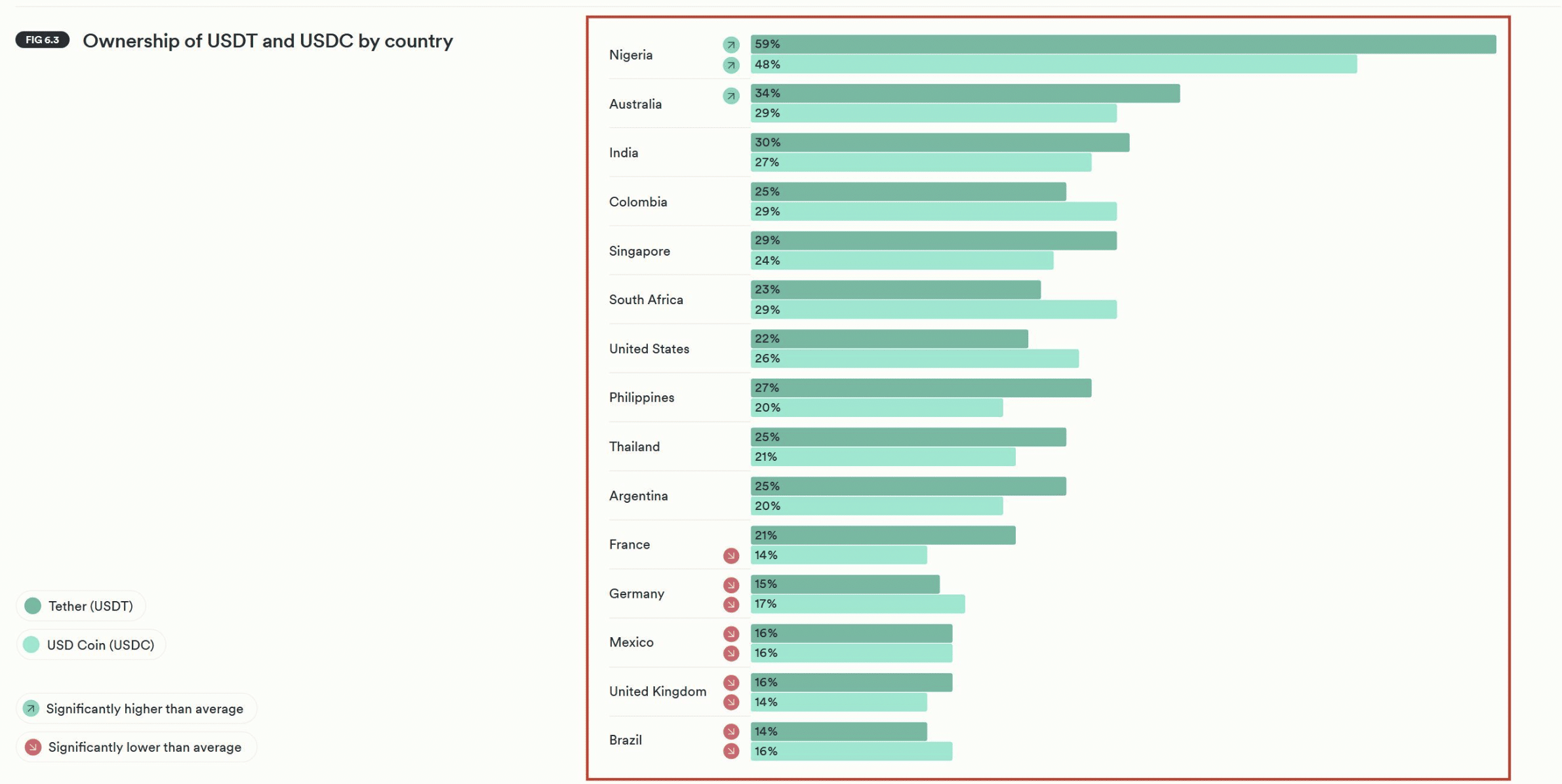
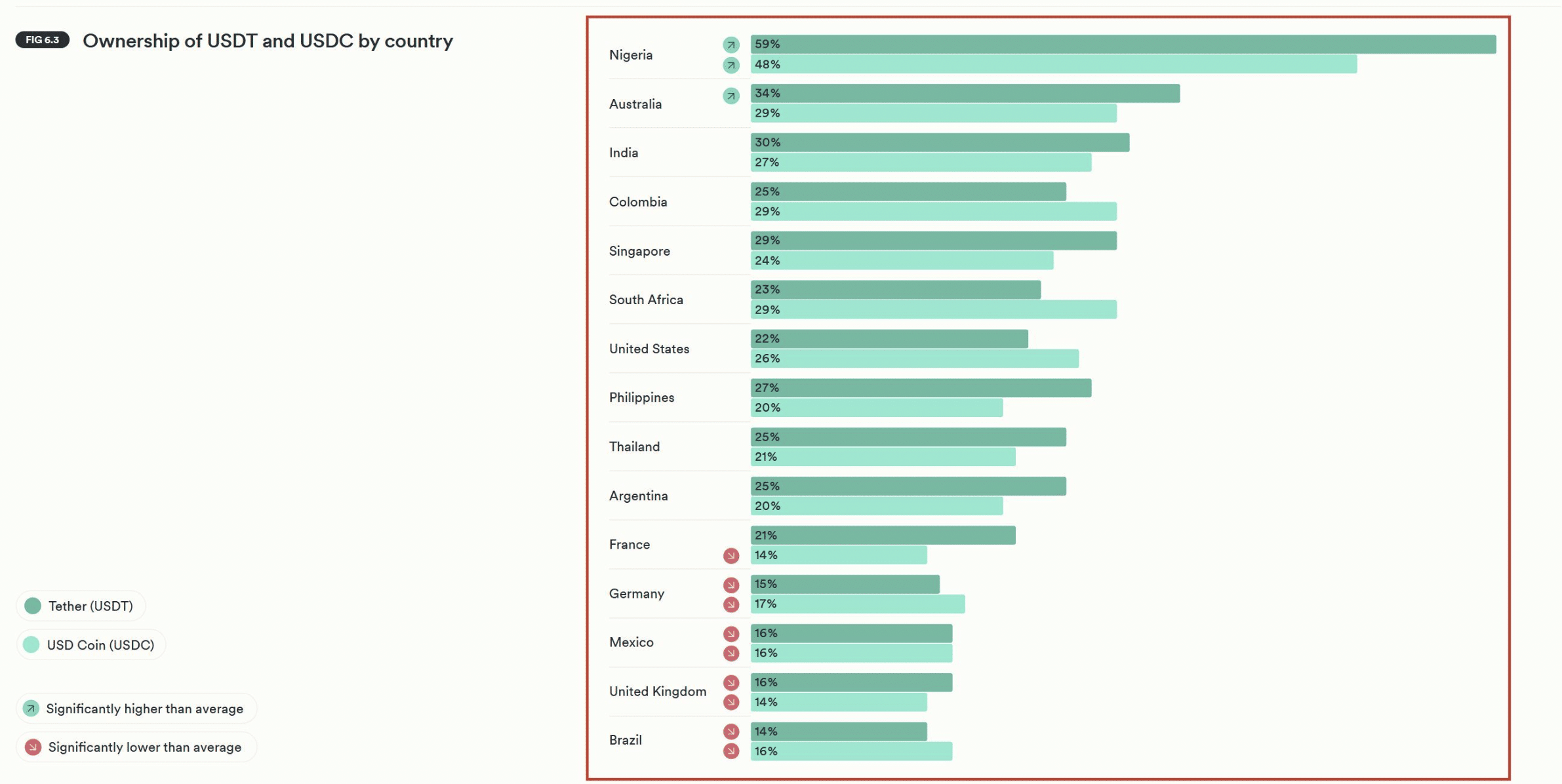
According to data shared by Leon Waidmann at Lisk, in countries with unstable currencies such as Nigeria, USDT is widely used as a way to hold dollar-based savings, with ownership close to 60%.
Source: BVNK

For many people, it acts as a simple way to protect their money from local currency fluctuations.

However, in more regulated economies like Colombia, South Africa, and the United States, USDC is becoming more popular than USDT.

This shift is largely linked to the GENIUS Act. Because of this regulatory clarity, many financial platforms and institutions in the U.S prefer USDC for transactions and settlements.

What’s more?

At the same time, another proposed law, the CLARITY Act, aims to clearly define which regulators oversee different crypto assets and protect decentralized finance activities.

However, analysts say strong stablecoin inflows do not always indicate a bullish crypto market. During uncertain periods, investors often move funds into dollar-pegged stablecoins as a safer place to park their money.

In simple terms, users widely adopt USDT in less regulated markets, while institutions and investors increasingly prefer USDC in regulated financial systems.

Although the stablecoin market has grown to $300 billion, recent on-chain data revealed that the market is still moving cautiously.

According to CryptoQuant, the recent hike in USDT and USDC supply may be a sign that investors are temporarily moving money into stablecoins during market uncertainty, rather than fully entering riskier crypto assets.

In fact, the current inflow levels are still lower than the one-year average – Evidence that confidence has not fully returned yet.


Final Summary

  • Regulatory clarity is shaping the market, particularly in the U.S., where laws like the GENIUS Act are strengthening trust in regulated stablecoins.
  • Global usage is diverging, with USDT dominant in volatile economies while USDC gains traction in regulated financial systems.


Trending Cryptos

Related Questions

QWhat is the main shift in the role of stablecoins as described in the BVNK report?

AStablecoins are shifting from being trading tools to becoming practical financial infrastructure used by people worldwide for everyday finance.

QAccording to the report, what percentage of gig workers receive their income through stablecoins?

AAround 35% of gig workers' income is received through stablecoins.

QHow has the GENIUS Act in the United States impacted stablecoins?

AThe GENIUS Act requires stablecoins to be fully backed by cash or Treasury assets, making them more reliable and closer to digital cash, which has strengthened trust in regulated stablecoins like USDC.

QWhat is the key difference in stablecoin usage between countries like Nigeria and the United States?

AIn countries with unstable currencies like Nigeria, USDT is widely used as a dollar-based savings tool, while in more regulated economies like the United States, USDC is becoming more popular due to regulatory clarity and institutional preference.

QWhat does the recent increase in USDT and USDC supply indicate, according to CryptoQuant?

AThe recent hike in USDT and USDC supply may indicate that investors are temporarily moving money into stablecoins during market uncertainty rather than fully entering riskier crypto assets, as confidence has not fully returned yet.

Related Reads

9.42 Million Retail Investors Compete for Changxin Technology, Who Got Allotted?

Evergreen Technology's IPO subscription results are now available. On July 20, the domestic memory chip giant announced the offline preliminary allotment results and online lottery results for its IPO. A total of approximately 9.43 million retail investors participated in the online subscription, generating 770,000 winning lots with a final winning rate of about 0.4714%, setting a record for new shares on the STAR Market. After triggering a clawback mechanism from institutional to retail investors, the online retail allocation was significantly increased to 3.851 billion shares. Simultaneously, 285 institutional investors participated in the offline subscription, ultimately receiving 2.173 billion shares at an allotment rate of approximately 0.1756%. Leading insurers and public funds were among the major recipients. Notably, Liang Wenfeng, founder of the major AI model company DeepSeek, through his quantitative investment firms Ningbo Huanfang Quantitative and Zhejiang Jiuzhang Asset, secured the largest share among private funds, with a total allotment worth approximately 175 million yuan. Estimates suggest potential profits could reach 730 million yuan if Evergreen Technology's market capitalization reaches 3 trillion yuan post-listing. The company is expected to list on July 27 and could become the highest-valued tech stock on the A-share market, with various brokerages providing valuations ranging from 1 trillion to over 4 trillion yuan. However, recent significant corrections in global tech stocks may impact its post-listing performance. (Character count: 1,196)

marsbit48m ago

9.42 Million Retail Investors Compete for Changxin Technology, Who Got Allotted?

marsbit48m ago

L2 'Recalibration': When L1 Becomes Its Own Rollup, What Is Ethereum's Endgame?

The article discusses the evolving relationship between Ethereum's Layer 1 (L1) and Layer 2 (L2) solutions, moving beyond the initial "L2 for scaling" model. As Ethereum L1 itself scales (increasing Gas Limit, statelessness, zkEVM), the unique value proposition of L2s shifts from merely providing cheap execution to offering differentiated features like application-specific optimization, privacy, and flexible governance. The piece explores three key themes: 1. **L2's New Role:** L2s are transitioning from a pure scaling technology to a spectrum of execution environments with varying degrees of security inheritance from Ethereum L1. 2. **Interoperability as State Trust:** Solving L2 fragmentation is less about cross-chain bridges and more about enabling faster, trust-minimized state verification between environments. This involves initiatives like faster L1 finality, intent-based architectures (Open Intents Framework), and native account abstraction. 3. **Blurring Layers:** With the potential integration of zk-proofs into L1 validation (making L1 akin to its own "Rollup") and the concept of "Native Rollups," the rigid boundary between L1 and L2 may fade. The future could be a unified system with multiple execution domains (for DeFi, gaming, privacy, etc.) sharing a common security, settlement, and state framework. In conclusion, Ethereum's goal is not to abandon L2s or re-centralize everything on L1, but to re-integrate the fragmented user experience—liquidity, accounts, applications—while preserving the scaling benefits of a multi-environment ecosystem. The endgame is a cohesive "one chain" feeling for users, powered by diverse but securely interconnected execution layers.

marsbit1h ago

L2 'Recalibration': When L1 Becomes Its Own Rollup, What Is Ethereum's Endgame?

marsbit1h ago

Trading

Spot

Hot Articles

What is $BITCOIN

DIGITAL GOLD ($BITCOIN): A Comprehensive Analysis Introduction to DIGITAL GOLD ($BITCOIN) DIGITAL GOLD ($BITCOIN) is a blockchain-based project operating on the Solana network, which aims to combine the characteristics of traditional precious metals with the innovation of decentralized technologies. While it shares a name with Bitcoin, often referred to as “digital gold” due to its perception as a store of value, DIGITAL GOLD is a separate token designed to create a unique ecosystem within the Web3 landscape. Its goal is to position itself as a viable alternative digital asset, although specifics regarding its applications and functionalities are still developing. What is DIGITAL GOLD ($BITCOIN)? DIGITAL GOLD ($BITCOIN) is a cryptocurrency token explicitly designed for use on the Solana blockchain. In contrast to Bitcoin, which provides a widely recognized value storage role, this token appears to focus on broader applications and characteristics. Notable aspects include: Blockchain Infrastructure: The token is built on the Solana blockchain, known for its capacity to handle high-speed and low-cost transactions. Supply Dynamics: DIGITAL GOLD has a maximum supply capped at 100 quadrillion tokens (100P $BITCOIN), although details regarding its circulating supply are currently undisclosed. Utility: While precise functionalities are not explicitly outlined, there are indications that the token could be utilized for various applications, potentially involving decentralized applications (dApps) or asset tokenization strategies. Who is the Creator of DIGITAL GOLD ($BITCOIN)? At present, the identity of the creators and development team behind DIGITAL GOLD ($BITCOIN) remains unknown. This situation is typical among many innovative projects within the blockchain space, particularly those aligning with decentralized finance and meme coin phenomena. While such anonymity may foster a community-driven culture, it intensifies concerns about governance and accountability. Who are the Investors of DIGITAL GOLD ($BITCOIN)? The available information indicates that DIGITAL GOLD ($BITCOIN) does not have any known institutional backers or prominent venture capital investments. The project seems to operate on a peer-to-peer model focused on community support and adoption rather than traditional funding routes. Its activity and liquidity are primarily situated on decentralized exchanges (DEXs), such as PumpSwap, rather than established centralized trading platforms, further highlighting its grassroots approach. How DIGITAL GOLD ($BITCOIN) Works The operational mechanics of DIGITAL GOLD ($BITCOIN) can be elaborated on based on its blockchain design and network attributes: Consensus Mechanism: By leveraging Solana’s unique proof-of-history (PoH) combined with a proof-of-stake (PoS) model, the project ensures efficient transaction validation contributing to the network's high performance. Tokenomics: While specific deflationary mechanisms have not been extensively detailed, the vast maximum token supply implies that it may cater to microtransactions or niche use cases that are still to be defined. Interoperability: There exists the potential for integration with Solana’s broader ecosystem, including various decentralized finance (DeFi) platforms. However, the details regarding specific integrations remain unspecified. Timeline of Key Events Here is a timeline that highlights significant milestones concerning DIGITAL GOLD ($BITCOIN): 2023: The initial deployment of the token occurs on the Solana blockchain, marked by its contract address. 2024: DIGITAL GOLD gains visibility as it becomes available for trading on decentralized exchanges like PumpSwap, allowing users to trade it against SOL. 2025: The project witnesses sporadic trading activity and potential interest in community-led engagements, although no noteworthy partnerships or technical advancements have been documented as of yet. Critical Analysis Strengths Scalability: The underlying Solana infrastructure supports high transaction volumes, which could enhance the utility of $BITCOIN in various transaction scenarios. Accessibility: The potential low trading price per token could attract retail investors, facilitating wider participation due to fractional ownership opportunities. Risks Lack of Transparency: The absence of publicly known backers, developers, or an audit process may yield skepticism regarding the project's sustainability and trustworthiness. Market Volatility: The trading activity is heavily reliant on speculative behavior, which can result in significant price volatility and uncertainty for investors. Conclusion DIGITAL GOLD ($BITCOIN) emerges as an intriguing yet ambiguous project within the rapidly evolving Solana ecosystem. While it attempts to leverage the “digital gold” narrative, its departure from Bitcoin's established role as a store of value underscores the need for a clearer differentiation of its intended utility and governance structure. Future acceptance and adoption will likely depend on addressing the current opacity and defining its operational and economic strategies more explicitly. Note: This report encompasses synthesised information available as of October 2023, and developments may have transpired beyond the research period.

962 Total ViewsPublished 2025.05.13Updated 2025.05.13

What is $BITCOIN

Discussions

Welcome to the HTX Community. Here, you can stay informed about the latest platform developments and gain access to professional market insights. Users' opinions on the price of BTC (BTC) are presented below.

活动图片