Texas targets crypto, gambling loopholes amid prediction market concerns

ambcryptoPublished on 2026-04-01Last updated on 2026-04-01

Abstract

Prediction markets have gained significant attention, particularly during the U.S. election cycle, but the rise of gambling within these markets has eroded public trust. In response, Texas Lieutenant Governor Dan Patrick is pushing for legislative changes to close gambling loopholes. He aims to prevent the exploitation of federal regulations, such as those of the CFTC, to bypass state gambling prohibitions. The goal is to ensure the integrity of elections and sports in Texas. Additionally, Patrick advocates for assessing the state’s approach to emerging financial technologies, including crypto, while prioritizing consumer protection and addressing issues like crypto ATM scams. The move coincides with a decline in public interest in prediction market gambling, as shown by Google Trends data.

Prediction markets have gained a lot of attention in the past two years. Zooming in, the rise in these markets escalated in Q4 2024 as the U.S. election started to heat up. However, on the flip side, gambling also became an integral part of the prediction markets’ growth cycle.

These began to undermine people’s trust in the prediction market. Hence, to combat this problem and to regain trust, Dan Patrick, Lieutenant Governor of Texas, came up with some legislative changes.

Under the State Affairs Committee category, Patrick underlined plans to close the gambling loopholes. In this push, the governor urged the lawmakers to,

Study the sudden inundation of prediction market gambling and the exploitation of federal law to circumvent Texas gambling prohibitions by allowing users to place bets on the outcome of elections and other events.

The reason behind this crackdown?

Needless to say, this move is intended to protect and reinforce the regulatory oversight of the Commodity Futures Trading Commission (CFTC). Patrick believes that the prediction markets are now exploiting the CFTC regulations just to bypass Texas state gambling prohibitions.

With clear intentions to have fair elections and corruption-free sports in Texas, Patrick added,

Make recommendations to ensure the integrity of Texas elections and Texas sports.

Echoing similar sentiments at the broader level, David Miller, enforcement director of CFTC, in his first public remark after joining, added,

We are aware of the speculation about insider trading. We are watching.

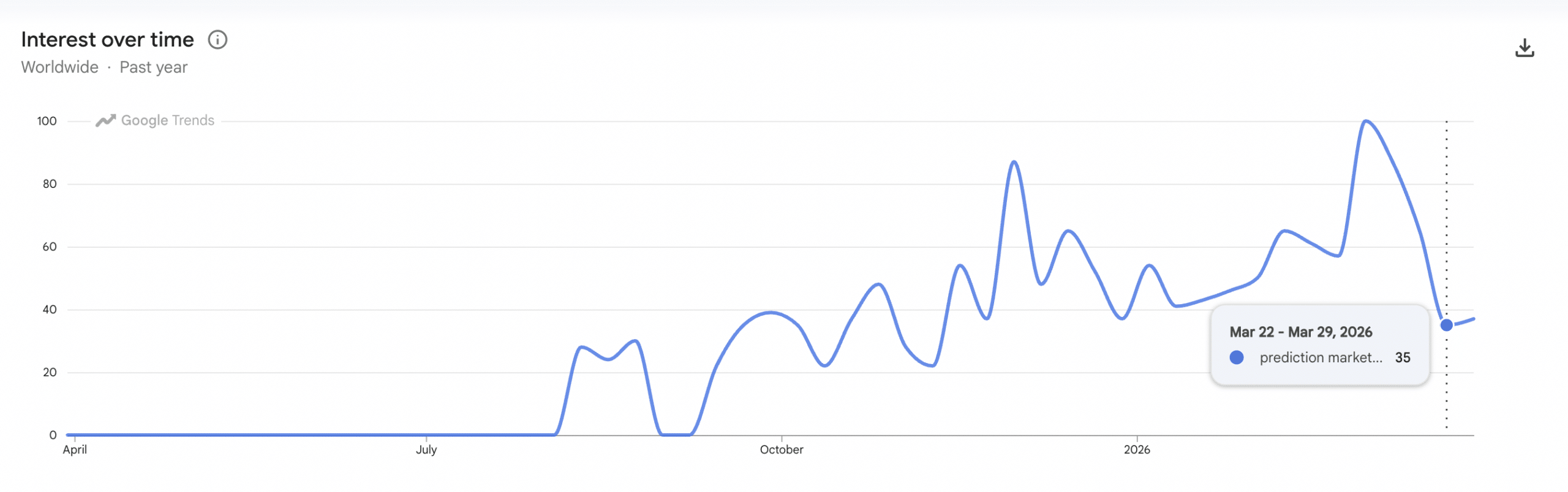
This comes as the Google Trends data saw a drop in the “prediction market gambling” keyword as of writing.
Source: Google Trends

As per the chart, the keyword had peaked to a Google Search score of 100 in early March. However, by the end of Q1 2026, the score stood at 35.

Besides prediction market reforms, Patrick has also come up with a plan to expand the future of crypto in Texas. He urged the lawmakers to:

Assess how the state’s financial regulatory agencies respond to emerging financial technologies and business models, while prioritizing the protection of consumers.

In fact, he also stressed the loopholes of scams surrounding the growing scale of crypto ATMs (virtual currency kiosks).

Lastly, the governor made a point to the lawmakers to look into Senate Bill 21 and how effectively it’s being implemented and whether it’s achieving its goal. For those unaware, Senate Bill 21 of Texas refers to the Texas Strategic Bitcoin Reserve bill implemented on the 20th of June, 2025.

This coincided with Polymarket recently coming up with its updated rulebook across its DeFi platform and CFTC-regulated U.S. exchange.


Final Summary

  • Prediction markets are growing, but with this growth, gambling has taken center stage, raising credibility issues.
  • David Patrick’s push for blockchain technology underlines how individual states are stepping up their crypto game as the U.S.-Iran war continues.


Related Questions

QWhat is the main concern that prompted Texas Lieutenant Governor Dan Patrick to propose legislative changes regarding prediction markets?

AThe main concern is that gambling has become an integral part of prediction markets, which began to undermine people's trust in them. This includes the use of crypto to circumvent Texas gambling prohibitions by allowing bets on elections and other events.

QWhich regulatory body's oversight does Dan Patrick aim to reinforce with his proposed crackdown on prediction markets?

ADan Patrick aims to reinforce the regulatory oversight of the Commodity Futures Trading Commission (CFTC).

QBesides prediction market reforms, what other emerging technology did Dan Patrick urge lawmakers to assess in relation to consumer protection?

ADan Patrick urged lawmakers to assess how the state's financial regulatory agencies respond to emerging financial technologies and business models, specifically mentioning the need to prioritize consumer protection in the context of crypto and the growing scale of crypto ATMs.

QWhat specific Texas bill, related to Bitcoin, did Dan Patrick ask lawmakers to review for effective implementation?

ADan Patrick asked lawmakers to look into Senate Bill 21, which is the Texas Strategic Bitcoin Reserve bill implemented on June 20, 2025.

QAccording to the Google Trends data mentioned in the article, what was the search score for 'prediction market gambling' by the end of Q1 2026?

AThe Google Search score for 'prediction market gambling' stood at 35 by the end of Q1 2026, down from a peak of 100 in early March.

Related Reads

Within Strategy's Framework, STRC's Dividend Yield Remains at 12% as Share Price Stays Below Par Value

Michael Saylor, Executive Chairman of Strategy (MSTR), confirmed that the dividend rate for its STRC perpetual preferred shares will remain at 12.00% through August 2026. The rate has increased from 9% at its July 2025 launch to the current high via a "ratchet" mechanism, which permanently raises the rate by 0.5% whenever the share price falls below $95. This mechanism is intended to push the price back toward its $100 par value and support Strategy's "at-the-market" (ATM) program for issuing new shares to fund Bitcoin purchases. However, the mechanism has not worked as intended. STRC shares closed at $89.46 on July 31, remaining about 10-11% below par value despite the record-high dividend. Competition from rival Strive's higher-yielding SATA securities has pressured demand. The persistent discount has forced Strategy to suspend new STRC issuances via its ATM program, limiting this funding channel for Bitcoin acquisitions. STRC's struggles reflect Bitcoin's own volatility, as the preferred shares historically move in tandem. Analysts have warned the ratchet structure carries long-term, one-way risk. A law firm is investigating Strategy's ability to maintain dividend payments if Bitcoin's price stays low. Retail investors own roughly 83% of outstanding STRC shares, a group seen as prone to panic selling during downturns. In response, Strategy has established financial reserves, including a liquidity cushion covering about 26 months of dividend/interest obligations, and a $2 billion share buyback program alongside a Bitcoin monetization framework, though the company emphasized it is not obligated to sell any Bitcoin.

cryptonews.ru18m ago

Within Strategy's Framework, STRC's Dividend Yield Remains at 12% as Share Price Stays Below Par Value

cryptonews.ru18m ago

Analyst: Bitcoin's Price Will Drop to $60k in August, Then Rebound to $70k

Financial analyst Andrey Poroshin has provided a new forecast for Bitcoin's price dynamics in August. Poroshin, an analyst at the Bitbanker exchange, expects the cryptocurrency market to experience a downturn this month, with prices retesting the $60,000 level due to a lack of supportive macroeconomic catalysts. He noted that the recent US Federal Reserve decision to hold interest rates did not significantly impact the market, while inflation remains above the 2% target. Poroshin stated that Bitcoin is ending July under pressure from moderate volatility and a lack of new macroeconomic stimuli, leading to continued market caution. According to his base scenario, Bitcoin will drop to a range of $60,000 to $62,000 before recovering to $70,000. He pointed out that even $70,000 remains below the cost of mining in the US, which has prompted some miners to shift towards AI data center operations. Poroshin cited the winding down of BitMEX's operations as a potential catalyst for a price rebound, suggesting the exit of weaker players often coincides with market reversals and reduced short-term selling pressure. He believes Bitcoin is currently less susceptible to geopolitical shocks, such as the Iran-US conflict, and does not expect significant market changes in August related to the pending CLARITY Act. Looking ahead, Poroshin forecasts that September will bring more active price fluctuations driven by potential Fed rate decisions and possible discussions or approval of the CLARITY Act.

cryptonews.ru18m ago

Analyst: Bitcoin's Price Will Drop to $60k in August, Then Rebound to $70k

cryptonews.ru18m ago

Trading

Spot
活动图片




