Tech Stocks Plunge and Bitcoin Slumps, Retail Investors Face Ultimate Test Ahead of SpaceX IPO

华尔街日报Published on 2026-06-05Last updated on 2026-06-05

Abstract

Technology stocks suffered their biggest drop in months, and Bitcoin fell below the $60,000 mark, coinciding with the eve of SpaceX's massive IPO plans. The sell-off was triggered by strong U.S. jobs data, dashing hopes for Fed rate cuts and reviving fears of further hikes. High-valuation sectors like AI and semiconductors led the declines, with the Nasdaq plunging over 4%. Cryptocurrencies, sensitive to higher interest rates and a strong dollar, also tumbled sharply. This market stress test raises critical questions about the limits of retail investor capital and its next destination. SpaceX's upcoming IPO, which plans to allocate an unusually high 30% of shares to retail investors, now faces a more uncertain landscape. Analysts warn that to buy SpaceX,散户 may need to sell existing holdings, with Tesla seen as a potential source of funds. The market is saturated with speculative options—from crypto and meme stocks to zero-day options and AI-themed ETFs—all competing for the same pool of retail attention and capital. While SpaceX's listing could inject fresh excitement, it also enters a fiercely competitive environment where investor loyalty is fleeting. The ease of zero-commission trading and lower barriers to margin trading accelerate capital rotation between narratives, making it difficult for any single story, even a historic IPO like SpaceX's, to dominate for long.

Tech stocks suffered their biggest drop in months, with Bitcoin falling below the $60,000 mark, all just as Elon Musk's SpaceX is preparing for what could be the largest IPO in history.

On June 5, according to Wall Street News, the May non-farm payrolls data significantly exceeded expectations, dashing market hopes for Federal Reserve rate cuts and bringing rate hike expectations to the forefront.

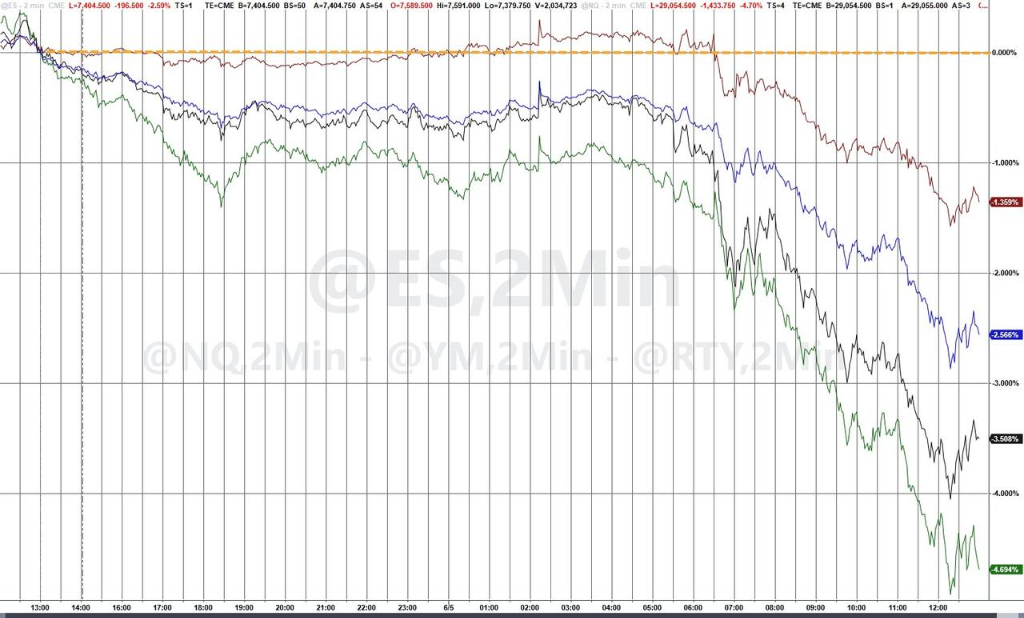
High-valuation sectors in US stocks were severely hit, with AI and semiconductors leading the declines. The S&P 500 fell 2.6%, the Nasdaq plunged over 4%, and the semiconductor index plummeted 10% in a single day, erasing over a trillion dollars in market value.
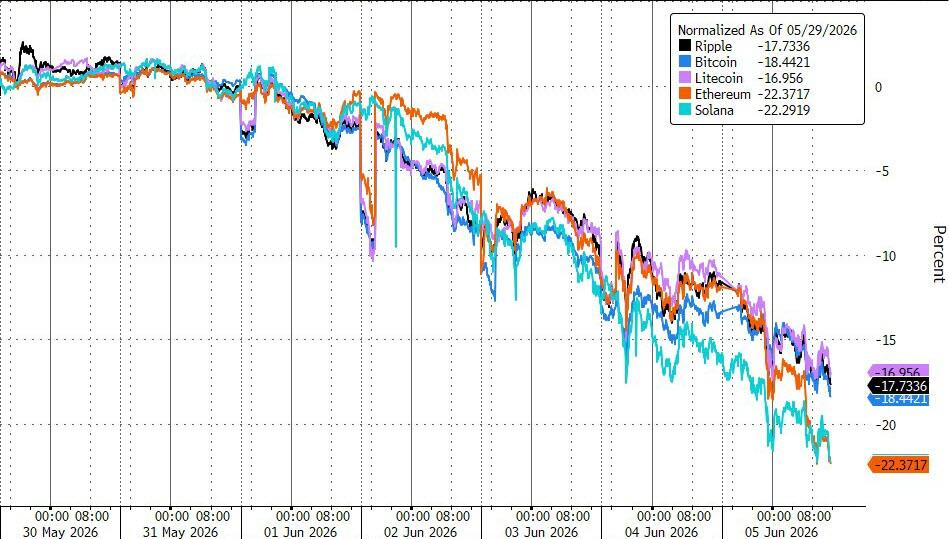
Cryptocurrencies plunged sharply due to high interest rates and a strong dollar. Bitcoin plummeted up to 7%, briefly falling below $60,000 for the first time since October 2024, wiping out all gains made since Trump's election. Ethereum tumbled 11% in a day, down over 20% for the week.
Multiple speculative trades favored by retail investors came under simultaneous pressure, leading to renewed scrutiny of the limits of retail capital and where this money might ultimately flow.

SpaceX's listing plan becomes even more uncertain against this backdrop. The demand for this rocket, satellite, and artificial intelligence company appears unstoppable, but the market's violent swings have planted doubts in investors' minds.

Friday's market plunge represents a concentrated stress test of the current market structure.

The simultaneous decline in the artificial intelligence sector, cryptocurrencies, and high-risk tech stocks made the day particularly unusual. Alex Morris of F/m Investments stated:

This feels like a severe shakeout in the tech sector, and it's another reminder that speculative assets like Bitcoin and SpaceX can sometimes quickly unwind their premiums and bleed out fast. No matter how real, how breathtaking SpaceX's rockets and satellite internet business are, they're not immune to this.

Steve Sosnick, Chief Strategist at Interactive Brokers, characterized this decline as a deeper structural warning:

It's a reminder that parabolic rises are inherently unstable and often end in surprising ways, especially when masses of investors equate risk with reward rather than viewing it as a variable to be balanced.

Mina Krishnan, a multi-asset portfolio manager at Schroders, pointed out that market fragility had already been building:

After nine consecutive weeks of gains and with positioning stretched to the limit, the kindling for a sell-off was already in place, waiting for a match. Today, it finally found one.

SpaceX plans to allocate up to 30% of its offering to retail investors, a proportion far exceeding the usual industry norm of around 5%.

Musk is clearly targeting his fanbase, a group that has flooded into the stock market in the era of zero commissions and become a formidable market force.

However, the timing for a retail allocation potentially as large as $22.5 billion may be less than ideal.

According to Bloomberg, at major retail broker Charles Schwab, client cash as a percentage of assets has fallen to its lowest level since at least 2019.

Bloomberg Intelligence data shows retail accounts now account for one-fifth of total trading volume, double the level 15 years ago; while data cited by Jefferies from Bloomberg indicates the combined market share of long-only and hedge funds has shrunk from 23% in 2010 to 15%.

This means that for retail investors to buy SpaceX, they will likely need to sell existing holdings to free up capital. Tesla, Musk's other public company, is seen as the most vulnerable candidate for such selling.

Meir Statman, a finance professor at Santa Clara University, was blunt:

Musk is trying to make SpaceX stock a meme stock, and he may well succeed. But I keep telling my students: a good company's stock is not necessarily a good investment. Valuation is always key.

SpaceX is entering a market ecosystem where speculative options have never been more concentrated.

From cryptocurrencies to meme stocks, zero-day options, leveraged ETFs, AI concept stocks, and prediction markets—each wave of narrative is backed by increasingly sophisticated trading infrastructure, all vying for the same pool of retail attention and capital.

According to Bloomberg Intelligence, over 600 US ETFs have been launched in the past six months alone, accounting for more than one-tenth of the roughly 5,200 products in the entire industry.

More than 20 ETFs linked to SpaceX have filed for registration this year, spanning various forms including leveraged, inverse, and options strategies.

Anthropic and OpenAI are not yet public, but ETFs tracking them are already queuing up for preparation. David Kass, a finance professor at the University of Maryland's business school, warned:

IPOs for Anthropic and OpenAI are likely coming later this year, and investors will then shift capital from one name to another. It's extremely rare to have several massive IPOs in such a short timeframe, and they're all competing for the same fixed pool of capital.

Dan Suzuki, Global Investment Strategist at iCapital, highlighted another possibility:

This creates a tricky setup for the upcoming SpaceX IPO, and there are genuine concerns about the market's capacity to digest supply. But the surprise might just be that this IPO could instead inject fresh excitement, offering retail investors a new story beyond the AI infrastructure theme, and thus provide market support.

Even if SpaceX successfully attracts a massive retail subscription, retaining those investors may be an even greater challenge.

According to JPMorgan's analysis of recent IPOs, retail investors chase first-day momentum about 86% of the time, and if the stock continues to rise, buying activity often increases further in the following weeks.

But retail holding periods themselves are inherently short. Kass stated:

A significant number of retail investors operate on a very short time horizon. They're more inclined to ask 'how much can I make this week or this month' rather than hold and wait like a value investor.

Kass emphasized that the spread of zero-commission trading combined with a constant barrage of information "only accelerates the flow of money between different narratives."

As regulators approve new rules, active margin traders are no longer bound by the long-standing requirement to maintain "at least $25,000 in account equity," further lowering the barrier to high-frequency trading.

Prediction markets, perpetual contracts, and the rise of brokerage platforms have collectively created a market environment where capital can switch between narratives faster than ever before.

This means that even if SpaceX sets a historic IPO record, it is unlikely to stand alone in the current market landscape.

It is merely the latest, and so far the most expensive, chip in this endless battle for attention.


Related Questions

QWhat were the main market events that occurred just before SpaceX's planned IPO, and how did they impact speculative assets?

ATechnology stocks experienced their biggest drop in months, with AI and semiconductor sectors leading the decline, and Bitcoin fell below $60,000, erasing all gains since the 2024 election. These events, triggered by strong non-farm payroll data that reduced hopes for Fed rate cuts, created a volatile market environment. This simultaneous downturn in high-risk assets like crypto and tech stocks served as a pressure test for market structure, raising questions about the sustainability of speculative premiums just as SpaceX was preparing for its massive public offering.

QWhy does SpaceX's plan to allocate 30% of its IPO to retail investors present a potential problem, especially for Tesla?

ASpaceX plans to allocate up to 30% of its IPO shares to retail investors, far exceeding the typical 5% industry norm. The problem is that retail investors' cash holdings are at multi-year lows. To buy SpaceX shares, they will likely need to sell existing holdings to raise capital. Tesla, another Elon Musk company and a popular retail holding, is seen as one of the most vulnerable assets from which investors might sell to fund their SpaceX purchases, creating potential downward pressure on Tesla's stock.

QWhat does Professor Meir Statman mean by saying Musk is trying to make SpaceX a 'Meme stock', and what caution does he offer?

AProfessor Meir Statman suggests that Elon Musk is actively cultivating a passionate fanbase to drive demand for SpaceX's IPO, similar to the social media-driven phenomenon behind 'Meme stocks.' He warns that while SpaceX might be a great company, its stock is not automatically a good investment. The key distinction is valuation. He cautions his students that a good company's stock can still be a poor investment if it is purchased at an excessively high price, emphasizing that valuation is always critical.

QHow does the current market ecosystem with numerous speculative options (like crypto, meme stocks, AI ETFs) challenge SpaceX's IPO?

AThe current market is saturated with competing speculative narratives and products, including cryptocurrencies, meme stocks, zero-day options, leveraged ETFs, and AI-themed funds. Over 600 new US ETFs were launched in the past six months alone. This creates a highly fragmented environment where retail investors' attention and capital are constantly pulled in different directions. SpaceX's IPO, while massive, is entering a battle for a finite pool of investor capital and must compete against these numerous other high-profile, narrative-driven investment opportunities.

QAccording to the article, what is the bigger challenge for SpaceX than attracting retail investors during the IPO?

AThe bigger challenge for SpaceX is retaining retail investors after the IPO. Analysis shows that about 86% of retail activity chases first-day momentum. However, retail investors generally have short holding periods, often asking 'how much can I make this week or this month?' rather than taking a long-term view. The combination of zero-commission trading, constant information flow, and lowered margin requirements accelerates the speed at which capital moves between different investment narratives. This means even if SpaceX has a successful IPO, it may struggle to keep retail investors' capital from quickly flowing to the next new story.

Related Reads

From Banning Doubao to Embracing Honor: Why Did WeChat Suddenly 'Change Its Face'?

The article explores the sudden shift in WeChat's strategy towards AI assistants from mobile phone manufacturers, transitioning from strict opposition to active collaboration. For over a year, WeChat fiercely resisted attempts by phone AI assistants (like ByteDance's Doubao in late 2025) to control its features via GUI automation ("simulated clicking"), citing security and data control concerns. This stance created a significant barrier for system-level AI integration. Now, Tencent has initiated A2A (Agent-to-Agent) partnerships with major phone brands like Honor, Xiaomi, OPPO, and vivo. This model allows a phone's system AI (e.g., Honor's YOYO) to parse a user's voice command and send a structured request directly to WeChat's own internal AI agent via secure APIs. WeChat then executes the action (e.g., sending a message) and returns the result. The article attributes Tencent's "change of face" to strategic pressure. While leading in social app usage, Tencent trails rivals like ByteDance and Alibaba in standalone AI app popularity. WeChat, with its vast mini-program ecosystem, is Tencent's key asset for an AI comeback. The upcoming WeChat AI agent aims to handle tasks like booking and payments within the app. However, phone system assistants remain the primary AI entry point for most users. The A2A collaboration allows Tencent to extend WeChat's AI reach to this crucial system layer while maintaining control over its core functions and data. For phone manufacturers, embracing A2A is a pragmatic move. The GUI route proved unviable due to WeChat's blocks. A2A offers a compliant path to integrate a vital service, enhancing their AI assistants' usefulness. It allows them to focus on developing their own AI ecosystems for other services while cooperating on WeChat access. The collaboration is framed as a mutual, strategic necessity: Tencent gains a distribution channel, and manufacturers gain a key functionality. The partnership relies on a "dual authorization" mechanism for security, requiring both user and app consent for each action. While questions about long-term data privacy practices remain, experts note A2A is more secure and compliant than GUI automation. Ultimately, this cooperation is seen as a tentative, calculated truce. Tencent's long-term goal is to make WeChat an AI-powered "service OS." Phone manufacturers aim to make their system AI the central user interface. Their paths may converge or clash in the future, but for now, the A2A deal represents the opening chapter in the battle for the AI-era user入口, driven by necessity and strategic calculus on both sides.

marsbit34m ago

From Banning Doubao to Embracing Honor: Why Did WeChat Suddenly 'Change Its Face'?

marsbit34m ago

On-Chain Figures on the Eve of Kickoff: 1.6 Billion Traded Before the World Cup Even Begins

"On-Chain Numbers on the Eve of the World Cup: $1.6 Billion Traded Before Kick-off" Analysis of on-chain markets before the 2026 FIFA World Cup reveals significant crypto integration into football. The most striking figure is the approximately **$1.6 billion** in total trading volume on the single "World Cup Winner" contract on the Polymarket prediction market platform, accumulated before a single match was played. This represents explosive growth for a sector whose annual volume surged from ~$16B in 2024 to ~$64B in 2025. The ecosystem is maturing beyond speculation. Key developments include: 1) **Infrastructure upgrades** like Polymarket's migration to native, regulated USDC stablecoin for settlements; 2) **Reliable data oracles**, such as Chainlink, being used to resolve real-world match outcomes on-chain; and 3) **Official recognition**, with FIFA appointing its first-ever "Prediction Markets" partner. Over 100 contracts now cover everything from the outright winner to individual match results and even non-sporting risks like venue relocation. This evolution marks a fundamental shift. While crypto firms are absent from FIFA's top-tier sponsor list, the technology has deeply penetrated the tournament's financial and predictive infrastructure through regulated stablecoin settlements, decentralized oracles, and new official partnership categories. The regulatory landscape remains complex and varies by jurisdiction, but on-chain markets for the World Cup are already a multi-billion-dollar reality.

marsbit1h ago

On-Chain Figures on the Eve of Kickoff: 1.6 Billion Traded Before the World Cup Even Begins

marsbit1h ago

From SpaceX's IPO to the Future of Crypto: Which Crypto Sectors Will Host the Trillion-Dollar Narrative?

From the SpaceX IPO, which targets a $750 billion raise at a $1.77 trillion valuation, we can extrapolate capital flow trends relevant to crypto. The focus shifts from speculative narratives to foundational infrastructure and real-world asset (RWA) integration. Key crypto sectors poised to benefit include: 1. **AI Infrastructure**: The narrative is moving from consumer-facing AI applications to underlying, scarce resources like compute power and decentralized GPU networks (e.g., TAO, RENDER, AKT, IO). These protocols are positioning as the essential "picks and shovels" providers for the AI economy. 2. **Real-World Assets (RWA)**: Beyond tokenized treasury bonds, RWA's future lies in on-chain equity and pre-IPO assets like SpaceX. This could democratize access to high-growth assets and reshape global capital flows, benefiting infrastructure projects like ONDO, LINK, and Plume that facilitate issuance, data, and liquidity. 3. **Core Financial Infrastructure**: Stablecoins, payment networks, and DePIN (Decentralized Physical Infrastructure Networks) are critical for settling the future on-chain economy. Their role expands from internal trading tools to foundational layers for global finance, AI systems, and real-world asset networks, leading to potential value reassessment. In summary, the next cycle may prioritize long-term infrastructure value—AI compute, asset tokenization networks, and settlement layers—over short-lived application hype, mirroring the broader market's shift towards funding the foundational systems of the future.

marsbit1h ago

From SpaceX's IPO to the Future of Crypto: Which Crypto Sectors Will Host the Trillion-Dollar Narrative?

marsbit1h ago

Trading

Spot
Futures

Hot Articles

What is $BITCOIN

DIGITAL GOLD ($BITCOIN): A Comprehensive Analysis Introduction to DIGITAL GOLD ($BITCOIN) DIGITAL GOLD ($BITCOIN) is a blockchain-based project operating on the Solana network, which aims to combine the characteristics of traditional precious metals with the innovation of decentralized technologies. While it shares a name with Bitcoin, often referred to as “digital gold” due to its perception as a store of value, DIGITAL GOLD is a separate token designed to create a unique ecosystem within the Web3 landscape. Its goal is to position itself as a viable alternative digital asset, although specifics regarding its applications and functionalities are still developing. What is DIGITAL GOLD ($BITCOIN)? DIGITAL GOLD ($BITCOIN) is a cryptocurrency token explicitly designed for use on the Solana blockchain. In contrast to Bitcoin, which provides a widely recognized value storage role, this token appears to focus on broader applications and characteristics. Notable aspects include: Blockchain Infrastructure: The token is built on the Solana blockchain, known for its capacity to handle high-speed and low-cost transactions. Supply Dynamics: DIGITAL GOLD has a maximum supply capped at 100 quadrillion tokens (100P $BITCOIN), although details regarding its circulating supply are currently undisclosed. Utility: While precise functionalities are not explicitly outlined, there are indications that the token could be utilized for various applications, potentially involving decentralized applications (dApps) or asset tokenization strategies. Who is the Creator of DIGITAL GOLD ($BITCOIN)? At present, the identity of the creators and development team behind DIGITAL GOLD ($BITCOIN) remains unknown. This situation is typical among many innovative projects within the blockchain space, particularly those aligning with decentralized finance and meme coin phenomena. While such anonymity may foster a community-driven culture, it intensifies concerns about governance and accountability. Who are the Investors of DIGITAL GOLD ($BITCOIN)? The available information indicates that DIGITAL GOLD ($BITCOIN) does not have any known institutional backers or prominent venture capital investments. The project seems to operate on a peer-to-peer model focused on community support and adoption rather than traditional funding routes. Its activity and liquidity are primarily situated on decentralized exchanges (DEXs), such as PumpSwap, rather than established centralized trading platforms, further highlighting its grassroots approach. How DIGITAL GOLD ($BITCOIN) Works The operational mechanics of DIGITAL GOLD ($BITCOIN) can be elaborated on based on its blockchain design and network attributes: Consensus Mechanism: By leveraging Solana’s unique proof-of-history (PoH) combined with a proof-of-stake (PoS) model, the project ensures efficient transaction validation contributing to the network's high performance. Tokenomics: While specific deflationary mechanisms have not been extensively detailed, the vast maximum token supply implies that it may cater to microtransactions or niche use cases that are still to be defined. Interoperability: There exists the potential for integration with Solana’s broader ecosystem, including various decentralized finance (DeFi) platforms. However, the details regarding specific integrations remain unspecified. Timeline of Key Events Here is a timeline that highlights significant milestones concerning DIGITAL GOLD ($BITCOIN): 2023: The initial deployment of the token occurs on the Solana blockchain, marked by its contract address. 2024: DIGITAL GOLD gains visibility as it becomes available for trading on decentralized exchanges like PumpSwap, allowing users to trade it against SOL. 2025: The project witnesses sporadic trading activity and potential interest in community-led engagements, although no noteworthy partnerships or technical advancements have been documented as of yet. Critical Analysis Strengths Scalability: The underlying Solana infrastructure supports high transaction volumes, which could enhance the utility of $BITCOIN in various transaction scenarios. Accessibility: The potential low trading price per token could attract retail investors, facilitating wider participation due to fractional ownership opportunities. Risks Lack of Transparency: The absence of publicly known backers, developers, or an audit process may yield skepticism regarding the project's sustainability and trustworthiness. Market Volatility: The trading activity is heavily reliant on speculative behavior, which can result in significant price volatility and uncertainty for investors. Conclusion DIGITAL GOLD ($BITCOIN) emerges as an intriguing yet ambiguous project within the rapidly evolving Solana ecosystem. While it attempts to leverage the “digital gold” narrative, its departure from Bitcoin's established role as a store of value underscores the need for a clearer differentiation of its intended utility and governance structure. Future acceptance and adoption will likely depend on addressing the current opacity and defining its operational and economic strategies more explicitly. Note: This report encompasses synthesised information available as of October 2023, and developments may have transpired beyond the research period.

363 Total ViewsPublished 2025.05.13Updated 2025.05.13

What is $BITCOIN

Discussions

Welcome to the HTX Community. Here, you can stay informed about the latest platform developments and gain access to professional market insights. Users' opinions on the price of BTC (BTC) are presented below.

活动图片














