# Rivalry Related Articles

HTX News Center provides the latest articles and in-depth analysis on "Rivalry", covering market trends, project updates, tech developments, and regulatory policies in the crypto industry.


The Computing Power Dilemma in the Sino-US AI Rivalry

The Sino-US AI rivalry faces a fundamental bottleneck: the widening compute power gap. While Chinese AI chip companies have seen investment surges, their current focus remains largely on the less demanding inference market. The real challenge lies in the high-end training chip sector, crucial for developing cutting-edge large language models (LLMs), where Nvidia holds a near-monopoly. The compute disparity is stark. US tech giants like Meta, Google, and xAI command massive GPU clusters, enabling them to train trillion-parameter models rapidly. Estimates suggest US data center count and total compute capacity significantly outstrip China's. This "brute force" advantage allows for faster model iteration and exploration of larger parameter scales, with top US models reportedly leading their Chinese counterparts by 8 to 15 months. Chinese alternatives, such as Huawei's Ascend and others from companies like Moore Thread and Biren, are emerging. They show promise in inference and some training scenarios, closing the performance gap with mid-range Nvidia products. However, the core hurdle extends beyond raw chip performance to the entrenched software ecosystem, exemplified by Nvidia's CUDA platform. The path forward involves "walking on two legs": navigating import restrictions while heavily investing in the domestic chip industry. Though still in a catch-up phase, China's vast market, talent pool, and capital are fostering progress. The ultimate test is whether Chinese firms can build a competitive hardware-software ecosystem to power the next generation of AI.

marsbit2 days ago 10:21

The Computing Power Dilemma in the Sino-US AI Rivalry

marsbit2 days ago 10:21

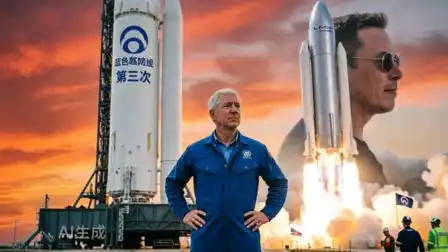
Bezos' Third Startup Still Can't Avoid Musk

Jeff Bezos Returns as CEO for Third Venture, Still Can't Avoid Musk After stepping down as Amazon CEO in 2021, Jeff Bezos has returned to the front lines as co-CEO of Prometheus, an AI startup he founded. In a recent CNBC interview, Bezos described the experience as "Type 2 fun"—exhausting but ultimately rewarding. Founded less than a year ago, Prometheus has already raised over $18 billion in two funding rounds, achieving a staggering $41 billion valuation. Prometheus aims to develop a "General Engineer AI" to accelerate the entire "invention loop"—design, simulation, testing, and manufacturing—for complex physical products like jet engines, spacecraft, and medical devices. This positions the company at the intersection of Bezos's past experiences: Amazon's platform-building scale and Blue Origin's rigorous physical engineering. This marks Bezos's third major venture, following Amazon and Blue Origin. His co-CEO is Vik Bajaj, bringing expertise from life sciences and hard tech. Bezos now dedicates most of his time to Prometheus, signaling his belief in its transformative potential. The move also comes as Bezos's space company, Blue Origin, faces challenges, including a recent test explosion delaying its New Glenn rocket. Meanwhile, Elon Musk's SpaceX achieved a record-breaking IPO, surpassing Amazon's market cap. While Musk focuses on AI for executing physical tasks (like Tesla's robots and SpaceX's engineering), Bezos is betting on AI to *invent* in the physical world. Prometheus enters a crowded industrial AI field with players like OpenAI, NVIDIA, and Tesla's Optimus. Its lofty valuation bets on the unproven but massive opportunity to become the foundational platform for engineering in the AI era—a "blue ocean" Bezos hopes to define before Musk does.

marsbit06/17 10:32

Bezos' Third Startup Still Can't Avoid Musk

marsbit06/17 10:32

活动图片