# Machine Economy Related Articles

HTX News Center provides the latest articles and in-depth analysis on "Machine Economy", covering market trends, project updates, tech developments, and regulatory policies in the crypto industry.

Wintermute: What Is Left to Build in Crypto?

The article argues that the foundational question for crypto has shifted. Instead of asking "what else can crypto do?", the real question is "why will the real world need crypto next?" The author's answer is the emerging **Machine Economy** – where autonomous agents and robots act as independent economic participants, making decisions, executing transactions, and initiating actions in both digital and physical worlds. Three key recent developments make this shift plausible: 1) AI models are now capable and cheap enough for autonomous, persistent action; 2) Open standards (e.g., stablecoins, Agent payment protocols) allow for composability; 3) Agents can now operate with context over long periods, changing the scale of automated activity. Crypto's core strengths—programmability, permissionlessness, fast settlement, and auditability—align well with the needs of autonomous systems, which don't fit traditional human-centric financial rails. Major platforms like Coinbase and Robinhood are already building infrastructure for Agent-based activity. However, challenges remain, primarily around **Security** (e.g., prompt injection attacks on Agent wallets) and **Attribution/Accountability** when AI-assisted systems fail. The most promising opportunities lie not in crowded foundational layers (L1s, models, exchanges) but in the connective tissue for the Machine Economy: **1) An economic layer for Agents** (handling authorization, risk, identity), **2) Physical AI** (enabling robots in structured environments like warehouses to transact), and **3) Machine-led discovery systems** (e.g., in autonomous scientific research).

marsbitYesterday 00:03

Wintermute: What Is Left to Build in Crypto?

marsbitYesterday 00:03

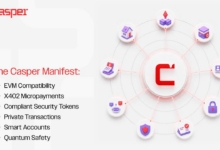
Casper Network Publishes the Casper Manifest, a Multi-Year Roadmap to Power Regulated Real-World Assets and the Machine Economy

The Casper Association has published "The Casper Manifest," a multi-year technical roadmap for Casper Network. Introduced at the Digital Finance Forum in Bermuda, the roadmap outlines nine coordinated initiatives designed to position the layer-1 blockchain as the infrastructure for regulated real-world asset (RWA) tokenization and the machine-to-machine economy. Key initiatives focus on: 1. **Developer Access:** Adding full Ethereum Virtual Machine (EVM) compatibility alongside its existing WebAssembly (Wasm) execution layer. 2. **User Experience:** Implementing gasless transactions, batch operations, and smart accounts with biometric authentication. 3. **Institutional Compliance & Privacy:** Building compliant security tokens aligned with the ERC-3643 standard and a multi-phase roadmap for confidential transactions with built-in audit tools. 4. **Machine Economy:** Implementing the X402 open payment standard to enable AI agents and machines to make autonomous, programmatic micropayments. 5. **Token Infrastructure:** Creating a Native Token Registry to give all tokens protocol-level status with fixed, predictable costs. 6. **Quantum Safety:** Developing hybrid accounts with both classical and quantum-resistant keys. The first initiative, X402 micropayments, is expected within weeks. Subsequent releases through 2026 and 2027 will include EVM compatibility, compliant security tokens, the Native Token Registry, gasless transactions, and quantum-safe features. The goal is to create a blockchain that is frictionless for users, trusted by institutions, and native for machines.

TheNewsCrypto05/12 13:20

Casper Network Publishes the Casper Manifest, a Multi-Year Roadmap to Power Regulated Real-World Assets and the Machine Economy

TheNewsCrypto05/12 13:20

VC Retrospective 2025: Compute is King, Narrative is Dead

Venture Capital Review 2025: Compute is King, Narrative is Dead The article reflects on the challenging yet transformative year of 2025 for crypto and AI investments. While on-chain financial tools and the machine economy saw significant growth, long-term crypto investors faced a difficult market structure plagued by a "negative prisoner's dilemma," premature token unlocks, and a major market failure in October that triggered industry-wide deleveraging. Despite these setbacks, the value creation in crypto and AI over the past decade has been immense, far outpacing other regions and sectors. The "Magnificent 7" tech giants and crypto assets collectively added trillions in market cap. The key lesson from 2025 is that value accrued to the narratives but to the owners of physical and financial bottlenecks: power, semiconductors, and scarce compute. Public market winners were companies like NVIDIA, TSMC, IREN, and Bloom Energy. In software, value flowed to embedded, "must-have" platforms (e.g., Alphabet, Meta) rather than optional tools. In private markets, foundational AI companies grew rapidly but faced fragility, while value-controlling companies (e.g., Applied Intuition, Anduril) were better positioned. Tokenized networks were the weakest performers, as usage failed to translate into token value capture. The core takeaway is that the market rewarded ownership of choke points and punished projects lacking control over cash flow or compute. For 2026, the investment focus shifts downstream to: (1) machine transaction surfaces (payments, billing, compliance), (2) applied infrastructure with existing budgets, and (3) high-conviction, non-consensus opportunities. The allocation will temporarily favor equity over tokens until market structure issues are resolved. The author concludes that a major shakeout is coming, but it also presents significant opportunity. The need to move beyond collective illusions and focus on real, budget-backed economic activity is paramount.

比推12/23 23:11

VC Retrospective 2025: Compute is King, Narrative is Dead

比推12/23 23:11

活动图片