# App Store Related Articles

HTX News Center provides the latest articles and in-depth analysis on "App Store", covering market trends, project updates, tech developments, and regulatory policies in the crypto industry.

Siri's "Androidization" Turning Point? iOS 27 to Launch AI App Store, Supporting Free Installation of Third-Party Bots

Apple is reportedly planning a major strategic shift for Siri and its AI ecosystem with iOS 27, moving towards a more open platform. According to Mark Gurman, the core of this strategy involves a "two-pronged" approach: deeply integrating its own Apple Intelligence while also opening Siri's underlying interfaces to third-party services. A key feature will be the introduction of a dedicated "AI App Store" section. This will allow users to freely install and use various third-party AI chatbots, not just ChatGPT, directly within Siri, functioning like an AI plugin marketplace. To bolster its capabilities, Apple is also considering deeply integrating Google's Gemini technology to enhance Siri and other system-level AI functions. This complementary strategy allows Apple to avoid direct competition with leading model developers and instead leverage external products to address its own weaknesses. The business logic behind this move is to defend its hardware dominance by offering a highly customizable AI experience to prevent users from switching to Android. Furthermore, Apple stands to generate significant revenue by applying its standard App Store commission model to subscriptions for these third-party AI services. This new AI vision is expected to be unveiled at WWDC26. This potential shift from a "walled garden" to an open "AI port" represents a significant change in Apple's philosophy, aiming to redefine smartphone interaction by making Siri a super-container for the world's best AI models.

marsbit03/30 01:18

Siri's "Androidization" Turning Point? iOS 27 to Launch AI App Store, Supporting Free Installation of Third-Party Bots

marsbit03/30 01:18

2026 Robot Track in Practice: Who is Paving the Way, Who is Mining, and Who is Building the System?

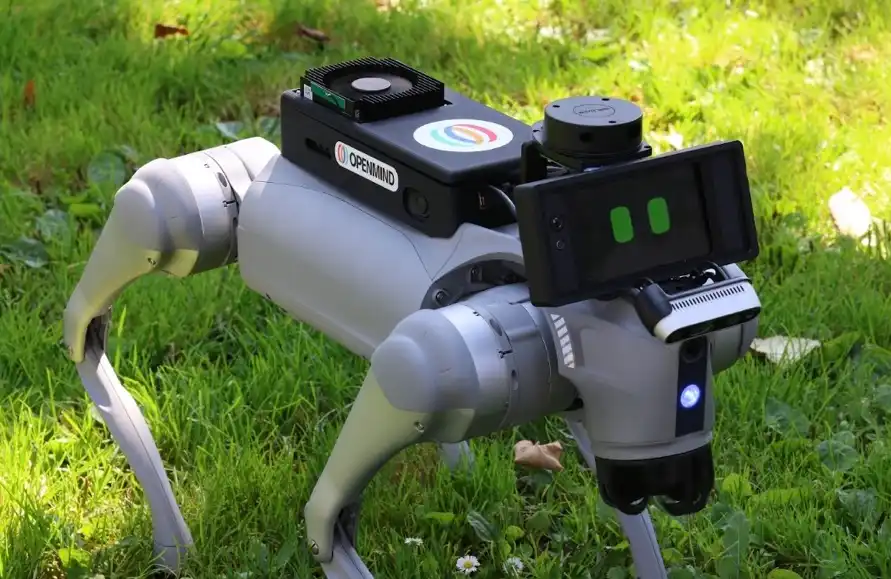
The 2026 embodied AI and DePIN narrative is shifting from hype to real-world applications. This analysis examines three leading projects in the robot economy: peaq, PrismaX, and OpenMind. peaq ($PEAQ) is a Layer-1 blockchain for the "Machine Economy," enabling devices to act as autonomous economic agents. A key case is a tokenized robotic farm in Hong Kong that generates real yield (e.g., 3820 USDT distributed to a user) from selling hydroponic vegetables, offering an ~18% APY. With partnerships like Bosch and Mastercard, and a ~$78M FDV, it's seen as an undervalued infrastructure play. PrismaX, backed by a $11M a16z-led round, focuses on generating crucial physical-world AI training data through human teleoperation. Users remotely operate real robots to earn points for a future airdrop. While attracting users, it faces risks from low-quality data farming and unproven commercial scalability. OpenMind ($ROBO) aims to be the "Android OS" for robots, providing a unified app store. It has partnered with 10+ major hardware firms (e.g., Unitree, UBTECH) and launched with 5+ apps. However, its $400M FDV is considered high, and it faces competition from closed systems like Tesla's Optimus. Together, these projects represent the essential stack for decentralized embodied AI: PrismaX (data layer) trains robots, OpenMind (OS/application layer) enables cross-hardware functionality, and peaq (network/incentive layer) facilitates automated economic transactions. The synergy between these layers is key to scaling practical applications.

marsbit02/15 10:07

2026 Robot Track in Practice: Who is Paving the Way, Who is Mining, and Who is Building the System?

marsbit02/15 10:07

App Gold Rush Guide: How to Develop and Promote an App with Zero Experience to Achieve 'Passive Winning'?

How to Build and Market an App for Passive Income: A Step-by-Step Guide This guide outlines a strategy for developing and marketing a B2C app to achieve significant Monthly Recurring Revenue (MRR), based on the author's experience of earning $20k in the first 30 days. **1. Validate Your App Idea:** Avoid building an app no one wants. Find a proven niche with existing paid apps (e.g., habit tracking, mental health, productivity). Research competitors on app stores and TikTok/Instagram to confirm demand and analyze their marketing strategies (influencers, UGC, paid ads). **2. Build the App Quickly:** Use an efficient tool stack (e.g., AI coders like Rork/Cursor, Superwall for paywalls, Firebase) to build an MVP in 3-7 days. Heavily "borrow" the onboarding flow and pricing from successful competitors, as this is crucial for converting users. Force an upfront paywall or free trial. **3. Publish on the App Store:** Key elements for the listing are a clear app name, a benefit-driven subtitle, and simple, conversion-focused screenshots. A guide is provided to avoid common App Store rejection pitfalls. **4. Market the App:** Five key channels are recommended: * **UGC Creators:** Pay creators (~$15/video) to post content, with bonuses for viral videos. * **Influencers:** Negotiate cost-per-mille (CPM) deals (~$1 per 1k views). * **Faceless Accounts:** Post consistent, branded slideshow or screen-recorded content for free. * **Founder-Led Content:** challenging but can be highly effective if a viral format is found. * **Paid Ads:** The most scalable and predictable channel once profitable. The core concept is to treat apps as "digital real estate" that generate true passive income. The process is presented as a repeatable formula for success.

marsbit01/25 01:10

App Gold Rush Guide: How to Develop and Promote an App with Zero Experience to Achieve 'Passive Winning'?

marsbit01/25 01:10

活动图片