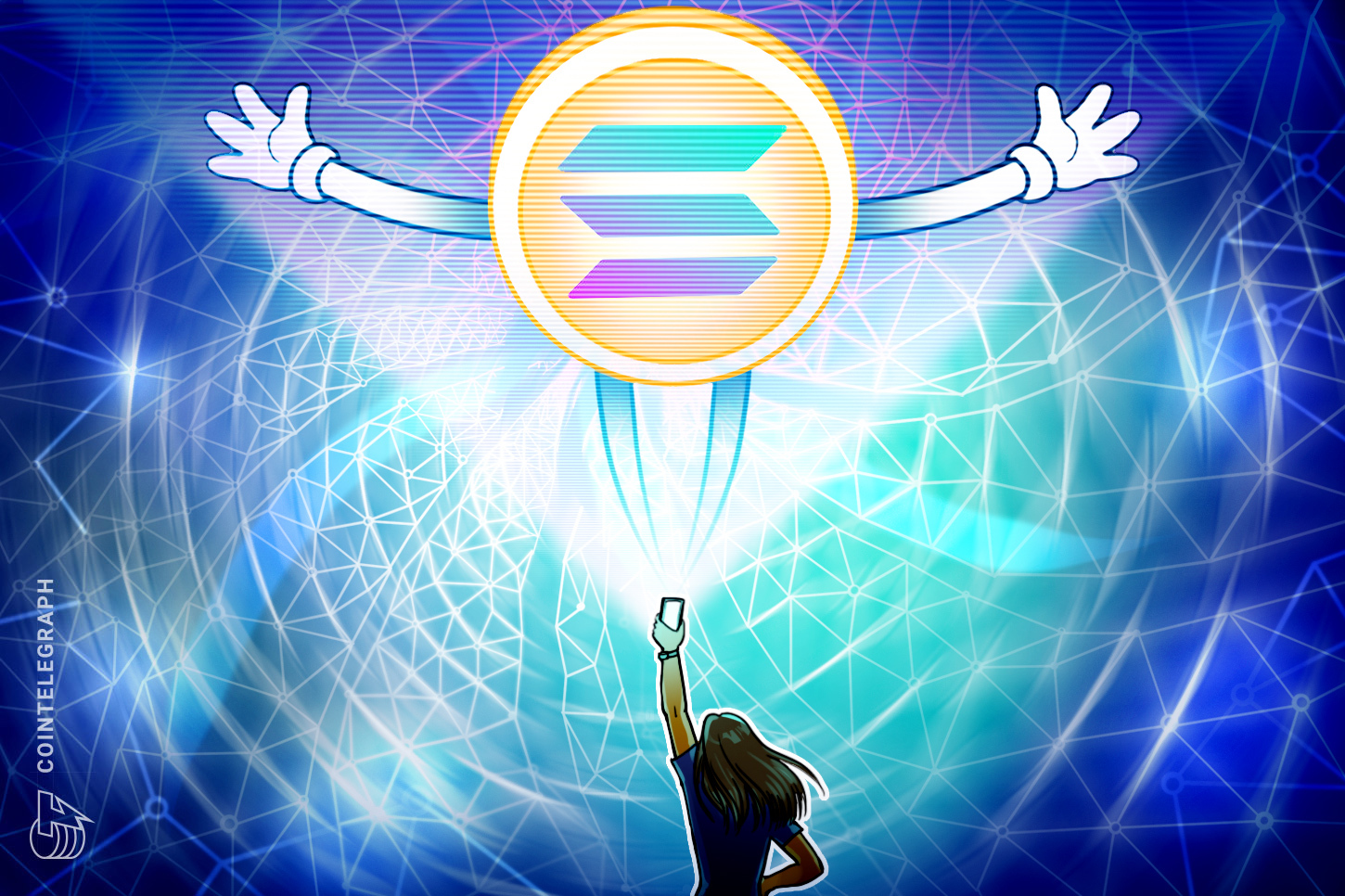
Superstate brings stablecoin-settled stock offerings to Ethereum and Solana

cointelegraphPublished on 2025-12-10Last updated on 2025-12-10

Abstract

Superstate has launched Direct Issuance Programs (DIPs), enabling SEC-registered public companies to raise capital directly on Ethereum and Solana. Investors can pay in stablecoins and receive tokenized shares instantly at real-time market prices. This onchain model uses Superstate’s SEC-registered transfer-agent infrastructure to update shareholder registries automatically, ensuring compliance with securities laws. The system allows companies to reduce financing costs and reach global investors, while providing instant settlement and regulatory safeguards. Superstate’s initiative builds on its growing onchain infrastructure, which has already attracted firms like SharpLink Gaming and Galaxy Digital. The tokenized real-world asset market has surpassed $24 billion, with Ethereum and Solana leading much of the activity.

Financial technology firm Superstate has rolled out a new way for US Securities and Exchange Commission (SEC)-registered public companies to raise capital directly onchain.

Through its Direct Issuance Programs (DIPs), any issuer registered with the SEC can now offer new shares on Ethereum and Solana, with investors paying in stablecoins and receiving tokenized shares instantly at real‐time market prices, according to a Wednesday announcement from Superstate shared with Cointelegraph.

Jim Hiltner, co-founder and head of business development at Superstate, told Cointelegraph, “The regulatory ability to directly issue registered shares isn’t new. What is new is that issuers can now conduct these offerings onchain, which changes what’s possible operationally and economically.”

The launch of DIPs is part of Superstate’s mission to bring compliant public‐market infrastructure onchain. The model uses Superstate’s SEC‐registered transfer‐agent infrastructure to update shareholder registries automatically as tokenized shares move between verified wallets, ensuring issuances comply with existing securities laws.

“Any SEC‐registered public company is able to run an issuer‐led primary offering onchain using this structure,” said Hiltner. “Our infrastructure is live now. Issuers can begin preparing and filing their programs immediately. The first public company offerings are expected to go live in 2026.”

Related: Spark marks first major rotation from US Treasurys into regulated DeFi

Expanding Superstate’s onchain ambitions

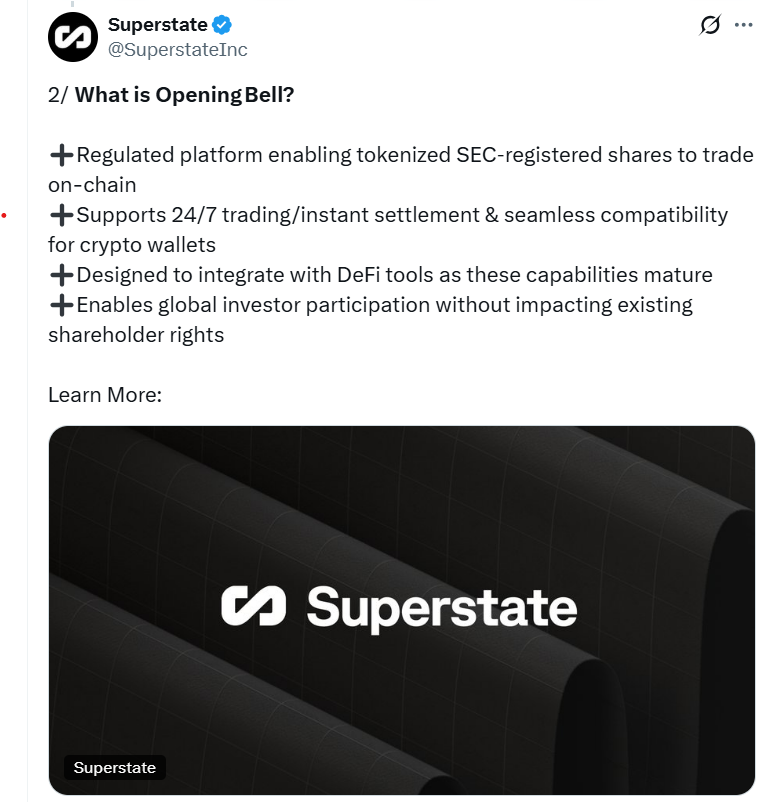
DIPs build on a year of onchain expansion for the fintech startup. In May, Superstate launched Opening Bell, a platform designed to tokenize and enable compliant onchain activity for SEC‐registered equities.
Source: Superstate

In September, SharpLink Gaming, one of the world’s biggest public holders of Ether (ETH), revealed plans to tokenize its common stock through Superstate’s platform. In the same month, Galaxy Digital announced its tokenized public shares on Solana using Superstate’s transfer-agent infrastructure.

The launch of DIPs also lands in a year when other tokenization initiatives are expanding across Ethereum and Solana, such as Franklin Templeton’s move from tokenized money funds to multi‐asset real‐world‐asset (RWA) platforms.

The tokenized real‐world asset market had surged to over $24 billion on public blockchains by Q3, 2025, with Ethereum and Solana accounting for well over half of all RWA activity.

Related: US Treasurys lead tokenization wave as CoinShares predicts 2026 growth

A new channel for issuers and investors

Hiltner said that DIPs allow companies to structure their offerings under standard SEC registrations, receive stablecoin proceeds directly into their wallets, and distribute tokenized shares instantly to verified investors.

Each transaction updates the issuer’s shareholder registry in real time, preserving the integrity of ownership records while enabling instant settlement. According to Hiltner, issuers can achieve lower financing costs through reduced underwriting and distribution fees and broader global reach to eligible investors.

For investors, the system allows retail and institutional participants to purchase newly issued stock directly from companies (sometimes below exchange prices), with shares settling to their wallets immediately.

“This combines regulatory compliance with onchain execution,” said Hiltner. “If an investor meets all requirements, they can participate; if not, the system blocks the transaction.”

Superstate’s model blends established securities law with crypto’s instant settlement rails and aims to bring traditional financial regulation to onchain capital markets infrastructure.

Magazine: Solana vs Ethereum ETFs, Facebook’s influence on Bitwise — Hunter Horsley

Trending Cryptos

Related Reads

Stablecoin Salaries: Why Are They Becoming the First Choice for Cross-Border Workers?

Stablecoin Salaries: Why They're Becoming the Top Choice for Global Remote Workers The traditional global salary system carries hidden exchange rate risks for freelancers in countries like India, Argentina, and Turkey who earn in USD but spend in local currencies. When salaries are instantly converted to local currency, workers lose purchasing power if that currency depreciates against the dollar. For instance, an Indian designer converting a $2000 monthly salary to rupees lost over 10% in purchasing power last year due to the rupee's decline. Holding even a portion of income in USD or USD-pegged stablecoins can preserve value. Stablecoins offer a solution by breaking down barriers to holding dollars. Opening foreign USD bank accounts is difficult, and international wire transfers incur high fees (averaging 6.5%) and delays. In contrast, stablecoin transfers are fast and low-cost. Furthermore, many countries with high inflation and depreciating currencies restrict citizens' access to foreign currency. Self-custody stablecoin wallets enable workers to hold dollar-equivalent assets without needing bank approval, bypassing these limits. These wallets integrate multiple functions: they allow users to convert only what's needed for daily expenses into local currency, keep the remainder in stablecoins, connect to on-chain lending or yield products, and even link to payment cards for direct spending. While challenges remain—such as the lack of deposit insurance and evolving regulatory frameworks—the trend is clear. Reports indicate a growing preference for USD or stablecoin payments among freelancers in high-inflation countries. This shift represents a fundamental restructuring of salary functions: payment currency, asset storage, yield generation, spending, and cross-border flow. It offers the freedom and flexibility that are core to money's purpose, signaling a profound change in the global financial landscape.

Foresight News12m ago

Stablecoin Salaries: Why Are They Becoming the First Choice for Cross-Border Workers?

Foresight News12m ago

Don't Just Focus on Layoffs, The New Structure of the Ethereum Foundation is More Worthy of Appreciation

The Ethereum Foundation (EF) has undergone a significant organizational restructuring, with the most notable change being a strategic refocusing of its priorities rather than just a 20% staff reduction (approximately 54 people). The new structure clearly prioritizes the Protocol and Access layers, which now comprise the largest teams (57 and 34 people, respectively). This signals EF's intent to concentrate its core resources on fundamental, hard-to-outsource aspects of Ethereum: protocol evolution, security, privacy, client development, and the foundational access layer. Key areas within the Protocol layer, led by an architecture group including Vitalik Buterin and Justin Drake, receive heightened emphasis. These include post-quantum security, zkEVM, formal verification, and long-term roadmap development ("Strawmap"). This reflects a shift towards tackling complex, interdependent challenges like scalability, privacy, and future-proofing the protocol, potentially moving from a pure "redundant security" multi-client model towards more specialized clients aided by AI-assisted formal verification. Financially, EF's budget is being reduced by approximately 40%. The goal is to transition from spending about 15% of its remaining funds annually to a more sustainable 5% rate, akin to a long-term endowment, ensuring its longevity. Concurrently, the restructuring involves pushing certain responsibilities—such as application development, adoption, and ecosystem coordination—to external organizations like EthLabs, the Ethereum Apps Guild, and others. This "multi-node" model aims to increase ecosystem resilience by decentralizing functions beyond the EF, though it introduces new coordination challenges. In essence, the reorganization represents EF consciously narrowing its scope to focus on the hardest, most critical protocol-level problems while fostering a more distributed and sustainable ecosystem structure for Ethereum's future growth.

Foresight News41m ago

Don't Just Focus on Layoffs, The New Structure of the Ethereum Foundation is More Worthy of Appreciation

Foresight News41m ago

Report Analysis: What Is Coherent Planning as CPO Booms?

Title: Report Interpretation: What Moves Is Coherent Making Amid the CPO Boom? Summary: JP Morgan analyst Samik Chatterjee reiterates an Overweight rating on Coherent (COHR), citing undervalued growth potential across three core areas: data center optical transceivers, co-packaged optics (CPO) chips, and industrial lasers/thermal management. COHR's 1.6T data center transceivers are in high demand, with pricing remaining firm. The rise of CPO is seen not as a threat but as a catalyst, creating higher demand for sophisticated optical components, an area where COHR holds a competitive edge with its comprehensive portfolio (lasers, isolators, VCSELs, thermoelectric coolers). Each CPO chip offers significantly greater revenue potential than traditional transceivers. Furthermore, its Optical Circuit Switch (OCS) technology targets a potential $4B market with reliability and power advantages. The company is expanding its InP (Indium Phosphide) device capacity fourfold within two years, securing substrate supply and transitioning to more cost-effective 6-inch wafers. As one of only two major suppliers of high-quality pump lasers—currently in severe shortage—COHR can now move up the value chain from components to complete line cards/systems, boosting ASP over tenfold. Gross margin targets (>42%) may be revised upward due to high-end product premiums, cost improvements from the wafer transition, and contributions from new high-margin products like CPO and OCS. Its efficient thermadite thermal material also offers long-term growth. Industrial segment revenue grows at a steady 5-10%, supported by semiconductor equipment orders. Changes in Apple's Face ID protocol present a re-competition opportunity for 3D sensing. Overall, Coherent is positioned as a key infrastructure provider, with AI-driven compute demand fueling the need for high-speed optical interconnectivity. Growth from CPO/OCS, stable industrial performance, and margin improvement support the bullish thesis. *Disclaimer: This summary interprets a third-party analyst report from JP Morgan. It does not constitute investment advice.*

marsbit1h ago

Report Analysis: What Is Coherent Planning as CPO Booms?

marsbit1h ago

After Laying Off 20% of Staff, What Are the Key Points of EF's New Structure?

Following the completion of a months-long organizational restructuring, the Ethereum Foundation (EF) announced a 20% workforce reduction (approximately 54 employees) on June 23rd. It reorganized its teams into five new core clusters: Protocol, Access, User, Community, and Institutional (plus Operations/Management support units). Officially, this move implements the EF's 2026 Mandate and 2025 Treasury Management Policy, aiming to create a more focused and "self-sovereign" organization. The restructuring prioritizes the CROPS principles—Censorship Resistance, Openness & Freedom, Privacy, and Security—as foundational organizational tenets. The Protocol cluster will focus on core protocol R&D, including MEV reduction and zkEVM. The Access cluster emphasizes preserving user "zero option" for non-custodial, permissionless interaction. The User, Community, and Institutional clusters will manage external engagement, with the latter handling institutional and regulatory matters. While offering enhanced severance and transition support for affected employees, the EF did not disclose budget allocations or specific KPIs for the new clusters. This has led to market uncertainty about the impact on project funding and development priorities. Analysts note the announcement's positive tone of mission focus contrasts with a backdrop of recent EF leadership changes and broader ecosystem pressures. The true impact—whether this signifies strategic realignment or reactive contraction—will become clearer as the new structure's resource allocation and project prioritization are revealed in the coming months.

marsbit1h ago

After Laying Off 20% of Staff, What Are the Key Points of EF's New Structure?

marsbit1h ago

Trading

Spot
Futures

Hot Articles

Discussions

Welcome to the HTX Community. Here, you can stay informed about the latest platform developments and gain access to professional market insights. Users' opinions on the price of SOL (SOL) are presented below.

活动图片