Strategy turns 1,690 BTC into $108.6M STRC buyback

cointelegraphPublished on 2026-08-10Last updated on 2026-08-10

Abstract

Strategy, the company holding the largest corporate Bitcoin treasury, sold 1,690 BTC for $108.6 million between August 3 and 9, using the proceeds to repurchase 1.15 million shares of its STRC preferred stock. This marks its fourth disclosed Bitcoin sale of 2026, bringing yearly sales to 6,948 BTC. The company continues to hold 840,447 BTC, purchased at an average price of $75,385 per coin, and sold the latest batch at an average of $64,262 per BTC. These Bitcoin sales have become part of a funding engine for repurchasing STRC stock. Strategy also reported a US dollar reserve of $4.65 billion, increased from about $4 billion the prior week, bolstered by proceeds from recent sales of its MSTR common stock. The company has $785.2 million remaining under its preferred stock repurchase program and another $1 billion available for Class A common stock buybacks. Following the buyback activity, STRC shares have rallied, reclaiming the $90 level and trading at $95.45 in premarket activity on the reporting Monday.

Strategy, which holds the largest corporate Bitcoin treasury, sold BTC for the second week in a row to repurchase its STRC preferred stock.

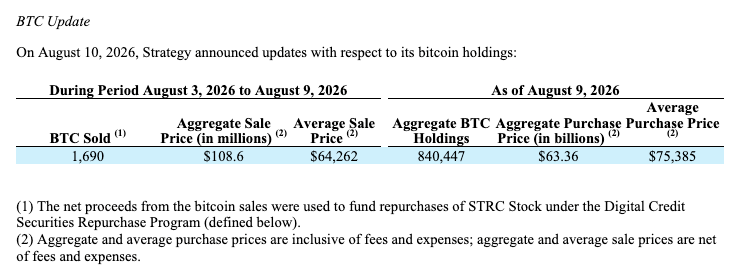
The company sold 1,690 Bitcoin for $108.6 million between Aug. 3 and Aug. 9, according to a Monday 8-K filing with the US Securities and Exchange Commission (SEC).

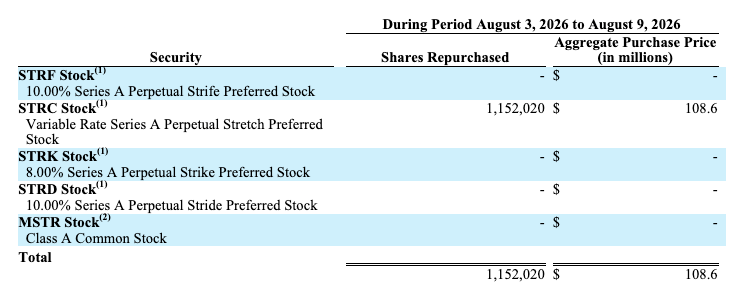
Strategy used the proceeds to buy back 1.15 million shares of its STRC preferred stock for $108.6 million. STRC is a variable-rate preferred stock designed to pay monthly dividends.

The transaction marked Strategy’s fourth disclosed Bitcoin sale of 2026, bringing its total Bitcoin sales for the year to 6,948 BTC, while the company still holds 840,447 BTC purchased for an aggregate $63.36 billion.

Bitcoin becomes part of the funding engine

Strategy sold the latest batch at an average net price of $64,262 per Bitcoin, while its total holdings carry an average purchase price of $75,385 per BTC, including fees and expenses.

Strategy’s prior disclosed sale involved 1,638 BTC for $104.73 million between July 27 and Aug. 2, when it also used Bitcoin sale proceeds to fund STRC repurchases.
Source: SEC

The latest filing shows that Strategy has $785.2 million remaining under its digital credit securities repurchase program, which covers its preferred stock, while another $1 billion remains available under its Class A common-stock repurchase program.

$4.65 billion reserve cushions preferred dividends

Strategy also continued building its US dollar reserve, reporting a balance of $4.65 billion as of Sunday, up from roughly $4 billion in the previous weekly update.

The company said $650 million of the $653.1 million in net proceeds from recent MSTR stock sales went toward the reserve, while the latest figure also includes expected proceeds from at-the-market (ATM) sales that had not yet settled.
Source: SEC

STRC shares have also rallied during Strategy’s recent buybacks, retaking $90 on Aug. 3 after rebounding 24% from their June lows.

STRC was up 0.46% at $95.45 in premarket trading Monday after closing Friday at $95, while MSTR gained 0.25% to $100.26, according to Yahoo Finance.

Magazine: Strategy became a symbol of the dot-com crash: Could history repeat?

Trending Cryptos

Related Questions

QHow much Bitcoin did Strategy sell in the week of August 3 to August 9, and for what total amount?

AStrategy sold 1,690 Bitcoin for a total of $108.6 million between August 3 and August 9.

QWhat did Strategy use the proceeds from the recent Bitcoin sale for?

AStrategy used the $108.6 million proceeds to repurchase 1.15 million shares of its STRC preferred stock.

QWhat is the total amount of Bitcoin Strategy has sold in 2026 so far, and how much does it still hold?

AStrategy has sold a total of 6,948 BTC in 2026. The company still holds 840,447 BTC, which were purchased for an aggregate of $63.36 billion.

QWhat is the purpose of Strategy's significant US dollar reserve, and what was its reported balance?

AStrategy's US dollar reserve is used to cushion preferred dividends. As of the latest report, the reserve balance was $4.65 billion.

QHow did the stock prices of STRC and MSTR react around the time of the latest disclosures?

ASTRC shares retook $90 on August 3 and were up 0.46% at $95.45 in premarket trading on Monday following the news. MSTR gained 0.25% to $100.26 in the same premarket session.

Related Reads

Trading Volume Halved: Korea's Two Major Crypto Exchanges Launch Listing Wars

As South Korea's stock market cools from its peak summer performance, leading cryptocurrency exchanges Upbit and Bithumb are intensifying their competition to list new digital assets. Following a significant slump in crypto trading volume during the first half of 2025—with total volume across five major KRW-based exchanges falling nearly 50% year-on-year as capital flooded into equities—the two exchanges have sharply increased their listing pace since July. In just over a month, both Upbit and Bithumb have each added 17 new KRW-trading pairs, far exceeding their average of 6-10 listings per month earlier in the year. This acceleration coincides with a decline in the Korean Composite Stock Price Index's (KOSPI) daily trading volume and a reduction in the proportion of retail investor participation in stocks. Analysts suggest that with the stock market's "wealth effect" diminishing, crypto exchanges are now competing more aggressively for the limited attention and risk capital of local retail investors. The newly listed assets are already contributing significantly to trading activity on the platforms. On Upbit, for example, several coins listed since July now rank among its top-traded assets by volume, collectively accounting for nearly 20% of its 24-hour trading volume recently. However, this surge in new listings appears to be primarily redistracting existing capital within the shrunken crypto market rather than attracting substantial new inflows. Consequently, the strategies of the two dominant exchanges, which together control about 96% of the KRW crypto trading market, are becoming increasingly similar, with both rushing to list the same trending assets to prevent the other from capturing all available trading demand.

marsbit24m ago

Trading Volume Halved: Korea's Two Major Crypto Exchanges Launch Listing Wars

marsbit24m ago

Behind a 26-Year-Old Hong Kong Trader's $150 Million Loss: A South Korean Stock Market 'Great Escape'

In 2026, the South Korean stock market, propelled by the AI boom's demand for high-performance memory chips, witnessed a dramatic rally and subsequent crash, illustrating the perils of excessive leverage, structural market flaws, and retail investor frenzy. The initial surge was driven by soaring share prices of memory giants Samsung Electronics and SK Hynix. This "once-in-a-lifetime" wealth creation story captivated local Korean retail investors, many of whom invested heavily using leverage, and attracted global capital through products like Hong Kong-listed leveraged ETFs. However, the market's heavy reliance on these two stocks and widespread leverage created systemic fragility. The turning point came in June 2026. A series of circuit-breaker halts triggered a vicious cycle of forced liquidations, leading to a steep market plunge. The collapse erased fortunes, leaving many leveraged retail investors in debt. It also exposed a high-profile case in Hong Kong where a 26-year-old trader, using unauthorized company funds and double leverage on a SK Hynix ETF, incurred massive losses of HKD 150 million. Analysis points to key factors behind the extreme volatility: the overwhelming dominance of two stocks in the KOSPI index, a culture of rampant retail leverage, and a fundamental mispricing where investors treated cyclical semiconductor stocks as perpetual growth stories. As the market entered a volatile consolidation phase, seasoned investors emphasized core risk management principles: avoiding leverage, understanding industry cycles, maintaining a margin of safety, and being wary of extreme market consensus. The episode serves as a stark reminder that high returns are inextricably linked to high risk, especially when amplified by leverage.

marsbit34m ago

Behind a 26-Year-Old Hong Kong Trader's $150 Million Loss: A South Korean Stock Market 'Great Escape'

marsbit34m ago

Trading

Spot

Hot Articles

What is $BITCOIN

DIGITAL GOLD ($BITCOIN): A Comprehensive Analysis Introduction to DIGITAL GOLD ($BITCOIN) DIGITAL GOLD ($BITCOIN) is a blockchain-based project operating on the Solana network, which aims to combine the characteristics of traditional precious metals with the innovation of decentralized technologies. While it shares a name with Bitcoin, often referred to as “digital gold” due to its perception as a store of value, DIGITAL GOLD is a separate token designed to create a unique ecosystem within the Web3 landscape. Its goal is to position itself as a viable alternative digital asset, although specifics regarding its applications and functionalities are still developing. What is DIGITAL GOLD ($BITCOIN)? DIGITAL GOLD ($BITCOIN) is a cryptocurrency token explicitly designed for use on the Solana blockchain. In contrast to Bitcoin, which provides a widely recognized value storage role, this token appears to focus on broader applications and characteristics. Notable aspects include: Blockchain Infrastructure: The token is built on the Solana blockchain, known for its capacity to handle high-speed and low-cost transactions. Supply Dynamics: DIGITAL GOLD has a maximum supply capped at 100 quadrillion tokens (100P $BITCOIN), although details regarding its circulating supply are currently undisclosed. Utility: While precise functionalities are not explicitly outlined, there are indications that the token could be utilized for various applications, potentially involving decentralized applications (dApps) or asset tokenization strategies. Who is the Creator of DIGITAL GOLD ($BITCOIN)? At present, the identity of the creators and development team behind DIGITAL GOLD ($BITCOIN) remains unknown. This situation is typical among many innovative projects within the blockchain space, particularly those aligning with decentralized finance and meme coin phenomena. While such anonymity may foster a community-driven culture, it intensifies concerns about governance and accountability. Who are the Investors of DIGITAL GOLD ($BITCOIN)? The available information indicates that DIGITAL GOLD ($BITCOIN) does not have any known institutional backers or prominent venture capital investments. The project seems to operate on a peer-to-peer model focused on community support and adoption rather than traditional funding routes. Its activity and liquidity are primarily situated on decentralized exchanges (DEXs), such as PumpSwap, rather than established centralized trading platforms, further highlighting its grassroots approach. How DIGITAL GOLD ($BITCOIN) Works The operational mechanics of DIGITAL GOLD ($BITCOIN) can be elaborated on based on its blockchain design and network attributes: Consensus Mechanism: By leveraging Solana’s unique proof-of-history (PoH) combined with a proof-of-stake (PoS) model, the project ensures efficient transaction validation contributing to the network's high performance. Tokenomics: While specific deflationary mechanisms have not been extensively detailed, the vast maximum token supply implies that it may cater to microtransactions or niche use cases that are still to be defined. Interoperability: There exists the potential for integration with Solana’s broader ecosystem, including various decentralized finance (DeFi) platforms. However, the details regarding specific integrations remain unspecified. Timeline of Key Events Here is a timeline that highlights significant milestones concerning DIGITAL GOLD ($BITCOIN): 2023: The initial deployment of the token occurs on the Solana blockchain, marked by its contract address. 2024: DIGITAL GOLD gains visibility as it becomes available for trading on decentralized exchanges like PumpSwap, allowing users to trade it against SOL. 2025: The project witnesses sporadic trading activity and potential interest in community-led engagements, although no noteworthy partnerships or technical advancements have been documented as of yet. Critical Analysis Strengths Scalability: The underlying Solana infrastructure supports high transaction volumes, which could enhance the utility of $BITCOIN in various transaction scenarios. Accessibility: The potential low trading price per token could attract retail investors, facilitating wider participation due to fractional ownership opportunities. Risks Lack of Transparency: The absence of publicly known backers, developers, or an audit process may yield skepticism regarding the project's sustainability and trustworthiness. Market Volatility: The trading activity is heavily reliant on speculative behavior, which can result in significant price volatility and uncertainty for investors. Conclusion DIGITAL GOLD ($BITCOIN) emerges as an intriguing yet ambiguous project within the rapidly evolving Solana ecosystem. While it attempts to leverage the “digital gold” narrative, its departure from Bitcoin's established role as a store of value underscores the need for a clearer differentiation of its intended utility and governance structure. Future acceptance and adoption will likely depend on addressing the current opacity and defining its operational and economic strategies more explicitly. Note: This report encompasses synthesised information available as of October 2023, and developments may have transpired beyond the research period.

1.8k Total ViewsPublished 2025.05.13Updated 2025.05.13

What is $BITCOIN

Discussions

Welcome to the HTX Community. Here, you can stay informed about the latest platform developments and gain access to professional market insights. Users' opinions on the price of BTC (BTC) are presented below.

活动图片