Author:Ilya Strebulaev
Compiled by: Deep Tide TechFlow
Deep Tide Introduction: A Stanford Business School professor reconstructed VC rankings using 230,000 investment data points, revealing that 90% of industry profits are captured by 5% of VCs. For founders, choosing the wrong investor can mean a difference of an order of magnitude in returns. This article provides actionable selection criteria.
This is a guest article by Ilya Strebulaev. He teaches Venture Capital and Private Equity at the Stanford Graduate School of Business and leads the school's Venture Capital Initiative. He publishes VC research, investor rankings, and financing guides for founders in his newsletter.
Every founder who raises capital from venture capitalists hears the same names: Sequoia, Andreessen Horowitz, Benchmark. But there's one number that should influence your fundraising strategy more than these names. By my estimate, about 5% of venture capitalists generate roughly 90% of the industry's profits. If you're choosing who to take money from, the most important question is: Is your investor in that 5%? Reputation does not accurately represent this.
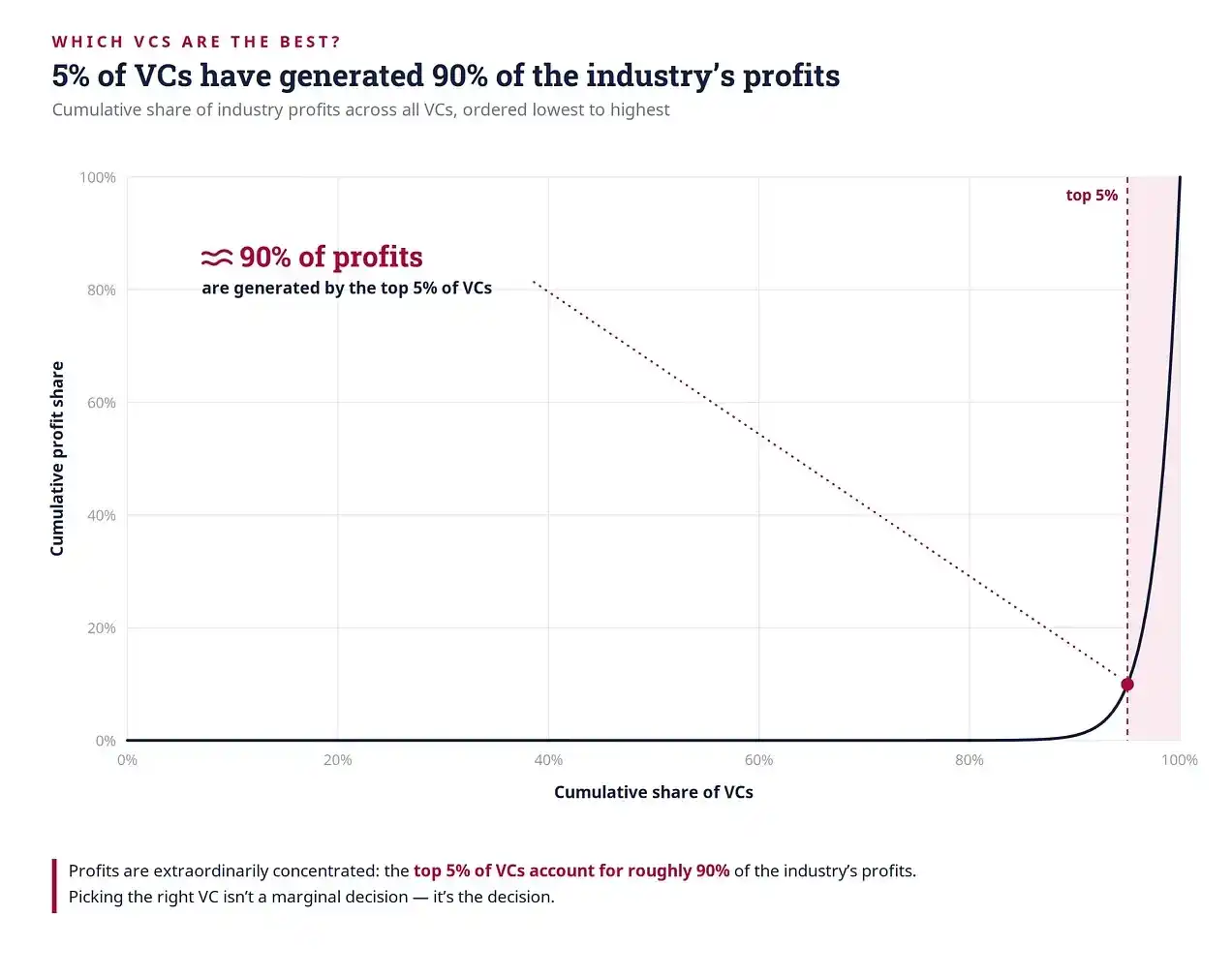
Image: The top 5% of VCs generate about 90% of the industry's profits. Whether your investor belongs to this 5% is more important than their brand reputation.
Until now, there hasn't been a transparent, fully data-driven method to answer this question. The industry relies heavily on the Forbes Midas List, which is largely a black box. When we tried to reverse-engineer it based on its public methodology, even our best-fitted replication had 49 of its own top 100 not appearing on the actual list. Among investors appearing on both our ranking and the Midas List, the correlation was only about 0.27.
Therefore, together with Blake Jackson, I built an alternative: the 2026 Strebulaev-Jackson VC Ranking, based on over 230,000 investments in more than 5,000 companies by nearly 13,000 venture capitalists over 30 years. Every score traces back to a specific investment in a specific company on a specific date. We apply no editorial judgment, make no manual adjustments, and do not rely on self-reported data from firms.
This article contains the full top 100 list, the methodology behind it, and—because a ranking alone won't get you a good investor—what you should do after getting the ranking.
What Does This Score Actually Measure
Six factors drive this score. It's worth reading carefully, as they collectively reward behaviors founders want in an investor.
Dilution. Owning 10% in the first round is not 10% at exit. Both companies might sell for $1 billion, but if one went through four rounds of financing, its early investors were diluted in each round. We track the equity stake change of each investment in every subsequent round.
Net Profit. Turning $10 million into $2 billion and turning $1 billion into the same $2 billion are different achievements. Subtracting the cost of each investment rewards capital efficiency and penalizes spraying large amounts of money to create a few headline wins. In our data, about three-quarters of investments have negative net returns.
Value Add. An investor who leads a round and takes a board seat contributes more than a passive check-writer. We give extra points for these roles.
Credit Allocation Between Firm and Individual. Investors move between firms. So when a partner jumps to a new firm after doing the best deal at a previous one, both firms should get some credit. We split it, 25% to the firm at the time of investment and 75% to the firm where the partner currently is. This reflects academic evidence that most of the return differential stems from individuals, not institutions.
2026 Results: Top Firms
Sequoia leads with 10,158 points. Andreessen Horowitz ranks second with 8,292 points. Accel, DST Global, and Tiger Global round out the top five. Within the top 20, two names deserve a second look from any founder building a target list. Parkway Venture Capital, founded in 2019, ranks #19 thanks to Figure AI. Notable ranks #20. Neither is a household name, and both rank above firms with significantly higher brand recognition.
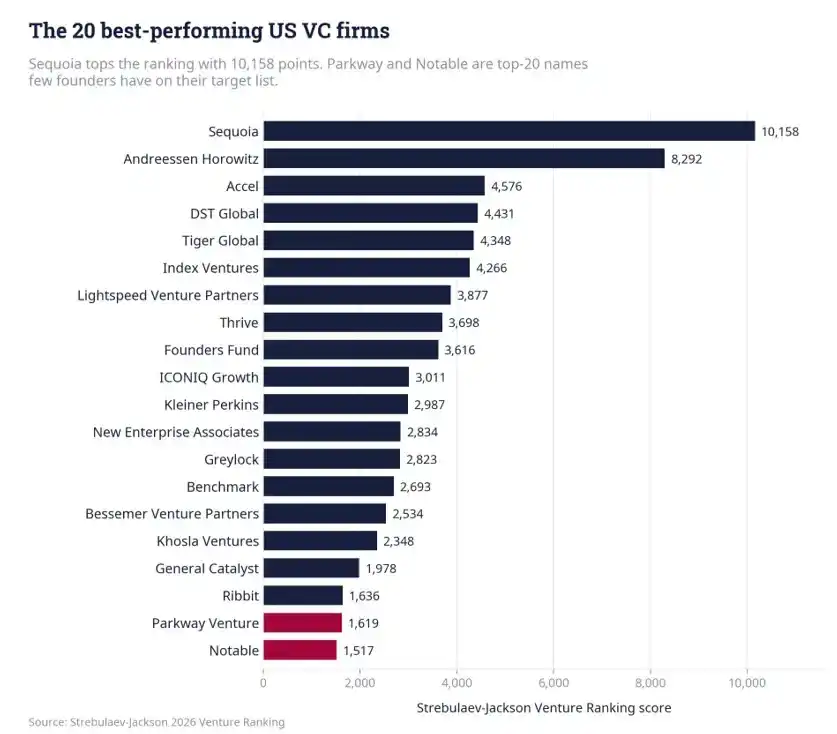
Image: Sequoia leads with 10,158 points. Two firms in the top 20 are names most founders have never interacted with.
Rank, Firm, Headquarters, Year Founded, Ranking Score, and Top Deal. Top Deal refers to the single investment from which the firm scored the most points according to our methodology, not necessarily its most famous or highest-valuation holding.
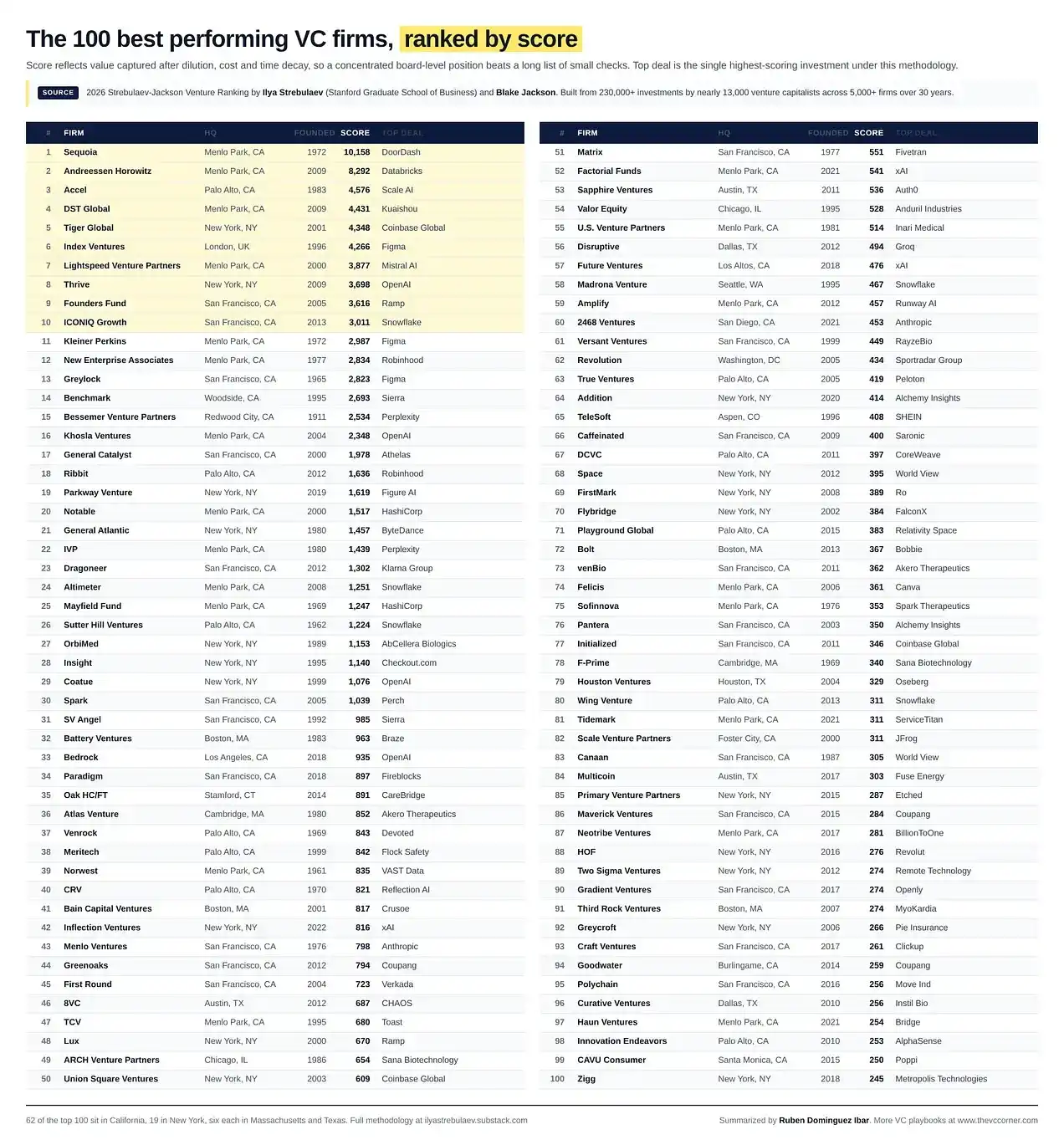
Image: All 100 firms with their headquarters, founding year, score, and top deal. 62 are based in California, 19 in New York, 6 each in Massachusetts and Texas.
Scores are rounded to integers. Geographic distribution: 62 of the top 100 firms are headquartered in California, 19 in New York, and 6 each in Massachusetts and Texas. Regardless of expansion at the seed and angel levels, the institutional core of US venture capital has not left its historical hubs.
Four patterns in this table are more important for founders than the ranking order itself.
The Difference Between Good and Famous is an Order of Magnitude
By rank 10, the score has dropped to about 3,000 points, less than a third of Sequoia's. By rank 100, the score is 245 points. The score of the top-ranked firm is about 41 times that of the 100th-ranked firm.
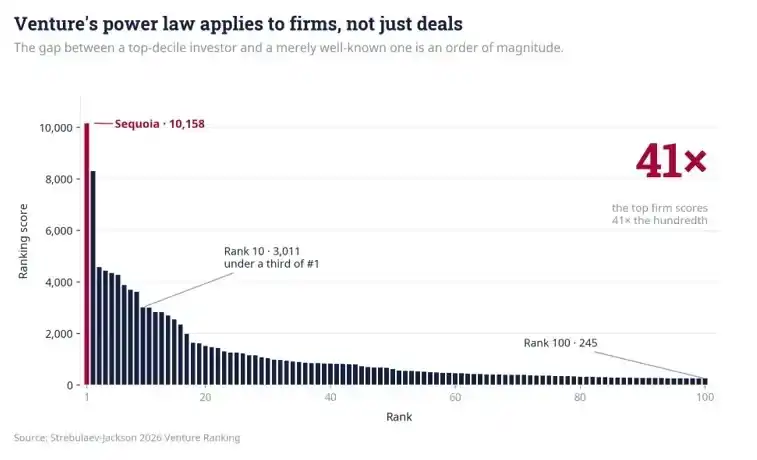
Image: By rank 10, the score is already less than a third of Sequoia's; by rank 100, the score is 245. The top score is 41 times the score at rank 100.
The power law in VC is often described at the single-deal level, but it applies just as powerfully to the firms themselves. For founders, this means the gap between a top-decile investor and a merely famous one is an order of magnitude, worth real effort to bridge.
Counting Unicorns Says Almost Nothing
This ranking is not a unicorn count race. SV Angel invested in ~139 unicorns but ranks #31. Insight Partners invested in ~124, ranking #28. Felicis has 58 unicorns, ranking #74. DST Global has 62 unicorns, ranking #4. Thrive has 47, ranking #8.
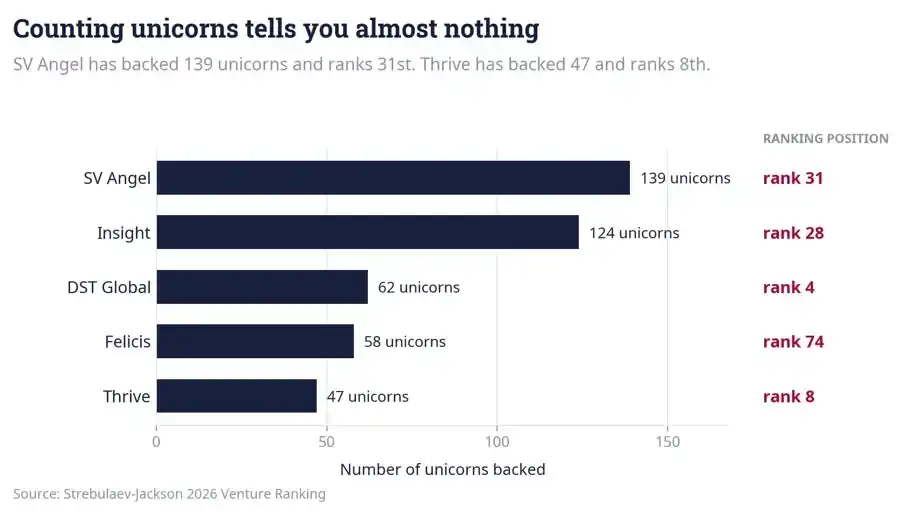
Image: SV Angel invested in 139 unicorns but ranks #31; Thrive invested in 47 but ranks #8. This methodology rewards value actually captured post-dilution, not logo count.
Why do firms with far fewer unicorns rank much higher? Because the methodology rewards value actually captured, not the number of trophy deals. A firm that wrote a small, heavily diluted check into a company that later became a unicorn scores low: dilution adjustments shrink the stake, net profit adjustments subtract the cost, and an early small position on a crowded cap table might not be worth much at exit. A firm with a large, concentrated, board-level position in a few winners gets a lot of points. On a per-unicorn basis, the highest-count firms score about 6 points, the most concentrated score over 80.
For founders, this gap reveals which investors commit and stay involved, and which write many small checks hoping one or two pay off.
Your Best Investor Might Be One You Never Pitched
The oldest in the top 100, Bessemer, traces its VC lineage to the 1970s. The youngest, Inflection Ventures, was founded in 2022. Eight of the top 20 were founded before 2000. This testifies to how durable true VC brands are. Yet 21 of the top 100 were founded in 2015 or later. Several of these rose rapidly on the back of one recent, fast-appreciating bet.
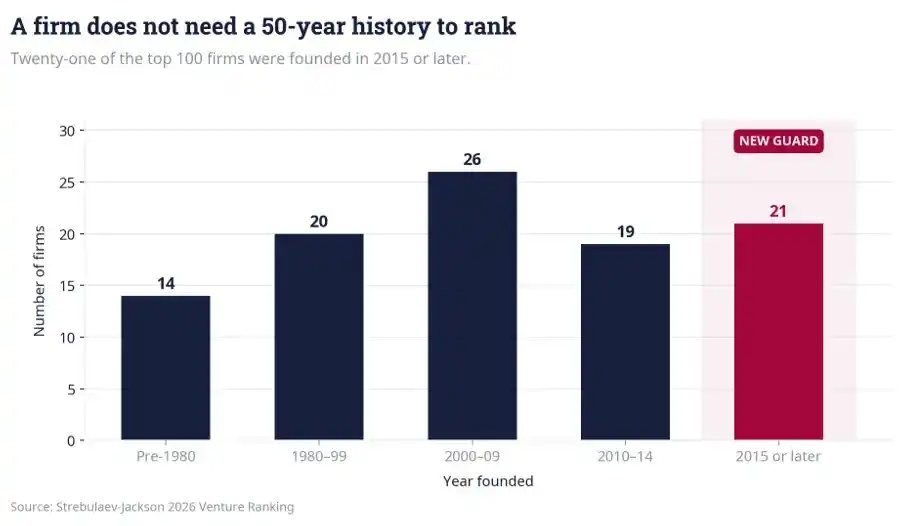
Image: 21 of the top 100 were founded in 2015 or later. Track records compound; a decade is enough to build one. Source: The VC Corner, 2026
A cohort of life sciences investors rank because of therapies, not software: OrbiMed (27), Atlas Venture (38), ARCH (49), Versant (61), and Sofinnova (75), all ranking on concentrated, capital-efficient bets. Crypto-native firms like Paradigm (34), Pantera (76), Multicoin (84), and Polychain (94) rank on another type of opportunity. The methodology is not biased toward any sector; it measures value created, net of cost and decay, wherever it happens.
If you're building in a specific domain, the best investor for you might be a specialist. And they will never appear at the top of a generalist media list.
AI Is Already Rewriting the Top of the List
Twenty-three firms in the top 100 have a frontier AI or AI infrastructure company as their single highest-scoring investment. That's almost a quarter of the list. The batch of companies they anchor mostly didn't exist five years ago, or were very small.
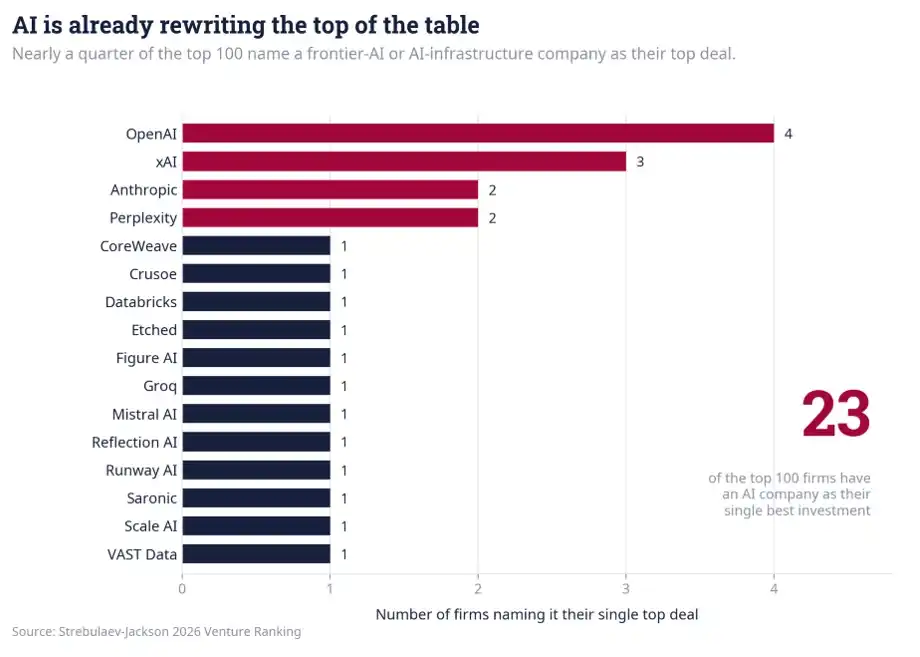
Image: Nearly a quarter of the top 100 list a frontier AI or AI infrastructure company as their top deal. Most of these companies did not exist or were very small five years ago.
The decay factor means this reshaping happens in real time. Firms that made early, concentrated bets on leading AI companies—like Thrive on OpenAI, Menlo on Anthropic, Lightspeed on Mistral—get credit immediately, not years later at exit.
What a Ranking Can't Tell You
Some founder somewhere is already pasting this table into a spreadsheet, sorting by rank. He's about to email firms #1 through #100 in order. I understand the impulse. Ranking lists are seductive precisely because they appear to do the thinking for you.
But if there's one thing you shouldn't do, it's using the list this way. Nor should you use any list released by Ruben, me, or anyone else this way. A ranking is an argument about what's good, compressed into a number. The order is the least interesting part. What matters is the reasoning behind it. See if that reasoning matches what you actually want to do. And see what your own research uncovers when you apply it to your situation. Read the methodology, object to the parts you want to object to, and then do your own homework.
A ranking can help you narrow a list, but the final choice should be driven by three things. No score fully captures any of them.
Consider Fit, Not Just Rank. This ranking measures many styles with one ruler. Crossover and hedge-fund-style firms like Tiger Global (5), DST Global (4), Dragoneer (23), Altimeter (24), Coatue (29), and Greenoaks (44) tend to take large minority stakes. They rarely or never take board seats. Sequoia and Benchmark operate with a deep-involvement, heavy-board model. Sutter Hill (26) virtually incubates companies from scratch. All these models score highly because they all create value. But from a founder's seat, they feel completely different. A founder who wants a deep partner and a founder who wants capital plus autonomy should pick different firms from the same top 100. A high rank won't tell you which one you're looking at.
Vet the Partner, Not the Brand. One of the most striking facts from our data is that a full half of the top 100 firms have no partner in the individual top 100. Firm strength and individual strength are far from the same thing. That's precisely why our methodology splits the score. The person sitting on your board isn't the brand; it's an individual. Ask who specifically will work with you, what else they have on their plate, how long they've been at the firm. Then do reference checks with founders they've backed. Include founders of companies that failed. How an investor behaves in a down round is the information you need most. No ranking, including ours, can provide that.
Remember, This is More Like a Marriage Than a Transaction. An investor will be your partner for seven, ten, sometimes fifteen years. That's longer than many marriages, and much harder to exit. You can sell the house, change the product, change the team. But it's very hard to move an investor off your cap table or board. That asymmetry should slow you down. Especially in the moment a competitive financing round pressures you to speed up.
The value-add factor exists in our ranking because deeply engaged investors demonstrably affect outcomes. But the same board seat that opens a door can also block a sale, overturn strategy, or fire the CEO. So don't just ask if the investor will help you win; ask if, on your worst day, you want this person in the room. An investor who ranks slightly lower but is truly aligned with you is better than one who ranks higher but isn't.
How to Use This List
Filter by Performance. The 5% who create 90% of the profits are worth real effort to reach. The table above tells you where they are.
Filter by Fit. Stage, sector, check size, and the kind of involvement you want.
Go One Layer Deeper, Look at Individuals. The firm gets you the meeting, but you work with one person for years after.
Do Downside Reference Checks. Talk to founders whose companies struggled, not just the stars on the firm's website.
What's Next
We will extend the same six factors to individual investors, not firms. The contrast with conventional wisdom is even starker: over half of our top 100 individual VCs are completely absent from the 2026 Forbes Midas List. We will also expand the ranking internationally, release sector-specific rankings starting with biotech and AI, incorporate verified data for firms and investors, and publish historical series for about 25 years, making the rise and fall of firms directly visible.
Q: Which VC firm performed best?
A: Sequoia Capital leads the 2026 Strebulaev-Jackson VC Ranking with 10,158 points. It leads Andreessen Horowitz's 8,292 points and Accel's 4,576 points. The score measures value actually captured after accounting for dilution, cost, and decay over time.
Q: How much better are top VC firms than average ones?
A: The top-ranked firm scores about 41 times more than the 100th-ranked firm. By rank 10, the score has already fallen to less than a third of Sequoia's. This indicates the power law in venture capital applies to the firms themselves, not just individual deals.
Q: Does investing in more unicorns mean a VC performs better?
A: No. SV Angel invested in about 139 unicorns but ranks #31. Thrive invested in 47 unicorns and ranks #8. The ranking rewards value actually captured after dilution, not the count of billion-dollar logos.
Q: How concentrated are VC returns?
A: The top 5% of VC firms create about 90% of the industry's profits. So whether your investor is in that 5% is decisive, not marginal.
Q: Do you need a decades-old firm to be a top VC?
A: No. 21 of the top 100 firms were founded in 2015 or later. So a decade of concentrated, well-timed holdings is enough to rank alongside firms with 50-year histories.
Q: Which AI companies do top VC firms name as their best investments?
A: 23 of the top 100 firms list a frontier AI or AI infrastructure company as their single highest-scoring investment. OpenAI is named by four firms, xAI by three, Anthropic and Perplexity each by two.
Q: Where are the best VC firms located?
A: Of the top 100 firms, 62 are headquartered in California, 19 in New York, and 6 each in Massachusetts and Texas.