South Korea Joins Global Bitcoin Spot ETF Push, Targets 2026 Rollout

bitcoinistPublished on 2026-01-10Last updated on 2026-01-10

Abstract

South Korea has announced plans to introduce Bitcoin spot exchange-traded funds (ETFs) by 2026 as part of its broader digital asset reforms. The government is using the established spot crypto ETF markets in the US and Hong Kong as key references for its framework. These ETFs allow investors to gain exposure to cryptocurrencies like Bitcoin without directly owning the assets. In addition to ETFs, South Korea's Financial Services Commission is accelerating legislation to establish a regulatory framework for stablecoins. The announcement comes as US Bitcoin spot ETFs have recently experienced significant outflows, with the latest weekly netflow reported at a negative $431 million. Concurrently, Bitcoin's price has retraced to approximately $90,500.

South Korea has announced plans to introduce Bitcoin spot exchange-traded funds (ETFs) in 2026 as part of broader digital asset reforms.

South Korea Using US & Hong Kong Crypto Spot ETFs As A Reference

South Korea revealed in its 2026 Economic Growth Strategy plans to allow spot digital asset ETFs this year, according to Wu Blockchain, citing local media outlet News1.

Spot ETFs are investment vehicles that allow traders to gain exposure to an underlying asset without having to directly own it. Such vehicles trade in the traditional markets, so investors of a spot ETF tied to a cryptocurrency never have to interact with blockchain components like wallets and exchanges.

Instead, the funds buy and custody the assets on behalf of investors. In recent years, spot ETFs tied to cryptocurrencies like Bitcoin have gained adoption in different regions of the world as DeFi and TradFi intersect.

The US Securities and Exchange Commission (SEC) approved spot ETFs for Bitcoin in January 2024 and Ethereum in July 2024, while the Hong Kong Securities and Futures Commission (SFC) allowed both in April 2024. Approvals related to altcoins like Solana followed in 2025.

Now, it would appear that South Korea is also looking to join the fray. Per the report, the country’s government has explicitly cited the digital asset spot ETF markets active in the US and Hong Kong as key reference points. Plans related to spot ETFs aren’t all that South Korea has announced. The Financial Services Commission (FSC) of the country is also accelerating the next phase of its digital asset legislation, which will establish a framework for stablecoins.

In the East Asian bloc, other governments have already made progress on stablecoins. Hong Kong enacted its stablecoin legislation in August, while Japan saw the launch of its first yen-backed token in October. While South Korea has set a timeframe of 2026, it’s unknown when exactly spot ETFs could be introduced. As such, it only remains to be seen what plans the government will reveal next and which assets besides Bitcoin will be covered.

Speaking of spot Bitcoin ETFs, these funds have been facing outflows in the US recently, as data from SoSoValue shows.
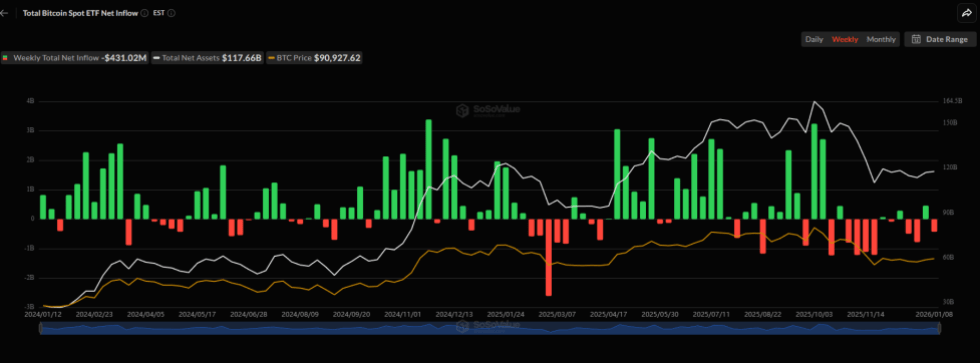
How the spot BTC ETF netflow has changed over the last couple of years | Source: SoSoValue

From the chart, it’s visible that the Bitcoin spot ETF weekly netflow has mostly been negative since the cryptocurrency’s decline started in October. There were a few weeks that saw a positive value, but the scale of net inflows remained limited.

The netflow for the latest week has stood at a negative $431 million, meaning that the US funds are continuing to bleed.

BTC Price

Bitcoin has erased some of its recent gains as its price has retraced back to $90,500.

Looks like the price of the coin has gone down recently | Source: BTCUSDT on TradingView


Trending Cryptos

Related Questions

QWhat is the timeline for South Korea's introduction of Bitcoin spot ETFs?

ASouth Korea plans to introduce Bitcoin spot exchange-traded funds (ETFs) in 2026 as part of its broader digital asset reforms.

QWhich two markets did South Korea cite as key reference points for its digital asset spot ETF plans?

ASouth Korea's government cited the digital asset spot ETF markets active in the United States and Hong Kong as key reference points.

QBesides spot ETFs, what other major digital asset legislation is South Korea's Financial Services Commission (FSC) accelerating?

AThe Financial Services Commission (FSC) of South Korea is also accelerating the next phase of its digital asset legislation to establish a framework for stablecoins.

QWhat was the netflow for the latest week for US Bitcoin spot ETFs, according to data from SoSoValue?

AThe netflow for the latest week for US Bitcoin spot ETFs was a negative $431 million, indicating continued outflows.

QWhat was the price of Bitcoin mentioned at the end of the article?

AAt the end of the article, the price of Bitcoin had retraced back to $90,500.

Related Reads

Bitcoin Withdrawals Continue: 8 Years of Storage in a Coldcard Cold Wallet Ended in Zero

Coldcard Hardware Wallet Hacked: Losses Mount Due to Vulnerable Seed Generation A critical vulnerability in Coldcard hardware wallets has led to a continued wave of fund thefts. According to Galaxy Research, the total stolen has reached 1,367.05 BTC (approx. $88.6 million) from 4,585 addresses, a significant increase from the initial 594.5 BTC reported on July 30, 2026. Most of the stolen funds remain on the attackers' addresses. The issue is not with the current firmware, which Coinkite has updated, but with seed phrases generated on vulnerable devices between March 2021 and the release of fixed firmware versions. Due to a programmer error, devices switched from using a hardware random number generator to the software-based Yasmarang generator, which was initialized with publicly accessible data like the chip's serial number. This made the seed phrases predictable through offline brute-force attacks, meaning wallets remain at risk until funds are moved to a new wallet generated with the patched firmware. Affected devices include Mk2/Mk3 with firmware 4.0.1–4.1.9 (and up to 5.0.3), Mk4/Mk5 up to version 5.6.0, and Q models up to 1.5.0Q. The only exceptions are seeds created with a high-entropy method like at least 50 independent dice rolls or a strong unique BIP-39 passphrase. All other owners must generate a new seed on the fixed firmware and transfer their assets. A case highlighting the human impact involves a 39-year-old long-term investor who lost 2 BTC (approx. $130,000) in minutes. He had accumulated the Bitcoin over eight years through physical labor, viewing it as a financial lifeline and a retirement plan in a country suffering from hyperinflation. His story underscores that even conservative "buy and hold in cold storage" strategies can be compromised by such underlying technical flaws. From a technical perspective, this incident echoes historical failures where weak random number generators undermined cryptographic security, challenging the assumption that offline storage is automatically foolproof.

cryptonews.ru1h ago

Bitcoin Withdrawals Continue: 8 Years of Storage in a Coldcard Cold Wallet Ended in Zero

cryptonews.ru1h ago

Trading

Spot

Hot Articles

How to Buy PUSH

Welcome to HTX.com! We've made purchasing Push Protocol (PUSH) simple and convenient. Follow our step-by-step guide to embark on your crypto journey.Step 1: Create Your HTX AccountUse your email or phone number to sign up for a free account on HTX. Experience a hassle-free registration journey and unlock all features.Get My AccountStep 2: Go to Buy Crypto and Choose Your Payment MethodCredit/Debit Card: Use your Visa or Mastercard to buy Push Protocol (PUSH) instantly.Balance: Use funds from your HTX account balance to trade seamlessly.Third Parties: We've added popular payment methods such as Google Pay and Apple Pay to enhance convenience.P2P: Trade directly with other users on HTX.Over-the-Counter (OTC): We offer tailor-made services and competitive exchange rates for traders.Step 3: Store Your Push Protocol (PUSH)After purchasing your Push Protocol (PUSH), store it in your HTX account. Alternatively, you can send it elsewhere via blockchain transfer or use it to trade other cryptocurrencies.Step 4: Trade Push Protocol (PUSH)Easily trade Push Protocol (PUSH) on HTX's spot market. Simply access your account, select your trading pair, execute your trades, and monitor in real-time. We offer a user-friendly experience for both beginners and seasoned traders.

4.1k Total ViewsPublished 2024.03.29Updated 2026.06.02

How to Buy PUSH

Discussions

Welcome to the HTX Community. Here, you can stay informed about the latest platform developments and gain access to professional market insights. Users' opinions on the price of PUSH (PUSH) are presented below.

活动图片












