Sorry everyone, Bitcoin is headed down to $43,500: Michael Terpin

cointelegraphPublished on 2026-08-04Last updated on 2026-08-04

Abstract

Veteran crypto investor Michael Terpin predicts Bitcoin will fall to approximately $43,500, a 66% drop from its all-time high of $126,100 in October 2025. He states the market has not yet seen true capitulation and emphasizes that a defining hallmark of a bottom is that prices don't quickly rebound. Terpin, an early industry investor and founder of Transform Ventures, believes Bitcoin is still following its traditional four-year cycle, dismissing arguments that institutional adoption has permanently altered its pattern. While acknowledging the historical outperformance of Michael Saylor's company Strategy, Terpin personally prefers direct Bitcoin investment over corporate structures or altcoins, advising a low-maintenance approach focused on cycle timing rather than constant portfolio management.

Bitcoin may have already erased half of its market cap, but veteran crypto investor Michael Terpin says the asset still has further to fall before hitting rock bottom.

“We still have more pain to go,” Terpin tells Cointelegraph on the Trade Secrets show. Terpin believes that Bitcoin will ultimately fall “66%” from its October 2025 all-time high of $126,100. “I think that brings us down into the 40s, and I think that’s about where we’re gonna go,” Terpin says.

To be precise, a 66% drop from the ATH would see Bitcoin changing hands for $43,500, a price the asset has not seen since early February 2024. The 68-year-old investor, often referred to as the “Godfather of Crypto,” has seen Bitcoin plunge enough times to know what a true bottom feels like.

The ‘defining hallmarks’ of a Bitcoin bottom

Terpin doesn’t think markets have seen true capitulation yet. “One of the defining hallmarks of the bottom is that it doesn’t pop back,” Terpin says.

Michael Terpin spoke to Cointelegraph on the Trade Secrets show. Source: Cointelegraph

Terpin points out that greed is invariably why most traders fail to time market cycles correctly. He points to Bitcoin’s previous cycle top in November 2021, when the asset reached around $69,000 before entering an extended consolidation period. “You had quite a bit of time to get out over $60,000. But then everybody thought it was going to $100,000,” Terpin says, “remember the laser eyes?”

Terpin wasn’t confident back then that Bitcoin would reach $100,000. “I thought there was a possibility it could go to a hundred, but I thought the sweet spot was going to be eighty-five. And it obviously underperformed that because of all the bad macro,” Terpin says.

“We’ve had two cycles in a row now with bad macro. And you would have expected good macro from Trump, but the tariffs, and some of the other things that allowed a lot of manipulation,” Terpin says.

Bitcoin ultimately reached $100,000 in December 2024, just a month after Donald Trump won the US presidential election.

Terpin worked with Ethereum in its early stages

Terpin was an early investor in the crypto industry and is the founder and CEO of blockchain advisory firm Transform Ventures.

Through his company, he worked with several projects during their early development stages that went on to become major names in the industry, including Ethereum, Tether, and WAX. He was also an advisor to Mastercoin, the world’s first initial coin offering (ICO) in 2013. It later became known as Omni Layer.

Terpin claims he was the first crypto investor to relocate to Puerto Rico, which is known for its crypto-friendly tax policies. Since moving, he has also invested in and helped fund several startups based on the island.

Michael Terpin says four-year cycle is not over

He is convinced that Bitcoin is still following its traditional four-year cycle, despite the industry debate in 2025 that institutional adoption and the launch of spot ETFs may have changed the market’s usual boom-and-bust pattern.
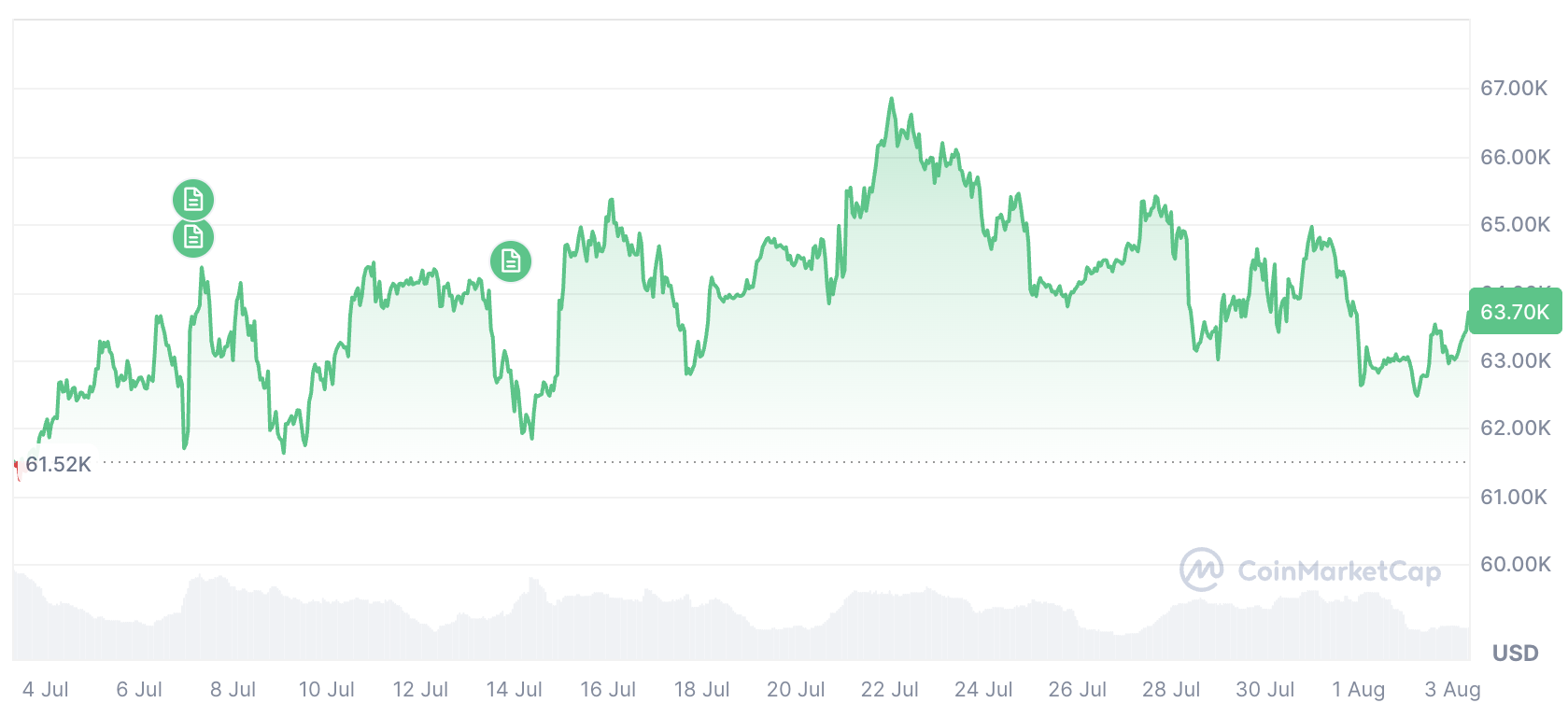
Bitcoin is up 1.67% over the past 30 days. Source: CoinMarketCap

“I think we’re still following the halvings. This whole argument that, you know, we’re only going up from here because institutions don’t sell is garbage, right? Institutions absolutely sell.”

Terpin is also cautious about companies built around Bitcoin exposure, including Strategy and its executive chairman Michael Saylor’s aggressive Bitcoin accumulation strategy.

Buying Strategy stock or Bitcoin?

While acknowledging Saylor’s success, Terpin says investors should understand the risks of investing in a corporate structure rather than owning the underlying asset.

“I mean historically, you’ve done better if you buy Strategy at the bottom and then sell it at the top than if you buy the Bitcoin,” Terpin says. “Whether he’s [Michael Saylor] able to keep that going, and you know, he avoided being wrecked in 2022 when he was actually underwater with his Bitcoin.” But Terpin would personally “rather bet on Bitcoin than a single company.”

And indeed, investors looking for a low maintenance approach should also bet on Bitcoin rather than chasing altcoins, which require far more active management.

“You only have to look at your portfolio like a couple times during the four-year cycle,” Terpin says.

“When we’re getting near the bottom, see if it’s time to buy. And when we’re getting near the top, see when it’s time to sell. And the rest of the time you can just be on the golf course. Whereas with altcoins, you gotta be, you gotta be on it,” Terpin says.





Trending Cryptos

Related Questions

QWhat specific Bitcoin price does Michael Terpin predict, and what percentage drop does that represent from its all-time high?

AMichael Terpin predicts Bitcoin will fall to $43,500. This represents a 66% drop from its October 2025 all-time high of $126,100.

QAccording to Terpin, what is one defining hallmark of a true Bitcoin market bottom?

ATerpin states that one defining hallmark of a true Bitcoin market bottom is that the price does not quickly rebound or 'pop back'.

QDoes Michael Terpin believe that the traditional four-year Bitcoin cycle has been broken by institutional adoption and ETFs?

ANo, Michael Terpin is convinced Bitcoin is still following its traditional four-year cycle. He dismisses arguments that institutional adoption and spot ETFs have permanently changed the boom-and-bust pattern.

QHow does Terpin's investment advice for Bitcoin differ from his advice for altcoins?

ATerpin advises that Bitcoin requires less active management—suggesting investors only need to check their portfolio a few times during a four-year cycle. In contrast, he says altcoins require constant, active attention ('you gotta be on it').

QWhat is Terpin's stated personal preference between investing in Bitcoin directly versus investing in Michael Saylor's company Strategy?

ATerpin would personally 'rather bet on Bitcoin than a single company.' While acknowledging that Strategy stock has historically outperformed Bitcoin in certain cycles, he prefers the direct ownership of the underlying asset.

Related Reads

The Biggest AI Black Hole: After Anthropic's Annual Revenue Hits $1 Trillion, Compute Power Prices Soar 10x

The article explores the potential for a dramatic surge in compute prices driven by the AI industry's explosive growth. It highlights a provocative prediction by tech podcaster Dwarkesh Patel: if AI labs like Anthropic continue their rapid revenue growth (projected to reach $1 trillion annually) while compute supply only expands at about 3x per year, the price of computing power could skyrocket by 10x or more. The core argument is a paradigm shift: GPUs are transitioning from mere hardware tools to carriers of "digital labor." If a single H100 GPU can host an AI agent capable of replacing a top-tier software engineer (with a Silicon Valley salary of $250k), its economic value should be recalibrated accordingly. Currently, the annual rental cost of an H100 is around $16k, creating a massive 15x valuation gap—a "labor arbitrage black hole." This imbalance stems from a critical mismatch: AI capabilities and commercial revenue are growing faster than the physical infrastructure (chips, data centers) can be built. With compute supply constrained by physical limits like chip manufacturing capacity, and demand soaring, prices are pressured upward. The piece further argues that expensive compute incentivizes using the most capable (and expensive) AI models, as cheaper, less efficient models waste more costly compute time—a phenomenon linked to the Alchian-Allen effect. Counterarguments are noted, suggesting AI's value may be capped in physical-world applications and that history often disproves predictions of resource scarcity. However, the response is that compute supply lacks the elasticity of traditional commodities. The conclusion is that before compute potentially becomes cheap and abundant, the industry may face an intense period of compute inflation and an arms race for this strategic resource.

marsbit56m ago

The Biggest AI Black Hole: After Anthropic's Annual Revenue Hits $1 Trillion, Compute Power Prices Soar 10x

marsbit56m ago

Trading

Spot

Hot Articles

What is $BITCOIN

DIGITAL GOLD ($BITCOIN): A Comprehensive Analysis Introduction to DIGITAL GOLD ($BITCOIN) DIGITAL GOLD ($BITCOIN) is a blockchain-based project operating on the Solana network, which aims to combine the characteristics of traditional precious metals with the innovation of decentralized technologies. While it shares a name with Bitcoin, often referred to as “digital gold” due to its perception as a store of value, DIGITAL GOLD is a separate token designed to create a unique ecosystem within the Web3 landscape. Its goal is to position itself as a viable alternative digital asset, although specifics regarding its applications and functionalities are still developing. What is DIGITAL GOLD ($BITCOIN)? DIGITAL GOLD ($BITCOIN) is a cryptocurrency token explicitly designed for use on the Solana blockchain. In contrast to Bitcoin, which provides a widely recognized value storage role, this token appears to focus on broader applications and characteristics. Notable aspects include: Blockchain Infrastructure: The token is built on the Solana blockchain, known for its capacity to handle high-speed and low-cost transactions. Supply Dynamics: DIGITAL GOLD has a maximum supply capped at 100 quadrillion tokens (100P $BITCOIN), although details regarding its circulating supply are currently undisclosed. Utility: While precise functionalities are not explicitly outlined, there are indications that the token could be utilized for various applications, potentially involving decentralized applications (dApps) or asset tokenization strategies. Who is the Creator of DIGITAL GOLD ($BITCOIN)? At present, the identity of the creators and development team behind DIGITAL GOLD ($BITCOIN) remains unknown. This situation is typical among many innovative projects within the blockchain space, particularly those aligning with decentralized finance and meme coin phenomena. While such anonymity may foster a community-driven culture, it intensifies concerns about governance and accountability. Who are the Investors of DIGITAL GOLD ($BITCOIN)? The available information indicates that DIGITAL GOLD ($BITCOIN) does not have any known institutional backers or prominent venture capital investments. The project seems to operate on a peer-to-peer model focused on community support and adoption rather than traditional funding routes. Its activity and liquidity are primarily situated on decentralized exchanges (DEXs), such as PumpSwap, rather than established centralized trading platforms, further highlighting its grassroots approach. How DIGITAL GOLD ($BITCOIN) Works The operational mechanics of DIGITAL GOLD ($BITCOIN) can be elaborated on based on its blockchain design and network attributes: Consensus Mechanism: By leveraging Solana’s unique proof-of-history (PoH) combined with a proof-of-stake (PoS) model, the project ensures efficient transaction validation contributing to the network's high performance. Tokenomics: While specific deflationary mechanisms have not been extensively detailed, the vast maximum token supply implies that it may cater to microtransactions or niche use cases that are still to be defined. Interoperability: There exists the potential for integration with Solana’s broader ecosystem, including various decentralized finance (DeFi) platforms. However, the details regarding specific integrations remain unspecified. Timeline of Key Events Here is a timeline that highlights significant milestones concerning DIGITAL GOLD ($BITCOIN): 2023: The initial deployment of the token occurs on the Solana blockchain, marked by its contract address. 2024: DIGITAL GOLD gains visibility as it becomes available for trading on decentralized exchanges like PumpSwap, allowing users to trade it against SOL. 2025: The project witnesses sporadic trading activity and potential interest in community-led engagements, although no noteworthy partnerships or technical advancements have been documented as of yet. Critical Analysis Strengths Scalability: The underlying Solana infrastructure supports high transaction volumes, which could enhance the utility of $BITCOIN in various transaction scenarios. Accessibility: The potential low trading price per token could attract retail investors, facilitating wider participation due to fractional ownership opportunities. Risks Lack of Transparency: The absence of publicly known backers, developers, or an audit process may yield skepticism regarding the project's sustainability and trustworthiness. Market Volatility: The trading activity is heavily reliant on speculative behavior, which can result in significant price volatility and uncertainty for investors. Conclusion DIGITAL GOLD ($BITCOIN) emerges as an intriguing yet ambiguous project within the rapidly evolving Solana ecosystem. While it attempts to leverage the “digital gold” narrative, its departure from Bitcoin's established role as a store of value underscores the need for a clearer differentiation of its intended utility and governance structure. Future acceptance and adoption will likely depend on addressing the current opacity and defining its operational and economic strategies more explicitly. Note: This report encompasses synthesised information available as of October 2023, and developments may have transpired beyond the research period.

1.5k Total ViewsPublished 2025.05.13Updated 2025.05.13

What is $BITCOIN

Discussions

Welcome to the HTX Community. Here, you can stay informed about the latest platform developments and gain access to professional market insights. Users' opinions on the price of BTC (BTC) are presented below.

活动图片