Solana’s Low Fees Create Strong Competition for Base, BNB, and Polygon and Fuel SUBBD Token

bitcoinistPublished on 2026-02-10Last updated on 2026-02-10

Abstract

Solana's consistently low transaction fees, often below $0.001, are creating intense competitive pressure on rival blockchains like Base, BNB Chain, and Polygon. This cost efficiency is driving retail liquidity toward Solana and shifting market demand toward low-friction utility platforms. A key beneficiary of this trend is SUBBD Token ($SUBBD), which leverages AI and Web3 infrastructure to disrupt the $191 billion creator economy. SUBBD addresses the high commission fees (up to 70%) on Web2 platforms by offering AI-driven tools for content creators, including voice cloning and automated assistants, enabling better monetization and workflow efficiency. The project has raised over $1.47 million in its ongoing presale, signaling strong interest in the convergence of AI and crypto for content monetization.

Trusted Editorial content, reviewed by leading industry experts and seasoned editors. Ad Disclosure

Quick Facts:

  • ➡️ Solana’s sub-cent transaction fees are forcing competitors like Base and Polygon to accelerate efficiency upgrades to retain retail liquidity.
  • ➡️ The market demand for low friction is shifting from DeFi trading to the $191B creator economy, where Web2 platforms charge up to 70% fees.
  • ➡️ SUBBD Token leverages AI and Web3 infrastructure to minimize platform fees and automate creator workflows, having raised over $1.47M in its ongoing presale.
  • ➡️ The convergence of AI tools (voice cloning, assistants) with crypto payments represents the next evolution of digital content monetization.

The battle for blockchain dominance isn’t just about theoretical throughput anymore; it’s about the tangible reality of user costs. And right now, Solana is dictating the pace.

Recent on-chain data shows that Solana’s average transaction fee remains consistently below $0.001, often hovering near $0.00025 for non-priority transactions. That creates immense pressure on competing ecosystems like Base, BNB Chain, and Polygon. It’s essentially forcing a ‘race to the bottom’ regarding cost efficiency.

Sure, Base (Coinbase’s Layer-2) saw fees drop significantly following the Ethereum Dencun upgrade. But network congestion can still spike costs to $0.05 or higher during peak retail activity.

Similarly, while BNB Chain and Polygon are cheap compared to Ethereum mainnet, they often struggle to match the sub-cent consistency of Solana’s monolithic architecture. Why does this matter? Because retail liquidity flows where friction is lowest. If a user can swap a token for a fraction of a penny on Solana versus paying five to ten cents elsewhere, those aggregate savings drive volume.

But the demand for reduced friction extends beyond simple token swaps. We’re seeing a capital rotation toward utility-driven platforms that solve ‘fee fatigue’ in other sectors, particularly the digital content economy. Just as traders flock to Solana to escape DeFi gas fees, content creators are hunting for alternatives to Web2 platforms that charge exorbitant commission rates.

This search for economic efficiency is driving interest toward decentralized apps merging AI utility with better monetization. That’s creating a serious tailwind for new entrants like SUBBD Token ($SUBBD).

Read more about $SUBBD here.

AI-Driven Monetization And The Fight Against 70% Fees

The disconnect between creator output and income retention has hit a wall. Legacy Web2 platforms frequently deduct between 20% and 70% of a creator’s earnings.

That’s a ‘platform tax’ making blockchain gas fees look negligible by comparison. SUBBD Token ($SUBBD) aims to disrupt this $191B industry by applying crypto’s low-friction philosophy to content monetization.

Operating as an ERC-20 token on Ethereum, SUBBD uses EVM-compatible smart contracts to replace intermediaries with code. But it’s not just a payment rail. The platform integrates proprietary AI models, including automated personal assistants, voice cloning, and object recognition, to streamline workflows.

The project offers a tech stack allowing influencers to create ‘AI versions’ of themselves to interact with fans 24/7. It effectively solves the scalability problem for humans (who, unlike bots, need sleep).

From a tokenomics perspective, integrating AI represents a major shift. By allowing creators to token-gate exclusive content and use AI tools for optimization, SUBBD lowers the barrier to entry while raising the revenue ceiling. Of course, the risk is execution; the platform must ensure its AI tools are intuitive enough for non-crypto natives.

But the value proposition is clear: creators keep more of what they earn, mirroring the efficiency users seek in high-performance blockchains.

Check out the $SUBBD presale here.

Presale Data Signals Appetite For Creator Economy Disruption

Traders are watching the SUBBD Token presale as a gauge for sentiment on the AI-Web3 convergence.

According to live data, the project has raised exactly $1.47M, a sign of steady accumulation despite broader market volatility. With tokens priced at $0.057495, early participants are positioning themselves before the platform fully deploys its mainnet features.
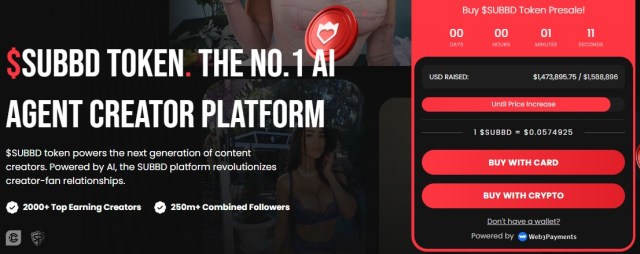
The staking architecture seems designed to encourage long-term holding rather than mercenary capital rotation. SUBBD offers a fixed 20% APY for the first year to users who lock their tokens. But it’s not just about yield.

Staking unlocks tangible utility: access to exclusive livestreams, ‘behind the scenes’ (BTS) drops, and XP multipliers that enhance platform standing. This gamified approach to liquidity retention suggests the team is prioritizing community stability over short-term hype.

In previous market cycles, utility tokens launching with functional ecosystems, rather than just roadmap promises, have tended to outperform during recovery phases. With the presale progressing, the focus shifts to the rollout of the ‘HoneyHive’ governance features and onboarding the first cohort of AI-driven influencers.

For investors tired of high-fee structures in both DeFi and Web2, SUBBD presents a logic-driven alternative.

Buy $SUBBD here.

This article is for informational purposes only and does not constitute financial advice. Cryptocurrencies are high-risk assets. Always perform your own due diligence before investing. The views expressed here are those of the author and do not necessarily reflect the official policy of any financial institution.

Editorial Process for bitcoinist is centered on delivering thoroughly researched, accurate, and unbiased content. We uphold strict sourcing standards, and each page undergoes diligent review by our team of top technology experts and seasoned editors. This process ensures the integrity, relevance, and value of our content for our readers.

patrubogdan

Follow

Full Profile

Related Posts

AI Can’t Save the Market Alone, But It Can Transform It: How SUBBD Token Redefines Content Economics

Russian Lawmaker Predicts Bitcoin Collapse While Smart Money Rotates into Layer 2 Utility

Chainlink Founder Sergey Nazarov Identifies 3 Trends That Will Define the Cryptosphere as Hyper Token Soars

Bitcoin Demand Plunges Per CryptoQuant, Yet Maxi Doge Endures

Crypto Markets Catch A Breather As Outflows Begin To Slow: Analysts

SUBBD Token’s Massive Projected Impact on the Content Creation Market in 2026

Trending Cryptos

Related Questions

QWhat is the average transaction fee on the Solana network, and how does it compare to competitors like Base and Polygon?

ASolana's average transaction fee remains consistently below $0.001, often near $0.00025 for non-priority transactions. This is significantly lower than competitors; Base can see fees spike to $0.05 or higher during congestion, and while BNB Chain and Polygon are cheaper than Ethereum, they struggle to match Solana's sub-cent consistency.

QWhat problem does SUBBD Token aim to solve in the digital content economy?

ASUBBD Token aims to disrupt the $191B digital content economy by addressing the exorbitant commission fees (20-70%) charged by legacy Web2 platforms. It uses crypto's low-friction philosophy and AI tools to allow creators to keep more of their earnings and automate workflows.

QWhat are some of the AI features integrated into the SUBBD platform?

AThe SUBBD platform integrates proprietary AI models, including automated personal assistants, voice cloning, and object recognition. It allows creators to make 'AI versions' of themselves to interact with fans 24/7, solving the scalability problem for human creators.

QHow much capital has the SUBBD Token presale raised, and what is the current token price?

AThe SUBBD Token presale has raised $1.47 million. The tokens are currently priced at $0.057495 in its ongoing presale.

QWhat staking rewards does SUBBD offer, and what utility do stakers gain?

ASUBBT offers a fixed 20% APY for the first year to users who lock their tokens. Staking also unlocks tangible utility, including access to exclusive livestreams, 'behind the scenes' content drops, and XP multipliers that enhance a user's standing on the platform.

Related Reads

Claude's Major New Feature: Screen Recording + Voice, Distilling Your Skills into AI Tasks in One Click

Claude has introduced a major new feature called "Record a Skill," available for Pro, Max, and Team users. This function, found in the Claude desktop app's CoWork menu, allows users to create reusable AI skills simply by recording their screen and providing voice narration while performing a task. Claude then automatically analyzes the recording and generates a functional Skill. A hands-on test confirmed the feature works seamlessly. Users start recording via the Skills manager, perform their workflow while verbally explaining the steps and logic, and avoid including sensitive information. After recording, Claude processes the content and creates the Skill, which can be saved and later invoked with a slash command (/). This eliminates the need for manual adjustments or writing complex instruction files. The innovation goes beyond mere efficiency. Previously, creating a Skill required writing a detailed SKILL.md file in Markdown—a significant barrier for non-technical users. "Record a Skill" bypasses this by directly capturing both actions and the implicit reasoning shared in the narration. This lowers the barrier to knowledge transfer and automation, addressing a core challenge in corporate knowledge management: the difficulty of getting experts to write and maintain documentation. However, the feature also highlights a shift in the nature of work. A case study from March 2026 showed a freelancer whose five-year client relationship was effectively replaced by a hand-coded Claude Skill automating their content workflow. With the even lower barrier of screen recording, the ability to distill personal expertise into automatable skills accelerates this trend. The "moat" for work is moving from simply knowing how to do a task to mastering tasks that are difficult or impossible to automate.

marsbit4m ago

Claude's Major New Feature: Screen Recording + Voice, Distilling Your Skills into AI Tasks in One Click

marsbit4m ago

Feeding AI "Noise" Can Also Boost Scores, This Work Enables Positive Transfer with Noise

Feeding "Noise" to AI Can Improve Performance: A Method Enables Positive Transfer from Noise This work, Semi-Supervised Noise Adaptation (SSNA), introduces a Noise Adaptation Framework (NAF) that challenges traditional transfer learning. Instead of requiring a labeled source domain of real data (e.g., images, text), NAF uses randomly generated Gaussian noise as the source. For a target task with C classes, it constructs C noise clusters by sampling from Gaussian distributions. Although this synthetic noise contains no semantic meaning, NAF trains it to form a discriminative class structure in a shared representation space—clustering same-class noise and separating different classes. The key is aligning this learned structure from the noise domain to the real, sparsely labeled target domain. A small number of target labels are still essential to establish the correspondence between noise clusters and actual classes. The training objective combines: 1) supervised loss on the few labeled target samples, 2) classification loss for the noise to build its structure, and 3) a distribution alignment loss (using Negative Domain Similarity) to minimize the gap between the noise and target domains in the shared space. Experiments show significant gains in few-label settings. With just 4 labels per class, NAF with a ResNet-18 backbone improves accuracy over a standard supervised baseline (ERM) by +12.35% on CIFAR-10, +7.61% on CIFAR-100, +4.38% on DTD-47, and +2.74% on Caltech-101. It also benefits fine-grained datasets and scales to ImageNet-1K (with 100 labels/class) and text classification (AG News). NAF can be integrated into existing semi-supervised methods like FixMatch for further gains. Ablation studies confirm the transferred benefit comes from the discriminative structure of the noise, not randomness itself. Collapsing all noise into a single point causes negative transfer, while increasing separation between noise cluster centers improves performance. The amount of noise per class is less critical once a basic structure forms. In conclusion, this work demonstrates that for positive transfer, the semantic content of source data may not be necessary. What can be effectively transferred is the *organizational structure* of categories within a representation space. This offers a promising alternative for scenarios where real source data is unavailable due to privacy, copyright, or procurement constraints.

marsbit5m ago

Feeding AI "Noise" Can Also Boost Scores, This Work Enables Positive Transfer with Noise

marsbit5m ago

Trading

Spot

Hot Articles

Discussions

Welcome to the HTX Community. Here, you can stay informed about the latest platform developments and gain access to professional market insights. Users' opinions on the price of SOL (SOL) are presented below.

活动图片