Solana’s 755% Surge Shows That Users Are Coming Back To The Table

bitcoinistPublished on 2026-03-08Last updated on 2026-03-08

Abstract

A new Messari report highlights Solana's remarkable resurgence, with its Total Payment Volume (TPV) surging 755% year-over-year, far outpacing competitors like Ethereum and traditional fintech giants. This growth signals a strong return of users and developers to the ecosystem, driven by Solana's high-speed, low-cost infrastructure that settles transactions in milliseconds for a fraction of a cent. The network is seeing renewed institutional interest as well, with Solana Spot ETFs recording nearly $40 million in inflows over a week, led by Bitwise's fund. Despite broader market pressures, these metrics indicate that Solana is aggressively positioning itself as a backbone for global payments.

After months of bearish pressure and fading market enthusiasm, Solana (SOL) appears to be finding its footing again. A new report by Messari, a crypto market intelligence platform, shows the network’s payment volume has surged dramatically by 755%, indicating that users are finally flooding back into the blockchain. Amid this surge, Solana has also seen a significant spike in its exchange-traded fund (ETF) despite its low price, indicating that users and institutional investors are returning to the market.

Solana 755% TPV Surge Point To User Comeback

In its new report, titled ‘State of Solana Payments,’ Messari reveals that the cryptocurrency is aggressively positioning itself as the backbone of global payment infrastructure. As of February 11, 2026, the report shows that Solana’s Total Payment Volume (TPV) recorded a 755.3% year-over-year growth rate, nearly tripling the median of 268.24% across traditional fintech giants and peer layer-1 blockchains.

The figures place Solana ahead of every competitor measured, including Ethereum at 625.2%, BNB Chain at 648.3%, and legacy processors like PayPal and Fiserv, which posted modest growth rates of 6% and 7.5%, respectively. Notably, the scale of Solana’s TPV growth points to a clear return of users to the ecosystem. Volume at this level does not occur without real on-chain activity, and the data shows that both developers and end users may be actively engaging with SOL’s payment infrastructure again.
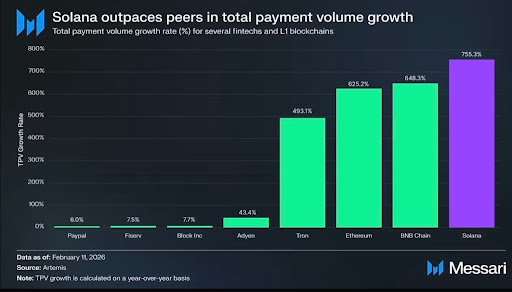
Source: Chart from Messari

In its report, Messari argues that most of SOL’s edge comes from the structural failures of traditional financial infrastructure. The current global system still relies heavily on legacy rails built for the internet. Because of this, payments are often expensive and slow. Transactions can take several days to complete as funds must pass through banks in different countries, placing a heavy burden on cross-border payments.

Messari notes that Solana addresses these issues by unifying “messaging and settlement into a single atomic operation.” Due to its high throughput and parallel architecture, the blockchain network is said to settle transactions in milliseconds, avoiding intermediaries from correspondent banks and the typical delays seen in legacy systems. Historically, SOL has also reportedly maintained a median block time of 392 milliseconds and a median transaction fee of $0.0004.

Institutional Investors Quietly Pile Into Solana ETFs

While SOL’s 755% TVL spike indicates that users are finally getting back into the network, institutional investors appear to be making similar moves, as new reports reveal a surge in Solana Spot ETFs.

According to LookOnChain data, Solana ETFs recorded 447,694 SOL in seven-day inflows, equivalent to approximately $40 million. The ETF surge comes as institutional demand surges despite broader bearish pressures on the SOL price.

Among the four Solana funds currently available for trading, Bitwise’s (BSOL) has attracted the largest net inflow by a wide margin. Daily flows into BSOL recently reached 205,287 SOL, bringing its seven-day total to 409,402 SOL. Fidelity (FSOL) ranked second in weekly inflows, recording 15,627 SOL over the past seven days, despite its daily inflow reaching just 4 SOL. By comparison, Grayscale’s (GSOL) daily inflow reached 361 SOL, and its seven-day total was 12,530 SOL.

SOL trading at $84 on the 1D chart | Source: SOLUSDT on Tradingview.com

Trending Cryptos

Related Questions

QWhat is the percentage surge in Solana's Total Payment Volume (TPV) according to Messari's report?

ASolana's Total Payment Volume (TPV) recorded a 755.3% year-over-year growth rate.

QHow does Messari explain Solana network's advantage over traditional financial systems?

AMessari states that Solana addresses the issues of traditional systems by unifying 'messaging and settlement into a single atomic operation,' settling transactions in milliseconds and avoiding intermediaries and delays.

QWhat does the 755% surge in TPV indicate about user activity on the Solana network?

AThe 755% surge in TPV indicates a clear return of users to the ecosystem, showing that real on-chain activity is happening and that both developers and end users are actively engaging with SOL's payment infrastructure.

QWhich Solana ETF attracted the largest net inflow according to LookOnChain data?

ABitwise’s Solana ETF (BSOL) attracted the largest net inflow by a wide margin, with a seven-day total of 409,402 SOL.

QWhat are Solana's reported median block time and median transaction fee?

ASolana has reportedly maintained a median block time of 392 milliseconds and a median transaction fee of $0.0004.

Related Reads

In Jinjiang, Fujian, a Storage Super Unicorn Lies Quiet

In Fujian's Jinjiang, a city known for sportswear, lies a quiet semiconductor giant: Fujian Jinhua Integrated Circuit Co. (JHICC). Once a promising domestic DRAM manufacturer alongside Yangtze Memory and ChangXin Memory Technologies (CXMT), its journey was derailed in 2018 when the U.S. placed it on an Entity List and filed criminal charges for alleged trade secret theft. This halted production for years. A turning point came in February 2024 when a U.S. federal court found JHICC not guilty. However, it had lost crucial time. While CXMT soared to become a top-valued A-share company in 2024, JHICC, with an estimated valuation of 80 billion RMB, was just restarting. Its current output is primarily customized DDR4 chips, not the advanced DDR5/HBM demanded for AI, but it still benefits from the broader memory chip upcycle. JHICC's story is tied to Chen Zhengkun, a veteran engineer who left Micron to lead the venture. Founded in 2016 with state-backed funding, JHICC partnered with Taiwan's UMC to develop DRAM technology. Rapid progress was cut short by the U.S. actions, which Micron initiated, partly due to its heavy reliance on the Chinese market. Post-sanctions, Chen's team worked to rebuild the production line with reduced reliance on U.S. technology. According to its records, JHICC achieved small-scale production and revenue growth under immense pressure. It now focuses on the stable "niche" DRAM market (e.g., TVs, routers) with a monthly capacity of ~40,000 wafers, aiming for 60,000 by 2026. It holds over 1,000 patents but remains on the Entity List. For Jinjiang, investing in JHICC was a bold industrial leap. The local government provided unwavering financial and logistical support during the crisis, helping the company survive. JHICC has become the anchor for a growing local semiconductor cluster. Though its scale lags behind domestic peers, JHICC's persistence symbolizes a hard-won foothold in a global market long dominated by Samsung, SK Hynix, and Micron. Having missed one boom, it seeks a place in the new AI-driven memory supercycle.

marsbit14m ago

In Jinjiang, Fujian, a Storage Super Unicorn Lies Quiet

marsbit14m ago

Must-Watch Events Next Week|CLARITY Act Could Face Senate Vote; SpaceX, Circle to Report Earnings (8.3-8.9)

**Summary: Key Events and Developments to Watch (August 3-9)** The upcoming week is marked by significant financial disclosures, key legislative deadlines, and notable product updates. **Major Financial Events:** Several companies are scheduled to release their Q2 2026 earnings. American Bitcoin (ABTC) will report on August 3, followed by SpaceX and Hut 8 Mining Corp. on August 4, and Circle on August 5. Notably, a significant portion of SpaceX shares (up to 12% of total shares) will be unlocked on August 6 following their earnings release. **Key Legislative Deadline:** The U.S. Senate faces an August 7 deadline to secure 60 votes for the CLARITY Act, a bipartisan bill aiming to establish a federal regulatory framework for cryptocurrencies. The Senate may hold a full vote on the bill during the week. **Economic Data:** The U.S. July Non-Farm Payrolls report will be released on August 7, providing crucial labor market data. **Technology & Product Updates:** * **Shutdowns:** DeFi portfolio tracker Zapper and wallet app Ctrl Wallet will cease operations on August 3. * **Upgrades:** LayerZero will deprecate its v1 relayers on August 3. XRP Ledger's new version 3.3.0, featuring five new functions, is expected next week. * **AI:** Elon Musk announced that the advanced Grok 4.6 AI model is set for release around August 7. * **Bitcoin:** The BIP-110 forced signaling for a potential Bitcoin network change is scheduled to begin around August 8. **Other Notable Events:** Chinese robotics firm Unitree Tech has set its preliminary price inquiry for its IPO for August 5. South Korean exchange Upbit will delist AQT and AERGO tokens on August 3.

marsbit2h ago

Must-Watch Events Next Week|CLARITY Act Could Face Senate Vote; SpaceX, Circle to Report Earnings (8.3-8.9)

marsbit2h ago

Trading

Spot

Hot Articles

Discussions

Welcome to the HTX Community. Here, you can stay informed about the latest platform developments and gain access to professional market insights. Users' opinions on the price of SOL (SOL) are presented below.

活动图片















