Solana whales bet $15mln against SOL – Bears can drive it down to $40 IF…

ambcryptoPublished on 2026-06-28Last updated on 2026-06-28

Abstract

Despite Solana demonstrating strong on-chain growth and diversification, with Q2 trading volume surging over 3,200% to $67 billion, its price action remains weak. A $15 million short position has been placed against SOL, suggesting some traders are betting on a bearish move. The rationale hinges on crowded leveraged long positions that could trigger forced selling if market momentum weakens, especially if Bitcoin faces pressure. This could drive SOL to retest the $40 level. The article frames Solana's current consolidation near $70 as a potential bull trap, noting early ETF outflow weakness in June 2026 as a counterpoint to the network's robust underlying activity.

Diversification is one of the key goals Layer 1 networks are trying to achieve.

Nothing shows this better than Solana.

According to Token Terminal, Solana’s trading volume has jumped to over $67 billion in Q2, up from just over $2 billion in Q1. To put this into perspective, that’s roughly a 3,200% QoQ increase, showing a sharp surge in on-chain activity this quarter.

Backing this narrative, Ansem has also pointed out Solana’s growing diversification, with activity spread across memecoins, perpetual trading, tokenized assets, staking protocols, and more. This mix of use cases is what’s helping Solana stand out among L1s right now.
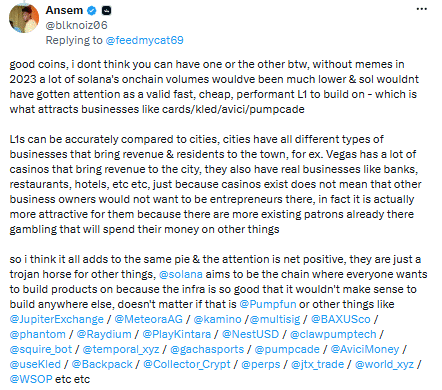
Source: X

To put it into context, another prominent analyst noted Solana’s expanding use cases across different sectors, further reinforcing the idea that demand isn’t purely speculative.

Instead, it’s driven by users who want to trade familiar assets on faster, more efficient rails.

Against this setup, Solana’s technical weakness starts to look more like a textbook undervaluation case. Price action has been lagging behind what’s actually happening on-chain, where activity continues to expand. In other words, the network is still seeing real usage growth even while the chart looks softer.

Historically, this kind of divergence is usually what traders start watching closely. And yet, Solana’s ETF flows suggest otherwise. Does this make the recent $15 million short on Solana [SOL] a more strategic setup, hinting at a potential bull trap forming underneath SOL’s current chop?

Is Solana setting up for a squeeze or a breakout?

Any large position around an asset needs strong factors supporting the bet.

From an on-chain perspective, a $15 million short on Solana looks like a bold call given how strong activity has been. Volume continues to push to new highs as Solana expands and diversifies into a more efficient L1, strengthening its position as a key player in the Web3 transition.

But that doesn’t necessarily mean the trader is relying on that narrative.

The counter-argument is positioning.

If there are heavily leveraged longs stacked below, a drop in momentum could trigger forced selling rather than voluntary exits. That kind of setup can accelerate downside moves, especially around key liquidity zones like $66.
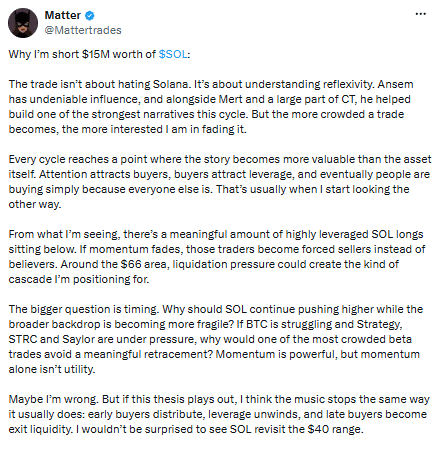
Source: X

The key question is timing.

If broader market conditions are weakening and Bitcoin [BTC] is under pressure, it raises the risk that crowded beta trades like SOL face a deeper pullback. If that unwind plays out, traders flush leverage, late longs become exit liquidity, and price breaks through support quickly. In that case, SOL can retest $40.

In this context, the trader’s $15 million short is being positioned as a liquidity-driven, risk-off trade rather than a purely fundamental call.

On ETFs, Solana spot products have seen steady inflows since launching, but June 2026 is showing early weakness. Flows are currently around -$5.8 million in outflows for the month.

Keeping all this in mind, Solana’s consolidation around $70, therefore, starts to look like a textbook bull trap.


Final Summary

  • Solana shows strong on-chain activity, but price and ETF flows are starting to weaken.
  • If leverage is crowded, the $15 million short may be betting on a liquidity flush and a possible bull trap in Solana [SOL].


Trending Cryptos

Related Questions

QAccording to the article, what is the key reason behind the divergence between Solana's on-chain activity and its price performance?

AThe article suggests that Solana's technical weakness (lagging price) looks like a textbook undervaluation case, where real on-chain usage is growing but the price chart appears softer. It hints this could be a strategic setup for a potential bull trap.

QWhat specific condition must be met for SOL's price to potentially retest $40, as mentioned in the analysis?

AFor SOL to potentially retest $40, broader market conditions would need to weaken with Bitcoin under pressure. This could trigger an unwind where leveraged longs are flushed, turning late longs into exit liquidity and causing a rapid break through support levels.

QHow does the article characterize the purpose of the $15 million short position on SOL by whales?

AThe article characterizes the $15 million short as a liquidity-driven, risk-off trade. It is positioned as a bet on a potential liquidity flush from crowded leveraged long positions, rather than being a purely fundamental call against Solana's strong on-chain activity.

QWhat evidence does the article provide for Solana's growing diversification and on-chain strength?

AThe article cites that Solana's trading volume jumped to over $67 billion in Q2 from just over $2 billion in Q1 (a ~3,200% QoQ increase). It also mentions activity is spread across memecoins, perpetual trading, tokenized assets, and staking protocols, showing demand beyond pure speculation.

QWhat does the data show about Solana spot ETF flows as of June 2026, and how does this relate to the overall narrative?

AAs of June 2026, Solana spot ETF flows are showing early weakness, with approximately $5.8 million in outflows for the month. This contributes to the bearish argument that, despite strong on-chain activity, price and investment flows are weakening, supporting the idea of a potential bull trap.

Related Reads

AI Can 'Have Moods Too'! New Research from USTC: Confusion and Anxiety Make AI Work Better

The article discusses research from the University of Science and Technology of China and Oxford, revealing that allowing AI to recognize and act upon simulated "internal emotions" can significantly improve its performance. The study demonstrates a coherent pairing between specific emotional states in AI agents and their subsequent skill choices. For instance, an agent feeling curious and desirous will search for products, while one feeling confused and tense will rephrase queries. This mirrors human decision-making influenced by emotions. Statistical validation showed a 76.5% semantic consistency in these pairings. Crucially, the research challenges the traditional view of AI errors as flaws to be eliminated. It found that "bad" emotions like confusion, tension, or frustration serve as useful metacognitive signals, indicating a mismatch between the current strategy and the environment. By responding to these signals, AI can proactively adjust before a failure occurs. This is particularly effective in complex tasks prone to failure. For example, in tasks like "heating an item" and "picking up two items," success rates surged from 9.6% to 56.9% and 4.4% to 31.3%, respectively, when using the emotion-driven skill selection method (EMOTION2SKILL). The AI's "nervous" state about a closed microwave, for instance, prompted it to check and open it first, preventing failure. The article also mentions related work from Tianjin University, which embeds emotional prediction into world models (Large Emotional World Model, LEWM), significantly improving prediction accuracy in human-centric environments. Removing emotional data was found to degrade performance even in unrelated logical reasoning tasks. These studies build on earlier findings, like those from Anthropic, that identifiable emotional representations exist within large language models (LLMs). The focus is shifting from philosophical debate about AI emotion to practically harnessing these internal states as functional signals to enhance AI robustness and capability.

marsbit1m ago

AI Can 'Have Moods Too'! New Research from USTC: Confusion and Anxiety Make AI Work Better

marsbit1m ago

Trading

Spot

Hot Articles

Discussions

Welcome to the HTX Community. Here, you can stay informed about the latest platform developments and gain access to professional market insights. Users' opinions on the price of SOL (SOL) are presented below.

活动图片