Solana Recovery Narrative Strengthens as RWA Market Hits $1.15B and Regulation Turns Positive

bitcoinistPublished on 2026-02-05Last updated on 2026-02-05

Abstract

Solana's (SOL) recent price decline below $100 has not diminished its broader recovery narrative. Despite a 25% drop from recent highs, key support near $95–$100 is holding, with technical indicators suggesting potential for a rebound toward $150 or higher. On-chain fundamentals are strengthening, with Total Value Locked reaching a record 73.4 million SOL ($7.5 billion) and daily transactions exceeding 100 million. The real-world asset (RWA) market on Solana has grown to $1.15 billion, supported by its low-cost, high-throughput infrastructure. Standard Chartered adjusted its 2026 SOL price target to $250 but raised its 2030 forecast to $2,000, citing Solana's advantages in micropayments, stablecoin transfers, and improving regulatory clarity.

Solana’s (SOL) recent price weakness has not erased the broader recovery narrative forming around the network. While SOL continues to trade below the psychologically important $100 level after a sharp pullback from January highs, on-chain data and institutional forecasts suggest the blockchain’s long-term positioning is improving.

Related Reading: Elon Musk Revives ‘Dogecoin To The Moon’ With Hint For 2027

Growing real-world asset (RWA) activity, record network usage, and a more constructive regulatory backdrop are increasingly shaping analysts’ views of Solana’s next phase.
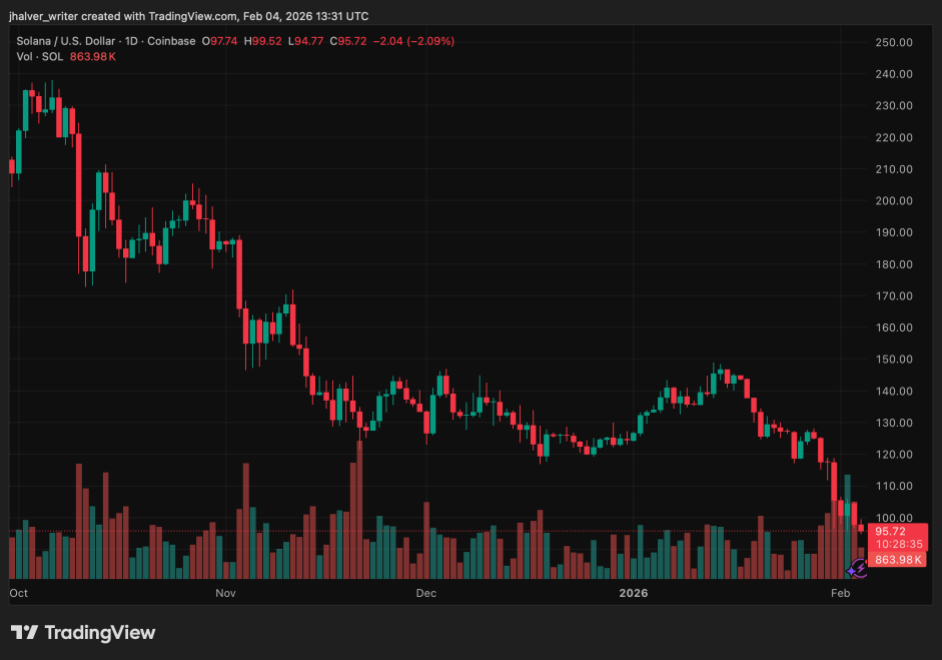
SOL's price trends to the downside on the daily chart. Source: SOLUSD on Tradingview

Price Pressure Persists, But Key Support Holds

SOL has fallen roughly 25% from recent highs near $127, slipping below $100 amid broader crypto market risk-off sentiment. Technical indicators still reflect caution, with bearish momentum dominating short-term charts and some analysts warning of a possible drop toward the $85 area if support near $95 fails.

That said, the $95–$100 zone has repeatedly acted as a major demand area in past market cycles. The daily relative strength index has dipped into oversold territory, a condition that has previously coincided with local bottoms for SOL.

Several technical analysts note that a sustained defense of this range could open the door to a recovery toward the $150 region, with more optimistic scenarios extending toward $215–$260 if resistance levels are reclaimed.

Network Activity And RWA Growth Support The Thesis

Despite price volatility, Solana’s on-chain fundamentals continue to strengthen. Total value locked recently reached an all-time high of 73.4 million SOL, equivalent to roughly $7.5 billion, marking an 18% weekly increase.

On the other hand, daily transactions have surged above 100 million, hitting multi-year highs, while decentralized exchange volumes are also at their strongest levels in months.

Beyond DeFi metrics, the real-world asset market on Solana has expanded rapidly, with tokenized RWAs on the network now estimated at around $1.15 billion. This growth aligns with Solana’s positioning as a low-cost, high-throughput settlement layer, particularly for stablecoins and tokenized financial products.

Faster, more stablecoin-friendly turnover and consistently low transaction fees have made the network increasingly attractive for high-volume use cases.

Standard Chartered Sees Long-Term Upside

Standard Chartered has reinforced this longer-term view, cutting its end-2026 SOL price target to $250 from $310 due to near-term volatility, while raising its 2030 forecast to $2,000.

The bank cited Solana’s dominance in micropayments, stablecoin transfers, and emerging real-world applications as key drivers behind its long-range projections.

According to the bank, Solana’s ability to process large transaction volumes at minimal cost gives it an advantage as regulation around digital assets becomes clearer and more supportive.

Related Reading: Ethereum Active Addresses Near All-Time High Despite Price Plunge

While short-term price action remains uncertain, the combination of rising network usage, expanding RWA activity, and improving regulatory clarity continues to underpin Solana’s recovery narrative.

Cover image from ChatGPT, SOLUSD chart on Tradingview

Related Questions

QWhat are the key factors supporting Solana's recovery narrative despite recent price weakness?

AThe key factors supporting Solana's recovery narrative are growing real-world asset (RWA) activity (now at $1.15B), record network usage (daily transactions above 100M), and a more constructive regulatory backdrop.

QWhat is Standard Chartered's long-term price forecast for SOL by the year 2030?

AStandard Chartered has raised its long-term price target for SOL to $2,000 by the year 2030.

QWhat technical price level is identified as a major demand area and crucial support for SOL?

AThe $95–$100 zone is identified as a major demand area that has acted as crucial support in past market cycles.

QWhat recent milestone did Solana's Total Value Locked (TVL) achieve?

ASolana's Total Value Locked (TVL) recently reached an all-time high of 73.4 million SOL, equivalent to roughly $7.5 billion.

QAccording to the bank, what are the key drivers behind Solana's long-range growth projections?

AAccording to Standard Chartered, the key drivers are Solana's dominance in micropayments, stablecoin transfers, and emerging real-world applications, enabled by its ability to process large transaction volumes at minimal cost.

Related Reads

Will the Next Crypto Bull Run Start with On-Chain Trading of SpaceX?

This article presents a scenario-based forecast for the crypto industry from 2026 to 2029, arguing that the next major cycle will be driven not by technological narratives but by legal access to real-world assets. The author predicts that by mid-2026, pre-IPO perpetual contracts for top private companies like SpaceX, OpenAI, and Anthropic on platforms like Hyperliquid will become the primary gateway for accessing quality assets, as most crypto-native tokens fail to capture real value. The much-hyped AI x Crypto intersection largely fails except for prediction markets, which thrive on betting on AI model supremacy. By 2027, public blockchain foundations are forced to choose between catering to retail speculation or building compliant infrastructure for institutions, with many opting for the latter. Growth in stablecoins and tokenized private credit/equity hits a "triple ceiling" due to regulatory and political uncertainty rather than market demand. The pivotal shift is forecast for 2028. A major liquidation event in pre-IPO perpetuals exposes the structural flaw of synthetic markets lacking a real underlying asset anchor. In response, regulatory changes finally allow the public solicitation of private securities resales to verified accredited investors. This creates a legitimate secondary market for real company equity, which then becomes the core asset class of the new bull market, relegating synthetic perps to a niche role. By 2029, the industry becomes "boring" but foundational. Tokens without claims on real cash flows or assets cease trading. Stablecoin growth is steady but politically capped. Crypto infrastructure fades from view as it gets absorbed into traditional finance backends. The article's central thesis is that the key bottleneck for crypto's next phase is legal and regulatory channels for real asset ownership, not technology.

marsbit1h ago

Will the Next Crypto Bull Run Start with On-Chain Trading of SpaceX?

marsbit1h ago

The Value Distribution of Stablecoins

**Summary: The Value Distribution of Stablecoins** The article argues that stablecoins are evolving from mere trading tools into broader channels for dollar access. It divides the stablecoin ecosystem into four layers to analyze how value is distributed: 1. **Issuance Layer:** Mints stablecoins, holds reserve assets, and captures the spread between reserve yield and user costs (e.g., Tether, Circle). This layer currently earns the largest profit margin. 2. **Infrastructure Layer:** Connects stablecoins to the traditional financial system, handling fiat on/off-ramps, banking integration, compliance (KYC/AML), and asset management (e.g., Bridge, BVNK). This is the "unglamorous" but critical work, building the essential bridges between crypto and real-world finance. 3. **Acquiring/Distribution Layer:** Integrates stablecoins into merchant systems, manages payment flows, and provides enterprise financial software (e.g., Stripe, Coinbase). They act as the access point for businesses. 4. **Application Layer:** The end-users and businesses that ultimately use stablecoins for payments, settlements, or as a store of value. They benefit from convenience but have little pricing power. The core thesis is that while the issuance layer currently dominates profits, the often-overlooked **infrastructure layer holds significant long-term potential**. The real challenge and barrier to mass adoption is not the on-chain transfer of stablecoins (which is simple), but the complex "last mile" integration into existing business workflows, banking systems, and regulatory frameworks across different countries. Companies in this layer are currently in a "land grab" phase, investing heavily to build networks, secure bank partnerships, and establish compliance pathways. While their position is currently pressured by the profitable issuers above and distribution platforms below, the article suggests that if stablecoins become a default financial rail for businesses, the infrastructure providers who have done the hard work of integration will ultimately gain strong pricing power and become entrenched, essential players.

marsbit7h ago

The Value Distribution of Stablecoins

marsbit7h ago

The Value Distribution of Stablecoins

The Value Distribution of Stablecoins The article argues that stablecoins are evolving from a mere trading tool into a broad "dollar channel." It analyzes the industry's value chain through four layers: 1. **Issuance Layer (e.g., Tether, Circle):** The top layer that mints stablecoins, holds reserve assets, and captures the thickest interest rate spread. 2. **Infrastructure Layer (e.g., Bridge, BVNK):** Connects stablecoins to the traditional financial system, handling critical but complex "dirty work" like fiat on/off-ramps, banking integration, compliance (KYC/AML), and cross-border settlement. 3. **Acquiring/Distribution Layer (e.g., Stripe, Coinbase):** Embeds stablecoins into merchant systems, manages payment flows, and integrates with enterprise software. 4. **Application Layer:** End-users and businesses that ultimately use stablecoins for payments, settlement, or storing value. The author posits that while the issuance layer currently captures the most profit, the most overlooked and potentially critical layer is infrastructure. The core challenge for stablecoin adoption isn't the on-chain transfer (which is simple), but bridging the gap between blockchain and the real-world financial system. This involves solving practical problems for businesses: fiat conversion, reconciliation, tax handling, and user onboarding. Infrastructure companies are currently in a difficult "land-grab" phase—building networks, securing banking relationships, and achieving compliance country-by-country. They face pressure from both the profitable issuance layer above and distribution platforms below. However, the author suggests this layer is building a crucial moat. Once stablecoins become a default business rail, the infrastructure players who have done the hard work of integration may gain significant, durable value and pricing power.

链捕手7h ago

The Value Distribution of Stablecoins

链捕手7h ago

Trading

Spot
Futures

Hot Articles

Discussions

Welcome to the HTX Community. Here, you can stay informed about the latest platform developments and gain access to professional market insights. Users' opinions on the price of SOL (SOL) are presented below.

活动图片















