Solana hits 10B transactions as Ethereum crosses 200M — two blockchains, two models

ambcryptoPublished on 2026-04-01Last updated on 2026-04-01

Abstract

Blockchain activity is rising, but the latest data reveals a widening gap in how that activity is defined. Solana processed a record 10.1 billion transactions in Q1 2026, driven by its high-throughput, low-fee model optimized for high-frequency use cases like trading and gaming. In the same period, Ethereum recorded just over 200 million transactions, also a record, reflecting its role as a high-value settlement layer for DeFi, institutional flows, and L2s. The contrast underscores two definitions of activity: Solana emphasizes quantity and volume, while Ethereum emphasizes value density and security. The data suggests these ecosystems are specializing rather than competing, with Solana as a high-throughput execution environment and Ethereum as a foundational settlement layer. Both models are expanding simultaneously, indicating a multi-chain future where networks optimize for different use cases.

Blockchain activity is rising across major networks, but the latest data highlights a widening gap in how that activity is defined.

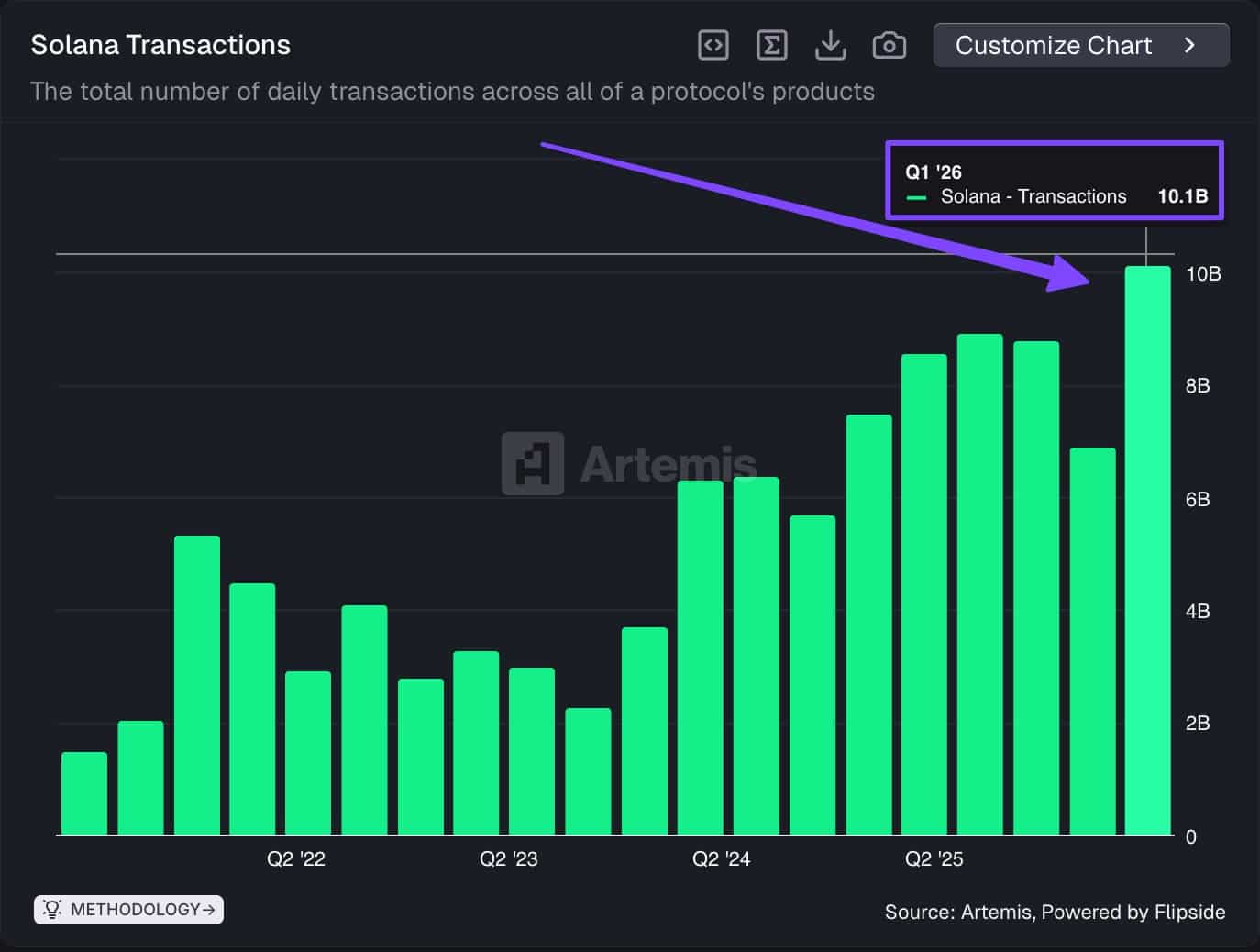
New figures from Artemis show Solana processed 10.1 billion transactions in Q1 2026, marking the first time it has crossed the 10B threshold in a single quarter.

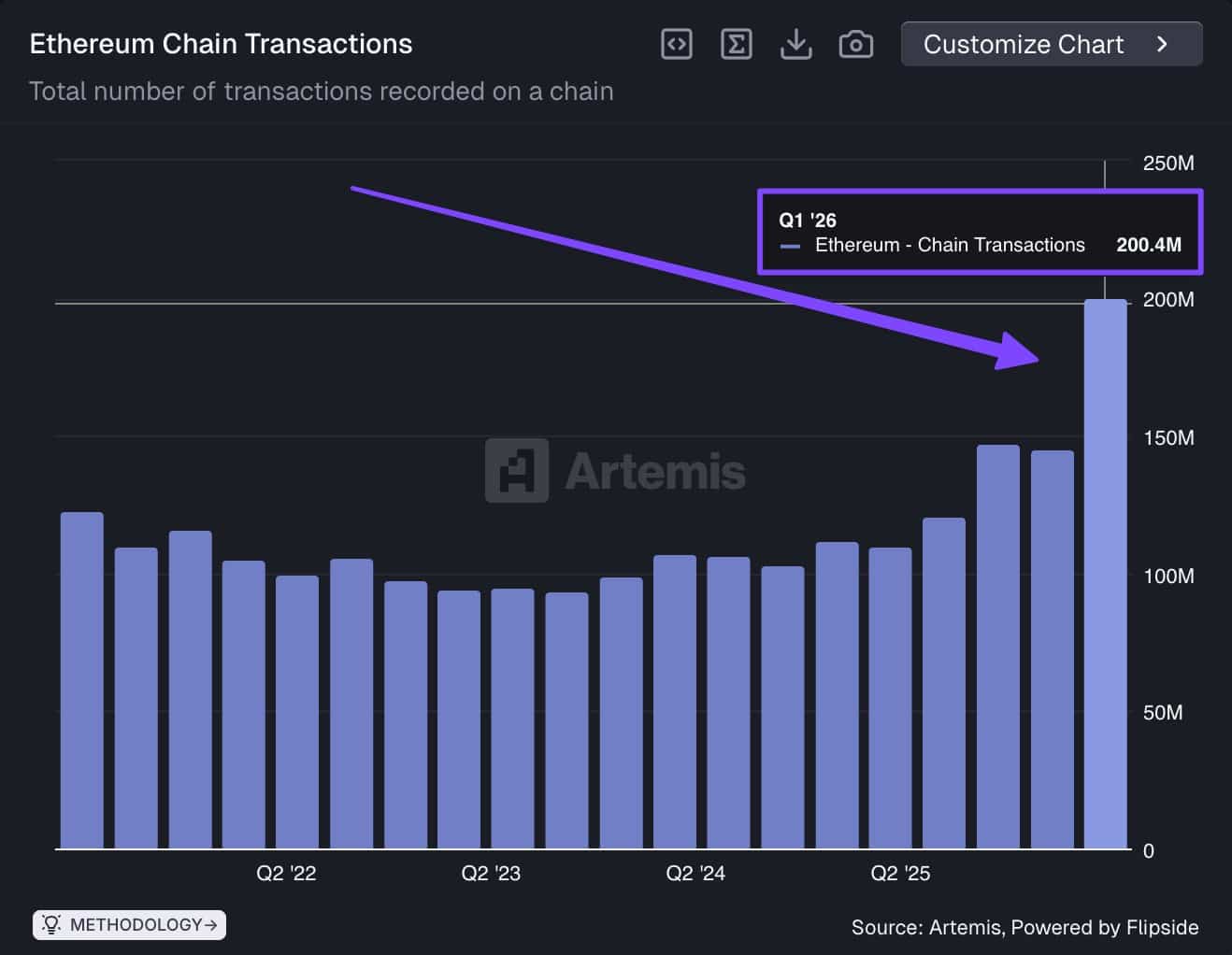
Over the same period, Ethereum recorded just over 200 million transactions, also a record high.

At face value, the disparity is stark. But the numbers point less to competition and more to diverging blockchain roles.

Solana’s throughput model accelerates

Solana’s transaction growth has been driven by its core design: high throughput and low fees.

The network has positioned itself as a platform for high-frequency activity, including trading, gaming, and automated transactions. This has enabled it to process billions of transactions per quarter, with activity accelerating through 2025 and into early 2026.
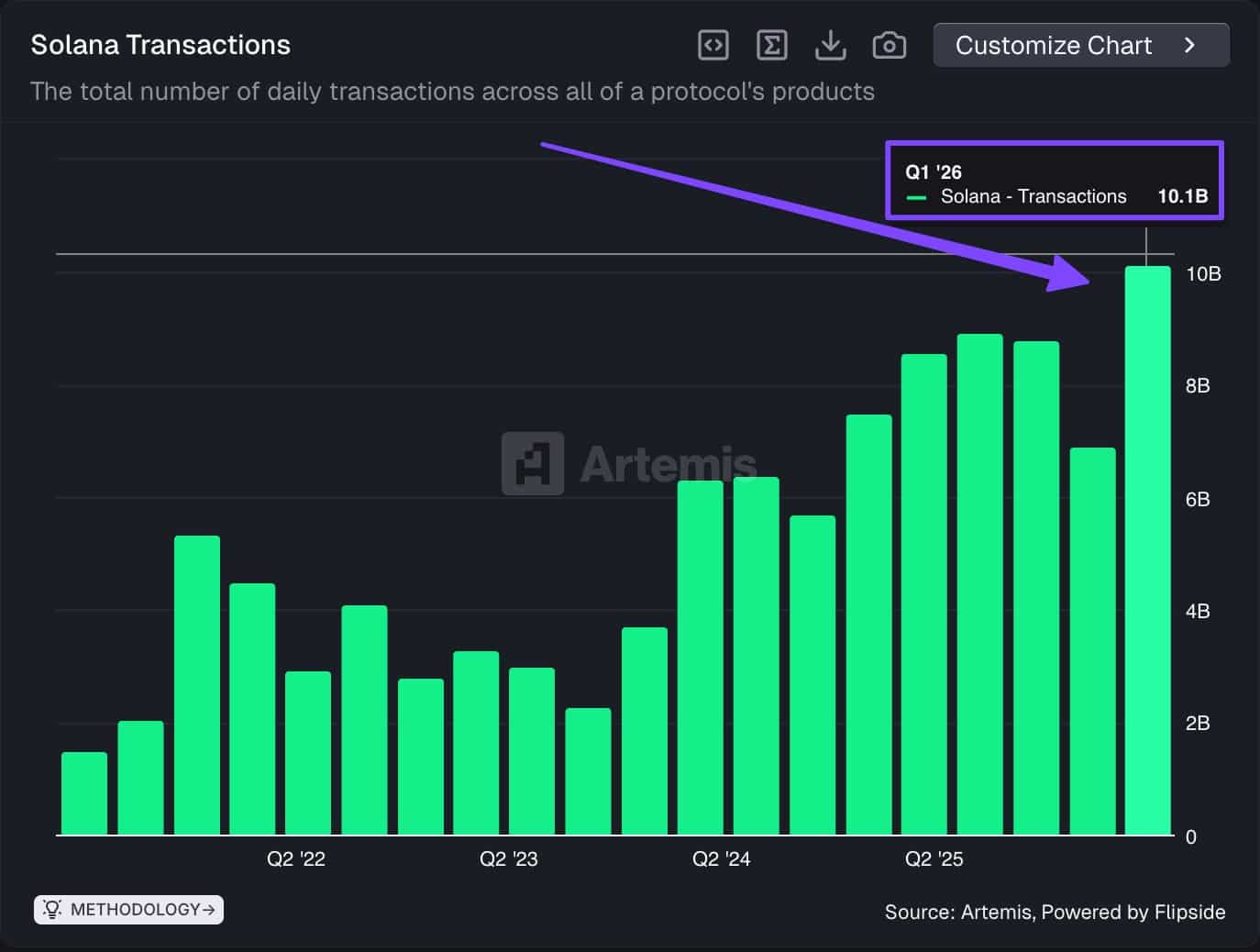
Source: Artemis

The scale reflects a system optimized for speed and volume, where transaction costs remain low enough to support frequent interactions.

Ethereum’s value layer expands steadily

Ethereum’s growth trajectory looks different.

While transaction counts remain significantly lower, the network continues to anchor high-value activity, including decentralized finance, institutional flows, and Layer 2 settlement.
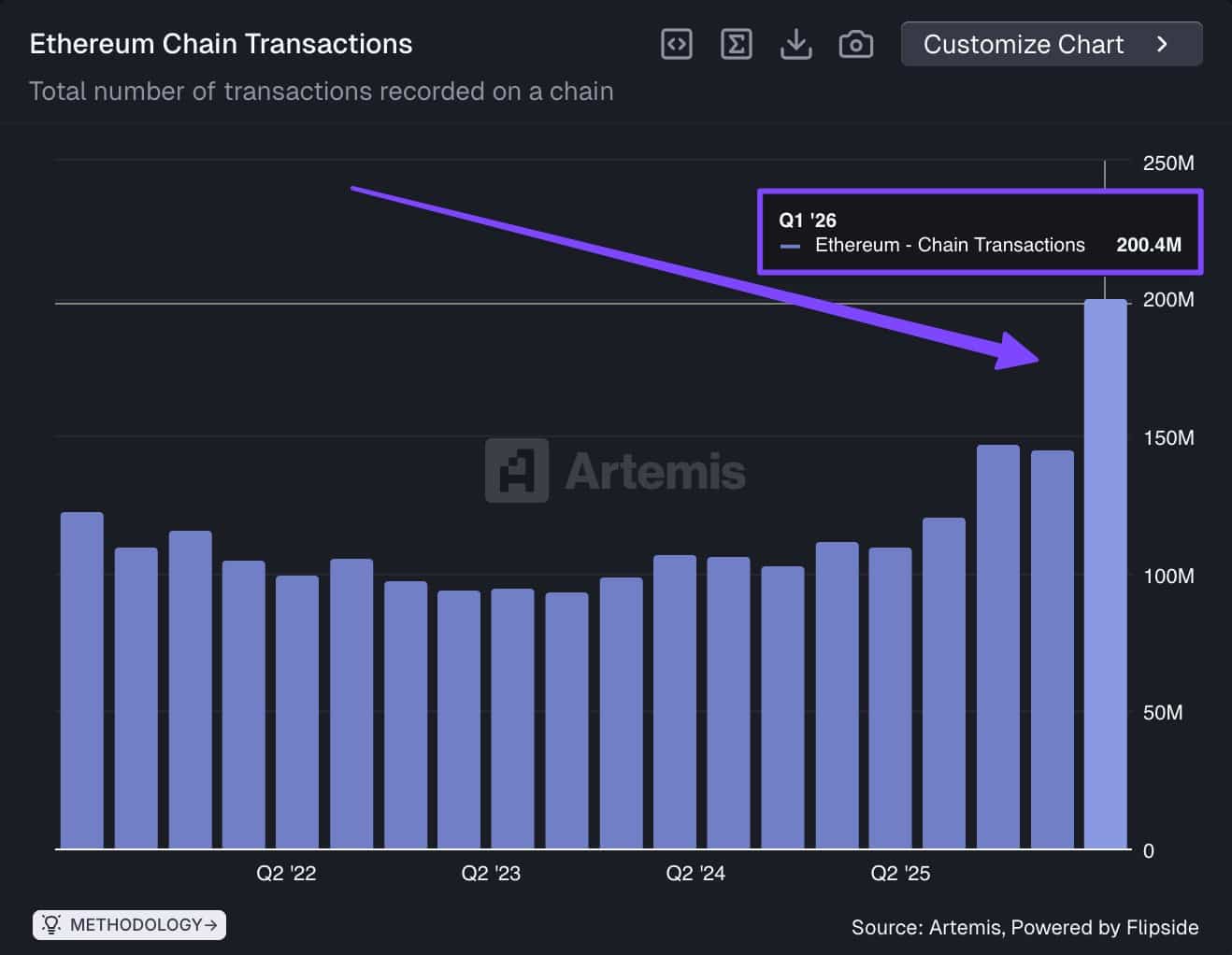
Source: Artemis

Rather than maximizing raw throughput, Ethereum’s ecosystem has evolved toward a model where activity is distributed across scaling layers, with the base chain acting as a secure settlement layer.

The result is fewer transactions, but typically higher value per interaction.

Two definitions of blockchain activity

The contrast between the two networks underscores a broader shift in how blockchain usage is measured.

Solana’s metrics highlight quantity — the ability to process massive volumes of transactions efficiently.

Ethereum’s metrics reflect value density — where fewer transactions can represent significant economic activity.

As a result, raw transaction count alone no longer provides a complete picture of network dominance.

A multi-chain reality takes shape

The data suggests that blockchain ecosystems are increasingly specializing rather than competing directly.

Solana is emerging as a high-throughput execution environment, while Ethereum continues to function as a foundational settlement layer for a broader ecosystem of applications.

Both models are expanding simultaneously, suggesting a market structure where different networks optimize for different use cases.


Final Summary

  • Solana’s 10.1B quarterly transactions highlight its strength in high-throughput, low-cost activity at scale.
  • Ethereum’s 200M transactions reflect its role as a high-value settlement layer, emphasizing quality over quantity.


Related Questions

QWhat are the key differences in transaction volume between Solana and Ethereum in Q1 2026, and what do these numbers represent?

AIn Q1 2026, Solana processed 10.1 billion transactions, while Ethereum recorded just over 200 million. These numbers represent a fundamental difference in their roles: Solana's high volume reflects its design as a high-throughput platform for frequent, low-cost activities like trading and gaming, whereas Ethereum's lower count reflects its role as a high-value settlement layer for DeFi and institutional flows, where fewer transactions carry greater economic weight.

QHow does Solana achieve its high transaction throughput, and what type of activity drives its growth?

ASolana achieves high transaction throughput through its core design, which prioritizes speed and low fees. This enables it to support high-frequency activities such as trading, gaming, and automated transactions, driving its growth in processing billions of transactions per quarter.

QWhat is Ethereum's primary function in the blockchain ecosystem, and how does its transaction model differ from Solana's?

AEthereum functions primarily as a secure settlement layer for high-value activities, including decentralized finance (DeFi) and institutional flows. Its transaction model differs from Solana's by emphasizing value density—fewer transactions that represent significant economic activity—rather than raw throughput, with much of its activity distributed across Layer 2 scaling solutions.

QWhy does raw transaction count no longer provide a complete picture of network dominance, according to the article?

ARaw transaction count no longer provides a complete picture of network dominance because blockchain ecosystems are specializing. Solana's metrics highlight quantity and efficiency in processing high volumes, while Ethereum's metrics reflect the economic significance and value per transaction, indicating that both networks serve different but equally important roles.

QWhat does the data suggest about the future structure of blockchain ecosystems, as illustrated by Solana and Ethereum?

AThe data suggests that blockchain ecosystems are increasingly specializing rather than competing directly. Solana is emerging as a high-throughput execution environment for frequent interactions, while Ethereum serves as a foundational settlement layer for high-value applications. This indicates a multi-chain reality where different networks optimize for distinct use cases, and both models can expand simultaneously.

Related Reads

Uncovering the Truth About Agent Commerce, Payments, and Infrastructure

Decoding Agent Commerce, Payments, and Infrastructure: The Reality Over the past year, I've been building infrastructure for the Agent economy, engaging with major players like Stripe, Visa, Coinbase, Google, and dozens of startups. A clear conclusion emerges: true, large-scale demand does not yet exist. Startups face structural challenges. Data points illustrate this gap. Stripe's Agent commerce platform has over 1,000 merchants but only single-digit transacting agents. Visa's Agent payment token requires 9-month KYC and a $250M revenue threshold, accessible only to giants like Amazon. On-chain analysis reveals actual daily Agent transaction volume is around $17k, half of which are test transactions. The article analyzes four potential markets: **1. Agent-to-Merchant (A2M):** Current AI shopping UX is often inferior to traditional e-commerce for visual, comparison-heavy purchases (clothing, electronics). Chat interfaces are a step back. Real merchant interest is defensive "Agent Engine Optimization," fearing future obsolescence, not current demand. Potential exists in high-frequency, low-decision purchases (e.g., food delivery) or simplifying terrible UX (complex checkouts, non-native shoppers), but these require massive consumer distribution channels dominated by giants like DoorDash and Amazon. **2. Agent-to-API (A2A):** Developers already have subscriptions and billing for core APIs (compute, data). The argument for micro-payments via crypto for sub-dollar API calls is addressed by pre-paid balances today. The deeper issue is supplier resistance; major SaaS firms rely on enterprise contracts, not fractional cent pricing. Opportunity lies in the long tail of niche services, but this is a smaller market catering to developers, a historically low-paying group. **3. Agent-to-Agent (A2A):** This remains a theoretical long-term vision with near-zero current transaction volume. It involves unique challenges: discovery, trust, negotiation, dispute resolution. When it materializes, it will require a fundamentally new settlement infrastructure for high-speed, variable-value, multi-party transactions. It's a real long-term bet, but not the current market. **4. Agent-to-Finance (A2F):** This is the only category with existing, paying demand. Integrating AI into financial workflows (trading, portfolio management) is a natural evolution and enables new capabilities like autonomous rebalancing. However, competition favors incumbents with regulatory licenses, compliance infrastructure, and existing client relationships. **The Real Issue:** Why is infrastructure still being built? Incumbents can afford long-term bets, and payment companies see every problem as a nail for their payment hammer. However, payment is just one piece. The core challenge is *coordination*—orchestrating work between Agents and humans, verifying outcomes, and settling results. Payment is part of settlement, which is part of coordination. Companies that solve the coordination problem will subsume payments, not the other way around. Startups lack the infinite runway of giants and must find today's real market, which, after a year of exploration, lies outside these four categories—in an area with real, growing, and underserved activity.

marsbit46m ago

Uncovering the Truth About Agent Commerce, Payments, and Infrastructure

marsbit46m ago

Kalshi, MTS, and a16z's Ambition

The article "Kalshi, MTS, and a16z's Ambition" explores prediction markets as a focal point of excitement in 2025 for investors, crypto enthusiasts, and media. It traces their intellectual lineage from Friedrich Hayek's ideas on dispersed knowledge and market coordination to Robin Hanson's Logarithmic Market Scoring Rule (LMSR), which incentivizes truthful information sharing. The piece argues that a16z's significant investment in prediction market platform Kalshi (valued at $220B) transcends mere financial speculation. a16z frames prediction markets as a new form of "media" that provides "presence"—a way for individuals to actively engage with and influence world events through financial stakes, countering postmodern detachment. By wagering on outcomes, users become "super observers," and the market's aggregated probabilities gain authoritative power to define event truth and importance. The article uses media company MTS ("Monitoring The Situation") as a case study of a16z's "new media" strategy: rapidly producing high-intensity, multi-format content to "take over the timeline." However, prediction markets like Kalshi are presented as the ultimate piece in this media empire. Their real-money, crowd-sourced probabilities possess a unique "reality distortion field" and perceived objectivity, potentially swaying public opinion and granting a private company unprecedented interpretive power over reality. Ultimately, Kalshi's immense valuation is attributed not just to its exchange model, but to its role as a foundational component in a16z's envisioned new media landscape, where prediction markets define narrative and truth.

链捕手46m ago

Kalshi, MTS, and a16z's Ambition

链捕手46m ago

Trading

Spot
Futures

Hot Articles

Discussions

Welcome to the HTX Community. Here, you can stay informed about the latest platform developments and gain access to professional market insights. Users' opinions on the price of ETH (ETH) are presented below.

活动图片














