Solana ETFs Are Beating Bitcoin On Relative Flows Despite SOL Crash

bitcoinistPublished on 2026-03-06Last updated on 2026-03-06

Abstract

Despite a 57% crash in SOL's price since their July launch, spot Solana ETFs have attracted approximately $1.45 billion in inflows. Bloomberg analyst Eric Balchunas called this a case of extremely unlucky timing but highlighted the resilience of these flows as a key positive signal. He noted that 50% of the assets come from serious institutional investors (13F filers), indicating a high-quality demand base. Balchunas made a striking comparison: when adjusted for market cap, these inflows are equivalent to $54 billion for Bitcoin—double what Bitcoin ETFs saw at a similar stage, even though Bitcoin's price was rising at that time. This suggests exceptionally strong relative demand for Solana products. While Bitcoin ETFs still dominate in absolute size with nearly $94.6 billion in assets, the persistent inflows into Solana ETFs during a severe price decline point to "sticky" institutional capital rather than short-term speculation. The analyst also cautioned against drawing broad conclusions from short-term price action, a point applicable to both Bitcoin and Solana. At the time of writing, SOL traded at $87.26.

Spot Solana ETFs have pulled in roughly $1.45 billion since launching in July even as SOL fell 57% over the same stretch, a combination Bloomberg ETF analyst Eric Balchunas called “about as unlucky timing as you’ll ever see in ETFs.” For crypto markets, the takeaway is not just the headline flow number, but what it may say about the depth and quality of institutional demand.

Spot Solana ETFs Beat Bitcoin ETFs

Balchunas argued that the resilience of those inflows matters as much as their size. “Solana is down 57% since the spot ETFs launched in July ... yet they managed to not only accumulate $1.5b in flows but not really give any of it up,” he wrote on X. He added that “50% of the assets are from 13F filers = serious inv base. Both really good signs for future IMO.”

The chart he shared shows cumulative Solana ETF flows climbing from about $410 million on Oct. 23, 2025, to $1.45 billion by March 2, 2026. The steepest acceleration came in late October through November, when cumulative inflows jumped sharply toward the $1 billion mark before continuing to grind higher into early March. Even with some flattening near the end of the period, the broader pattern is one of persistent net intake rather than hot-money churn.
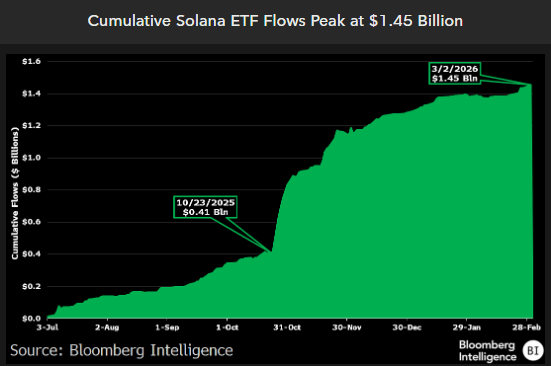
Cumulative Solana ETF flows | Source: X @EricBalchunas

Balchunas’ more provocative point was the relative comparison with Bitcoin. “The other thing about these flows, if we adjust for the size of solana vs bitcoin mkt cap, it’s the equiv of $54b in net new flows, which is about DOUBLE where bitcoin was at the same point,” he wrote. “And bitcoin was up a ton at that time vs down 57%. Anyhow, pretty impressive numbers given size and condition of the underlying mkt.”

That comparison goes to the heart of the thesis. Absolute flows still heavily favor Bitcoin, whose US spot ETF complex sits near $94.6 billion in assets, according to the table Balchunas posted separately. BlackRock’s IBIT alone accounts for roughly $57.1 billion, while Fidelity’s FBTC and Grayscale’s GBTC hold about $13.9 billion and $11.5 billion, respectively. On Wednesday, the group took in another $461.77 million, with IBIT contributing $306.58 million.
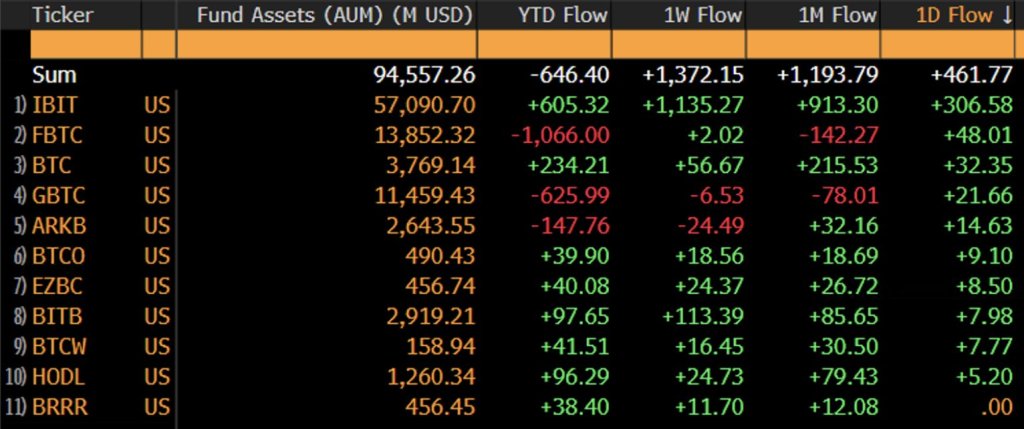
Bitcoin ETF data | Source: X @EricBalchunas

But Balchunas used that same Bitcoin flow snapshot to make a broader point about the risks of drawing sweeping conclusions from short windows of market action. After noting that Bitcoin had risen 12% since the Iran strike while gold fell, he posed a deliberately overstated question: “So does that mean gold has failed as a safe haven and may be devoid of any purpose and vice-versa for btc?” He then answered it himself in the next post.

“I don’t actually think this btw, just trying to point out the problem with making these types of damning judgements of an asset based on a short term window of price action,” Balchunas wrote. “Gold has my respect as asset as does bitcoin. Bitcoin’s surge may have little to do w geopolitics but rather the Jane St bogeyman going away and vibe change. And ppl selling gold may just be taking profits, some may be looking for next run in btc, wth knows.”

The same logic applies to Solana. A 57% drawdown would usually be the sort of backdrop expected to choke off ETF demand, not sustain it. Instead, the Solana products appear to have attracted sticky capital and, at least in Balchunas’ framing, done so at a pace that compares favorably with Bitcoin once market-cap context is applied.

At press time, Solana traded at $87.26.
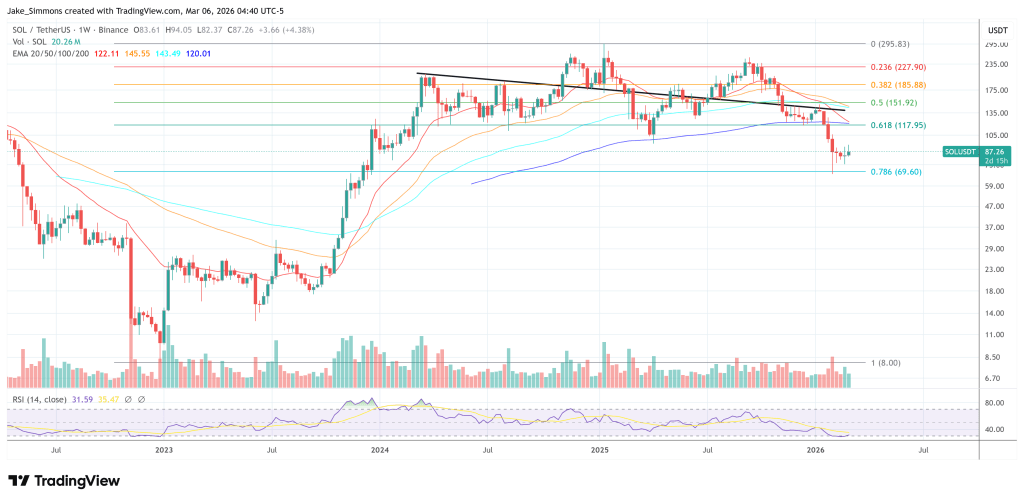
SOL must reclaim the 200-week EMA, 1-week chart | Source: SOLUSDT on TradingView.com

Related Reads

Why Not Short Even When Bearish? Munger Did the Math on a 'Losing Trade'

Why Not Short Even When Bearish? Charlie Munger's Calculated "Loss-Making Account" Many traders, drawn to speculative tools like futures contracts, often face repeated failures. As the article notes, unless one is a genius, such instruments should be avoided for long-term profit-seeking. Similarly, the practice of short selling is viewed with caution. The author firmly states a policy of not shorting, even when bearish, preferring to simply wait. The core reason? Successful short selling requires exceptionally difficult conditions to profit. Legendary investors Warren Buffett and Charlie Munger have themselves reflected on painful short-selling experiences. Munger highlights two critical flaws in the mathematical logic of shorting: 1. Asymmetrical Risk/Reward: A long position has a maximum loss of 100% but unlimited upside. A short position caps profit at 100% (if a stock falls to zero) but carries theoretically unlimited loss potential. 2. The "Promoter" Problem: Fraudulent or struggling companies can prolong their decline. As Munger said, "You can run out of money before the promoter runs out of ideas," meaning short sellers may be forced to cover positions at a loss before the company's true fate unfolds. The article cites Stanley Druckenmiller, a famed hedge fund manager. He once shorted 12 companies that all eventually went bankrupt. However, intense market rallies forced him to cover his positions within three weeks, resulting in massive losses—$200 million of his capital plus an additional $600 million. He concluded he likely never made money shorting in his career. His experience perfectly illustrates Munger's points: facing unlimited losses and being wiped out before being proven right. The conclusion is clear: for most investors, complex instruments like short selling and derivatives are not viable paths to stable, long-term gains. Self-reflection is advised before repeatedly wasting time and capital on such speculative strategies.

marsbit22m ago

Why Not Short Even When Bearish? Munger Did the Math on a 'Losing Trade'

marsbit22m ago

For Hedging, Buy Gold and Oil; For Explosive Growth, Buy AI; Bitcoin, the 'Outdated' Asset, Enters a Bear Market

Bitcoin’s price has recently fallen sharply, hitting a two-month low near $66,000, with Ethereum also dropping to a three-month low. While surface explanations point to ETF outflows, geopolitical tensions, and corporate selling, a deeper issue is emerging: Bitcoin is losing a crucial asset competition. For years, Bitcoin thrived in a low-rate environment where investors sought alternatives amid inflation fears and dissatisfaction with traditional options. Now, the market landscape has shifted, leaving Bitcoin stuck in an "awkward middle ground," facing challenges on three fronts: 1. **As an inflation hedge, gold is winning.** Investors worried about persistent inflation are turning to tangible assets like gold, energy stocks, and commodity producers, which offer more direct pricing power and physical backing. 2. **For growth exposure, AI is winning.** Those seeking high growth now favor AI-related companies with actual revenues and profits, an area where Bitcoin's lack of cash flow puts it at a disadvantage. 3. **Within crypto, infrastructure and stablecoins are winning.** Even investors wanting crypto exposure have alternatives like exchanges, stablecoin issuers, and tokenization firms, whose performance is directly tied to real-world adoption and offers clearer operational leverage. The recent market reaction to inflation warnings highlights this shift. Instead of boosting Bitcoin as "digital gold," such news now drives flows toward traditional inflation-sensitive assets. Therefore, recent events like ETF outflows and corporate selling are seen not as causes, but as symptoms of this new reality. Capital has more compelling options, and investors are becoming more selective. The emerging bear case for Bitcoin is no longer about it being a fraud or failed technology, but rather that **scarcity alone is no longer enough**. It is no longer seen as the best hedge, the best growth asset, or the only crypto play.

marsbit38m ago

For Hedging, Buy Gold and Oil; For Explosive Growth, Buy AI; Bitcoin, the 'Outdated' Asset, Enters a Bear Market

marsbit38m ago

SaaS Battle Royale: The Survivors Who Win All Share One Common Trait

**Summary** The AI revolution has triggered a "SaaS apocalypse," forcing a brutal market shakeout. The key dividing line is the pricing model. Companies like Snowflake and Datadog, which charge based on consumption (e.g., data processed or compute used), are thriving. AI workloads actively *generate* more demand for their services, fueling growth. Datadog's accelerating revenue is a prime example. Microsoft and Palantir, as platform/ecosystem players, also benefit by acting as essential channels for AI deployment. In contrast, traditional SaaS firms built on per-seat or per-task licensing (e.g., Intuit, Adobe) face direct pressure, as AI threatens to automate the very human tasks their software supports. Companies like Salesforce, a per-seat giant, are caught in the middle. While showing strong AI monetization (e.g., its Agentforce platform) and experimenting with consumption-based "Flex Credits," its stock remains under pressure, illustrating that the market rewards *completed* transitions, not just the intent. The recent Microsoft Build conference underscored key trends: AI is evolving from an assistant to an autonomous "agent," and platform providers like Microsoft are consolidating their control. The market's recovery is highly selective, focused on identifying which companies are "fed by AI" versus "eaten by AI." Future focus will be on the diffusion of this recovery to transforming companies and the real-world adoption data of AI agents like Microsoft Copilot.

marsbit55m ago

SaaS Battle Royale: The Survivors Who Win All Share One Common Trait

marsbit55m ago

Trading

Spot
Futures

Hot Articles

What is $BITCOIN

DIGITAL GOLD ($BITCOIN): A Comprehensive Analysis Introduction to DIGITAL GOLD ($BITCOIN) DIGITAL GOLD ($BITCOIN) is a blockchain-based project operating on the Solana network, which aims to combine the characteristics of traditional precious metals with the innovation of decentralized technologies. While it shares a name with Bitcoin, often referred to as “digital gold” due to its perception as a store of value, DIGITAL GOLD is a separate token designed to create a unique ecosystem within the Web3 landscape. Its goal is to position itself as a viable alternative digital asset, although specifics regarding its applications and functionalities are still developing. What is DIGITAL GOLD ($BITCOIN)? DIGITAL GOLD ($BITCOIN) is a cryptocurrency token explicitly designed for use on the Solana blockchain. In contrast to Bitcoin, which provides a widely recognized value storage role, this token appears to focus on broader applications and characteristics. Notable aspects include: Blockchain Infrastructure: The token is built on the Solana blockchain, known for its capacity to handle high-speed and low-cost transactions. Supply Dynamics: DIGITAL GOLD has a maximum supply capped at 100 quadrillion tokens (100P $BITCOIN), although details regarding its circulating supply are currently undisclosed. Utility: While precise functionalities are not explicitly outlined, there are indications that the token could be utilized for various applications, potentially involving decentralized applications (dApps) or asset tokenization strategies. Who is the Creator of DIGITAL GOLD ($BITCOIN)? At present, the identity of the creators and development team behind DIGITAL GOLD ($BITCOIN) remains unknown. This situation is typical among many innovative projects within the blockchain space, particularly those aligning with decentralized finance and meme coin phenomena. While such anonymity may foster a community-driven culture, it intensifies concerns about governance and accountability. Who are the Investors of DIGITAL GOLD ($BITCOIN)? The available information indicates that DIGITAL GOLD ($BITCOIN) does not have any known institutional backers or prominent venture capital investments. The project seems to operate on a peer-to-peer model focused on community support and adoption rather than traditional funding routes. Its activity and liquidity are primarily situated on decentralized exchanges (DEXs), such as PumpSwap, rather than established centralized trading platforms, further highlighting its grassroots approach. How DIGITAL GOLD ($BITCOIN) Works The operational mechanics of DIGITAL GOLD ($BITCOIN) can be elaborated on based on its blockchain design and network attributes: Consensus Mechanism: By leveraging Solana’s unique proof-of-history (PoH) combined with a proof-of-stake (PoS) model, the project ensures efficient transaction validation contributing to the network's high performance. Tokenomics: While specific deflationary mechanisms have not been extensively detailed, the vast maximum token supply implies that it may cater to microtransactions or niche use cases that are still to be defined. Interoperability: There exists the potential for integration with Solana’s broader ecosystem, including various decentralized finance (DeFi) platforms. However, the details regarding specific integrations remain unspecified. Timeline of Key Events Here is a timeline that highlights significant milestones concerning DIGITAL GOLD ($BITCOIN): 2023: The initial deployment of the token occurs on the Solana blockchain, marked by its contract address. 2024: DIGITAL GOLD gains visibility as it becomes available for trading on decentralized exchanges like PumpSwap, allowing users to trade it against SOL. 2025: The project witnesses sporadic trading activity and potential interest in community-led engagements, although no noteworthy partnerships or technical advancements have been documented as of yet. Critical Analysis Strengths Scalability: The underlying Solana infrastructure supports high transaction volumes, which could enhance the utility of $BITCOIN in various transaction scenarios. Accessibility: The potential low trading price per token could attract retail investors, facilitating wider participation due to fractional ownership opportunities. Risks Lack of Transparency: The absence of publicly known backers, developers, or an audit process may yield skepticism regarding the project's sustainability and trustworthiness. Market Volatility: The trading activity is heavily reliant on speculative behavior, which can result in significant price volatility and uncertainty for investors. Conclusion DIGITAL GOLD ($BITCOIN) emerges as an intriguing yet ambiguous project within the rapidly evolving Solana ecosystem. While it attempts to leverage the “digital gold” narrative, its departure from Bitcoin's established role as a store of value underscores the need for a clearer differentiation of its intended utility and governance structure. Future acceptance and adoption will likely depend on addressing the current opacity and defining its operational and economic strategies more explicitly. Note: This report encompasses synthesised information available as of October 2023, and developments may have transpired beyond the research period.

363 Total ViewsPublished 2025.05.13Updated 2025.05.13

What is $BITCOIN

Discussions

Welcome to the HTX Community. Here, you can stay informed about the latest platform developments and gain access to professional market insights. Users' opinions on the price of BTC (BTC) are presented below.

活动图片