Solana 2025 Report Card: Annual Revenue of $1.5 Billion, Surpassing the Combined Total of 'Hyperliquid + Ethereum'

Odaily星球日报Published on 2026-01-04Last updated on 2026-01-04

Abstract

Solana's 2025 Performance: A Record-Breaking Year with $1.5B in Revenue In 2025, Solana emerged as the top-performing blockchain network, generating a total revenue of $1.5 billion, surpassing the combined revenue of Hyperliquid and Ethereum. According to Nansen, its on-chain fee income alone reached $603 million, exceeding that of Tron and Ethereum and securing its position as the leader in public blockchain earnings. Key metrics underscored Solana's dominance: it recorded over 10.5 billion active addresses and approximately 23.01 billion transactions, both figures leading all major blockchains. Its on-chain spot trading volume hit $1.6 trillion, surpassing all centralized exchanges except Binance, indicating a significant shift of crypto activity to on-chain platforms. Solana's revenue structure is composed of four main components: base fees (burned for deflation), priority fees (paid to validators), MEV-related income, and minor sources like storage fees. This efficient model supports high transaction volumes while maintaining a median fee below $0.01. The report highlights that public chains, Perp DEXs (like Hyperliquid with $908M revenue), and launchpads (like Pump.fun with $549M revenue) remain the most profitable crypto sectors, second only to stablecoins. Solana's growth is attributed to its scalability, low costs, and vibrant ecosystem, including meme coin trends and DeFi innovations.

Original|Odaily Planet Daily(@OdailyChina)

Author|Wenser(@wenser 2010 )

The year 2025, which belonged to cryptocurrency, has passed. This year, in addition to a series of favorable policies, the regulatory layer development was even more rapid.

From the Meme coin issuance wave sparked by Pump.fun, to the on-chain Perp DEX trend led by Hyperliquid, and then to the stablecoin and PayFi financial wave driven by Circle (CRCL) going public, the on-chain ecosystems of numerous public chains have also entered a period of explosion. Among them, Solana, with its ecological vitality, underlying infrastructure construction, and its "application-first" internet-style capital network positioning, surpassed Ethereum to become the "New King of Annual On-Chain Networks".

Odaily Planet Daily will梳理 (sort out) the Solana on-chain ecosystem in this article, attempting to explore the "best business model" in the current crypto market (Odaily Note: Data sources vary, statistical calibers differ, for reference only).

Solana On-Chain Revenue Exceeds $600 Million, Outperforms Ethereum and TRON to Become the "Strongest Public Chain"

Solana's "year-end report card" starts with public chain revenue. Although the price of SOL has been falling since it rose to a new high of nearly $300 last year, and the highest rebound did not reach $270, from the perspective of public chain operation, its ability to generate revenue is already "fragmented and first".

2025 Solana On-Chain Fee Revenue Breaks Through $600 Million

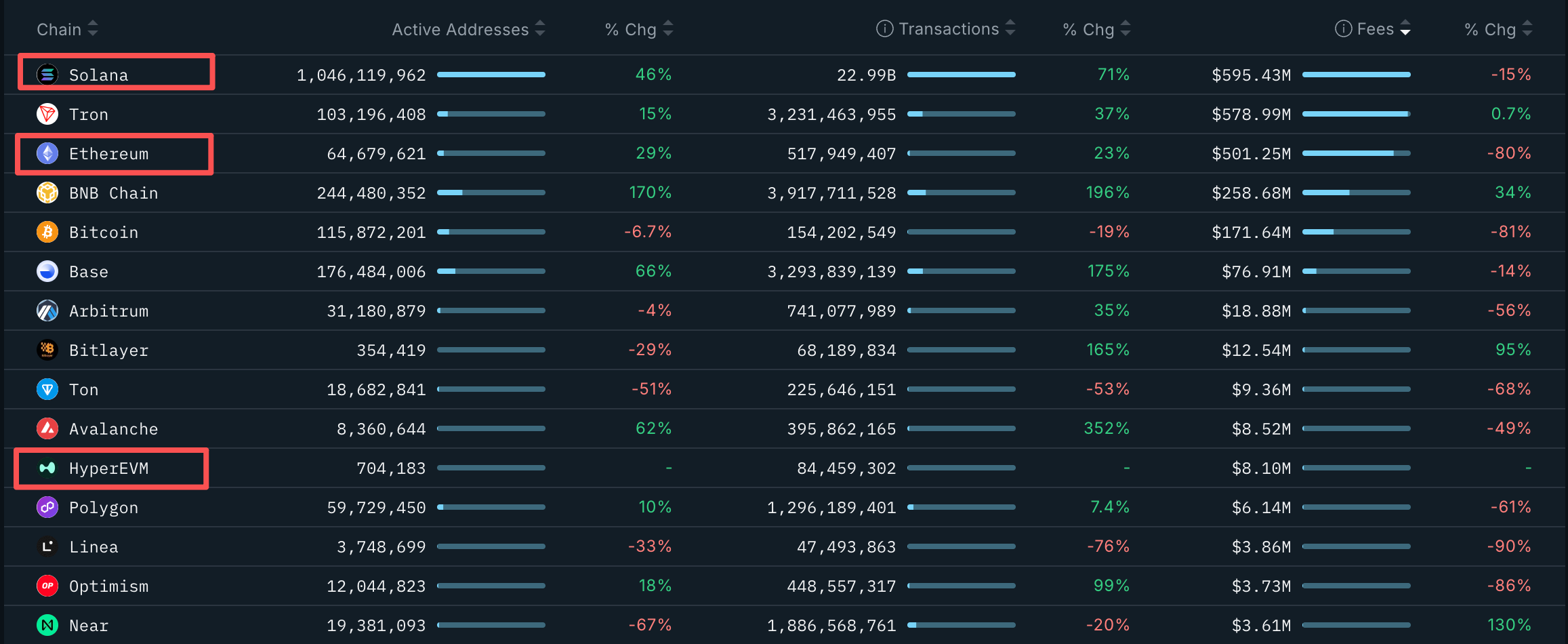
On January 2nd, Nansen data showed that Solana's on-chain fee revenue in 2025 broke through $600 million, surpassing TRON and Ethereum to rank first. The top five blockchains by on-chain fees last year were:

  • Solana ($603 million);
  • TRON ($581 million);
  • Ethereum ($514 million);
  • BNB Chain ($259 million);
  • Bitcoin ($172 million).

In addition, the number of active addresses on the Solana chain exceeded 1.05 billion, and the number of on-chain transactions was about 23.01 billion, both higher than public chains such as Ethereum, Bitcoin, and Tron.

Latest data shows that,as of the time of writing, Solana has maintained its first position in terms of number of active addresses, number of transactions, and revenue fees within the past year.
2025 Solana Annual Revenue Exceeds $1.5 Billion, Surpassing the Combined Revenue of "Hyperliquid + Ethereum"

According to Blockworks Research data, Solana's full-year revenue in 2025 exceeded $1.5 billion, leading all public chain networks. Hyperliquid followed closely with revenue of $780 million; Ethereum generated $690 million in the same period, both lagging behind Solana. At the same time, and even more commendable, Solana achieved this revenue achievement while its median transaction fee remained below 1 cent.

In this regard, Solana co-founder Anatoly Yakovenko affirmed this achievement and pointed out that capacity growth and cost-effectiveness are the core driving forces. He believes that network scale, not high fees, supports sustainable revenue expansion.

2025 Solana On-Chain Spot Trading Volume Reaches $1.6 Trillion, Surpassing All CEXs Except Binance

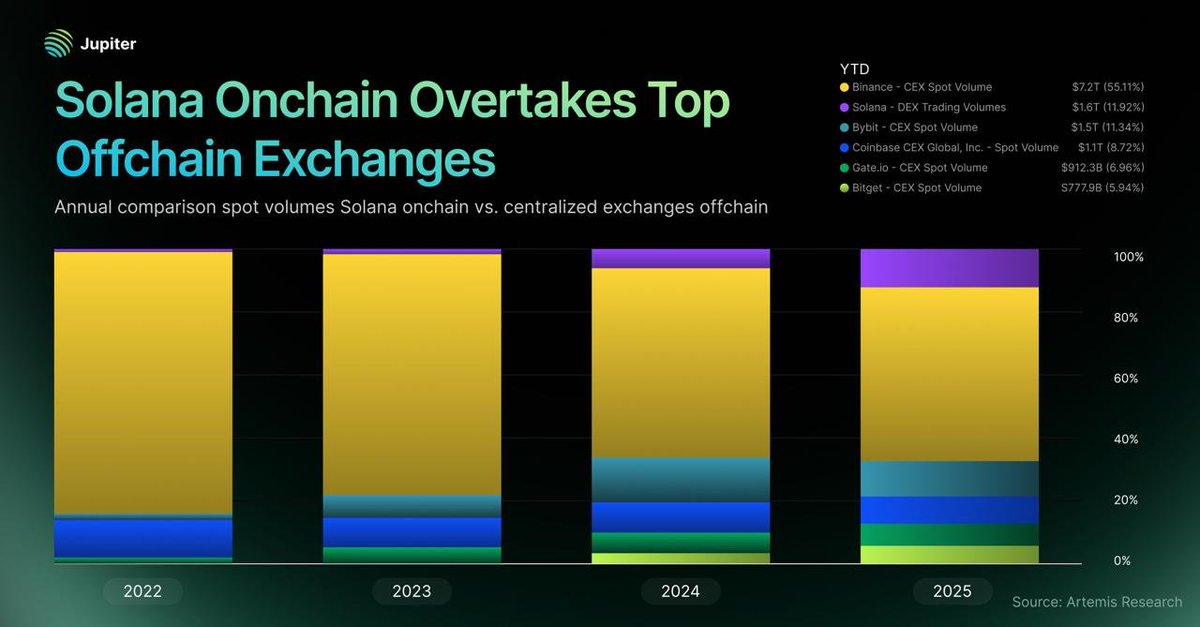
Recently, The Kobeissi Letter stated that the on-chain spot trading volume on Solana in 2025 officially reached $1.6 trillion, surpassing all centralized exchanges except Binance.

According to data from JupiterExchange, the proportion of Solana's on-chain trading volume to total trading volume has grown from 1% to 12% since 2022. In 2025, Solana's total trading volume officially exceeded that of Bybit, Coinbase Global, and Bitget, second only to Binance.

At the same time, Binance's market share has dropped from 80% to 55% since 2022. This also means that industry activity in cryptocurrency is rapidly shifting on-chain.
Revealing the Composition of Solana Ecosystem On-Chain Revenue: 4 Components Support Over $600 Million

Based on available information, Solana's network revenue mainly comes from on-chain transaction fees. Unlike Ethereum and others, its fee mechanism design focuses more on deflation and validator incentives. The composition of the total fee revenue of $603 million in 2025 is as follows:

First Revenue: Base Fee

  • A very low fixed base fee is charged per transaction (about 5000 lamports).
  • This portion of the fee is entirely burned, not distributed to validators, directly reducing the total supply of SOL, creating deflationary pressure.
  • Accounts for a large proportion of total fee revenue, especially in 2025 with explosive transaction growth, the burning mechanism significantly enhanced SOL's scarcity.

Second Revenue: Priority Fee

  • An additional fee that users can optionally pay to speed up transaction confirmation.
  • During periods of high congestion (e.g., meme coin craze, large DEX trades), priority fees increase significantly, becoming a major source of revenue increment.
  • This portion of the fee is distributed to block producers (Leaders) and stakers, and is the main reward source for validators.

Third Revenue: MEV (Maximal Extractable Value) Related Revenue

  • Tips paid by searchers through MEV clients like Jito further supplement income.
  • The proportion of MEV revenue increased in 2025, closely related to complex arbitrage opportunities in DEX and meme coin trading.

Fourth Revenue: Other Minor Sources

Such as account rent (storage fees), voting fees, etc., accounting for a small proportion.

In the overall distribution mechanism, about 50% of the fees indirectly benefit all SOL holders through the burning mechanism (deflation); about 50% is directly distributed to validators and stakers, incentivizing network security. Unlike Ethereum, where protocol revenue fees mainly go to validators, Solana's burning mechanism gives its network revenue greater long-term value capture capability, which is also the key to maintaining low fees under high transaction volume.

Overview of Crypto Money-Making Machine Business Models: Public Chains, Perp DEXs, Launchpads Remain the Most Profitable Tracks, Second Only to Stablecoins

Finally, synthesizing existing market information, public chains (Solana, Ethereum, TRON), on-chain perp DEXs (like Hyperliquid, Aster, etc.), and on-chain Launchpads (like Pump.fun) are still the most profitable tracks in the crypto industry, second only to stablecoin projects that collect interest and have stable issuance.

Although we previously analyzed the awkward survival state of current public chain projects in the article "Only 10 Public Chains Have Weekly Revenue Over $100,000: Swimming Naked After the Tide Recedes", the existence of public chains like Solana, Ethereum, TRON, and Base tells us: public chains are still the most profitable crypto track today, perhaps even without exception.

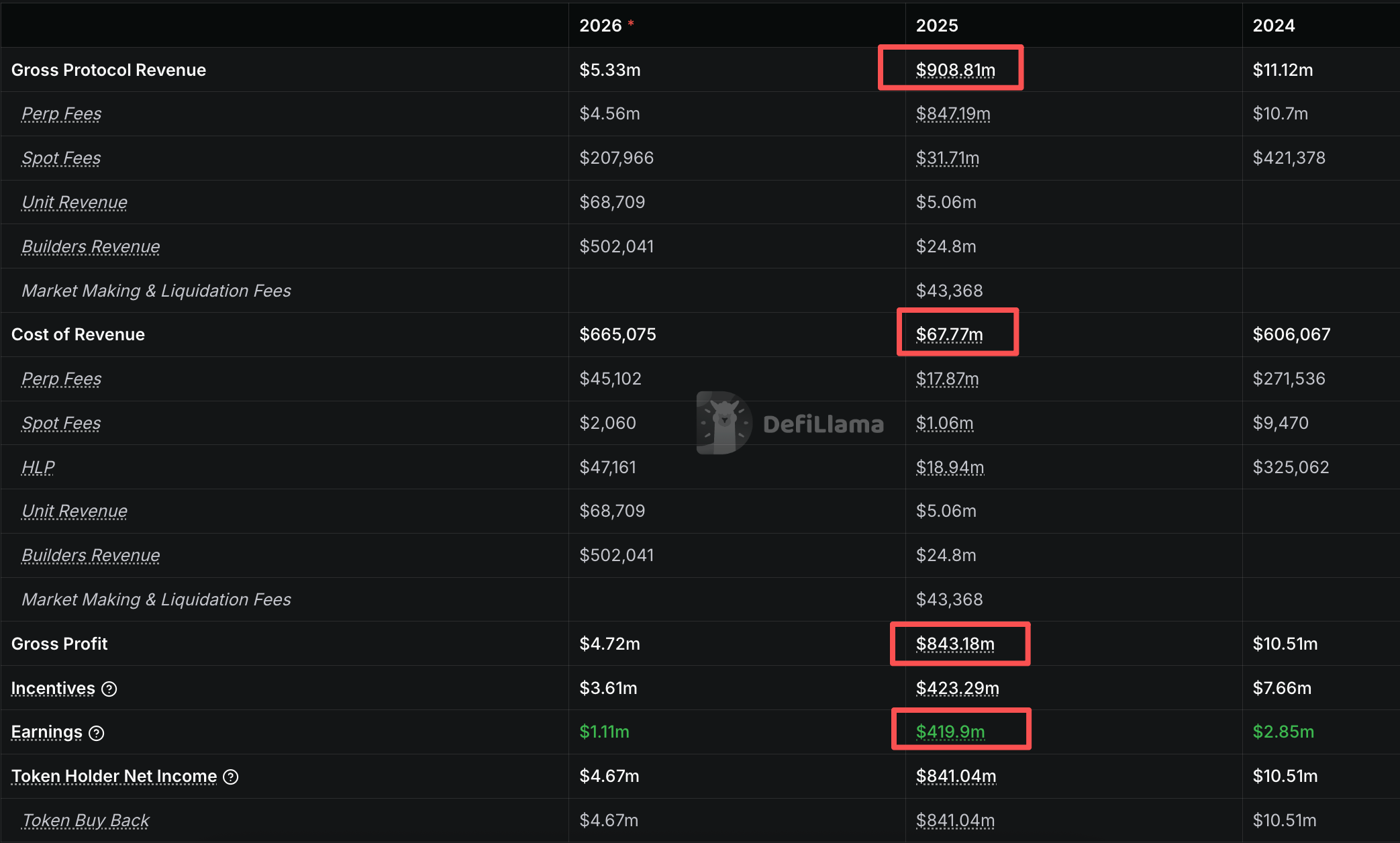
According to DefiLlama data, Hyperliquid's revenue in 2025 was $908 million; its cost of revenue was approximately $67.77 million, and its annual net profit was approximately $843 million. Excluding incentive-based expenses, the net profit attributed to the platform in 2025 was as high as approximately $420 million.
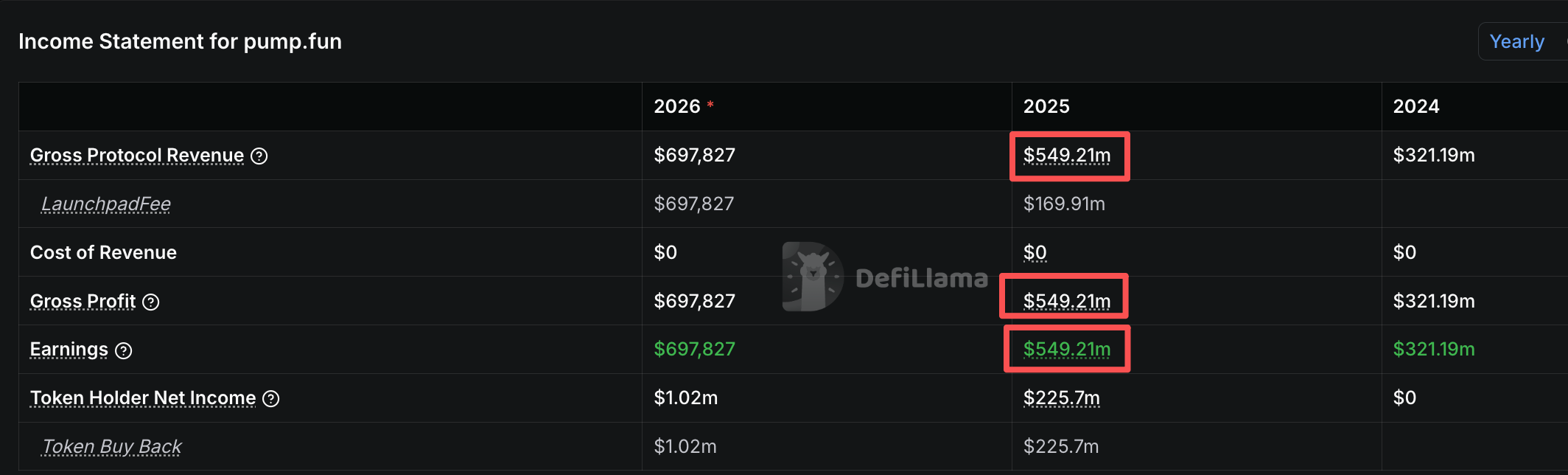
According to DefiLlama data, Pump.fun's annual revenue in 2025 was approximately $550 million. Unlike on-chain perp DEX platforms like Hyperliquid, as a "one-click coin issuance platform", Pump.fun does not need to incur incentive expenses, so its platform's annual net profit is approximately equal to its annual revenue, i.e., $549 million.
Based on the above information, the industry's mainstream revenue-generating machines are still top applications like public chains, on-chain Perp DEXs, and Launchpad coin issuance platforms, second only to stablecoins (e.g., Tether's net profit related to the stablecoin sector alone reached $7.43 billion in 2025).


Trending Cryptos

Related Questions

QWhat was Solana's on-chain fee revenue in 2025, and how did it rank compared to other major blockchains?

ASolana's on-chain fee revenue in 2025 was $603 million, ranking it number one among all major blockchains, surpassing Tron ($581 million) and Ethereum ($514 million).

QWhat was Solana's total annual revenue for 2025, and how does it compare to the combined revenue of Hyperliquid and Ethereum?

ASolana's total annual revenue for 2025 was over $1.5 billion, which is more than the combined revenue of Hyperliquid ($780 million) and Ethereum ($690 million).

QWhat were the four main components that made up Solana's $603 million in on-chain fee revenue?

AThe four main components were: 1. Base fees (burned, creating deflationary pressure), 2. Priority fees (paid to validators and stakers), 3. MEV (Maximal Extractable Value) related income, and 4. Other minor sources like account rent and voting fees.

QHow much on-chain spot trading volume did Solana process in 2025, and what does this volume surpass?

ASolana processed $1.6 trillion in on-chain spot trading volume in 2025, surpassing the volume of all centralized exchanges except for Binance.

QAccording to the article, what are the most profitable business models in the crypto industry,仅次于稳定币?

AThe most profitable business models,仅次于稳定币, are public chains (like Solana, Ethereum, Tron), on-chain Perp DEXs (like Hyperliquid), and on-chain Launchpads (like Pump.fun).

Related Reads

The "Impossible Triad" Is Fundamentally a Pseudo-Problem

The article argues that blockchain's fundamental limitation is not the scalability trilemma (decentralization, scalability, security), which has been largely solved, but the lack of **privacy** and, until recently, clear **legitimacy**. Blockchain is described as a slow, expensive, globally shared computer whose core value is censorship resistance and verifiability. While ideal for native digital assets like money (e.g., stablecoins), its default transparency acts as a **tax**, exposing all transactions and enabling MEV extraction, which deters serious institutional capital. Simultaneously, its permissionless nature created regulatory ambiguity. The piece contends that **privacy** is the missing critical feature. It rejects the false choice between total transparency and complete anonymity. Modern cryptography (like zero-knowledge proofs) enables **compliant privacy**: users can prove facts (solvency, KYC status, compliance) without revealing the underlying sensitive data (specific holdings, identities). This preserves auditability for regulators and eliminates the leak of financial information. With recent regulatory progress (e.g., the GENIUS Act) addressing legitimacy, adding default, provably compliant privacy becomes a pure upgrade. It transforms blockchain from a costly, public ledger into a confidential settlement layer, finally bridging the gap to mainstream institutional and individual adoption of on-chain finance.

链捕手3h ago

The "Impossible Triad" Is Fundamentally a Pseudo-Problem

链捕手3h ago

Optical Chips: Collective Capacity Expansion

The global optical chip industry is experiencing a massive wave of expansion driven by surging AI data center demand. Major players across the US, Japan, Europe, and China are aggressively investing to ramp up production capacity. In the US, Coherent is expanding its 6-inch Indium Phosphide (InP) semiconductor fab in Texas, supported by CHIPS Act funding and a $2 billion strategic investment from NVIDIA. Lumentum is building a new factory for InP optical devices, and Nokia is scaling its advanced photonic chip packaging and testing capabilities. NVIDIA's investments aim to secure future supply of critical lasers and optical interconnect products for AI infrastructure. Japan's JX Advanced Metals, a leading InP substrate supplier, plans a multi-billion yen investment to increase its capacity 7-10 times, strengthening its grip on the crucial upstream materials market. In Europe, IQE and Tower Semiconductor settled a patent dispute and signed a multi-year InP epitaxial wafer supply agreement, highlighting that next-generation silicon photonics platforms will integrate high-performance InP components. STMicroelectronics and Sivers Semiconductors are also expanding silicon photonics production and partnerships. China is rapidly building out its domestic supply chain. Dongshan Precision's subsidiary, Source Photonics, announced a $12 billion project to expand optical chip and module production. Companies like Sanan Optoelectronics and Yunnan Germanium are scaling up InP chip manufacturing and substrate production, moving towards vertical integration from materials to modules. While debate continues around the exact future architecture—whether CPO (Co-Packaged Optics), NPO, or pluggables will dominate—analysts like Morgan Stanley argue the underlying driver is unchangeable: the explosive growth in bandwidth demand. This will inevitably increase the volume of optical engines, lasers, and related content per GPU, regardless of the final technical path. The competition for "more light" in the AI era has intensified into a global, full-chain capacity race.

marsbit5h ago

Optical Chips: Collective Capacity Expansion

marsbit5h ago

Stablecoins Finally Find Real Yield: An In-Depth Look at On-Chain Reinsurance Re | A Conversation with Re Founder Karan Saroya

Stablecoin Real Yield Found: A Deep Dive into On-Chain Reinsurance with Re's Karan Saroya As stablecoin supply exceeds $170 billion, the search for sustainable, non-speculative yield intensifies. Re, an on-chain reinsurance platform, provides an answer: connecting stablecoin capital to the trillion-dollar traditional reinsurance market. Re operates as a regulated reinsurer, accepting stablecoin deposits as collateral to back US insurance companies. These insurers pay premiums, generating yield that flows back to on-chain depositors. Currently supporting 35 insurers and underwriting $500 million, Re projects scaling to over $1 billion soon. Key insights from a Bankless podcast with founder Karan Saroya and investor Avichal of Electric Capital: 1. **Uncorrelated, Real-World Yield:** Re offers stablecoin holders access to reinsurance returns (targeting 12-14%+), an asset class entirely separate from crypto or equity markets. 2. **Operational Efficiency via Smart Contracts:** Re replaces traditional, labor-intensive capital fundraising with smart contracts, allowing a ~12-person team to compete with industry giants. 3. **Regulatory Leverage:** For every $1 of collateral, regulations allow backing $5-7 in written premiums. This leverage amplifies returns from the underlying risk-free rate. 4. **DeFi Integration:** Depositors receive receipt tokens, which can be used in protocols like Morpho for "looping," potentially pushing yields to 18-20%+. 5. **The "DeFi Mullet" Model:** A compliant front-end (regulated reinsurer) paired with a decentralized back-end (smart contracts, DeFi capital markets). 6. **RE Governance Token:** Modeled on Lloyd's of London, the token governs the central capital pool's allocation, counterparty acceptance, and parameters. 7. **Real Economic Impact:** Capital funds real-world productivity (factories, clinics, businesses) via insurance, moving beyond crypto's internal loops. The discussion highlights a pivotal moment: DeFi's supply-side infrastructure is now met by real demand for productive yield, potentially kickstarting a flywheel where vast on-chain stablecoin capital seeks these real-world returns.

链捕手6h ago

Stablecoins Finally Find Real Yield: An In-Depth Look at On-Chain Reinsurance Re | A Conversation with Re Founder Karan Saroya

链捕手6h ago

1996 or 1999? Walsh's First Test is 'How to View AI'

"1996 or 1999? Wall's First Big Test Is 'How to View AI'" Federal Reserve Chairman Wall's initial challenge is not whether to raise or cut rates, but a more fundamental judgment: what kind of boom is the current AI boom? This will determine the Fed's policy path and define his legacy. Economics is split between two opposing views, according to reporter Nick Timiraos. One sees imminent productivity gains that will increase supply and cool inflation, allowing the Fed to hold steady. The other argues that while productivity benefits are distant, demand shocks are here now, and waiting for data confirmation risks missing the intervention window, forcing sharper rate hikes later. Wall has signaled a leaning toward the first view, echoing 1996-era Alan Greenspan, who embraced strong, productivity-driven growth without fear of inflation. However, Wall faces a different macro environment than Greenspan did, with tariff pressures, expanding fiscal deficits, and diminishing globalization benefits, which could force more significant inflation pressures even if AI benefits materialize. Wall's logic, expressed before taking office, is that AI-driven productivity gains won't show in official data for years. If the Fed waits for confirmation, it might mistakenly tighten policy and choke off the very growth that could suppress inflation. This argues for using forward-looking narratives over lagging data. Chicago Fed President Austan Goolsbee presents a key counter-argument. He distinguishes between expected and unexpected productivity booms. A widely anticipated boom, like the current AI wave, can cause people to spend future wealth gains in advance, overheating the economy before productivity actually rises, thus requiring preemptive rate hikes. He cites rising costs for AI data centers as evidence of such overheating. Fed Governor Christopher Waller offers a rebuttal to Goolsbee, noting the "expected spending" mechanism only works if people can borrow against future income, which many households cannot do due to borrowing constraints. Wall also faces a paradox related to his desire to reduce the Fed's use of "forward guidance" (pre-announcing policy moves). This practice was established in 1999 when Greenspan began signaling hikes to avoid market shocks. If the economy follows a less optimistic path, Wall may be forced to choose between using the guidance he wants to abolish or risking market volatility by staying silent. The ultimate question defining Wall's first major test remains: Is this 1996 or 1999?

marsbit7h ago

1996 or 1999? Walsh's First Test is 'How to View AI'

marsbit7h ago

Trading

Spot
Futures

Hot Articles

Discussions

Welcome to the HTX Community. Here, you can stay informed about the latest platform developments and gain access to professional market insights. Users' opinions on the price of ETH (ETH) are presented below.

活动图片