Silver Is Soaring, Can Tokenized Silver Amplify Leverage Further?

marsbitPublished on 2026-01-27Last updated on 2026-01-27

Abstract

Silver prices have surged dramatically, breaking historical records by reaching over $117 per ounce and accumulating a 517% increase since 2017—outpacing both Bitcoin and gold. With a market cap of approximately $6.18 trillion, silver is the second most valuable asset globally. This rally has spurred interest in tokenized silver as a way to gain exposure, including through leveraged contracts. Two major tokenized silver assets stand out: - **Kinesis Silver (KAG)**, with a market cap of $406 million, is backed by physical silver (1 token = 1 oz), offers global payments and redemption, but carries issuer dependency and regulatory risks. - **iShares Silver Trust (SLV)**, with a $39.5 million market cap, tracks a traditional ETF managed by BlackRock, provides good liquidity and institutional backing, but does not allow physical redemption and incurs management fees. Additionally, leveraged trading is available on platforms like Hyperliquid, Binance (offering up to 20x leverage on XAG/USDT), and Bitget, with significant trading volumes. The surge is driven by factors including Trump’s trade policies, expectations of U.S. interest rate cuts, silver’s new classification as a critical mineral in the U.S., supply constraints, and its role as a hedge amid geopolitical tensions. Analysts suggest the rally may continue due to these structural and macroeconomic tailwinds.

Original|Odaily Planet Daily(@OdailyChina)

Author|Wenser(@wenser 2010)
Silver, this precious metal asset once called "poor man's gold," is sweeping the global market with a storm-like momentum. The reason is none other than its terrifying surge.

Recently, the price of silver once broke through $117 per ounce intraday, hitting a record high. As a result, since the high point of the 2017 crypto cycle, silver has officially surpassed Bitcoin's gain (about 500%) and gold's gain (slightly less than 300%) with a cumulative increase of approximately 517%. According to data from the 8marketcap website, the current price of silver is around $110, with a market capitalization reaching $6.18 trillion, ranking second among global assets, second only to gold. Such an astonishing trend naturally triggers market frenzy. Besides buying silver funds or physical silver through traditional brokers or offline stores, tokenized silver might also be an option, especially the leveraged contracts on exchanges and on-chain Perp DEXs.

Current State of Tokenized Silver: Only 2 Targets Have Relatively Good Liquidity

According to data from the Coingecko website, the overall market capitalization of the tokenized silver sector is temporarily reported at approximately $446 million, with a 24-hour increase of about 5.6%; specifically, the tokenized silver with relatively good liquidity are the following 2 types:

Kinesis Silver (KAG): Market cap temporarily reported at $406 million

Like the gold token KAU, the KAG silver token is launched by Kinesis, a British digital asset utility platform registered in the Cayman Islands. Major trading platforms include Kinesis Money, BitMart, UAE exchange Emirex, and others.

It is understood that KAG is backed by fully insured and regularly audited vaults (globally distributed storage), with each token pegged to 1 ounce of investment-grade silver; it supports global real-time payments; supports physical silver redemption; and has no storage fees.

Its potential risks are similar to those of the Tether company, which issues the XAUT gold token. This token highly depends on the asset credibility of the issuer and faces certain regulatory uncertainties. Furthermore, limited by its small market cap, the market depth is relatively average, and market fluctuations may lead to premiums or discounts, relying more on the trading platform to manage order matching.

Nevertheless, information on the Coingecko website shows that KAG's 24-hour trading volume is about $5.5 million, already ranking second in trading volume in the tokenized silver market.

iShares Silver Trust(SLV): Market cap temporarily reported at $39.5 million

A silver token pegged to the iShares Silver Trust, launched by Ondo Finance, holds the corresponding physical silver through the BlackRock iShares Silver Trust (SLV) ETF.

Its advantages lie in tracking a regulated traditional SLV ETF, having good liquidity, and supporting instant minting or redemption (for users outside the US); combining traditional finance with blockchain convenience; institutional-level endorsement; no need to handle physical silver directly.

Its potential risks include: primarily relying on the asset credibility of issuers like BlackRock and Ondo; does not support physical silver ownership or direct redemption; includes certain ETF fund management fee costs; US users are restricted from trading, and it faces potential securities regulatory restrictions.

Main trading platforms include centralized exchanges such as Gate, Bitmart, Bitget, AscendEX, etc.

It is worth mentioning that SLV also supports contract trading, with leverage up to 10x.

Coingecko website information shows that SLVON's 24-hour trading volume is about $21.2 million, ranking first in trading volume in the tokenized silver market.

Besides the two major silver tokens KAG and SLVON, the silver token Silver rStock (SLVR) launched by Solana生态 stock tokenization platform Remora Market, and the Gram Silver (GRAMS) token pegged to 1 gram of silver launched by Token Teknoloji A.Ş also belong to spot tokens, but their market capitalization and liquidity are extremely low. Compared to KAG and SLVON, the price difference from physical silver is larger, and participation in trading is not recommended.

Silver Leverage Trading Platforms: Hyperliquid, Binance, Bitget, and other exchanges

Besides spot silver tokens, currently many US stock tokenization platforms, on-chain Perp DEXs, CEXs, and DEXs have opened leveraged contract trading related to silver, supporting leverage up to 20x. The following are specific trading platforms for readers' reference:

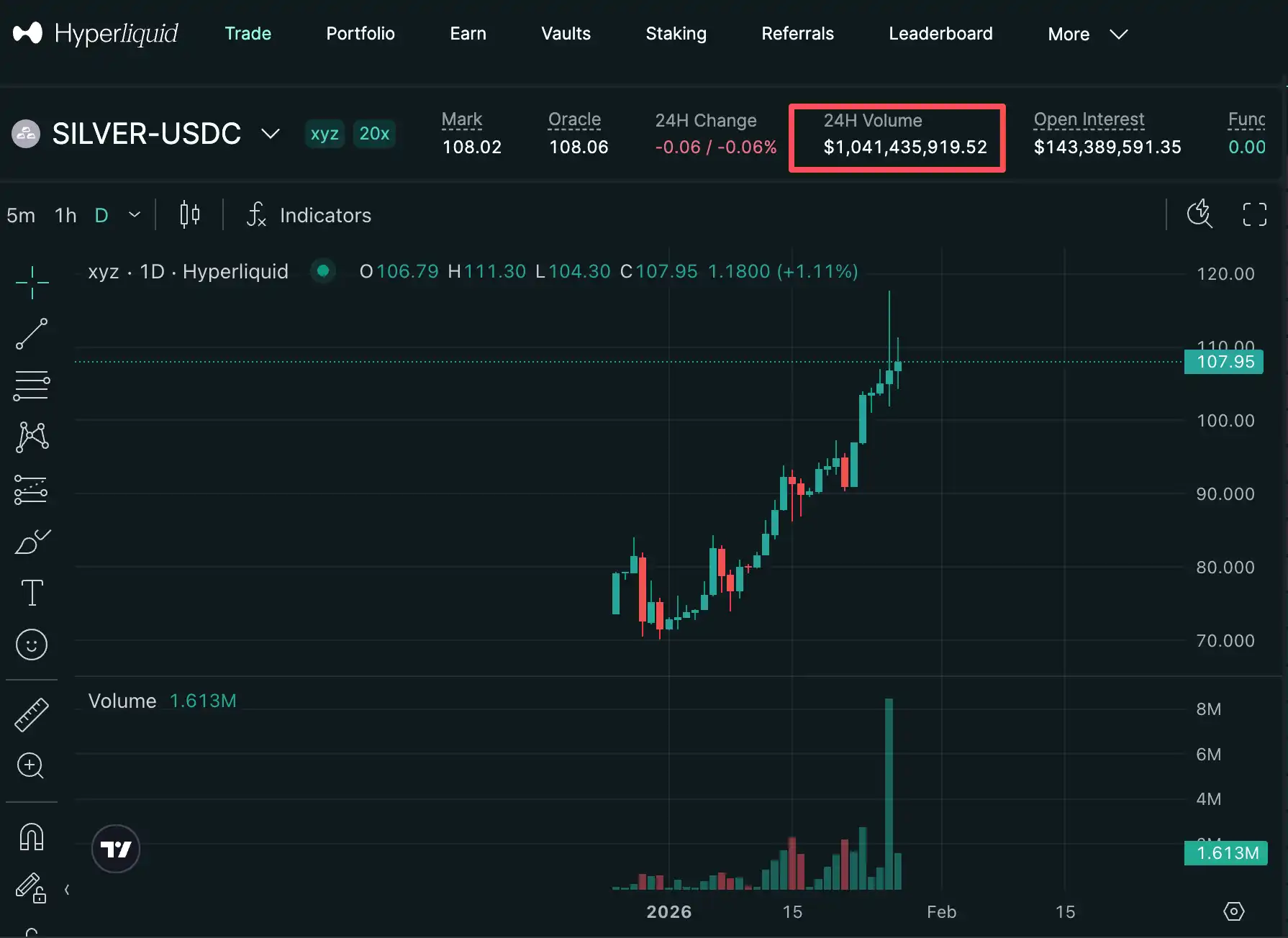
Channel One——Hyperliquid: https://app.hyperliquid.xyz/trade/xyz:SILVER, the Silver/USDC contract trading pair's 24-hour trading volume exceeded $1 billion;
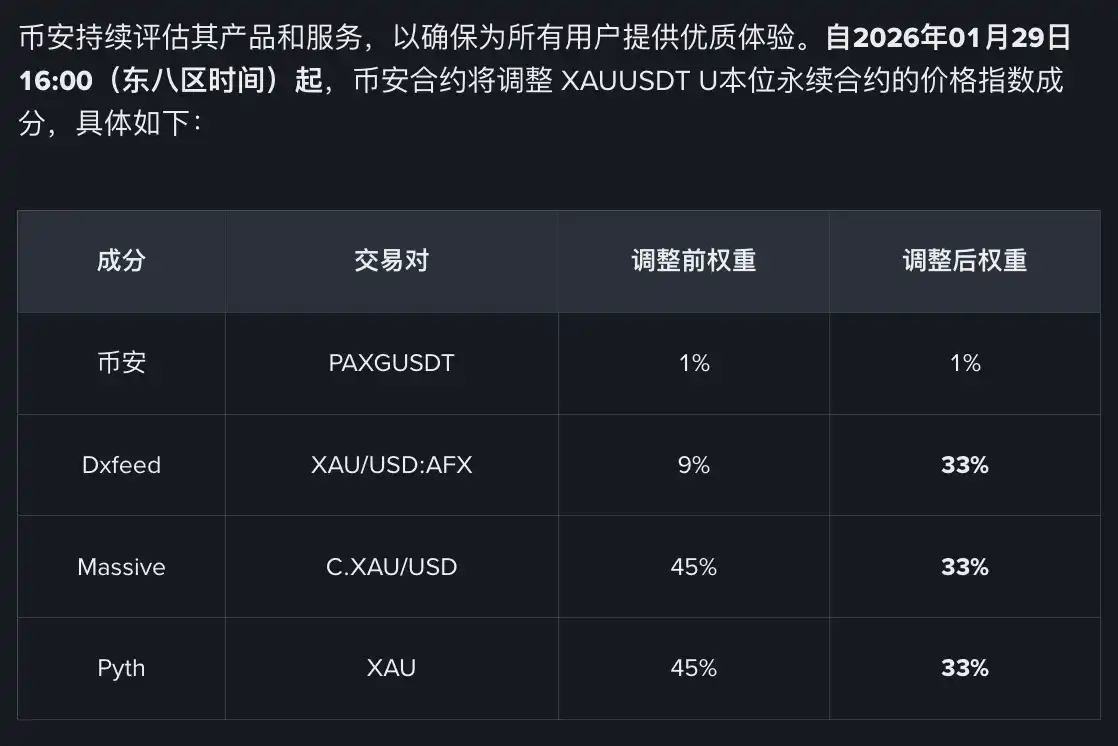
Channel Two——Binance:https://www.binance.com/zh-CN/futures/XAGUSDT, supports leveraged trading for the XAG/USDT trading pair, with leverage up to 20x. Currently, the 24-hour trading volume is $1.32 billion. According to the announcement, this trading pair was officially opened on January 7th; the latest news shows that Binance will change the price index composition of this contract on January 29, 2026.
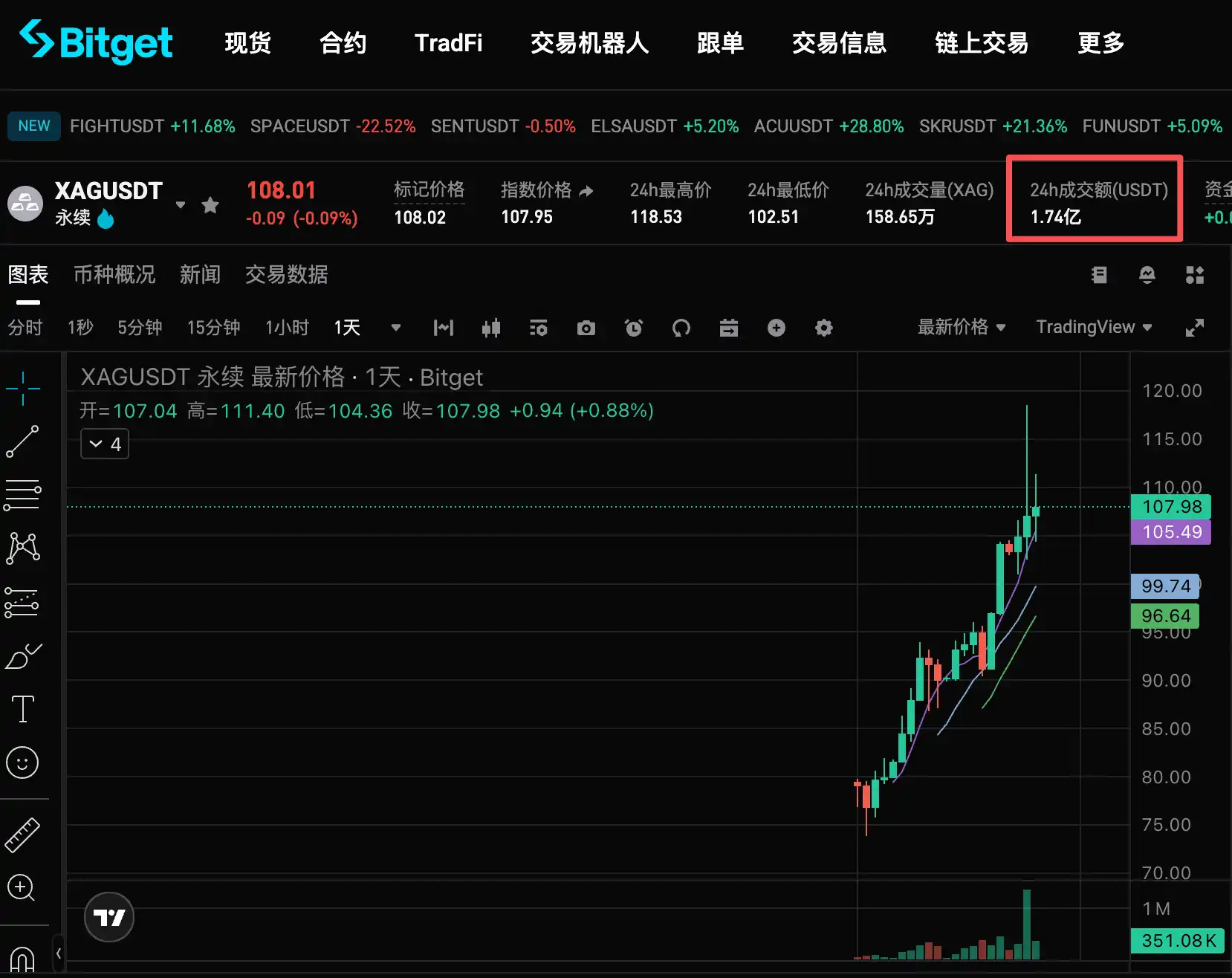
Channel Three——Bitget:https://www.bitget.site/zh-CN/futures/usdt/XAGUSDT, supports leveraged trading for the XAG/USDT trading pair, with leverage up to 20x. Currently, the 24-hour trading volume is $174 million.
Conclusion: Trump's Hawkish Policies and Dovish Rate Preferences Will Be the Best Catalyst for Precious Metals

Looking back, Trump's rise to power leading to tense international political and economic situations, tariff trade wars, and his preference for Federal Reserve rate cuts are the best catalysts for the rise in precious metal prices. Specifically for silver, besides past reasons like supply tightness and its role as an important raw material, risk-off assets and the US attitude are crucial.

J. Safra Sarasin strategist Claudio Wewel pointed out that the continuous surge in silver prices stems from the market's reduced expectations for US rate cuts and silver's newly acquired status as a key mineral. The US Department of the Interior listed silver as a critical mineral in November, increasing the possibility of the US imposing tariffs on this metal. He noted that this exacerbates long-term supply tightness and prompts US importers to accelerate silver purchases. Meanwhile, retail investors, finding it difficult to buy gold at historically high prices, are turning to silver as a safe-haven asset.

In other words, silver's main rise comes from both "scarcity" and "safe-haven nature." Combined with the recently tense Middle East situation again, the price peak for silver may be far from over.


Trending Cryptos

Related Questions

QWhat are the two tokenized silver assets with relatively good liquidity mentioned in the article?

AKinesis Silver (KAG) and iShares Silver Trust (SLV).

QWhich platform offers a silver contract with up to 20x leverage and has a 24-hour trading volume of 13.2 billion US dollars?

ABinance, for the XAG/USDT trading pair.

QWhat are the main reasons cited for the surge in silver prices according to the article?

AMarket expectations of reduced US interest rate cuts, its new status as a US critical mineral (increasing potential tariffs), long-term supply tightness, and its role as a risk-off asset for retail investors.

QWhat is the key difference between the KAG and SLV tokenized silver products regarding physical redemption?

AKAG supports physical silver redemption, while SLV does not offer direct physical silver ownership or redemption.

QWhich on-chain Perp DEX is mentioned for trading a silver/USDC perpetual contract with a significant 24-hour volume?

AHyperliquid, for its SILVER/USDC trading pair.

Related Reads

As Consensus Accelerates, What Are Young Investors Betting On?

Title: As Consensus Forms Faster, What Are Young Investors Betting On? In the rapid evolution of tech investment, a new generation of young investors is navigating a landscape where AI, robotics, commercial aerospace, and quantum computing are advancing simultaneously. Traditional investment logic based on financial models is giving way to a need for deep technical understanding and the ability to act before industry consensus forms. An analysis of trends from the "WAIC FUTURE TECH" list of young investment leaders reveals key shifts in focus. The first major trend is the movement of AI from the digital screen into the physical world. Investment is shifting from large language models and chatbots towards embodied AI, robotics, AI hardware, and edge computing. While demonstrations generate excitement, the real challenge lies in achieving scalable, reliable, and cost-effective delivery in complex real-world environments like factories and logistics. Success depends not just on algorithms but on the integration of sensors, actuators, and control systems. Second, the competitive focus for large models is moving beyond raw capability toward building an "intelligence flywheel." The goal is to create self-reinforcing systems where user interaction generates data, improving the model, which in turn enhances the user experience and attracts more engagement. Companies that successfully embed AI into workflows to create these closed-loop systems can build lasting value that isn't easily erased by the next model upgrade. Third, facing a potential bottleneck in high-quality human-generated data, investors are looking at new underlying technologies. Reinforcement learning and self-play, as demonstrated by AlphaGo Zero, offer paths for AI to generate its own experience. Scientific foundation models, which aim to build general AI capabilities for fields like life sciences and materials discovery, represent a non-consensus direction that could unlock new frontiers of knowledge and data. Finally, in deep-tech areas like quantum computing, commercial aerospace, and space-based infrastructure, patient capital is essential. These fields have long, uncertain development and validation cycles involving complex engineering, supply chains, and regulations. Investment here requires a long-term view, focusing on foundational team capabilities and the eventual emergence of market demand, even if commercial returns are distant. Collectively, these trends illustrate how young investors are adapting to a new era. They are learning to make earlier, technically-informed judgments, balance hype with real-world viability, and provide the patient capital needed to build the deep-tech foundations of the future.

marsbit8m ago

As Consensus Accelerates, What Are Young Investors Betting On?

marsbit8m ago

Can Japan Buy Growth with AI? Will the Bond Market Believe It?

Japan's cabinet has introduced the 2026 Basic Policy on Economic and Fiscal Management and Reform, shifting its primary fiscal target. The new framework moves away from the traditional annual primary balance goal and instead prioritizes a stable reduction of the debt-to-GDP ratio. This change is tied to a strategy of increased "responsible proactive fiscal" spending, aiming to boost long-term growth through investments in strategic sectors like AI, semiconductors, energy, and robotics. The government estimates total public and private investment in 62 key technologies could exceed 370 trillion yen by 2040. The market reaction has been mixed and cautious. While equity markets may respond to policy signals, bond markets are focused on fiscal credibility. Concerns center on whether the weakening of the clear primary balance anchor could lead to looser fiscal discipline. If investors doubt that these strategic investments will generate sufficient productivity gains, tax revenue, and nominal growth to outpace rising interest costs, they may demand higher yields on Japanese Government Bonds (JGBs). Recent volatility in the yen and JGB yields, with the 10-year yield briefly reaching 2.9%, reflects this skepticism. The success of this new framework hinges on two factors: whether Japan can achieve a nominal growth rate consistently higher than its long-term interest rates, and whether future budgets demonstrate disciplined control over bond issuance. The government's narrative is that strategic investment is essential to break Japan's cycle of low growth, aging, and labor shortages. However, the bond market will continuously assess the credibility of this plan, pricing the risk that it may represent fiscal expansion rather than a viable growth strategy.

marsbit45m ago

Can Japan Buy Growth with AI? Will the Bond Market Believe It?

marsbit45m ago

Misjudged A-Shares: Resilience, Expectations, and Confidence

China's A-share market recently faced selling pressure, especially in tech sectors, initially triggered by a global tech sell-off that began in South Korea. However, the article argues this is a case of "mistaken injury" and highlights the market's underlying resilience. This resilience stems from three main pillars: **1) Tech Sector Fundamentals:** Unlike Korea's market dominated by a few memory chip stocks, China's tech sector is diversified across computing, communications, electronics, and semiconductors, supported by dual narratives of global AI supply chains and domestic substitution. Core areas like optical modules and fiber optics continue to show strong earnings growth. **2) "National Team" Support:** State-backed institutions and large corporations have made significant market purchases and announced buybacks, providing liquidity and signaling confidence. This is seen as a stabilizing policy signal, often associated with market bottoms. **3) Broader Market Pillars:** Other major sectors are showing endogenous recovery momentum. Consumer stocks benefit from stabilizing CPI and signs of sector recovery (e.g., liquor price hikes). Cyclical sectors like aluminum have high earnings, potential price increases due to tight supply, and low valuations. The financial sector offers stable dividends and low valuations. The conclusion is that the sell-off was driven by external contagion, not a collapse in fundamentals. With strong policy support and recovering momentum across key sectors, the A-share market possesses the toughness to regain stability.

marsbit1h ago

Misjudged A-Shares: Resilience, Expectations, and Confidence

marsbit1h ago

Trading

Spot

Hot Articles

How to Buy T

Welcome to HTX.com! We've made purchasing Threshold Network Token (T) simple and convenient. Follow our step-by-step guide to embark on your crypto journey.Step 1: Create Your HTX AccountUse your email or phone number to sign up for a free account on HTX. Experience a hassle-free registration journey and unlock all features.Get My AccountStep 2: Go to Buy Crypto and Choose Your Payment MethodCredit/Debit Card: Use your Visa or Mastercard to buy Threshold Network Token (T) instantly.Balance: Use funds from your HTX account balance to trade seamlessly.Third Parties: We've added popular payment methods such as Google Pay and Apple Pay to enhance convenience.P2P: Trade directly with other users on HTX.Over-the-Counter (OTC): We offer tailor-made services and competitive exchange rates for traders.Step 3: Store Your Threshold Network Token (T)After purchasing your Threshold Network Token (T), store it in your HTX account. Alternatively, you can send it elsewhere via blockchain transfer or use it to trade other cryptocurrencies.Step 4: Trade Threshold Network Token (T)Easily trade Threshold Network Token (T) on HTX's spot market. Simply access your account, select your trading pair, execute your trades, and monitor in real-time. We offer a user-friendly experience for both beginners and seasoned traders.

12.5k Total ViewsPublished 2024.03.29Updated 2026.06.02

How to Buy T

Discussions

Welcome to the HTX Community. Here, you can stay informed about the latest platform developments and gain access to professional market insights. Users' opinions on the price of T (T) are presented below.

活动图片












