Shiba Inu rallies 26%, but whales quietly step aside – What happens now?

ambcryptoPublished on 2026-01-05Last updated on 2026-01-05

Abstract

Shiba Inu (SHIB) rallied 26% in early January, boosted by Bitcoin's surge above $90k. Despite the price increase, on-chain data indicates that large holders (whales) have been reducing their holdings since late November, suggesting the rally is driven by short-term hype rather than strong accumulation. The top 10 wallets control 62.65% of the supply, though 41% is permanently locked in a burn address. Key support lies at $0.0000085–$0.0000087; a drop below $0.0000078 could signal bearish momentum returning. Low recent on-chain movement implies room for growth, but whale distribution remains a cautionary signal.

Shiba Inu [SHIB] rallied 16.3% on Sunday, the 4th of January. It was up 26% at the time of writing, measured from the start of the new year.

This rally came alongside a Bitcoin [BTC] price bounce above the $90k level, which lent many altcoins bullish short-term momentum.

In a post on X, crypto market data platform Santiment revealed that a good chunk of the memecoin’s supply was concentrated within a few whales’ wallets.

The top 10 largest SHIB holders controlled 62.65% of the entire supply. It must be noted that the wallet containing 41% is a dead wallet and marked a major burn event from May 2021 by Vitalik Buterin.

Measuring SHIB’s on-chain selling pressure

During the 10/10 crash, Shiba Inu went down 43% in 8 hours after a nasty downside wick on Binance. While it saw a bounce immediately after, it marked a strong bearish continuation for SHIB.

Yet, the mean coin age and dormant circulation metrics hardly spiked higher, showing little sell pressure on-chain. This changed in December.

The metrics illuminate the movements of SHIB on-chain, and more movement of long-term dormant tokens creates more considerable changes in the metrics.

These reflect a flurry of large token movements, likely for selling.

In the past few days, even as prices bounced toward local resistance levels, there wasn’t sizeable on-chain SHIB movement. This suggested low profit-taking pressure from holders and that there was more room for growth.

On the other hand, bulls should beware that the larger SHIB wallets have been falling in number since late November, the supply distribution metric showed. Smaller wallets continued to rise in number.

This lack of whale accumulation indicated the current rally was not a product of long-term buying pressure, but short-term hype.
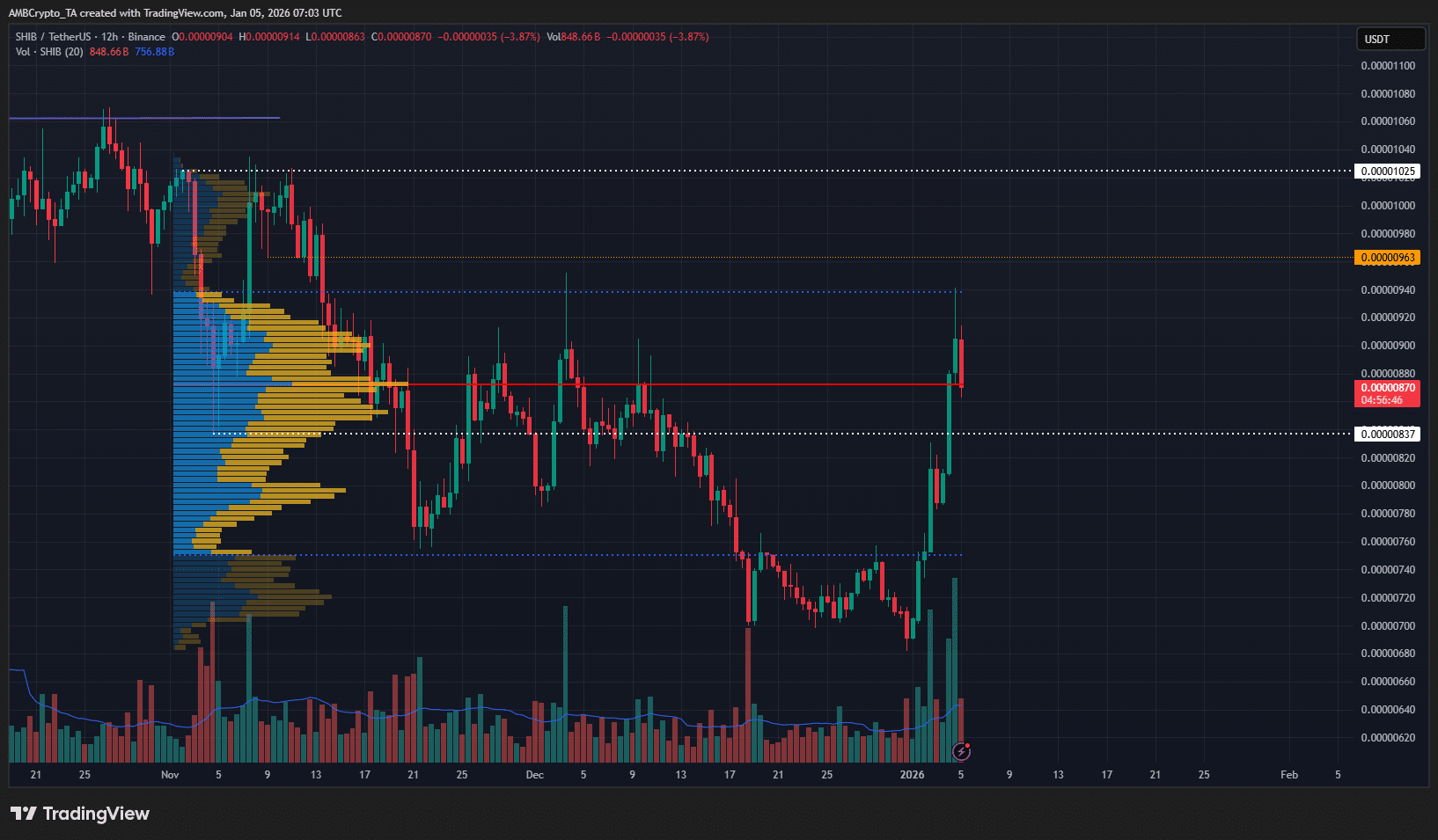
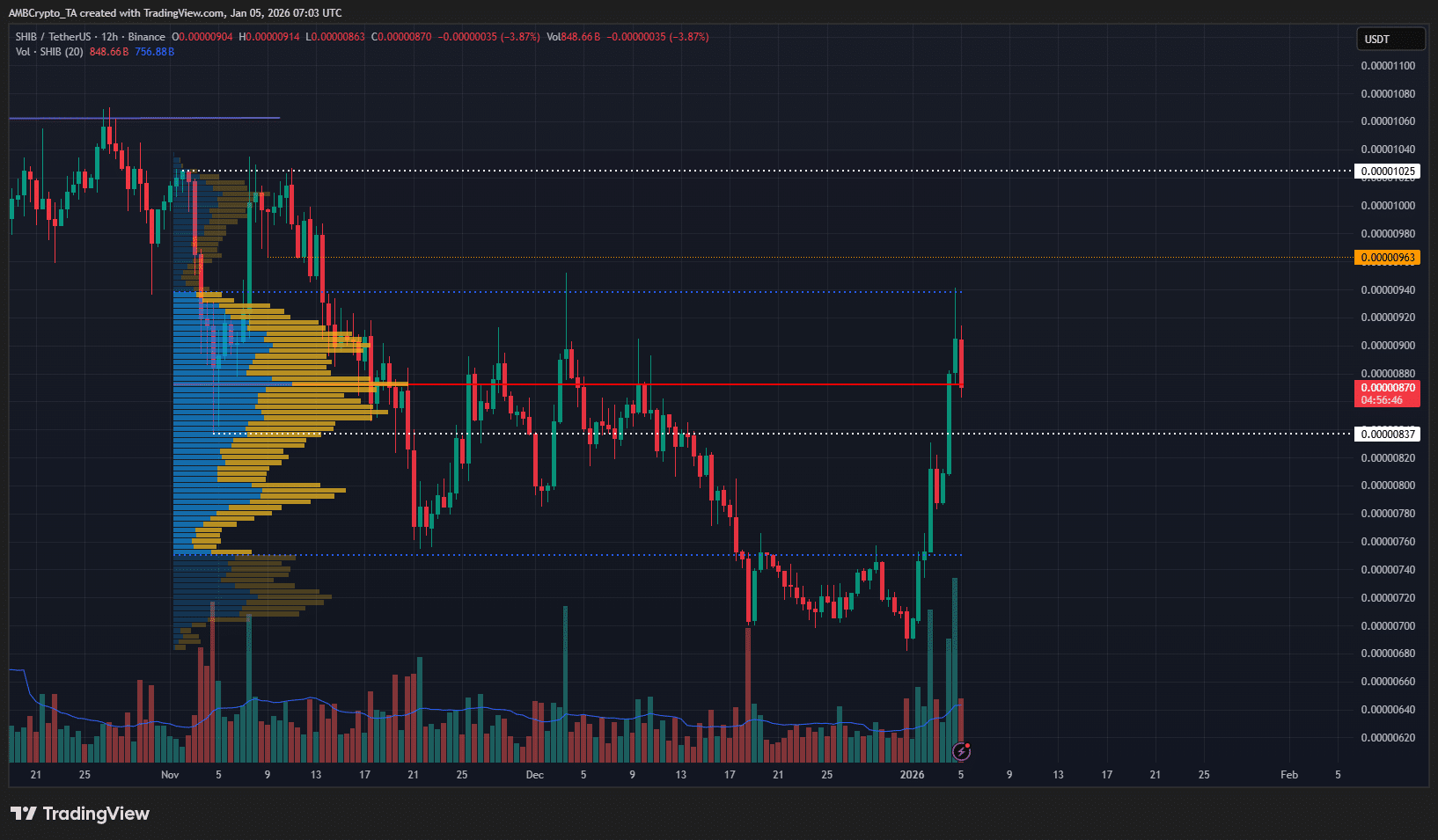
Source: SHIB/USDT on TradingView

For traders, there’s nothing wrong with hype. Any volatility is welcome, so long as it brings about a trend. Shiba Inu does have a trend now that is short-term bullish.

This could morph into a rally that lasts a few weeks if bullish sentiment persists.

The Fixed Range Volume Profile tool showed that the $0.0000085-$0.0000087 area was a high-volume support node, with SHIB testing the Point of Control (red) at the time of writing.

A retracement below the $0.0000078 level would be a sign that the momentum had faltered and bears were beginning to control the market once more.


Final Thoughts

  • The supply in the hands of the top 10 addresses suggests centralization, but investors should remember that 41% is in a burn address, inaccessible forever.
  • The larger SHIB wallets were distributing lately, and a wave of selling was last seen in December.


Related Questions

QWhat was the percentage increase of Shiba Inu (SHIB) on Sunday, January 4th, and how much was it up from the start of the new year at the time of writing?

AShiba Inu rallied 16.3% on Sunday, January 4th, and was up 26% from the start of the new year at the time of writing.

QAccording to Santiment, what percentage of the total SHIB supply is controlled by the top 10 largest holders, and what is significant about the wallet containing 41%?

AThe top 10 largest SHIB holders control 62.65% of the entire supply. The wallet containing 41% is a dead wallet, marking a major burn event from May 2021 by Vitalik Buterin.

QWhat do the mean coin age and dormant circulation metrics indicate about the on-chain selling pressure for SHIB during the crash and in December?

ADuring the crash, the metrics hardly spiked, showing little on-chain sell pressure. However, this changed in December, when the metrics reflected a flurry of large token movements, likely for selling.

QWhat does the recent trend in the number of larger SHIB wallets versus smaller wallets suggest about the nature of the current rally?

AThe number of larger SHIB wallets has been falling since late November, while smaller wallets have increased. This lack of whale accumulation indicates the current rally is a product of short-term hype, not long-term buying pressure.

QAccording to the Fixed Range Volume Profile tool, what price level would signal that the bullish momentum has faltered and bears are taking control?

AA retracement below the $0.0000078 level would be a sign that the momentum had faltered and bears were beginning to control the market once more.

Related Reads

Splashing Out 27 Billion Yuan, OpenAI Establishes New Company to Accelerate AI Deployment

On May 11th, OpenAI announced the formation of a new company, "OpenAI Deployment Company," with an initial investment of over $4 billion (approximately 27.2 billion RMB). This venture aims to help businesses build and deploy AI solutions. OpenAI is also acquiring the AI consulting firm Toromo to rapidly scale the deployment company's capabilities. This new entity, majority-owned by OpenAI, brings together 19 investment, consulting, and system integration partners, led by TPG with co-lead founding partners including Advent International, Bain Capital, and Brookfield. OpenAI's Chief Revenue Officer, Denise Dresser, stated that while AI is becoming increasingly capable, the current challenge lies in integrating these systems into core business infrastructure and workflows. The deployment company is designed to bridge this gap and translate AI capabilities into operational impact. This move comes as OpenAI emphasizes the next competitive phase will depend on the efficiency of deploying AI in real business scenarios. The company reports over 1 million businesses already use its products and APIs. OpenAI is significantly increasing its investments in computing power, with co-founder Greg Brockman stating the company expects to spend $50 billion on compute this year, a dramatic increase from $3 million in 2017. The announcement follows OpenAI's recent completion of a record $122 billion funding round in late March, led by Amazon, Nvidia, and SoftBank, valuing the company at $852 billion post-money. Major strategic investors committed $110 billion as a base for this round. Concurrently, OpenAI is advancing its core model development. It has shifted focus from its Sora video generator to developing advanced robotics and AI models that interact with the physical world. It has also begun allowing select users access to a new model specialized in identifying software vulnerabilities and is reportedly preparing to launch an enhanced image generation model in the coming weeks. According to reports citing founder Sam Altman, OpenAI is considering an IPO as early as 2027, with a potential valuation around $1 trillion.

marsbit6m ago

Splashing Out 27 Billion Yuan, OpenAI Establishes New Company to Accelerate AI Deployment

marsbit6m ago

The Essence of AI Layoffs: Why More AI Adoption Leads to More Corporate Anxiety?

The author, awaiting potential inclusion on an 8000-person layoff list, analyzes the true nature of recent "AI-driven" layoffs. They argue that while AI use, particularly tools like Claude for code generation, has skyrocketed and boosted developer output (e.g., 2-5x more code commits), this has not translated into proportional business growth or revenue. The core issue is a misalignment between increased "Input" (code) and tangible "Outcomes" (user value, revenue). AI acts as a costly B2B SaaS, inflating operational expenses without guaranteed returns. Two key problems emerge: 1) The friction that once filtered out bad ideas is gone, as AI allows cheap pursuit of even weak concepts. 2) Organizational "alignment tax"—the difficulty of coordinating across teams—becomes crippling when development velocity outpaces consensus-building. Thus, layoffs serve two immediate purposes: 1) To offset ballooning AI costs (Token consumption) and maintain cash flow, as rising input costs without outcome growth destroys unit economics. 2) To reduce organizational bloat and alignment friction by simply removing teams, thereby speeding up execution in the short term. Therefore, these layoffs are fundamentally caused by AI, even if AI doesn't directly replace roles. They represent a painful correction until companies learn to convert AI-driven productivity into real business outcomes and streamline organizational coordination to match the new pace of work. The cycle will continue until this learning curve is mastered.

marsbit1h ago

The Essence of AI Layoffs: Why More AI Adoption Leads to More Corporate Anxiety?

marsbit1h ago

Trading

Spot
Futures

Hot Articles

How to Buy SHIB

Welcome to HTX.com! We've made purchasing SHIBA INU (SHIB) simple and convenient. Follow our step-by-step guide to embark on your crypto journey.Step 1: Create Your HTX AccountUse your email or phone number to sign up for a free account on HTX. Experience a hassle-free registration journey and unlock all features.Get My AccountStep 2: Go to Buy Crypto and Choose Your Payment MethodCredit/Debit Card: Use your Visa or Mastercard to buy SHIBA INU (SHIB) instantly.Balance: Use funds from your HTX account balance to trade seamlessly.Third Parties: We've added popular payment methods such as Google Pay and Apple Pay to enhance convenience.P2P: Trade directly with other users on HTX.Over-the-Counter (OTC): We offer tailor-made services and competitive exchange rates for traders.Step 3: Store Your SHIBA INU (SHIB)After purchasing your SHIBA INU (SHIB), store it in your HTX account. Alternatively, you can send it elsewhere via blockchain transfer or use it to trade other cryptocurrencies.Step 4: Trade SHIBA INU (SHIB)Easily trade SHIBA INU (SHIB) on HTX's spot market. Simply access your account, select your trading pair, execute your trades, and monitor in real-time. We offer a user-friendly experience for both beginners and seasoned traders.

10.6k Total ViewsPublished 2024.03.29Updated 2025.06.04

How to Buy SHIB

Discussions

Welcome to the HTX Community. Here, you can stay informed about the latest platform developments and gain access to professional market insights. Users' opinions on the price of SHIB (SHIB) are presented below.

活动图片












