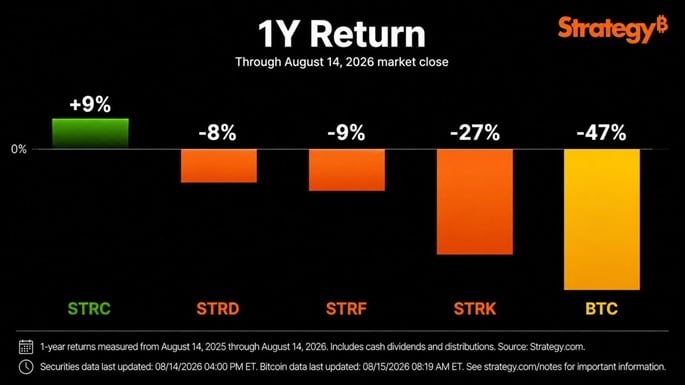
According to an annual performance chart posted on X on August 16 by Strategy Inc. (Nasdaq: MSTR) Executive Chairman Michael Saylor, STRC has outperformed bitcoin by 56 percentage points over the past year. The chart reflects returns as of market close on August 14 and highlights the performance gap between bitcoin and Strategy's income-producing securities during the market downturn.
Saylor wrote:
"Over the past year, $BTC fell 47%. The performance of our Digital Credit instruments ranged from -27% to +9%, with $STRC up 9%".
The accompanying chart shows STRD down 8%, STRF down 9%, and $STRK down 27%, with Bitcoin trading around $63,000 on August 16. Strategy clarified that the annual calculations cover the period from August 14, 2025, to August 14 and include cash dividends and payments, providing a broader picture than just stock price changes.
Stretch, trading under the ticker STRC, is a perpetual preferred stock with a variable annual dividend rate, designed to encourage trading near its $100 nominal value. On Strategy's official STRC information page, the annual rate for August is listed as 12%, with cash dividends paid twice monthly, subject to board approval.
STRD is a Strategy perpetual preferred stock with a fixed 10% annual dividend rate paid quarterly. STRF is the company's highest-priority preferred stock, offering fixed annual cash dividends of 10% paid quarterly. $STRK is a convertible perpetual preferred stock with a fixed 8% annual dividend rate paid quarterly. Dividends are not guaranteed.
Dividends Change the Performance Comparison Picture
STRC's reported annual return of 9% differs from its current 12% annual dividend rate, which applied for only part of the period. The preferred shares were issued in July 2025 at a 9% rate and saw increases for seven consecutive months before reaching the 12% level for fixing dates on or after July 1. Their market price can fluctuate, while dividends were included in the reported annual return.
In its Q2 earnings report, Strategy described digital credit as a primary financing channel. The company reported that as of July 26, 2026, STRC securities raised $7.53 billion since issuance a year prior, a 254% increase, while cumulative dividends paid across all preferred shares reached $1.06 billion.
Under its "Digital Credit Capital Framework," the company established a cash reserve policy, revised the STRC dividend policy, and authorized the repurchase of up to $1 billion in preferred securities alongside a separate $1 billion common stock repurchase program. Strategy also authorized bitcoin sales for specific purposes, including replenishing reserves, paying dividends, interest, and approved repurchases.
Saylor has positioned STRC as the income layer in a four-layer digital money structure. In his model, bitcoin serves as the equity layer, with preferred securities used to create income instruments with varying volatility and risk profiles.
Lower Volatility Does Not Eliminate Risk
Despite the positive annual return, STRC shares fell to an all-time low of $71.25 on June 26 and have since traded below their $100 nominal value. Strategy maintained the dividend rate at 12% for August after the preferred shares closed July at $89.46, reflecting the company's effort to support its share price.
Digital credit repurchases began in late July, with the company buying 288,930 STRC shares for approximately $25 million, at an average price of $86.53 per share, a 13.47% discount to the $100 nominal value. Since the start of the year, Strategy sold approximately $218.4 million worth of bitcoin to fund part of the preferred share dividends.
The dividend structure depends partly on Strategy's ability to meet ongoing cash obligations while maintaining a bitcoin-focused balance sheet. The preferred shares are not secured by the company's bitcoin assets. Saylor has previously stated that for capital gains to cover STRC preferred dividends over time, bitcoin's annual appreciation must exceed the company's break-even level on $BTC.
Bitcoin as an asset class has historically been significantly more volatile than traditional stocks, bonds, and commodities, a gap Strategy's preferred structures aim to narrow.
The Position of Strategy's Common Shares
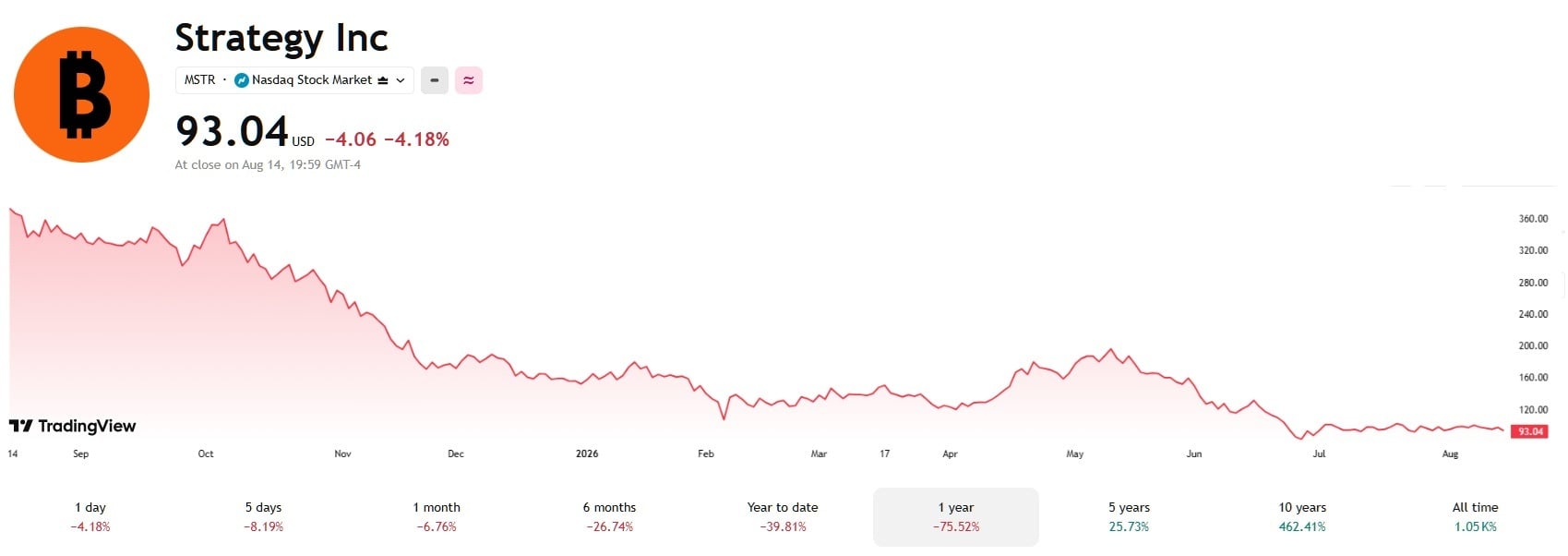
The annual chart features four types of Strategy preferred securities alongside bitcoin, while MSTR—the company's Class A common stock—sits below them in the capital structure. On August 14, MSTR closed at $93.04, approximately 75.52% lower than a year earlier.
Common shareholders are entitled to residual earnings after preferred dividends, which alone amounted to $400.7 million in Q2. Strategy reported a Q2 net loss of $8.22 billion, or $24.45 per diluted common share, linked to an $8.32 billion unrealized loss on digital assets. The $1 billion MSTR stock repurchase program remains fully available; the company states it will consider repurchases when management believes the market price is below intrinsic value.
end-content