Author:Prathik Desai
Compiled by:Block unicorn
A few weeks ago, I called Robinhood a financial supermarket because it meets all the financial needs of Americans on a single platform. In "Building a Financial Supermarket," I wrote that Robinhood's newly launched chain platform itself does not need to be profitable, as long as it can connect its more than a dozen companies and cross-sell various products to its over 28 million registered users.
I still believe this argument is directionally correct, but it lacks strength.
This morning, from the other side of the world, I watched Robinhood's second-quarter earnings call. Afterward, I felt that the concept of a "financial supermarket" underestimates the company's future potential. Supermarkets thrive by getting more customers through the door. Robinhood's Q2 results show it can thrive by making users who first bought product A on Robinhood buy more of product A, buy it more frequently, and gradually become interested in products B, C, and D on Robinhood.
Because the company can do this, it has grown rapidly recently, even without attracting more people to its door for the first time.
In today's article, I will explain the mechanics behind the Robinhood supermarket that transforms each customer into a denser revenue node over time, and why two of its least profitable businesses launched (or to be launched) this year—its chain and social feed—could become the most important parts.
The Rules
In just five years of being public and eleven years since its app launch, Robinhood has broken the $5 billion annual revenue mark. In comparison, brokerage giant Charles Schwab took nearly 30 years since its founding in 1971 to reach $5 billion in annual revenue. One of the biggest drivers of Robinhood's revenue growth is its massive user base—30 million funded accounts. Its product line is broad, covering needs for all age groups, from crypto trading to gold and retirement accounts. For most businesses, these metrics indicate strong user coverage. However, Robinhood is reluctant to measure its own growth by these.
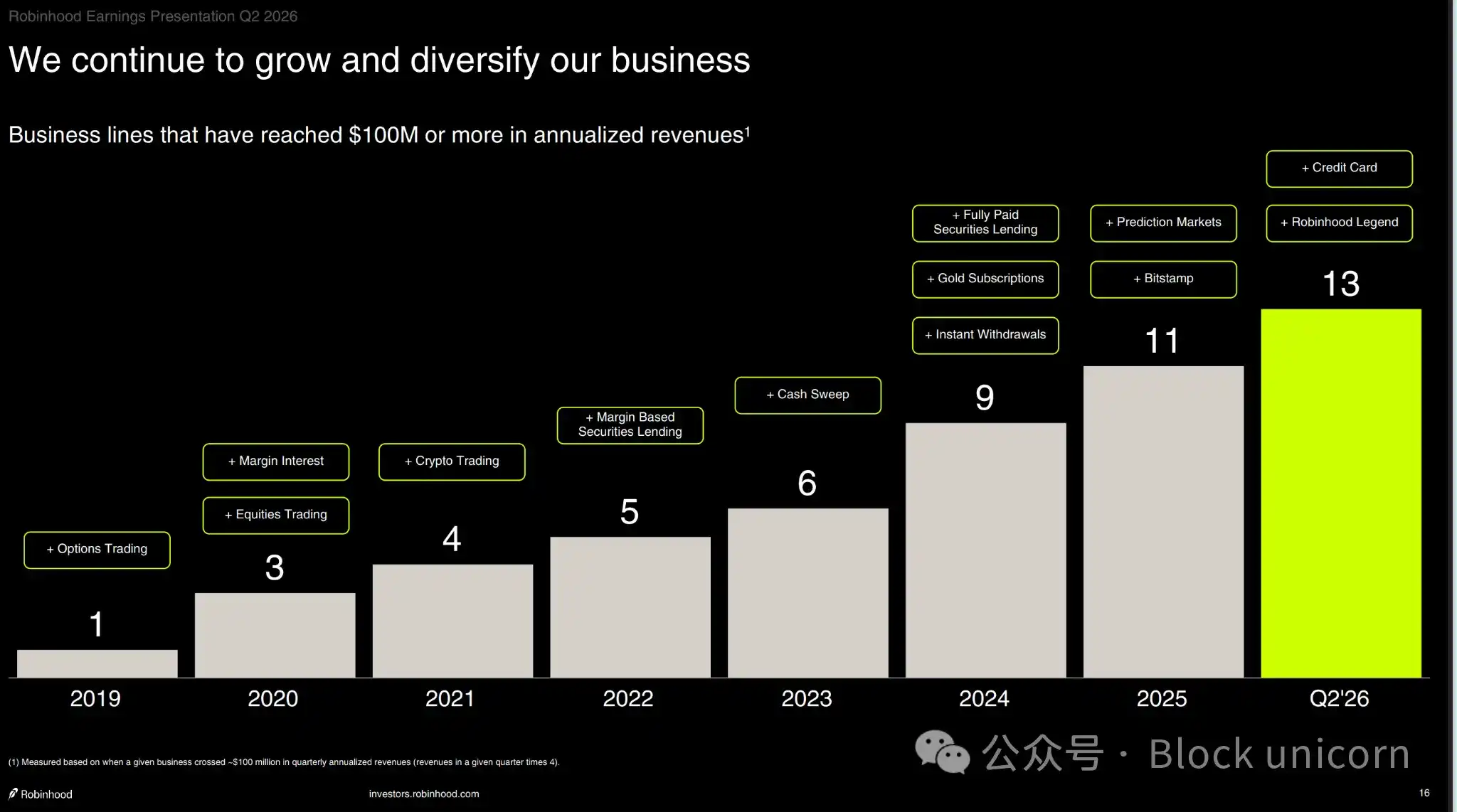
Early in the earnings call, Robinhood CFO Shiv Verma told investors to judge the company by three metrics: net deposits, the Rule of 40, and the number of business lines with Annualized Revenue Rate (ARR) at or above $100 million.
In Q2 2026, Robinhood's desktop trading and analytics platform Legend and its credit card business became the latest to join the $100 million Annual Recurring Revenue (ARR) club. The company now has 13 business lines on that list.
But let's put those aside and look at the finer details.
At the end of Q2 2026, Robinhood's paying users grew 7% year-over-year, from 26.5 million to 28.4 million. Over the same period, Average Revenue Per User (ARPU) grew 24%, from $151 to $187.
Revenue per customer is growing more than three times faster than the number of customers.
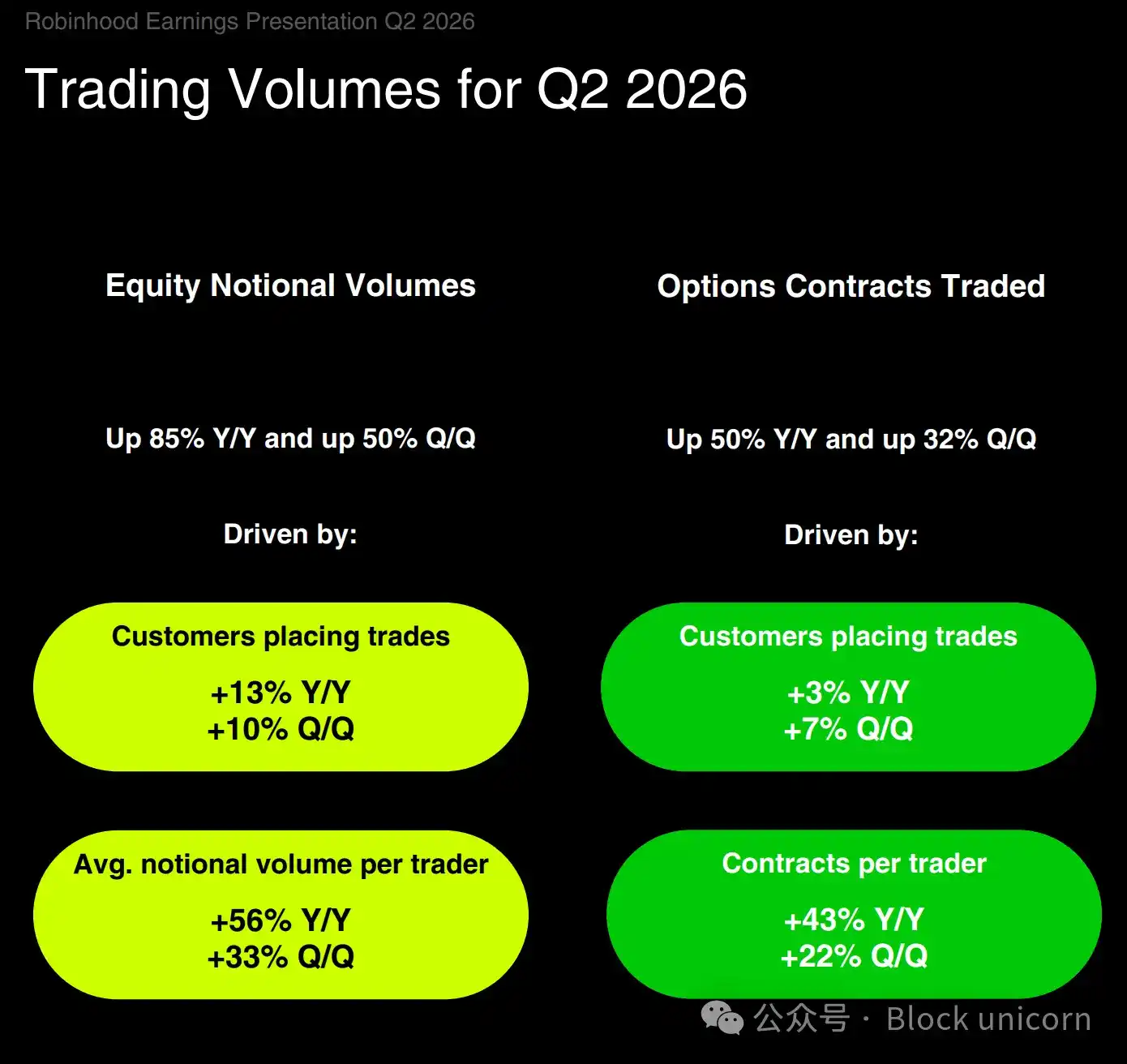
Trading data reflects this. Robinhood's Q2 volume per customer data shows notional stock volume per trader grew 56% year-over-year, and options contracts traded per trader grew 43%. However, the number of customers trading stocks only grew 13%, and those trading options only grew 3%.
Robinhood's event contracts business, which didn't exist 15 months ago, generated $156 million in revenue, up 50% quarter-over-quarter. And Robinhood achieved all this without needing to acquire a new user base.
In May, I wrote that Robinhood's ability to bundle stock, options, and perpetual futures trading with event contracts allows it to offer a better information-pricing platform than its competitors.
All of this suggests that the accurate metric for evaluating a company like Robinhood is how much its average basket size per customer has grown, which is the growth in its Average Revenue Per User (ARPU).
Gold Ignition
Although Robinhood has over a dozen companies, one of the most critical drivers of its growth engine is the Gold membership subscription. In just the past two years, Robinhood Gold adoption has nearly doubled, growing from 8.2% to 17% of total paying users.
In Q2 2026, the annual subscription revenue from Gold was $216 million, accounting for only about 4% of total revenue. But the benefits each Gold member brings to the overall business go far beyond that. Compared to the average customer, Gold members have about 4.2 times more assets under custody and are about 3.1 times more likely to purchase retirement products.
During the earnings call, CFO Verma noted that 40% to 50% of Robinhood's new customers sign up for Gold, regardless of which product they initially came through.
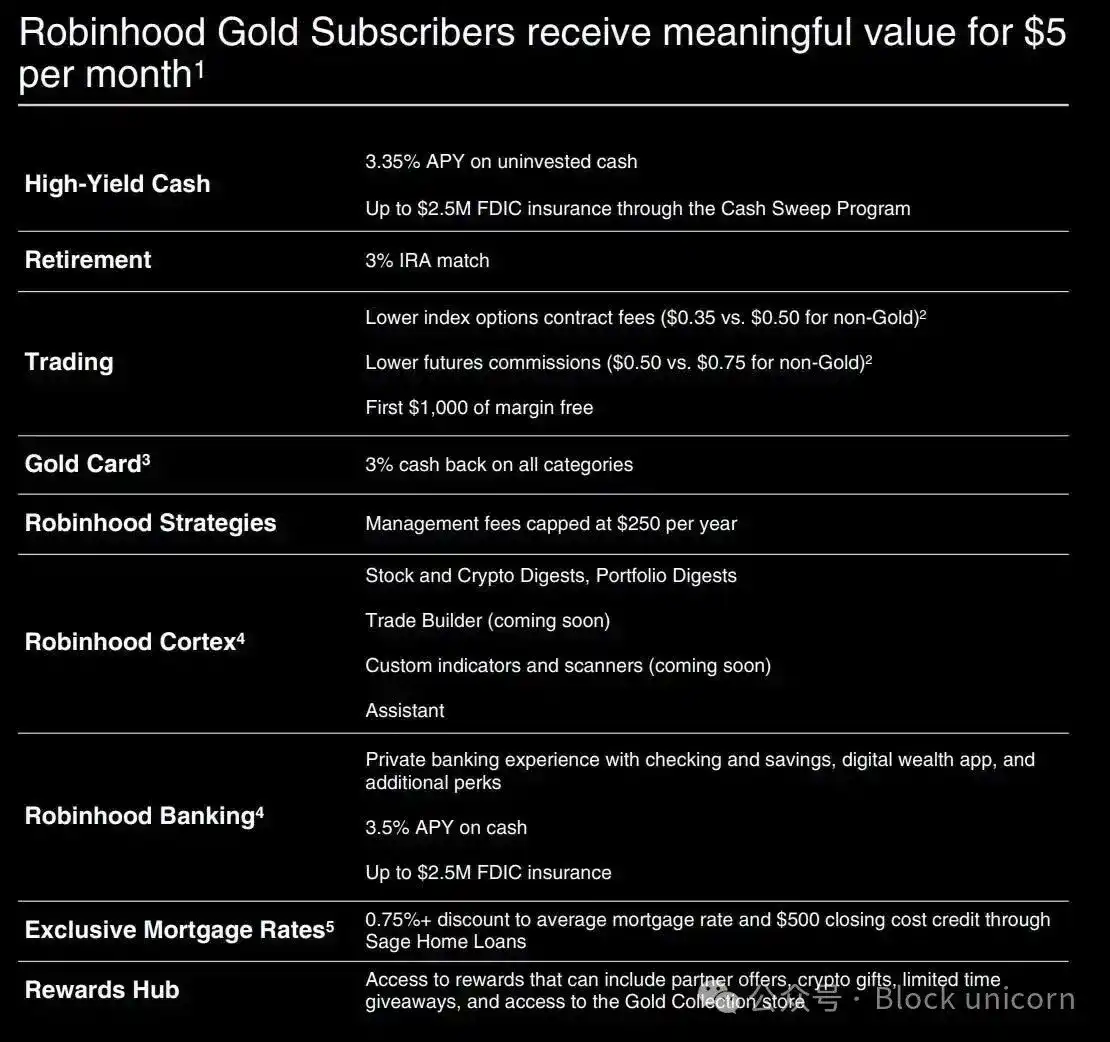
This demonstrates Robinhood's powerful cross-sell moat. Even if customers initially come for commission-free stock trading, the World Cup prediction market, or the 3% cashback credit card, half of them eventually upgrade to Gold. Once they pay the $5 monthly membership, they join an exclusive community of 4.8 million members with perks like lower-priced options contracts, a 3% IRA match from employers, a 3.5% APY on cash deposits, a credit card, and much more.
This cross-adoption is measurable. Verma pointed out that prediction market users are more likely to also have a retirement account on Robinhood. So, the person betting on a football game via Robinhood's prediction market is also boosting their Individual Retirement Account (IRA) with Robinhood's retirement products.
Robinhood's financial product supermarket does not segment customers into "gamblers" and "serious investors." It sells products to the same customer, and each product the customer uses increases the likelihood they will use others.
Despite Robinhood's powerful distribution moat, I feel its most exciting moves are yet to come.
Two Catalysts
In "Building a Financial Supermarket," I argued that Robinhood Chain is barely profitable and doesn't need to be. I positioned Robinhood Chain as a connective layer meant to increase engagement with other businesses. After watching the Q2 earnings, my view of Robinhood's future has slightly shifted. Its Chain and the upcoming Robinhood Social will be two catalysts that horizontally run across all of Robinhood's products and drive cross-selling among its dozen-plus businesses.
Think about what the chain enables. A customer buys tokenized stock. That token becomes collateral in a lending market. The loan is used to buy a perpetual futures position. Now, one dollar is being used across three products in one trade, without leaving the app. In the fragmented brokerage ecosystem of the past, these three actions would have occurred on three disconnected platforms. Each platform had its own cumbersome sign-up process and required the customer to make a fresh decision. Composability removes that friction.
The chain builds cross-selling into the infrastructure so customers can cross-buy with minimal or zero friction.
Robinhood CEO Vlad Tenev said the company plans to open its social feed to all users by the end of Q3. Tenev expects this internal feed to enhance credibility by backing trading ideas with verifiable portfolios on the Robinhood trading platform. Currently, trading ideas often come from different sources. A trader might get an idea for a potential trade from Twitter, a podcast, or a friend. The customer then forms trading intent and eventually enters the Robinhood platform to execute the trade. Robinhood Social aims to bring this process in-house.
This is the most underrated aspect of its social feed. The credibility it can bring to 30 million funded users is something no screenshot or podcast from any external platform can match. When the feed opens to the masses, Robinhood will internalize the last step of the user trading intent conversion process that relies on external resources.
I don't see Robinhood Chain and Social as standalone business lines for the company. Instead, I see them as catalysts that will drive all of its other businesses. A community of 30 million users discussing the latest event contracts, how they are building disciplined lifestyles through retirement accounts and the latest stock tokens (giving them a chance to get in before the Anthropic IPO) will create a sense of FOMO more effectively than any user acquisition marketing campaign.
The Loyalty Playbook
Robinhood's value capture strategy resembles what we saw earlier with Costco. Most of the profits for the third-largest retailer in the U.S. come from membership fees, while they price their shelf products near cost to attract members. The profit doesn't exist in the neutral layer. But these neutral layers often create adjacent spaces for value accumulation. Just as Costco's shelf layouts and inventory management drive people to buy their subscription.
Robinhood Chain and Social are akin to such neutral layers that create value accumulation layers. They both provide reasons for an investor or trader to choose Robinhood Gold and to pick from multiple products in the financial supermarket.
One of the biggest questions about Robinhood over the years has been cyclicality. Despite Robinhood hitting record stock and options trading volumes in Q2, its crypto trading volume declined for the third consecutive quarter. Even on Robinhood Chain, over 80% of the volume is still driven by meme coin speculation.
Skeptics might see all this as problematic. But I disagree.
Robinhood's diversified and robust business lines ($100 million ARR) ensure its combined business is no longer at the mercy of market cycles. Even if trading volumes fall, interest-earning assets don't necessarily. Its margin book grew 127% year-over-year to $21.6 billion.
On a platform like Robinhood, prediction markets, traditionally driven by sports and elections, take a different shape. Robinhood's joint venture with Susquehanna International Group, Rothera, gave it a CFTC-regulated license to trade prediction markets, allowing it to create its own event contracts. This enables the company to smooth out the cyclicality of seasonal categories like sports and elections and offer year-round event contracts tied to macroeconomic and S&P 500 announcement events.
Gold subscription revenue is a fixed monthly income, unaffected by monthly market performance. Robinhood spent five years integrating several businesses with different revenue peak times, making the entire company more resistant to cyclicality than any single business line.
This is reflected in Average Revenue Per User (ARPU). ARPU grew 24% because the average customer is now plugged into more businesses, and a customer plugged into five uncorrelated revenue streams is far more stable than one plugged into a single, volatile revenue source.
The more products each user touches, the more stable Robinhood's own revenue curve becomes. A trough in one business line is filled by a peak in another, and both peaks often come from the same user's account.
Coinbase redistributes existing crypto capital among consumers and institutions. Traditional brokers hold assets but cannot create engagement. Robinhood's unique edge is its ability to turn a single customer relationship into a compounding, self-diversifying revenue node that spans both traditional and crypto businesses—and both can be connected and amplified through its native blockchain.