Robinhood Chain's First Breakout Hit Is a Meme Cat: Retail Investors Dig Out CashCat's 'Original Name,' CEO Jumps on the Trend

marsbitPublished on 2026-07-08Last updated on 2026-07-08

Abstract

Robinhood Chain launched its mainnet on July 1st, promoting tokenized U.S. stocks as its core feature. However, the first asset to gain significant traction was a meme token called CASHCAT, which surged over 1700% in 24 hours, reaching a market cap of $120 million. The token's narrative stems from Robinhood's early history: CEO Vlad Tenev revealed the company's initial working name was "CashCat." CASHCAT has no official ties to Robinhood and declares itself as "pure cat" with zero utility. Tenev added fuel by tweeting on July 8th that the chain is "great for memes," which the community saw as implicit approval. The hype has attracted copycat tokens on other chains like Solana and impersonator accounts promoting scams. The article highlights the extreme volatility and risks associated with this new, illiquid meme token on a fledgling blockchain, cautioning investors to verify contracts and treat any investment as high-risk speculation.

Author: Claude, Shenchao TechFlow

Shenchao Introduction: One week after the Robinhood Chain mainnet launch, while the officially promoted stock token hasn't gone viral yet, a Meme cat called CASHCAT has taken off first, with its price surging over 1700% in 24 hours at one point and its market cap exceeding $120M. Its entire narrative boils down to one sentence: the working name for Robinhood during its startup phase was CashCat. CEO Tenev himself shared this history and even tweeted a meme on the day of the surge. Meanwhile, copycat tokens and fake 'Roaring Kitty' shilling accounts are already in position.
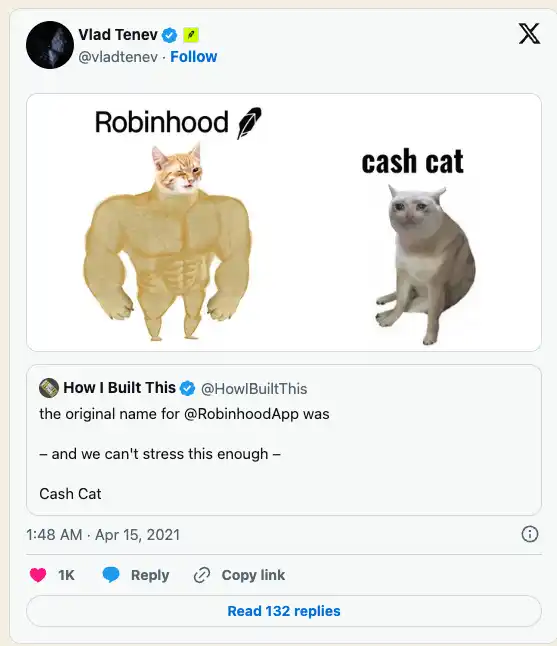
Attracting traffic and retail investor attention still depends on Memes.

Robinhood spent a year paving the way for its own blockchain, pitching tokenized stocks as the core story. However, the first truly viral asset on the chain turned out to be a cartoon cat holding cash.

According to GMGN monitoring, on July 8th, the market capitalization of the Meme token CASHCAT on Robinhood Chain exceeded $120 million, with a 24-hour increase of over 1700%. In the following hours, readings from different data platforms continued to rise. According to CoinGecko data, CASHCAT primarily trades on the Uniswap V3 deployed on Robinhood Chain, with the CASHCAT/WETH pair seeing a 24-hour trading volume of approximately $28 million. For a new chain that has only been live for a week and has very few ecosystem applications, this cat is the current traffic itself.

Seventh Day Post-Mainnet Launch, The First Viral Asset Is a Meme

First, some background.

On July 1st, Robinhood officially launched the public mainnet for Robinhood Chain at an event in London. This is an Ethereum Layer 2 based on Arbitrum technology, unveiled by CEO Vlad Tenev and crypto business head Johann Kerbrat. The official positioning of this chain is quite 'serious'. Its core product, Stock Tokens, tracks the price performance of over 200 US stocks and ETFs and is open to users in over 120 jurisdictions (excluding US users). DeFi protocols like Uniswap and 1inch were deployed on day one, and Robinhood pledged to cover all Gas fees for the first 90 days.

According to the official script, the protagonists of this chain should have been tokenized stocks and RWA (Real World Assets). However, the script didn't follow the plan. In the first week after the mainnet launch, the most actively traded pair on the chain wasn't any stock token, but CASHCAT. Retail investors set the tone for this 'retail broker's chain' first.

A clear warning for holders: CASHCAT's current trading depth is concentrated on a single trading pair within a single DEX. Liquidity is thin on a new chain, price readings vary significantly across platforms, and both slippage and wick risk upon entry/exit are far higher than for Memes on mature chains.

Archaeology of the 'Original Name', Tenev Himself Told the CashCat Story

CASHCAT's success relies on a real piece of company history.

In early interviews, Tenev recalled the company naming process: "The original working name was actually CashCat, but everyone felt it wasn't powerful enough. My wife would introduce me to her friends by saying, 'They're the Robin Hoods of finance, doing things for the little guy.' That's how the name Robinhood stuck." This account has been cited in numerous company retrospectives after the GameStop saga, making it verifiable 'archaeological material.' This is the biggest difference between CASHCAT and other cat/dog coins built on fabricated stories.

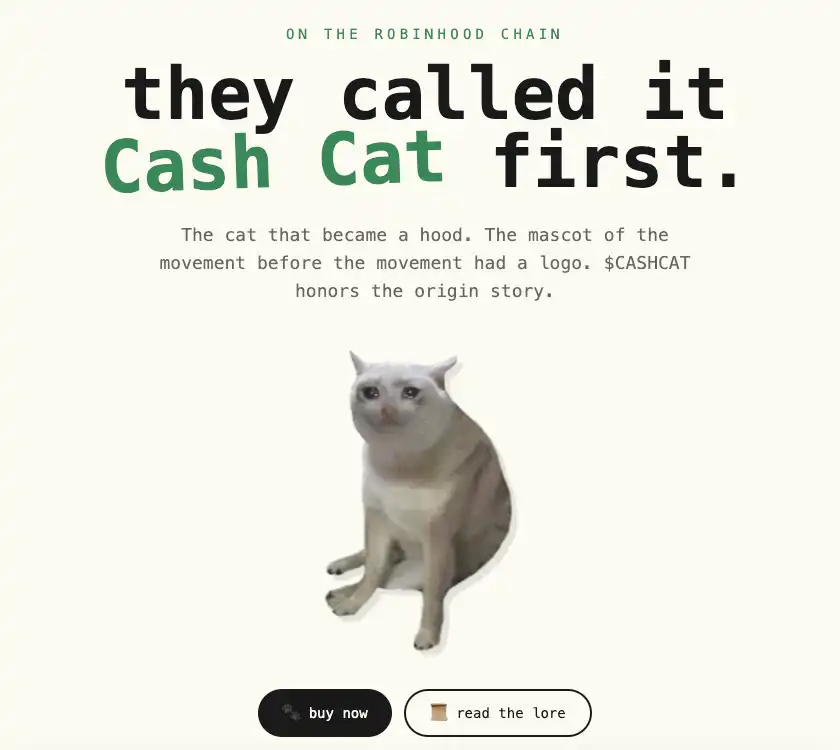
The token's structure is as simple as it gets. According to the project's website, the total supply is 1 billion tokens, with zero buy/sell taxes. The liquidity pool tokens have been fully burned, and it self-identifies as "zero utility, one hundred percent cat." The website also explicitly states that the project has no affiliation with Robinhood, calling it "fan fiction with a ticker."

The narrative is real, the product is unrelated. Readers need to distinguish these two facts: Robinhood's history provides this cat with viral material, but the company does not endorse it. The token's value is built entirely on attention, with no safety net when that attention fades.
Tenev Tweets Meme, Market Interprets It as Semi-Endorsement

What truly pushed the frenzy to its peak was Tenev himself.

On July 8th, Tenev posted on X (formerly Twitter): "We're making Robinhood Chain the best RWA public chain... but it runs Memes really well too." The post garnered over 500,000 views within hours. While he didn't mention CASHCAT by name, the timing coincided with the day of the massive surge. The community interpreted it as implicit approval, if not an assist, for the Meme frenzy on the chain.

There's a layer of historical irony here. During the 2021 GameStop short squeeze, Robinhood was thrust into Congressional hearings for restricting retail buys of GME, becoming the 'villain' in the retail narrative. Five years later, this company's blockchain completes its cold start, precisely relying on the Meme culture that retail investors excel at, with the object of speculation being the name the company itself discarded. The CASHCAT website even specifically plays on this irony: "Cash Cat doesn't do options, and it doesn't do PFOF (Payment for Order Flow)."
For traders, it's necessary to heavily discount the actual value of this tweet. A playful tweet from Tenev and an official Robinhood endorsement are separated by an entire compliance department. The company has no commitments regarding custody, listing, or providing liquidity for the Meme token. The effectiveness of such sentiment catalysts typically lasts only hours.

Copycat Tokens and Fake 'Roaring Kitty' Accounts Are Already in Position

Once the heat arrived, the tools to hunt retail investors followed.

First, cross-chain copycat tokens. According to aggregated monitoring information from CoinGecko, an identically named CASHCAT has already been deployed on the Solana chain. The original contract is deployed on Robinhood Chain with an address starting with 0x020b and ending with 18b4; identically named tokens on other chains are unrelated to the original.

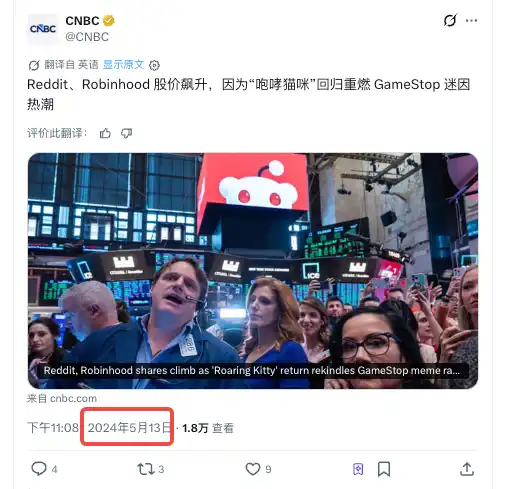
Second, impersonator accounts shilling. For example, an X account with the handle "RK" and a username highly similar to GameStop saga protagonist 'Roaring Kitty' Keith Gill tweeted, "CASHCAT is the first major Meme on Robinhood chain," and included a Solana contract address in the post.

New chain, new Meme, fake accounts, cross-chain copycats—this combination has claimed victims in every past Meme cycle. If you still decide to participate now, at least do these three things: verify the contract address, use only official or reputable cross-chain bridges, and keep your position size to lottery-ticket levels.

CASHCAT's current total value is just a good story plus a wave of attention, neither of which has a retention mechanism.


Trending Cryptos

Related Questions

QWhat is CASHCAT, and why did it become the first viral asset on Robinhood Chain after its mainnet launch?

ACASHCAT is a meme token featuring a cartoon cat holding cash. It became the first viral asset on Robinhood Chain, launched on July 1, due to its connection to Robinhood's early history. The name 'CashCat' was Robinhood's original working name before it adopted 'Robinhood,' a fact shared by CEO Vlad Tenev. The token's price surged over 1700% in 24 hours, capturing significant market attention and liquidity on the new chain.

QWhat historical anecdote about Robinhood gives CASHCAT its narrative foundation?

AThe narrative foundation for CASHCAT comes from an anecdote shared by Robinhood CEO Vlad Tenev. He revealed that the company's original working name during its early days was 'CashCat,' but it was changed to 'Robinhood' because the latter was perceived as more powerful and aligned with the idea of 'stealing from the rich to give to the poor.' This true piece of company history differentiates CASHCAT from other meme tokens with fabricated backstories.

QHow did Robinhood CEO Vlad Tenev's actions on social media contribute to the hype around CASHCAT?

AOn July 8, Vlad Tenev posted on X, stating, 'We're building Robinhood Chain to be the best RWA public chain... but it runs Memes pretty well too.' Although he didn't mention CASHCAT by name, the timing coincided with the token's massive price surge. The community interpreted the post as a tacit endorsement or acknowledgment of the meme token activity on the chain, significantly fueling the hype and market speculation.

QWhat are the key risks associated with trading CASHCAT as highlighted in the article?

AThe article highlights several key risks: 1) The token's trading is concentrated on a single DEX (Uniswap V3) and a single trading pair (CASHCAT/WETH) on the new Robinhood Chain, leading to thin liquidity. 2) This results in high slippage, price volatility, and significant differences in price readings across data platforms. 3) The token's value is based solely on a historical narrative and market attention, with no underlying utility or backing from Robinhood, making it highly susceptible to rapid value loss when hype fades.

QWhat fraudulent activities emerged following CASHCAT's price surge, and what precautions should investors take?

AFollowing the surge, fraudulent activities included: 1) The deployment of fake 'CASHCAT' tokens on other blockchains like Solana, which are unrelated to the original Robinhood Chain token. 2) Impersonator accounts on social media, such as one mimicking 'Roaring Kitty' (Keith Gill), promoting these fake tokens. Investors are advised to: verify the correct contract address (the original starts with 0x020b and ends with 18b4), use only official or reputable cross-chain bridges, and limit their investment to an amount they are prepared to lose ('lottery ticket' sized positions).

Related Reads

In Conversation with Ray Dalio: We Are Currently in an AI Bubble, with 1% of My Portfolio in Bitcoin

Ray Dalio, founder of Bridgewater Associates, warns in an interview that the current AI boom shows classic bubble characteristics, which could lead to significant economic downturns as seen in past cycles like 1929 or 2000. He explains that speculative enthusiasm, fueled by debt and overvaluation, often precedes a crash when rising rates or taxation force asset sales, causing widespread losses and recession. Dalio also outlines his "Big Cycle" theory, describing an approximate 80-year pattern where widening wealth gaps, massive government deficits, and shifting geopolitical power (like China's rise) create internal conflict and global instability. He emphasizes that we are in a late-cycle, transitional phase where traditional powers like the US and UK face decline. For personal wealth protection, Dalio advises diversification beyond cash into assets like stocks, bonds, real estate, and particularly gold, which he prefers over Bitcoin. While he holds about 1% of his portfolio in Bitcoin as a non-printable hard asset, he views gold as more secure from technological or governmental threats. Regarding AI's impact, Dalio believes it will disproportionately benefit capital owners, worsening inequality by replacing both physical and cognitive labor. He suggests that human intuition and emotional intelligence, combined with AI, will be key for future workers. On taxation, Dalio argues that wealth taxes are impractical and risk triggering asset sell-offs, reducing productive investment. He points to the UK as a cautionary example of debt, low productivity, and political strife. Geopolitically, Dalio foresees a more regionalized world, with the US showing weakness in prolonged conflicts like with Iran, akin to past imperial declines. The ideal outcome, he suggests, is coexisting powerful blocs (e.g., Americas, China-Asia Pacific) without major war.

marsbit1h ago

In Conversation with Ray Dalio: We Are Currently in an AI Bubble, with 1% of My Portfolio in Bitcoin

marsbit1h ago

Daily 7.2 Trillion KRW: Foreign Capital's Record Net Buying on Friday! Wall Street Says Headwinds for Korean Stock Fund Flows Have Subsided

South Korean stock market sees a dramatic shift in fund flows. On July 31, foreign investors made a record net purchase of approximately KRW 7.2 trillion in KOSPI stocks, marking a fundamental reversal from the persistent large-scale net outflows seen in previous months. This contributed to a significant narrowing of foreign net selling in July to KRW 9.8 trillion, down sharply from KRW 48.4 trillion in June and KRW 44.5 trillion in May. Simultaneously, domestic institutional pressure eased. South Korean pension funds and asset managers turned to a net buying position in July, purchasing KRW 1.0 trillion worth of KOSPI shares, contrasting with net sales in May and June. Market volatility is expected to be dampened by new financial regulations. Effective July 31, the Financial Services Commission tightened access for retail investors to single-stock leveraged ETFs by raising the minimum cash deposit requirement. Trading volumes for these products subsequently dropped to about 50% of their monthly average. Citigroup Research maintains its year-end KOSPI target of 10,000 points. The firm cites several supportive factors: the substantial easing of headwinds from capital outflows, a robust fundamental outlook for the semiconductor sector, historically low market valuations, strong economic fundamentals, and the potential for policy support from financial authorities if needed.

marsbit1h ago

Daily 7.2 Trillion KRW: Foreign Capital's Record Net Buying on Friday! Wall Street Says Headwinds for Korean Stock Fund Flows Have Subsided

marsbit1h ago

Thanks to Dice Rolls, Bitcoin Keys Are Stored Offline, But Not Everyone Will Do It

The article discusses using dice rolls to generate secure Bitcoin wallet seeds, providing entropy independent of potentially flawed hardware random number generators. It explains that each fair dice roll offers about 2.585 bits of entropy, with around 50 rolls needed for a standard 12-word seed phrase and 99+ recommended for higher security. This method gained attention after a vulnerability was revealed in some Coldcard hardware wallets, where a faulty firmware RNG (dating back to 2021) compromised generated keys. The analysis notes that while a dice-generated main seed was safe from this specific flaw, other Coldcard functions (like creating paper wallets, backup keys, or passwords) could still be vulnerable if they used the defective RNG. The piece argues that while dice-based entropy is technically robust, the manual process is error-prone, tedious, and unrealistic for most new users, who might make mistakes in recording or inputting rolls. It concludes that while manual entropy generation should remain an option for advanced users, the long-term goal is to develop reliable, user-friendly hardware and software that securely generates randomness without requiring specialized knowledge. Coldcard users are advised to check their firmware version and replace any secondary secrets (like paper wallet keys) created with vulnerable devices, while also considering multi-signature setups with devices from different manufacturers for added security.

cryptonews.ru6h ago

Thanks to Dice Rolls, Bitcoin Keys Are Stored Offline, But Not Everyone Will Do It

cryptonews.ru6h ago

Trading

Spot

Hot Articles

What is TRUMP CAT

Trump Cat Family, $Trump Cat: An Unraveled Mystery Introduction In the constantly evolving landscape of crypto projects and web3 innovations, a curious phenomenon has emerged—one that appears to straddle the line between cryptocurrency and internet meme culture. This is the enigmatic “Trump Cat Family”, also referred to as “$Trump Cat”. Though it might arouse curiosity among crypto enthusiasts, the reality appears far removed from the standard definition of a crypto project. This article aims to explore the concept of Trump Cat Family, bringing to light the context surrounding it and clarifying its status in the crypto realm. What is Trump Cat Family, $Trump Cat? At first glance, one might think that “Trump Cat Family” refers to a legitimate cryptocurrency or web3 project. However, upon deeper investigation, it becomes evident that the term lacks the trappings of a traditional crypto venture. Instead, “Trump Cat” seems to be predominantly associated with the viral meme culture that surged following controversial statements made by former U.S. President Donald Trump regarding Haitian immigrants. The media coverage sparked a myriad of memes, humorous interpretations, and a wave of social commentary. These memes depict various forms of satire centred on Trump's dialogue, often utilising cats in comedic and sometimes absurd scenarios. Rather than a structured project aimed at addressing technological advancements or financial transactions, the “Trump Cat Family” concept exists predominantly in the realm of internet humour. Who is the Creator of Trump Cat Family, $Trump Cat? In the investigation of who stands behind the “Trump Cat Family,” it becomes apparent that there exists no identifiable creator or founding figure. The phenomenon seems to have originated from collective internet expression, rather than from a singular visionary with a defined project goal. This anonymity further emphasises its status as a meme rather than a structured initiative akin to most known crypto projects. Who are the Investors of Trump Cat Family, $Trump Cat? Given that “Trump Cat Family” does not conform to the characteristics of a reputable crypto project, the question of investment becomes moot. There have been no established foundations or organisations expressing support for a project by this name. Instead, what exists are individual contributors to meme culture—hobbyists, artists, and social media users who collectively populate the internet with their interpretations and humour surrounding the term “Trump Cat.” This organic growth within digital human communication reflects more of a social commentary than a financial investment landscape. How Does Trump Cat Family, $Trump Cat Work? If one seeks to establish how “Trump Cat Family” operates, the answer is vastly different from what might be expected of standard crypto projects. There are no operational mechanisms, technological innovations, or unique features inherent to this phenomenon. Instead, it exists through viral spread online, relying upon social media platforms for proliferation. The “how” lies in the realm of culture and communication—its essence derived from the dynamics of social interaction rather than from established crypto protocols or blockchain functionalities. What makes “Trump Cat” unique, if anything, is the way it dramatizes a political dialogue through humour. People utilise engaging visuals, inside jokes, and inventive storytelling to convey sentiments regarding political figures and societal issues. The power of memes transcends traditional communication, encapsulating complex thoughts in a form that resonates widely, yet remains elusive in terms of quantifiable success or structured goals. Timeline of Trump Cat Family, $Trump Cat September 2024: The discourse surrounding Donald Trump's comments about Haitian immigrants allegedly consuming pets gains traction online, leading to a blossoming of memes and parodic interpretations across various platforms. Continuing Impact: Following this period, the “Trump Cat” phenomenon sees continued life as social media users leverage humour to address, critique, or simply celebrate the absurdity of political conversations and events. It is essential to note that as “Trump Cat Family” lacks the formal structure of a traditional project, the timeline consists primarily of anecdotal observation rather than remarkable milestones commonly found in recognised crypto ventures. Key Points Meme Culture: Rather than a structured crypto initiative, “Trump Cat” aligns more with the evolving landscape of internet memes. Origin of the Term: The genesis of “Trump Cat” relates directly to commentary on President Trump's remarks about Haitian immigrants, sparking widespread humorous representation. Absence of a Project Framework: The term fails to align with any defined project objectives, creators, or investors, marking it as a novel cultural experience rather than a crypto project. Conclusion In summary, the investigation into “Trump Cat Family, $Trump Cat” reveals a phenomenon entrenched in internet meme culture rather than a recognised project within the cryptocurrency or web3 sectors. The virality surrounding the term is birthed from collective user engagement, reflective of modern digital discourse rather than a formalised initiative with structure or strategic foresight. For all the curiosity it may invoke among those seeking the next big crypto project, “Trump Cat Family” serves as a testament to humanity's creativity, humour, and often absurd relationship with politics in the digital age.

311 Total ViewsPublished 2025.01.22Updated 2025.01.22

What is TRUMP CAT

Discussions

Welcome to the HTX Community. Here, you can stay informed about the latest platform developments and gain access to professional market insights. Users' opinions on the price of CAT (CAT) are presented below.

活动图片












