Author: Nancy, PANews
Meme coins continue to create “noise” on Robinhood Chain, but they are gradually no longer the only main attraction. As on-chain funds continue to accumulate and trading activities heat up, DeFi building blocks are being assembled on this hot L2.
Classic DeFi mechanisms like AMM, CLOB, lending, perpetual contracts, ve(3,3), OHM are being replicated on Robinhood Chain, with “adaptations” for new assets and new scenarios emerging. Some protocols have even climbed to the top of the chain in terms of revenue and TVL. Simultaneously, the underlying assets are expanding from purely crypto assets to RWA assets like tokenized stocks, with “Lego building” happening around these assets.
AMM: Evolving from Trading Pools to Programmable Liquidity Layer
Since the launch of Robinhood Chain’s mainnet, Uniswap has quickly become the core Automated Market Maker (AMM) and liquidity infrastructure on the chain, meeting the main trading demand for assets like tokenized stocks, RWAs, and Meme coins. In less than two months since its launch, the cumulative trading volume of Uniswap on Robinhood Chain has exceeded $20 billion.
Liquidity demand on Robinhood Chain is currently distributed mainly across Uniswap V2, V3, and V4. Dune data shows that on August 27 alone, the combined daily trading volume of various Uniswap versions accounted for nearly 95% of Robinhood Chain’s overall daily trading volume, handling almost the vast majority of on-chain trading demand.
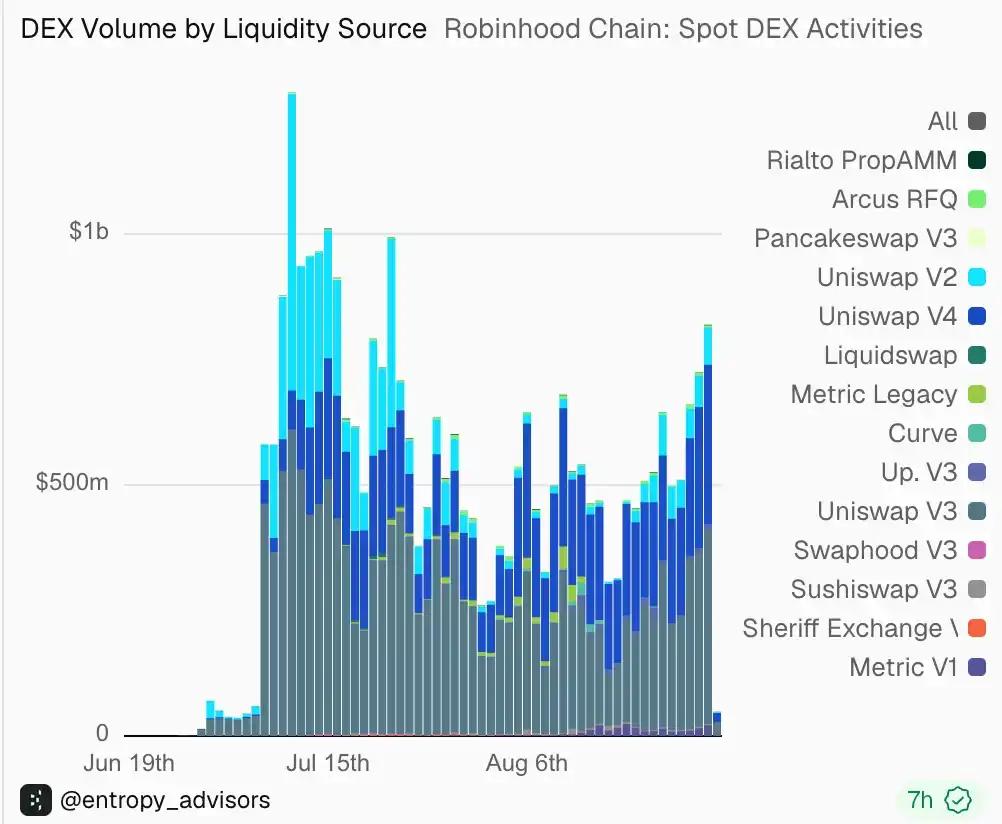
Among them, V3 remains the main layer for large transactions and deep liquidity, while V4 has begun to introduce more programmable mechanisms on top of the traditional AMM model, becoming an important traffic entry point for new assets and applications.
Particularly, the launch of Uniswap Labs' own Launchpad pools.trade on August 5th directly integrates the token issuance process with permanently locked V4 liquidity pools. On one hand, this taps into the high-frequency traffic entry point of Meme issuance and trading; on the other hand, it further drives trading demand for V4. Data shows that as of August 25, pools.trade's daily trading volume already accounted for 12.2% of Robinhood Chain's overall trading volume, pushing V4's trading volume to rapidly approach that of V3.
Uniswap V4 innovations change the role of AMM in on-chain finance, transforming relatively standardized trading pools into a programmable liquidity layer, and also provide differentiated trading mechanisms for different types of assets like tokenized stocks, RWAs, and Memes.
Deepstate: Bringing the Traditional Order Book On-Chain
Compared to some order book DEXs that use off-chain matching and on-chain settlement, Fully On-Chain CLOBs (Central Limit Order Books) place the logic for placing orders, canceling orders, and matching on the blockchain. Hyperliquid is a typical representative of this model.
Deepstate, built by the former CTO of SushiSwap, is a new DEX deployed on Robinhood Chain. Its core adopts a Fully On-Chain Order Book model (CLOB) where limit orders, cancellations, and matching logic are all executed within smart contracts. Unlike AMMs which rely on liquidity pools and mathematical curves for pricing, order books allow traders to directly submit specific buy and sell prices, with price discovery completed by market supply and demand.
Another advantage of the order book model is its closer resemblance to the trading experience of traditional exchanges. Market makers can concentrate their funds at price points where execution is most likely, instead of dispersing liquidity along a curve as in AMMs. Therefore, in theory, it can provide deeper effective order book depth with less capital, while avoiding the impermanent loss faced by traditional AMM LPs.
This model is particularly suitable for the developing tokenized stock and stablecoin markets on Robinhood Chain. Traditional financial assets like stocks typically have clear price ranges and higher trading frequencies. Large transactions are also more sensitive to order book depth, spreads, and slippage. Order books theoretically provide tighter spreads and lower slippage with higher capital efficiency, making them closer to the trading logic of traditional securities markets.
Of course, Fully On-Chain CLOBs also impose higher demands on blockchain performance, as placing, canceling, and matching orders all require on-chain execution. Robinhood Chain's low costs and high performance provide a more suitable infrastructure environment for Fully On-Chain CLOBs like Deepstate, also giving them the opportunity to further migrate the traditional exchange order book model on-chain.
Lending: Making Stocks Go from Tradable to Financeable
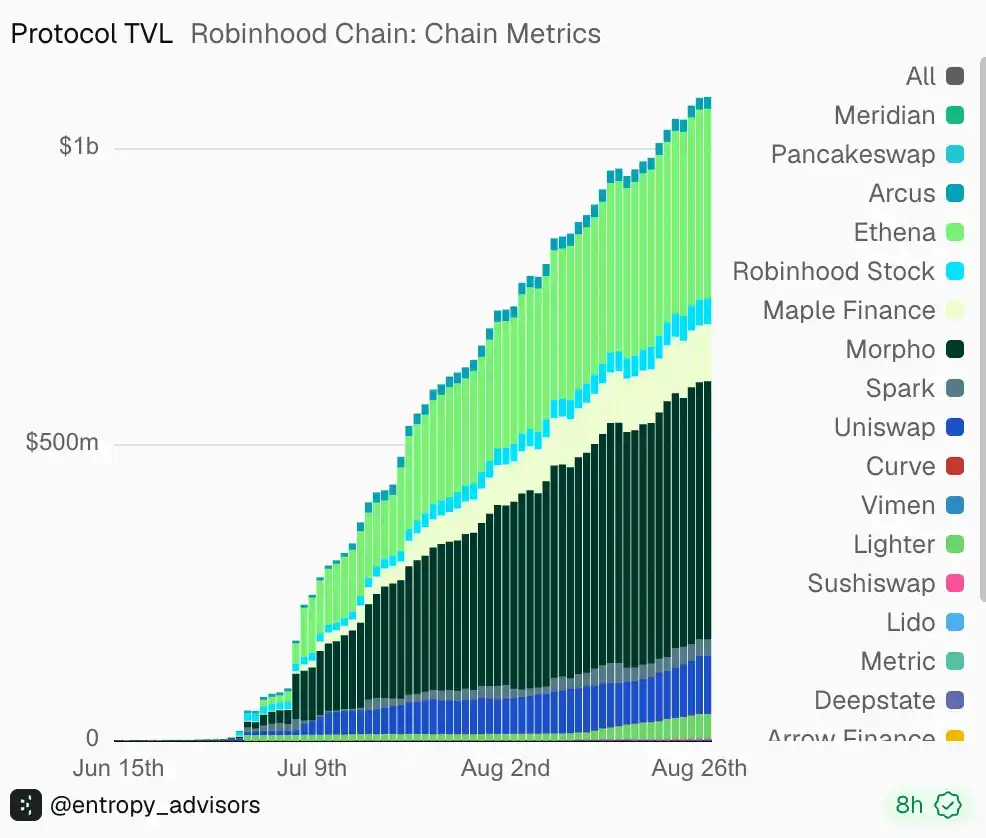
The Earn lending product launched by Robinhood in partnership with Morpho primarily caters to the savings and yield needs for USDG. Here, Morpho serves as the underlying lending protocol, providing isolated lending markets; Steakhouse acts as a risk curator, responsible for screening borrowing markets and managing risk parameters; while Ethena, Maple, Spark, etc., provide assets that can serve as collateral and generate yield, constituting the source of Earn's returns. The core of this model is not to let users borrow against collateralized stocks, but to channel stablecoin savings demand from the Robinhood ecosystem into on-chain lending markets, providing yields for USDG through collateral and lending spreads.
In terms of capital scale, Morpho has become one of the largest lending infrastructure providers on Robinhood Chain. Dune data shows that the total size of lending markets related to Morpho on the chain has exceeded $870 million, with Vault TVL over $430 million, and cumulative borrowing volume around $390 million, demonstrating high capital utilization.
Arrow Finance is a natively deployed Overcollateralized Debt Position (CDP) and DeFi gateway on Robinhood Chain. Users can deposit crypto assets, ETFs, and tokenized stocks into vaults, and mint the stablecoin aUSD under an overcollateralized condition, thereby releasing on-chain liquidity without directly selling assets. This means users can gain stablecoin liquidity while continuing to hold their stock exposure. In terms of risk control, Arrow employs isolated Vaults and independent liquidation mechanisms, equipped with stability pools and an oracle system for crypto assets, stablecoins, and tokenized stocks, also considering price processing issues during traditional stock market closures.
And as stocks can be traded, collateralized, and lent on-chain, they are no longer just on-chain stock certificates but begin to possess DeFi asset attributes.
Perps: Stocks Can Not Only Be Traded But Also Become Collateral for Leverage
Perpetual contracts are becoming another important DeFi track on Robinhood Chain.
Lighter is the official perpetual trading entry point within Robinhood Wallet and also one of the largest Perp DEXs on Robinhood Chain currently. Its trading products are mainly perpetual contracts for crypto assets like BTC and ETH, while also supporting tokenized stocks as margin. With the launch of Robinhood Chain points incentives, Lighter's trading volume and liquidity have grown rapidly.
According to Castle Labs data, since launching points on Robinhood Chain, Lighter's Perp trading volume has seen significant growth, with a daily average trading volume of $280 million and cumulative trading volume exceeding $3 billion. Meanwhile, Dune data shows that Lighter's TVL on Robinhood Chain has surpassed $41.22 million.
In terms of protocol revenue, DeFiLlama data shows that in the past 7 days, Lighter's revenue on Robinhood Chain exceeded $196,000, ranking fifth on the chain for protocol revenue.
Arcus is launched by the dYdX team, with investment from Robinhood Crypto. It supports 24/7 perpetual contract trading for both crypto assets and tokenized U.S. stocks, while also allowing users to use tokenized stocks as collateral for leveraged trading.
Recently, Arcus further launched the pToken protocol, which converts perpetual contract account shares under specific markets and leverage levels into transferable ERC-20 tokens. This gives positions, originally confined within trading accounts, the potential to further enter the on-chain DeFi ecosystem, such as being used in lending or other protocols. Concurrently, Arcus launched a multi-asset collateral feature, allowing tokenized assets like SPY, QQQ, and the MAG7 (Magnificent Seven) stocks to serve as collateral for perpetual trading.
It can be seen that Perp DEXs on Robinhood Chain are not only incorporating tokenized stocks into trading targets and collateral systems but also further attempting to tokenize Perp positions themselves, endowing them with transferable, composable on-chain asset attributes, and further connecting them to more on-chain scenarios.
ve(3,3): Binding Token Emissions, Governance, and Real Trading Together
The ve(3,3) mechanism combines Curve's Vote-Escrowed (ve) model with the DEX token economic model of OlympusDAO's (3,3) game theory: users lock tokens to obtain veToken voting rights, use votes to decide which trading pairs receive emission incentives, and simultaneously share the trading fees from corresponding pools—the core logic is to bind "locking, voting, rewards" together, incentivizing long-term holders rather than short-term sell pressure. This mechanism was first proposed by Solidly, with Velodrome and Aerodrome later becoming typical representatives.
UponRH is a native ve(3,3) DEX and liquidity layer on Robinhood Chain, with a mechanism design similar to Velodrome. After users lock $UP as veUP NFTs, they can participate in weekly Gauge voting to determine the direction of token emissions; trading fees and incentives generated by the protocol are then distributed to voters. Meanwhile, UponRH supports both traditional AMM and Concentrated Liquidity (CL) pools, achieves automatic yield compounding through Vaults, and is deeply integrated with the StonkBrokers launchpad to provide default locked liquidity and emission support for new tokens.
Compared to early ve(3,3) protocols, UponRH's Gauge Cap (emission cap) mechanism is its biggest highlight, linking token emissions to the actual trading fees generated by the liquidity pool. When emissions exceed the pool's actual income-carrying capacity, the excess portion is burned. This binds token incentives more closely to real trading demand, thereby improving capital efficiency and token deflation potential.
Fables, on the other hand, is a ve(3,3) DEX built on Uniswap v4 Hooks, specifically designed for differentiated markets for RWAs like tokenized stocks (NVDA, AAPL, TSLA), ETFs (SPY, GLD), as well as crypto assets. Unlike traditional AMMs treating all assets with the same fixed fee schedule, Fables uses Hooks to write separate logic for each pool, allowing fees to adjust in real-time based on factors like time, volatility, and market sentiment, enabling LPs to earn up to 2.1 times more under the same risk.
Currently, Fables' points and Creator Fees program has launched, providing liquidity grants both points and fee shares; its $PROLOGUE token is designed as a future airdrop voucher, planned to be exchanged for the official governance token FABLES at a certain ratio after TGE, with TGE expected in October.
From UponRH to Fables, it can be seen that this is not simply a copy of previous ve(3,3) gameplay. The former attempts to constrain single-pool emissions through Gauge Caps linked to real trading fees, reducing vampire-like mining in low-activity or even “dead” pools. The latter integrates ve governance with Uniswap V4 Hooks, adapting to the market-making needs of RWA assets like tokenized stocks through dynamic fee mechanisms, then connecting liquidity incentives and governance mechanisms to the pools.
OHM Model: Remaking Reserve Currency with Code Constraints and Real Reserves
The OHM model, represented by Olympus DAO, is a decentralized reserve currency protocol. It enriches the treasury by selling tokens at a discount through bonds, while attracting long-term holding with high APY staking (Staking + Rebase), aiming to create a DeFi base currency with fluctuating price but intrinsic value anchor, rather than a stablecoin pegged to fiat.
NetNet is a modified OHM-style protocol deployed on Robinhood Chain. Unlike traditional OHM models relying on policy committees to adjust economic parameters and sustaining high yields through continuous issuance and new capital inflows, NetNet attempts to reconstruct this mechanism through code constraints and real asset reserves.
Its core idea is to hand over key parameters like issuance, bond pricing, fees, and buybacks to on-chain formulas for automatic execution, reducing human intervention. Simultaneously, it introduces a Risk-Free Value (RFV) mechanism, requiring that for every NET token issued, the treasury must hold at least one unit of stable assets like USDG, thereby providing rigid asset value support for the token. According to the protocol design, when NET's market price falls below the Net Asset Value (NAV) corresponding to the treasury's assets, the protocol can provide some price support through buyback and burn mechanisms. Additionally, NetNet attempts to shift the source of yield from mere token issuance to real asset yields. Idle stablecoins in the treasury can earn interest via lending protocols like Morpho, while an RWA Sleeve is set up to allocate assets like tokenized U.S. stocks, aiming to increase treasury asset value through capital appreciation and dividends.
It's important to note that RFV constrains the lower limit of token issuance and the treasury's repayment capacity; it does not equate to setting a hard floor for secondary market prices. Asset reserves can provide a certain value anchor but cannot eliminate risks from liquidity drying up, severe price volatility, or high-premium trading. If market prices deviate long-term from the treasury's NAV, liquidity contraction or even a stampede could still occur.
Currently, Robinhood Chain is gradually evolving from a token launch playground to a richer DeFi financial experimental field. But what might be more noteworthy is perhaps not how many DeFi models are being replicated, but rather how these financial building blocks, while accommodating crypto-native assets, are enabling more TradFi assets to gain stronger on-chain composability.