Ripple Links Up With $130 Billion Riyad Bank’s Innovation Arm Jeel

bitcoinistPublished on 2026-01-27Last updated on 2026-01-27

Abstract

Ripple has partnered with Jeel, the innovation arm of Riyad Bank, to explore blockchain applications in Saudi Arabia. The collaboration will focus on cross-border payments, digital asset custody, and tokenization within Jeel's regulatory sandbox. This initiative supports Saudi Arabia's Vision 2030 digital transformation goals by aiming to improve payment speed, cost efficiency, and transparency. Both companies plan to develop proofs-of-concept in a controlled environment to test scalable and interoperable financial infrastructure. Ripple's leadership emphasized the alignment with the Kingdom's ambitions to become a leading fintech hub.

Ripple has signed a partnership with Jeel, the innovation and technology arm of Riyad Bank, to explore blockchain applications across cross-border payments, digital asset custody, and tokenization in Saudi Arabia. The collaboration positions Ripple inside a regulated testing environment as the Kingdom accelerates its Vision 2030 digital transformation agenda.

Ripple Expands In Saudi With Riyad Bank

Jeel announced the tie-up on X: “We are pleased to announce in Jil our partnership with Ripple to explore advanced applications aimed at enhancing the speed and efficiency of payments. This partnership focuses on studying use cases for the custody of digital assets, alongside developing prototypes within Jil’s regulatory sandbox, in support of the objectives of Vision 2030.”

In a press release dated January 26, 2026, Jeel said the partnership will evaluate how blockchain can improve the “speed, cost efficiency, and transparency of cross-border payments,” while also exploring digital asset custody and tokenization use cases. The firms plan to develop proofs-of-concept within Jeel’s sandbox to test Ripple’s technologies “in a controlled, compliant environment,” with an emphasis on scalable and interoperable infrastructure for financial services across the Kingdom.

Jeel CEO George Harrak positioned the sandbox as the core mechanism for turning blockchain concepts into regulated experimentation. “This partnership with Ripple reflects our strategy of using the Jeel Sandbox to responsibly explore next-generation financial infrastructure,” Harrak said. “By combining regulated experimentation with global blockchain expertise, we are building the foundations to evaluate scalable use cases that enhance cross-border payments and digital asset capabilities in line with the Kingdom’s long-term digital ambitions.”

Ripple’s Managing Director for the Middle East and Africa, Reece Merrick, described the work as an effort to integrate enterprise blockchain into Saudi financial architecture, explicitly tying it to the Vision 2030 roadmap.

“Saudi Arabia’s visionary leadership has established the Kingdom as a forward-thinking global hub for digital transformation,” Merrick said. “It is against this progressive backdrop that Ripple has signed an MOU with Jeel to explore integrating secure, efficient blockchain solutions into the national financial architecture. We are committed to demonstrating how Ripple’s enterprise-grade digital assets technology can unlock significant efficiencies in areas like cross-border payments, aligning directly with Saudi Arabia’s goal of building a world-leading, competitive fintech ecosystem.”

Merrick echoed that messaging in a separate post, saying the partners will explore use cases spanning “cross-border payments, digital asset custody, and tokenization,” and adding that he is “excited to help shape the future of Saudi Arabia’s financial infrastructure.”

For Jeel, the partnership is pitched as a step beyond conventional fintech acceleration into “regulated blockchain experimentation,” extending its innovation mandate while supporting Riyad Bank’s ambitions to evaluate next-generation digital financial services. For Ripple, Jeel’s sandbox and institutional network offer a pathway into the Kingdom’s fast-growing fintech landscape, with the press release noting that the arrangement creates a venue to showcase Ripple’s infrastructure in a “highly regulated and innovation-driven environment.”

At press time, XRP traded at $1.90.
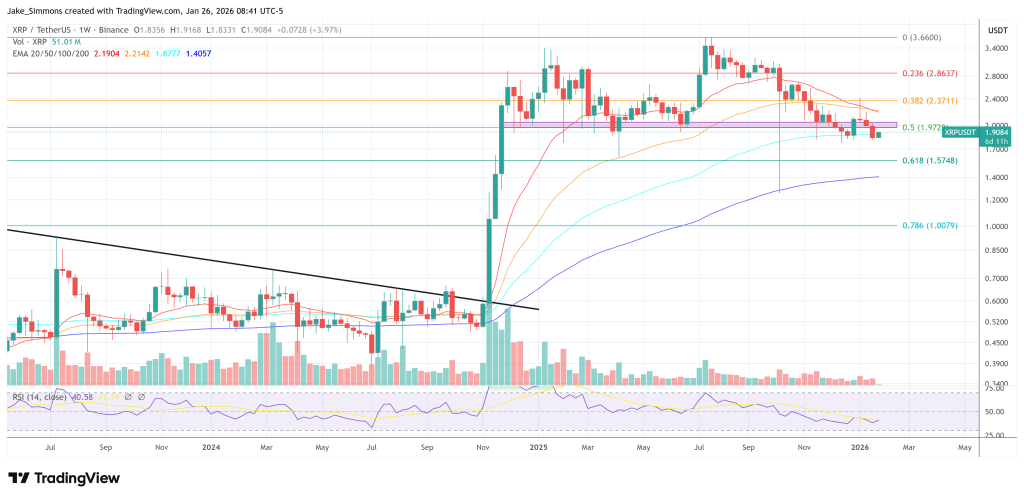
XRP tries to reclaim the 100-week EMA, 1-week chart | Source: XRPUSDT on TradingView.com

Trending Cryptos

Related Questions

QWhat is the main purpose of the partnership between Ripple and Jeel?

AThe partnership aims to explore blockchain applications across cross-border payments, digital asset custody, and tokenization in Saudi Arabia within a regulated testing environment.

QWhich Saudi national initiative does this collaboration support?

AThe collaboration supports Saudi Arabia's Vision 2030 digital transformation agenda.

QWhat specific mechanism will be used to test Ripple's technologies?

AThe technologies will be tested through proofs-of-concept developed within Jeel's regulatory sandbox, which provides a controlled and compliant environment.

QWho is the CEO of Jeel and how did he describe the partnership's strategy?

AJeel CEO George Harrak described the strategy as using the Jeel Sandbox to responsibly explore next-generation financial infrastructure through regulated experimentation combined with global blockchain expertise.

QWhat role does Ripple's Managing Director for Middle East and Africa attribute to Saudi leadership in this initiative?

AReece Merrick stated that Saudi Arabia's visionary leadership has established the Kingdom as a forward-thinking global hub for digital transformation, creating a progressive backdrop for this blockchain integration.

Related Reads

In-depth: The Foreign Guest Genspark

The article "The Foreign Guest: Genspark" investigates the identity and business practices of AI startup Genspark, which presents itself as a Palo Alto-based "AI Costco" offering a subscription bundle of over 70 models and numerous AI agent tools. Despite its official Silicon Valley narrative, Genspark's founding team has deep roots in Chinese tech giant Baidu, a history systematically downplayed in its branding. The company actively cultivates an image as an elite US firm, heavily publicizing partnerships and endorsements from OpenAI, Anthropic, and Microsoft, while distancing itself from the Chinese AI community and obscuring its connections to Chinese investors and open-weight models (like those from DeepSeek, Moonshot AI, and MiniMax) that power its services. Genspark's core strategy involves rapidly cloning and integrating successful AI product concepts (e.g., from Perplexity, Manus, Plaud) into its unified platform, supported by aggressive marketing, including Super Bowl ads and paid native content in publications like The Wall Street Journal. Critically, the article suggests a significant portion of its engineering and product development is conducted by a team in Beijing, operating outside its official US corporate structure. This duality allows Genspark to leverage Chinese talent and models for efficiency and cost reduction while constructing a public facade as a purely American success story. The piece concludes that Genspark's most effective agent is its own corporate identity, meticulously engineered to obscure its Chinese underpinnings and be perceived solely as a Silicon Valley company.

marsbit42m ago

In-depth: The Foreign Guest Genspark

marsbit42m ago

Debate: Korean Workers Fear Unemployment, While Musk Envisions a Society 'Without Work'?

While South Korean auto workers fear job losses from robotics, Elon Musk envisions a future where AI and robots render most work optional. This article explores the growing tension between immediate anxieties over automation and long-term visions of a post-work society. The piece begins with recent strikes at Hyundai's Korean plants, where unions, amid standard wage negotiations, also sought job guarantees against advancing robotics—specifically mentioning Boston Dynamics' Atlas. This reflects how anxiety about technological displacement is emerging even before robots are fully capable of replacing skilled labor on assembly lines. The author argues that while current robotics still struggle with the nuanced, experiential knowledge of veteran workers, the *perception* of imminent replacement is fueling social conflict prematurely. This modern "Luddite" sentiment is compared to the 19th-century English textile workers who smashed machines. Historically, Luddites weren't simply anti-technology; they were protesting the rapid devaluation of their skills and the unequal distribution of productivity gains. Similarly, today's workers ask who will bear the cost of transition and share in the new wealth created by machines. In contrast, figures like Elon Musk propose an optimistic endpoint: with AI and robotics driving extreme abundance, the link between work and survival could break. He suggests concepts like "Universal High Income" could allow society to share the technological bounty, transforming work from a necessity into a choice. The core challenge, however, lies in the transition. The author notes that technology's benefits diffuse slowly, while its disruptive costs—job losses, skill obsolescence—can be concentrated and immediate. The risk is a painful interim period where productivity gains are captured by a few before new social contracts, safety nets, and retraining systems are established. The conclusion calls for proactive governance. Just as past industrial revolutions gave rise to labor standards and social safety nets, the robotics era needs its own frameworks. These should address job transition support, distribution of productivity gains, safety liability, and ethical deployment. Embracing such "constraints" is not opposition to progress but a necessary step to ensure technology benefits society broadly. The discussion sparked by Hyundai's workers, therefore, is not premature but essential.

marsbit55m ago

Debate: Korean Workers Fear Unemployment, While Musk Envisions a Society 'Without Work'?

marsbit55m ago

Trading

Spot

Hot Articles

What is $BANK

Bank AI: A Revolutionary Step in the Future of Banking Introduction In an era marked by rapid advancements in technology, Bank AI stands at the intersection of artificial intelligence (AI) and banking services. This innovative project seeks to redefine the financial landscape, enhancing operational efficiency, security measures, and customer experiences through the power of AI. As we embark on this exploration of Bank AI, we will delve into what the project entails, its operational dynamics, its historical context, and significant milestones. What is Bank AI? At its core, Bank AI represents a transformative initiative aimed at integrating artificial intelligence into various banking operations. This project harnesses the capabilities of AI to automate processes, improve risk management protocols, and enhance customer interaction through personalised services. The primary objectives of Bank AI include: Automation of Banking Functions: By leveraging AI technologies, Bank AI aims to automate routine tasks, reducing the burden on human resources and enhancing efficiency. Enhanced Risk Management: The project utilises AI algorithms to predict and identify risks, thereby fortifying security measures against fraud and other threats. Personalisation of Banking Services: Bank AI focuses on offering tailored financial products and services by analysing customer data and behaviours. Improving Customer Experience: The implementation of AI-driven solutions, such as chatbots and virtual assistants, aims to provide users with more human-like interactions, revolutionising the way customers engage with banks. With these goals, Bank AI positions itself as a crucial player in rendering banking more efficient, secure, and user-centric. Who is the Creator of Bank AI? Details regarding the creator of Bank AI remain unknown. As such, no specific individual or organisation has been identified in the available information. The anonymity surrounding the project's inception raises questions but does not detract from its ambitious vision and objectives. Who are the Investors of Bank AI? Similar to the project's creator, specific information regarding the investors or supporting organisations of Bank AI has not been disclosed. Without this information, it is challenging to outline the financial backing and institutional support that might be propelling the project forward. Nevertheless, the importance of having a robust investment foundation is pivotal for sustaining development in such an innovative field. How Does Bank AI Work? Bank AI operates on several innovative fronts, focusing on unique factors that differentiate it from traditional banking frameworks. Below are key operational features: Automation: By applying machine learning algorithms, Bank AI automates various manual processes within banks. This results in reduced operational costs and allows human workers to redirect their efforts towards more strategic activities. Advanced Risk Management: The integration of AI into risk management practices equips banks with tools to accurately predict potential threats such as fraud, ensuring that customer information and assets remain secure. Tailored Financial Recommendations: Through continuous learning from customer interactions, the AI systems develop a nuanced understanding of user needs, enabling them to offer tailored advice on financial decisions. Enhanced Customer Interactions: Utilizing chatbots and virtual assistants powered by AI, Bank AI enables a more engaging customer experience, allowing users to have their queries resolved quickly, thus reducing wait times and improving satisfaction levels. Together, these operational features position Bank AI as a pioneer in the banking sector, establishing new benchmarks for service delivery and operational excellence. Timeline of Bank AI Understanding the trajectory of Bank AI requires a look at its historical context. Below is a timeline highlighting important milestones and developments: Early 2010s: The conceptualisation of AI integration into banking services began to gain attention as banking institutions recognised the potential benefits. 2018: A marked increase in the implementation of AI technologies occurred when banks started using AI tools like chatbots for basic customer service and risk management systems for improved security handling. 2023: The sophistication of AI continued to advance, with generative AI being introduced for more complex tasks such as document processing and real-time investment analysis. This year marked a significant leap in the capabilities afforded to banks by AI technology. 2024-Current Status: As of this year, Bank AI is on an upward trajectory, with ongoing research and developments poised to further enhance capabilities in banking operations. Continued exploration of AI applications hints at exciting developments yet to come. Key Points About Bank AI Integration of AI in Banking: Bank AI focuses on adopting artificial intelligence to streamline banking processes and improve user experiences. Automation and Risk Management Focus: The project strongly emphasises these areas, aiming to shift the burden of routine tasks while enhancing security frameworks through predictive analytics. Personalised Banking Solutions: By harnessing customer data, Bank AI enables tailored banking services that cater to individual user needs. Commitment to Development: Bank AI remains committed to ongoing research and development efforts, ensuring its adaptability and ongoing relevance as technology continues to evolve. Conclusion In summary, Bank AI exemplifies a crucial step forward in the banking industry, leveraging artificial intelligence to reshape operational paradigms, enhance security, and promote customer satisfaction. Despite gaps in information surrounding the creator and investors, the clear objectives and functional mechanisms of Bank AI provide a strong foundation for its ongoing evolution. As AI technology continues to advance and merge with the banking sector, Bank AI is well-positioned to significantly impact the future of financial services, enhancing the way we understand and interact with banking.

266 Total ViewsPublished 2024.04.06Updated 2024.12.03

What is $BANK

Discussions

Welcome to the HTX Community. Here, you can stay informed about the latest platform developments and gain access to professional market insights. Users' opinions on the price of BANK (BANK) are presented below.

活动图片