Ripple CLO Explains What The New SEC Guidance Means For XRP

bitcoinistPublished on 2026-03-18Last updated on 2026-03-18

Abstract

Ripple's Chief Legal Officer Stuart Alderoty asserts that the SEC's new guidance confirms XRP is not a security but a digital commodity, aligning with Ripple's long-standing position. The SEC's interpretation clarifies how federal securities laws apply to crypto assets, which many view as a significant regulatory shift. Legal experts and market commentators, including pro-XRP lawyer Bill Morgan, see this as validation of Ripple's court victory and a bullish development for XRP. The token was trading at $1.52 at the time of reporting.

Ripple’s chief legal officer Stuart Alderoty says the SEC’s latest crypto guidance does more than clarify policy. In his reading, it effectively cements what Ripple has argued for years: XRP is not a security, but a digital commodity.

The comment came after the US Securities and Exchange Commission said it had issued “an interpretation that clarifies the application of federal securities laws to crypto assets,” calling the move “a major step” toward giving markets, investors and innovators more clarity.

Ripple’s Top Lawyer Reacts

Alderoty quickly tied that announcement to Ripple’s long-running legal fight with the agency, writing via X:
“We always knew XRP wasn’t a security – and now the SEC has made clear what it is: a digital commodity. Grateful to the Crypto Task Force for working to deliver the clarity that markets, investors, and innovators have long deserved.”

That framing matters because it pushes the conversation beyond the narrower question of whether XRP sales can fall within securities laws in certain contexts. Alderoty’s post suggests Ripple sees the SEC’s latest interpretation as broader validation of the company’s core position: that XRP itself should be treated as a commodity-style crypto asset rather than a security instrument.

Notably, the Commission’s new guidance defines how federal securities laws apply to crypto assets. Even so, the market reaction around XRP was immediate, with several legal commentators and crypto experts reading the move as a meaningful shift in the regulatory ground beneath the asset.

Among the strongest reactions was from pro-XRP lawyer Bill Morgan, who linked the development directly to the Ripple case and Judge Analisa Torres’ reasoning. “So Judge Torres’ reasoning in SEC v. Ripple about XRP was 100% correct and is now accepted by the SEC in relation to most cryptos,” Morgan wrote.

Chad Steingraber wrote, “We have the official list of Digital Commodities from the SEC,” then named a group of tokens which are included as examples inside the SEC document: APT, AVAX, BTC, BCH, ADA, LINK, DOGE, ETH, HBAR, LTC, DOT, SHIB, SOL, XLM, XTZ and XRP.

Luke Martin pushed the bullish interpretation further, arguing that “If XRP isn’t a security, nothing is a security. Unfathomably bullish.”

For XRP holders and Ripple supporters, the significance lies not only in the SEC’s updated crypto guidance, but in the fact that Ripple’s legal win appears to have gained another regulatory seal of approval, cementing XRP’s standing as a digital commodity.

At press time, XRP traded at $1.52.
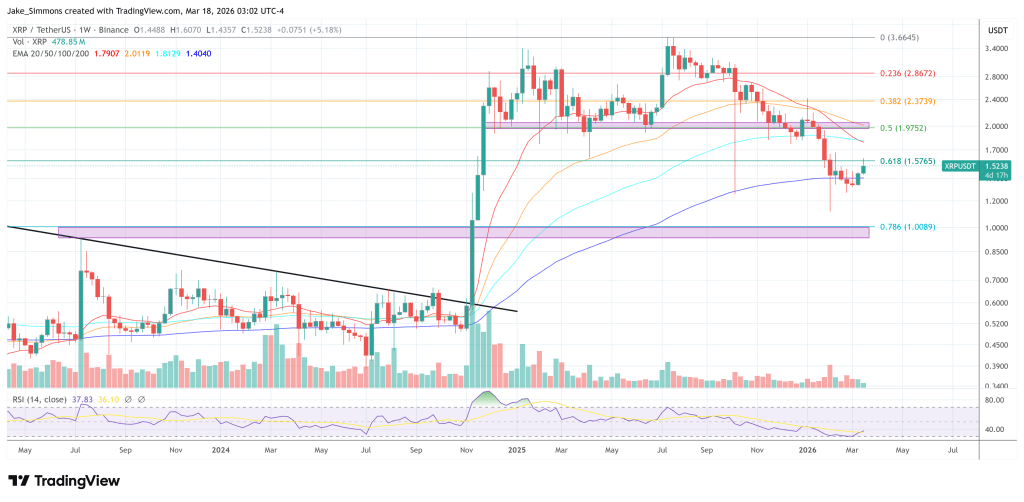
XRP must rise above the 0.618 Fib, 1-week chart | Source: XRPUSDT on TradingView.com

Trending Cryptos

Related Questions

QWhat does Ripple's CLO, Stuart Alderoty, claim the SEC's new guidance clarifies about XRP?

AStuart Alderoty claims that the SEC's new guidance clarifies that XRP is not a security, but a digital commodity.

QHow did the market and legal experts react to the SEC's new crypto guidance regarding XRP?

AThe market reaction was immediate and bullish, with legal commentators and crypto experts viewing it as a meaningful regulatory shift that validates XRP's status as a commodity, with some calling it 'unfathomably bullish'.

QWhich tokens did the SEC document list as examples of digital commodities according to Chad Steingraber?

AAccording to Chad Steingraber, the SEC document listed APT, AVAX, BTC, BCH, ADA, LINK, DOGE, ETH, HBAR, LTC, DOT, SHIB, SOL, XLM, XTZ, and XRP as examples of digital commodities.

QWhat was the price of XRP at the time the article was published?

AAt press time, XRP traded at $1.52.

QHow did pro-XRP lawyer Bill Morgan interpret the SEC's new guidance in relation to the Ripple case?

ABill Morgan interpreted the SEC's new guidance as confirming that Judge Analisa Torres' reasoning in the SEC v. Ripple case was '100% correct' and is now accepted by the SEC for most cryptocurrencies.

Related Reads

Dialogue with Jia Hang | Looking Back at Two Decades of Chinese Payment Going Global

**Summary: A Conversation with Jia Hang on Two Decades of China's Payment Globalization** Jia Hang, a veteran with over twenty years in payments, reflects on China's attempts to build a global payment network through three key phases: UnionPay (card networks), Alipay+ (digital wallets), and now, stablecoins. His journey began at UnionPay International, aiming to establish China's card network abroad. While successful in following Chinese tourists ("where Chinese go, UnionPay goes"), it struggled to achieve true global scale. The core lesson: card networks like Visa/Mastercard's unassailable advantage isn't just technical standards, but their deeply entrenched **governance and profit-sharing models** that create powerful network effects. Competing as the "same species" is nearly impossible. At Ant Group, he led Alipay+, a strategy to bypass card networks by interconnecting local e-wallets worldwide. While innovative, it faced a similar ceiling. Mobile QR payments and card swipes were essentially **the same species competing for the same pie**, lacking a disruptive value proposition for users or a sustainable new incentive model to replace the card networks' established flywheel. Today, at Singapore's DCS, Jia focuses on stablecoin-based payments. He argues stablecoins represent a fundamental shift. They are not competing with Visa for consumer payments but challenging the **traditional banking and account system for value movement**. Products like "U Cards" (stablecoin-linked payment cards) are transitional, leveraging existing card networks for acceptance while building new rails. The real potential lies in stablecoins enabling seamless, low-cost global value transfer, potentially reorganizing the financial infrastructure around **accounts rather than cards**. Jia believes stablecoin adoption for local retail payments, cross-border transactions, and as high-yield savings vehicles is becoming irreversible. This could gradually reduce reliance on traditional fiat channels, especially in regions with weak currencies or capital controls. The quest for the "next global payment network" continues, now centered on whether stablecoins can successfully bridge Web2 and Web3, establish new governance, and create compelling user value beyond mere cost reduction.

marsbit19m ago

Dialogue with Jia Hang | Looking Back at Two Decades of Chinese Payment Going Global

marsbit19m ago

Circle's Stock Price Plunges 76%, Hong Kong Dollar Stablecoin Set to Launch Within Two Weeks

Circle's stock price has plunged approximately 76% from its 2023 peak, reflecting a major market revaluation. Despite this, Circle President Heath Tarbert emphasized the company's focus on long-term execution and its dominant position with USDC's $73 billion circulation across 34 blockchains. The competitive landscape is intensifying. A new consortium-backed stablecoin, Open USD, is attempting to challenge incumbents by sharing reserve yields with partners. More significantly, Visa's new stablecoin platform, initially supporting Open USD while also being compatible with USDC, could erode Circle's network effects. In response, Circle is expanding into real-world payments through partnerships like the one with Japan's JCB. Separately, Tether (USDT) faces a two-year compliance window under new U.S. regulations, requiring it to adjust its reserve composition away from assets like Bitcoin and loans towards cash and U.S. Treasuries. Meanwhile, in Hong Kong, Standard Chartered-backed fintech firm Dian Dian is poised to launch a licensed HKD-pegged stablecoin (HKDAP), moving the industry into a phase where the real test is integrating licensed stablecoins into actual payment flows and corporate treasury systems. The sharp decline in Circle's stock underscores a broader shift: the stablecoin market is moving from a winner-takes-all dynamic to a multi-player competitive arena where execution, compliance, and real-world utility are becoming paramount.

marsbit20m ago

Circle's Stock Price Plunges 76%, Hong Kong Dollar Stablecoin Set to Launch Within Two Weeks

marsbit20m ago

Amidst Capital's Encirclement, Decentralization is the Sole Defense for Public Blockchains

In a landscape dominated by power and profit motives, the author argues that decentralization is not merely one desirable feature among many in blockchain design—it is the singular, non-negotiable defense against corporate and capital capture. The article adopts a Machiavellian, realist perspective on human institutions, positing that businesses will inevitably attempt to co-opt any valuable network to protect their profits and dominance. While external attacks like 51% forks are often discussed, the greater existential risk is internal capture—the gradual erosion of a protocol’s neutrality by vested interests, as seen historically with platforms like Visa and Google. The piece critiques permissioned chains, highly centralized “permissionless” layer-1s, and layer-2s without sufficient decentralization (e.g., single sequencers) as inherently vulnerable. These compromised systems, promoted by established financial players, are framed as delaying tactics to stifle truly open networks that threaten existing high-fee, inefficient business models. Real-world examples, such as closed enterprise consortiums that exclude competitors, illustrate how such systems cement oligopolies rather than foster innovation. The author concludes that while decentralized protocols like Ethereum are imperfect and costly to operate, they represent the only viable long-term equilibrium. In a market where value naturally flows to the most secure and neutral settlement layer, only maximally decentralized public blockchains can resist being subsumed by capital and powerful incumbents.

Foresight News30m ago

Amidst Capital's Encirclement, Decentralization is the Sole Defense for Public Blockchains

Foresight News30m ago

Trading

Spot

Hot Articles

What is XRP 2.0

XRP 2.0: A New Frontier in the Cryptocurrency Landscape Introduction to XRP 2.0 In the ever-evolving realm of cryptocurrency, new projects continuously emerge, vying for attention and adoption. One such promising initiative is XRP 2.0, a novel cryptocurrency project designed to leverage advanced blockchain technology and robust encryption methodologies. While the name draws parallels with Ripple’s XRP, it’s crucial to note that XRP 2.0 operates independently, focusing on enhancing transaction security, privacy, and scalability. As the digital financial landscape increasingly embraces decentralized solutions, XRP 2.0 aims to contribute meaningfully to web3 and the overall expansion of crypto projects. What is XRP 2.0? At its core, XRP 2.0 is a cryptocurrency project that aims to create a secure and decentralized digital currency ecosystem. Its foundational technology integrates sophisticated blockchain principles with cutting-edge encryption techniques. The overarching goal of XRP 2.0 is to establish itself as a reliable and efficient platform enabling swift transaction execution while prioritizing enhanced privacy protections for its users. The project is promoted as a solution to many limitations faced by existing cryptocurrencies, proposing a system that can handle a higher volume of transactions with improved speed and privacy. This versatility positions XRP 2.0 as a significant contender in a marketplace riddled with various digital currencies. Who is the Creator of XRP 2.0? The identity of the creator behind XRP 2.0 has been flagged as ‘Wilbur.’ However, comprehensive details regarding Wilbur or their associated entity remain elusive. The anonymity of many cryptocurrency creators is not an uncommon phenomenon in the industry, often designed to maintain a degree of privacy and security. Who are the Investors of XRP 2.0? As of now, specific information related to the investment foundations or organizations supporting XRP 2.0 is not publicly available. In the cryptocurrency sector, the backing by reputed investors can significantly influence a project's credibility and success, yet the transparency regarding the financial supporters of XRP 2.0 has not been established. How Does XRP 2.0 Work? XRP 2.0 stands out by employing a combination of blockchain technology and advanced encryption algorithms that ensures secure and decentralized transactions. Its innovative structure includes unique features designed to foster user engagement and broaden functionalities beyond conventional cryptocurrency transactions. Among these features, XRP 2.0 incorporates AI-powered capabilities, such as text-to-image and text-to-speech functionalities. These additions are designed to enhance the interactive experience for users, promoting broader applicability across various sectors. By bridging technological advancements with user-centered design, XRP 2.0 aims to capture the attention of a diverse range of individuals and enterprises looking to integrate cryptocurrency solutions into their operational frameworks. Timeline of XRP 2.0 Understanding XRP 2.0 requires examining the milestones that have defined its journey thus far: July 23, 2023: XRP 2.0 is introduced as a novel cryptocurrency project, aiming to revolutionize secure and decentralized transaction capabilities in the blockchain domain. September 8, 2023: The launching of another project, XRP20, occurs, marking the emergence of an ERC-20 token on the Ethereum blockchain that remains unrelated to XRP 2.0. November 13, 2023: The XRP Ledger undergoes a significant update with the release of rippled server software version 2.0.0. It is essential to note that this development is disconnected from the XRP 2.0 cryptocurrency project. Key Points About XRP 2.0 To distill the essence of XRP 2.0, several critical factors emerge: Unique Features: The inclusion of features like AI-powered text-to-image and text-to-speech further diversifies the potential applications of XRP 2.0. Blockchain Technology: The framework utilizes advanced blockchain mechanisms and encryption protocols, ensuring a secure and decentralized environment for transactions. Scalability and Privacy: XRP 2.0 prioritizes enhanced privacy protections in transaction processes and the scalability necessary to accommodate a growing user base. No Affiliation with Ripple: Importantly, despite its name, XRP 2.0 does not have any allegiance or collaboration with Ripple’s XRP, distinguishing its operational framework and objectives within the cryptocurrency ecosystem. Conclusion XRP 2.0 represents an ambitious venture into the cryptocurrency sphere, aiming to offer a combination of security, privacy, and efficiency in digital transactions. By integrating sophisticated technologies and user-friendly features, the project sets out to broaden the horizons of what cryptocurrency can achieve in today's digital economy. While the anonymity of its creator and lack of disclosed investors might raise questions for some, XRP 2.0's focus on advanced functionalities and decentralisation enhances its appeal amidst an increasingly crowded crypto market. As the cryptocurrency landscape continues to evolve, XRP 2.0 may yet emerge as a pivotal player in the expansion of secure and scalable blockchain solutions.

1.2k Total ViewsPublished 2024.04.01Updated 2024.12.03

What is XRP 2.0

Discussions

Welcome to the HTX Community. Here, you can stay informed about the latest platform developments and gain access to professional market insights. Users' opinions on the price of XRP (XRP) are presented below.

活动图片