Ripple CEO Predicts Big Wins For Clarity Act And XRP

bitcoinistPublished on 2026-02-20Last updated on 2026-02-20

Abstract

Ripple CEO Brad Garlinghouse predicts the CLARITY Act will pass by April's end, bringing crucial regulatory clarity to the US crypto industry. He argues this will spur growth, contrasting it with the current "vacuum" that leads to enforcement battles. Garlinghouse emphasized that XRP has already gained legal clarity from a court ruling that it is not a security. He stated Ripple's strategy focuses on demonstrating real-world utility for enterprise use cases rather than retail speculation, and highlighted the company's $3 billion acquisition spree since 2023 to build out its infrastructure capabilities. He also noted that the policy debate is no longer "crypto vs. banks," as major financial incumbents now also want a clear rulebook to compete.

Ripple CEO Brad Garlinghouse used a Feb. 18 appearance on Fox to argue that US crypto policy is nearing a turning point, predicting the long-stalled CLARITY Act will pass by the end of April and framing regulatory certainty as a direct catalyst for broader industry growth, including for XRP, which he emphasized has already cleared a key legal hurdle.

Why Ripple CEO Garlinghouse Is Bullish

Garlinghouse pointed to shifting Washington momentum and said prediction markets have moved in favor of passage. “The CLARITY Act spiked because of comments yesterday, from [a] senator [...] I think now 90% will pass by the end of April,” he said. “I said a couple weeks ago I thought at the end of April [...] people talked about [being] optimistic.”

He added that the White House is now actively pressing stakeholders, describing a meeting “today with a lot of leaders on both sides (crypto and banking) in the White House, [...] [with] the White House pushing hard.”

Pressed on Ripple’s position, Garlinghouse argued the bill’s flaws are less important than ending what he cast as a policy vacuum that has pushed the sector into enforcement battles. “Our position [is] very much, don’t let perfection be the enemy of progress,” he said. “No bill is perfect [...] we need clarity.”

He contrasted Ripple’s posture with the broader industry’s situation by referencing the company’s long-running US legal fight. “Ripple has been fortunate — sued by [the] government — a judge [...] say[ing] XRP is not a security. We have clarity,” Garlinghouse said, before reiterating the point in starker terms when asked directly: “Not a security. Courts ruled clearly.”

In his telling, the CLARITY Act is meant to keep crypto from being forced into a securities regime that doesn’t map cleanly onto how many networks and tokens function. “If something is a security, all kinds of obligations because [...] you own part of the company,” he said, contrasting that with crypto tokens where holders typically don’t receive dividends or governance rights analogous to electing a board. He also claimed the prior administration’s approach “failed in courts,” arguing that a modern framework is required for the US to compete.

Ripple’ Strategy And XRP

The interview also touched on the sector’s pullback from highs. Garlinghouse tied some of that weakness to policy delays. He said the CLARITY Act getting “pushed [and] stalled, late January [...] did not help,” while arguing Ripple entered 2026 with strong momentum after what he called “a tremendous year in 2025.”

On relative performance, he claimed XRP has held up better than other majors. “To your point, crypto markets, XRP best performing major crypto, down 20%,” he said, while noting other assets were down materially more from peaks.

He framed Ripple’s strategy as proving demand through enterprise use cases rather than retail narratives: “The more we demonstrate real practical utility using technologies to solve real problems, [the] more you see that play out in a positive way.”

Garlinghouse cited Ripple’s M&A push as part of a broader effort to build infrastructure that appeals to corporate finance teams. He said Ripple has spent “three billion dollars [on] acquisitions since 2023,” including expanding into “custody, prime [brokerage], treasury management, stablecoin [and] payment” capabilities.

He highlighted the treasury-management firm it acquired, saying it “processed 13 trillion dollars payments last year,” and emphasizing how early institutional stablecoin adoption still is: “Crypto-enabled, zero of those were stablecoin enabled.”

For now, he suggested dealmaking is taking a back seat to integration. “We bought two big companies last year [...] the first half of this year [is] very much on let’s pause [...] integrate,” he said, adding: “For time being, we’re going to slow down, before we speed up.”

Garlinghouse also argued the CLARITY fight is no longer “crypto versus banks,” pointing to big incumbents wanting a rulebook. He said the “vast majority of the crypto industry” is prepared to accept imperfect language, including around customer rewards, because it would be “a major step forward.” He added that banks are now leaning in as well, citing Goldman Sachs leadership as wanting “the same level playing field” to compete as traditional finance moves deeper into crypto.

At press time, XRP traded at $1.4196.
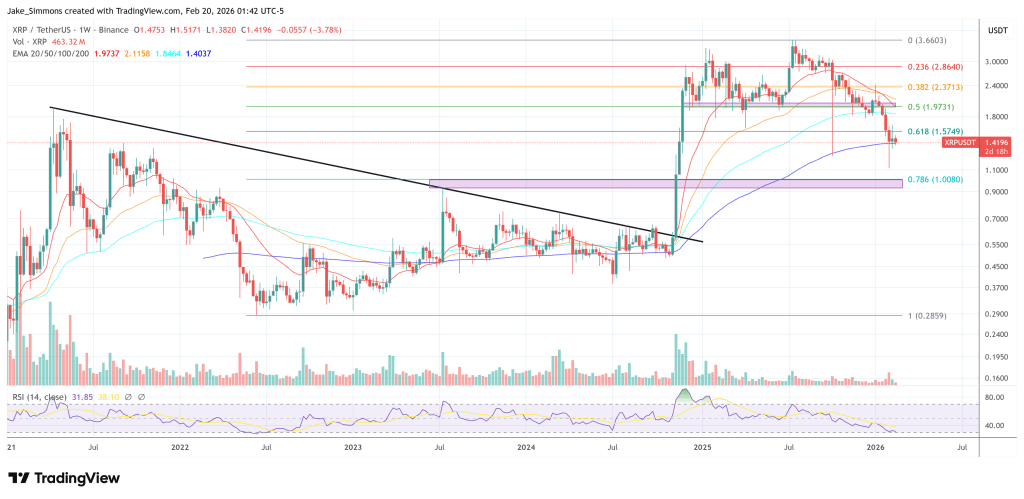
XRP remains above the 200-week EMA, 1-week chart | Source: XRPUSDT on TradingView.com

Trending Cryptos

Related Questions

QWhat is the CLARITY Act and when does Brad Garlinghouse predict it will pass?

AThe CLARITY Act is a proposed US crypto regulation bill. Ripple CEO Brad Garlinghouse predicts it will pass by the end of April, citing shifting momentum in Washington and prediction markets estimate of a 90% chance of passage.

QAccording to Garlinghouse, why is regulatory clarity so important for the crypto industry?

AGarlinghouse argues that regulatory clarity is a direct catalyst for broader industry growth. He states that ending the current policy vacuum is more important than a perfect bill, as the lack of clear rules has pushed the sector into enforcement battles and hindered progress.

QWhat key legal status for XRP did Garlinghouse emphasize during the interview?

AGarlinghouse emphasized that a US court has clearly ruled that XRP is not a security. He stated, 'Courts ruled clearly,' giving Ripple a significant advantage and clarity that many other crypto projects lack.

QHow does Garlinghouse describe Ripple's recent acquisition strategy and its current focus?

AGarlinghouse said Ripple has spent three billion dollars on acquisitions since 2023 to build infrastructure in areas like custody, prime brokerage, and treasury management. However, the current focus for the first half of the year is on pausing new deals to integrate the two big companies they acquired last year.

QHow did Garlinghouse characterize the current political dynamic around the CLARITY Act?

AGarlinghouse stated the fight is no longer 'crypto versus banks.' He explained that big incumbent financial institutions, like Goldman Sachs, now also want a clear rulebook to create a level playing field as traditional finance moves deeper into crypto, and the vast majority of the crypto industry is prepared to accept an imperfect bill as a major step forward.

Related Reads

Global Stock Market's Storm Center: South Korea's Stock Market De-leveraging Is Largely Complete

Storm's Eye: South Korean Market De-leveraging Nears Completion The recent sharp correction in South Korean equities, with the KOSPI index dropping 32% from its June high, has been a key trigger for global tech stock volatility. The core driver was not a fundamental shift but a forced de-leveraging process within the market's unique structure, which is now largely complete. Two main leverage channels amplified the sell-off: 1. **Leveraged ETFs:** Their size, proportionally four times larger than in the U.S., peaked near $50 billion. Their mandatory daily rebalancing mechanism created a vicious cycle of "price drop → forced selling → further drop." Approximately 75% of this excess has been unwound, shrinking to $26 billion, with regulatory curbs now blocking new inflows. 2. **Hedge Fund Leverage:** Using swaps to magnify exposure, hedge funds saw their net long positioning fall by over 50% from peak levels. The most intense phase of this institutional de-leveraging is over. In contrast, **retail margin debt** poses minimal systemic risk. At 0.5% of market cap, it is far lower than in the U.S. or China, lacks automatic triggers, and is concentrated in smaller stocks. The conclusion: the high-leverage structures most prone to "chain-reaction selling" have been substantially cleared. The market is transitioning from a liquidity-driven crash to one priced more on fundamentals. The article argues that the AI trend—centered on Korean memory chips—remains intact. This episode represents a painful but necessary clearing of crowded trades, not the end of the AI revolution. For investors, the key question is conviction in the long-term AI direction; if the trend is real, current volatility is a cost of entry, not a terminal risk.

链捕手46m ago

Global Stock Market's Storm Center: South Korea's Stock Market De-leveraging Is Largely Complete

链捕手46m ago

The Eternal Fragments of Money: Third-Party Payment Has No First Principle

"The Enduring Fragments of Money: Third-Party Payments Lack a First Principle" Stripe is reportedly attempting to acquire PayPal, marking a significant shift reminiscent of PayPal's merger with the original X.com 30 years ago. The article analyzes Stripe's strategic challenges and the broader payments industry landscape. Despite its initial success with a developer-friendly API model, Stripe missed its optimal IPO window during the pandemic and has since seen its valuation decline. Its attempts to expand through acquisitions and new ventures, particularly in stablecoins (like its OUSD project) and Agent-focused payments (ACP/MPP protocols), have faced headwinds. The author argues that the payment industry remains highly fragmented and is ultimately an adjunct to the traditional banking system. This structure limits the potential for any single player, including Stripe, to achieve complete dominance. While stablecoins and the future rise of autonomous Agent economies present potential growth avenues, they are not yet mainstream and still require integration with the existing financial system. For now, Agent-based transactions are largely used for speculative "volume boosting" rather than substantive business applications. Stripe's current move to acquire PayPal is seen as an attempt to bolster its weak consumer-facing (C-side) business after its stablecoin-focused strategies faltered. Meanwhile, PayPal is described as structurally outdated, unable to revive itself through new products like Venmo or PYUSD. The future of payments may lie not in payments themselves but in value-added services like more efficient settlement networks. The author suggests that companies like Stripe and Circle, which are building their own blockchains (Tempo, Arc) and stablecoins, are positioning themselves to eventually profit from high-efficiency settlement systems. These new networks could potentially bypass some traditional banking layers. In conclusion, the article posits that third-party payment is a perpetually fragmented battlefield where scale alone cannot ensure victory. Players must find new models, focusing on efficiency to compete with the entrenched banking system. Stripe's acquisition of PayPal represents a bet on this uncertain future.

链捕手1h ago

The Eternal Fragments of Money: Third-Party Payment Has No First Principle

链捕手1h ago

Trading

Spot

Hot Articles

What is XRP 2.0

XRP 2.0: A New Frontier in the Cryptocurrency Landscape Introduction to XRP 2.0 In the ever-evolving realm of cryptocurrency, new projects continuously emerge, vying for attention and adoption. One such promising initiative is XRP 2.0, a novel cryptocurrency project designed to leverage advanced blockchain technology and robust encryption methodologies. While the name draws parallels with Ripple’s XRP, it’s crucial to note that XRP 2.0 operates independently, focusing on enhancing transaction security, privacy, and scalability. As the digital financial landscape increasingly embraces decentralized solutions, XRP 2.0 aims to contribute meaningfully to web3 and the overall expansion of crypto projects. What is XRP 2.0? At its core, XRP 2.0 is a cryptocurrency project that aims to create a secure and decentralized digital currency ecosystem. Its foundational technology integrates sophisticated blockchain principles with cutting-edge encryption techniques. The overarching goal of XRP 2.0 is to establish itself as a reliable and efficient platform enabling swift transaction execution while prioritizing enhanced privacy protections for its users. The project is promoted as a solution to many limitations faced by existing cryptocurrencies, proposing a system that can handle a higher volume of transactions with improved speed and privacy. This versatility positions XRP 2.0 as a significant contender in a marketplace riddled with various digital currencies. Who is the Creator of XRP 2.0? The identity of the creator behind XRP 2.0 has been flagged as ‘Wilbur.’ However, comprehensive details regarding Wilbur or their associated entity remain elusive. The anonymity of many cryptocurrency creators is not an uncommon phenomenon in the industry, often designed to maintain a degree of privacy and security. Who are the Investors of XRP 2.0? As of now, specific information related to the investment foundations or organizations supporting XRP 2.0 is not publicly available. In the cryptocurrency sector, the backing by reputed investors can significantly influence a project's credibility and success, yet the transparency regarding the financial supporters of XRP 2.0 has not been established. How Does XRP 2.0 Work? XRP 2.0 stands out by employing a combination of blockchain technology and advanced encryption algorithms that ensures secure and decentralized transactions. Its innovative structure includes unique features designed to foster user engagement and broaden functionalities beyond conventional cryptocurrency transactions. Among these features, XRP 2.0 incorporates AI-powered capabilities, such as text-to-image and text-to-speech functionalities. These additions are designed to enhance the interactive experience for users, promoting broader applicability across various sectors. By bridging technological advancements with user-centered design, XRP 2.0 aims to capture the attention of a diverse range of individuals and enterprises looking to integrate cryptocurrency solutions into their operational frameworks. Timeline of XRP 2.0 Understanding XRP 2.0 requires examining the milestones that have defined its journey thus far: July 23, 2023: XRP 2.0 is introduced as a novel cryptocurrency project, aiming to revolutionize secure and decentralized transaction capabilities in the blockchain domain. September 8, 2023: The launching of another project, XRP20, occurs, marking the emergence of an ERC-20 token on the Ethereum blockchain that remains unrelated to XRP 2.0. November 13, 2023: The XRP Ledger undergoes a significant update with the release of rippled server software version 2.0.0. It is essential to note that this development is disconnected from the XRP 2.0 cryptocurrency project. Key Points About XRP 2.0 To distill the essence of XRP 2.0, several critical factors emerge: Unique Features: The inclusion of features like AI-powered text-to-image and text-to-speech further diversifies the potential applications of XRP 2.0. Blockchain Technology: The framework utilizes advanced blockchain mechanisms and encryption protocols, ensuring a secure and decentralized environment for transactions. Scalability and Privacy: XRP 2.0 prioritizes enhanced privacy protections in transaction processes and the scalability necessary to accommodate a growing user base. No Affiliation with Ripple: Importantly, despite its name, XRP 2.0 does not have any allegiance or collaboration with Ripple’s XRP, distinguishing its operational framework and objectives within the cryptocurrency ecosystem. Conclusion XRP 2.0 represents an ambitious venture into the cryptocurrency sphere, aiming to offer a combination of security, privacy, and efficiency in digital transactions. By integrating sophisticated technologies and user-friendly features, the project sets out to broaden the horizons of what cryptocurrency can achieve in today's digital economy. While the anonymity of its creator and lack of disclosed investors might raise questions for some, XRP 2.0's focus on advanced functionalities and decentralisation enhances its appeal amidst an increasingly crowded crypto market. As the cryptocurrency landscape continues to evolve, XRP 2.0 may yet emerge as a pivotal player in the expansion of secure and scalable blockchain solutions.

1.2k Total ViewsPublished 2024.04.01Updated 2024.12.03

What is XRP 2.0

Discussions

Welcome to the HTX Community. Here, you can stay informed about the latest platform developments and gain access to professional market insights. Users' opinions on the price of XRP (XRP) are presented below.

活动图片