Ripple CEO Predicts Big Wins For Clarity Act And XRP

bitcoinistPublished on 2026-02-20Last updated on 2026-02-20

Abstract

Ripple CEO Brad Garlinghouse predicts the CLARITY Act will pass by April's end, bringing crucial regulatory clarity to the US crypto industry. He argues this will spur growth, contrasting it with the current "vacuum" that leads to enforcement battles. Garlinghouse emphasized that XRP has already gained legal clarity from a court ruling that it is not a security. He stated Ripple's strategy focuses on demonstrating real-world utility for enterprise use cases rather than retail speculation, and highlighted the company's $3 billion acquisition spree since 2023 to build out its infrastructure capabilities. He also noted that the policy debate is no longer "crypto vs. banks," as major financial incumbents now also want a clear rulebook to compete.

Ripple CEO Brad Garlinghouse used a Feb. 18 appearance on Fox to argue that US crypto policy is nearing a turning point, predicting the long-stalled CLARITY Act will pass by the end of April and framing regulatory certainty as a direct catalyst for broader industry growth, including for XRP, which he emphasized has already cleared a key legal hurdle.

Why Ripple CEO Garlinghouse Is Bullish

Garlinghouse pointed to shifting Washington momentum and said prediction markets have moved in favor of passage. “The CLARITY Act spiked because of comments yesterday, from [a] senator [...] I think now 90% will pass by the end of April,” he said. “I said a couple weeks ago I thought at the end of April [...] people talked about [being] optimistic.”

He added that the White House is now actively pressing stakeholders, describing a meeting “today with a lot of leaders on both sides (crypto and banking) in the White House, [...] [with] the White House pushing hard.”

Pressed on Ripple’s position, Garlinghouse argued the bill’s flaws are less important than ending what he cast as a policy vacuum that has pushed the sector into enforcement battles. “Our position [is] very much, don’t let perfection be the enemy of progress,” he said. “No bill is perfect [...] we need clarity.”

He contrasted Ripple’s posture with the broader industry’s situation by referencing the company’s long-running US legal fight. “Ripple has been fortunate — sued by [the] government — a judge [...] say[ing] XRP is not a security. We have clarity,” Garlinghouse said, before reiterating the point in starker terms when asked directly: “Not a security. Courts ruled clearly.”

In his telling, the CLARITY Act is meant to keep crypto from being forced into a securities regime that doesn’t map cleanly onto how many networks and tokens function. “If something is a security, all kinds of obligations because [...] you own part of the company,” he said, contrasting that with crypto tokens where holders typically don’t receive dividends or governance rights analogous to electing a board. He also claimed the prior administration’s approach “failed in courts,” arguing that a modern framework is required for the US to compete.

Ripple’ Strategy And XRP

The interview also touched on the sector’s pullback from highs. Garlinghouse tied some of that weakness to policy delays. He said the CLARITY Act getting “pushed [and] stalled, late January [...] did not help,” while arguing Ripple entered 2026 with strong momentum after what he called “a tremendous year in 2025.”

On relative performance, he claimed XRP has held up better than other majors. “To your point, crypto markets, XRP best performing major crypto, down 20%,” he said, while noting other assets were down materially more from peaks.

He framed Ripple’s strategy as proving demand through enterprise use cases rather than retail narratives: “The more we demonstrate real practical utility using technologies to solve real problems, [the] more you see that play out in a positive way.”

Garlinghouse cited Ripple’s M&A push as part of a broader effort to build infrastructure that appeals to corporate finance teams. He said Ripple has spent “three billion dollars [on] acquisitions since 2023,” including expanding into “custody, prime [brokerage], treasury management, stablecoin [and] payment” capabilities.

He highlighted the treasury-management firm it acquired, saying it “processed 13 trillion dollars payments last year,” and emphasizing how early institutional stablecoin adoption still is: “Crypto-enabled, zero of those were stablecoin enabled.”

For now, he suggested dealmaking is taking a back seat to integration. “We bought two big companies last year [...] the first half of this year [is] very much on let’s pause [...] integrate,” he said, adding: “For time being, we’re going to slow down, before we speed up.”

Garlinghouse also argued the CLARITY fight is no longer “crypto versus banks,” pointing to big incumbents wanting a rulebook. He said the “vast majority of the crypto industry” is prepared to accept imperfect language, including around customer rewards, because it would be “a major step forward.” He added that banks are now leaning in as well, citing Goldman Sachs leadership as wanting “the same level playing field” to compete as traditional finance moves deeper into crypto.

At press time, XRP traded at $1.4196.
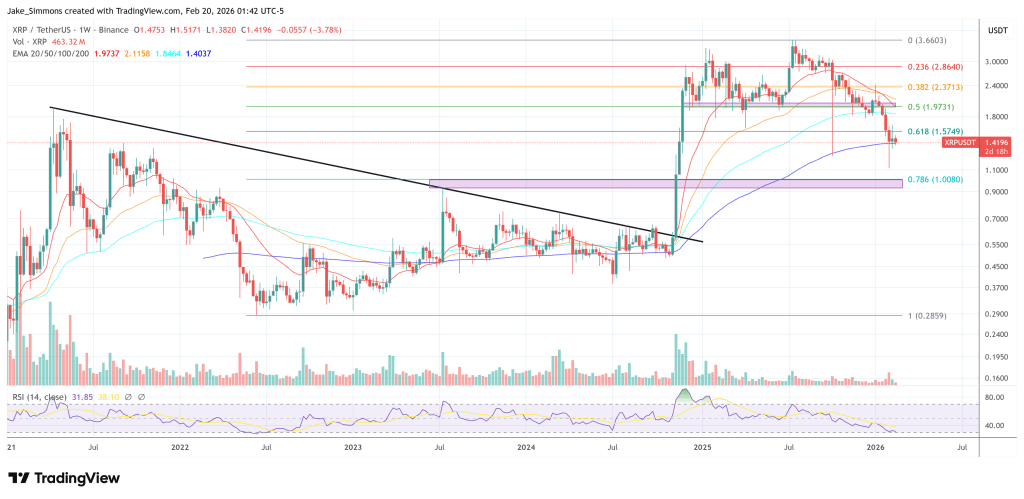
XRP remains above the 200-week EMA, 1-week chart | Source: XRPUSDT on TradingView.com

Related Questions

QWhat is the CLARITY Act and when does Brad Garlinghouse predict it will pass?

AThe CLARITY Act is a proposed US crypto regulation bill. Ripple CEO Brad Garlinghouse predicts it will pass by the end of April, citing shifting momentum in Washington and prediction markets estimate of a 90% chance of passage.

QAccording to Garlinghouse, why is regulatory clarity so important for the crypto industry?

AGarlinghouse argues that regulatory clarity is a direct catalyst for broader industry growth. He states that ending the current policy vacuum is more important than a perfect bill, as the lack of clear rules has pushed the sector into enforcement battles and hindered progress.

QWhat key legal status for XRP did Garlinghouse emphasize during the interview?

AGarlinghouse emphasized that a US court has clearly ruled that XRP is not a security. He stated, 'Courts ruled clearly,' giving Ripple a significant advantage and clarity that many other crypto projects lack.

QHow does Garlinghouse describe Ripple's recent acquisition strategy and its current focus?

AGarlinghouse said Ripple has spent three billion dollars on acquisitions since 2023 to build infrastructure in areas like custody, prime brokerage, and treasury management. However, the current focus for the first half of the year is on pausing new deals to integrate the two big companies they acquired last year.

QHow did Garlinghouse characterize the current political dynamic around the CLARITY Act?

AGarlinghouse stated the fight is no longer 'crypto versus banks.' He explained that big incumbent financial institutions, like Goldman Sachs, now also want a clear rulebook to create a level playing field as traditional finance moves deeper into crypto, and the vast majority of the crypto industry is prepared to accept an imperfect bill as a major step forward.

Related Reads

Borrowing Money from a Hundred Years Later, Building Incomprehensible AI

Tech giants like Alphabet, Amazon, Meta, and Microsoft are undergoing a radical financial transformation due to AI. Their traditional "light-asset, high-free-cash-flow" model is being dismantled by staggering capital expenditures on AI infrastructure—data centers, GPUs, and power. Combined 2026 guidance exceeds $700 billion, a 4.5x increase from 2022, causing free cash flow to plummet (e.g., Amazon's fell 95%). To fund this, they are borrowing unprecedented sums through long-dated, multi-currency bonds (e.g., Alphabet's 100-year bond). The world's most conservative capital—pensions, insurers—is now funding Silicon Valley's most speculative bet. This shift makes these companies resemble heavy-asset industrials (railroads, utilities) rather than software firms, threatening their premium valuations. Historically, such infrastructure booms (railroads, fiber optics) followed a pattern: genuine technology, overbuilding fueled by competitive frenzy, aggressive debt financing, and a crash triggered by financial conditions—not technology failure. The infrastructure remained, but many original builders and financiers did not survive. The core gamble is a "time arbitrage": using cheap debt today to build scale and lock in customers before AI capabilities commoditize. They are betting that AI revenue will materialize before debt comes due. Their positions vary: Amazon is under immediate cash pressure; Meta's path to monetization is unclear; Alphabet has a robust core business buffer; Microsoft has the shortest path from infrastructure to revenue. The contract is set: the most risk-averse global capital has lent its time to Silicon Valley, awaiting a future that is promised but uncertain.

marsbit27m ago

Borrowing Money from a Hundred Years Later, Building Incomprehensible AI

marsbit27m ago

The 'VVV' Concept Soars 9x in Half a Year, The New AI Narrative on Base Chain

"The article explores the 'VVV' concept as the new AI-focused narrative within the Base ecosystem, centered around the token $VVV of the privacy-focused, uncensored generative AI platform Venice, led by crypto veteran Erik Voorhees. Venice has seen significant growth in 2026, with its API users surging, partly attributed to exposure from OpenClaw. The platform now boasts over 2 million total users and 55,000 paid subscribers. Correspondingly, the $VVV token price has risen over 9x this year. Key to its performance are tokenomics designed for value accrual: reduced annual emissions, subscription revenue used for buyback-and-burn, and a unique staking mechanism. Staking $VVV yields $sVVV, which can be used to mint $DIEM tokens. Each staked $DIEM provides a daily $1 credit for using Venice's API services, creating tangible utility. The article also highlights other tokens associated with the 'VVV' narrative. $POD, the token of distributed AI network Dolphin (which co-developed Venice's default AI model), saw a massive price surge. $cyb3rwr3n, a project for a Venice credit auction market, gained attention due to perceived connections to Venice's team despite official denials. Finally, $SR of robotics platform STRIKEROBOT.AI rose after announcing a partnership with Venice for robot vision-language model development. Overall, the 'VVV' ecosystem combines AI platform growth, deflationary tokenomics, and innovative utility mechanisms, driving significant investor interest and price action in related tokens."

marsbit36m ago

The 'VVV' Concept Soars 9x in Half a Year, The New AI Narrative on Base Chain

marsbit36m ago

Anthropic and OpenAI Have Single-Handedly Severed the Logic of Pre-IPO Stock Tokenization

The pre-IPO stock token market is experiencing significant turmoil following strong statements from AI giants Anthropic and OpenAI. Both companies have updated their official policies, declaring that any transfer of their company shares—including sales, transfers, or assignments of share interests—without prior board approval is "invalid" and will not be recognized in their corporate records. This means buyers in such unauthorized transactions would not be recognized as shareholders and would have no shareholder rights. A major point of contention is the use of Special Purpose Vehicles (SPVs), which are legal entities commonly used by pre-IPO token platforms to pool investor funds and indirectly acquire shares from employees or early investors. The companies explicitly state they do not permit SPVs to acquire their shares, and any such transfer violates their restrictions. They warn that third parties selling shares through SPVs, direct sales, forward contracts, or stock tokens are likely engaged in fraud or are offering worthless investments due to these transfer limits. This stance directly threatens the core model of many pre-IPO token platforms, which rely on SPV structures. The announcement revealed additional risks within this model, such as complex "SPV-within-SPV" layering that obscures legal transparency, increases management fees, and creates a chain reaction risk of invalidation. Following the news, tokens like ANTHROPIC and OPENAI on platforms like PreStocks fell sharply (over 20%). The market reaction highlights a divergence: while asset-backed pre-IPO tokens plummeted, purely speculative pre-IPO futures contracts, which are bilateral bets on future IPO prices with no claim to actual shares, remained relatively stable as they are unaffected by the transfer restrictions. The industry is split on the implications. Some believe the fundamental logic of pre-IPO token trading is broken if leading companies reject SPV-held shares, potentially causing a domino effect. Others, like Rivet founder Nick Abouzeid, argue that buyers of such unofficial tokens always knowingly accepted the risk of non-recognition by the company. The statements serve as a stark risk warning and a corrective measure for a market where valuations for some AI-related pre-IPO tokens had soared to irrational levels, far exceeding recent funding round valuations.

marsbit1h ago

Anthropic and OpenAI Have Single-Handedly Severed the Logic of Pre-IPO Stock Tokenization

marsbit1h ago

Anthropic and OpenAI Personally Sever the Logic of Pre-IPO Crypto-Stocks

The pre-IPO token market has been rocked by strong statements from Anthropic and OpenAI. Both AI giants have updated official warnings, declaring that any sale or transfer of their company shares without explicit board approval is "invalid" and will not be recognized on their corporate records. This directly targets Special Purpose Vehicles (SPVs), the common legal structure used by pre-IPO token platforms. These platforms typically use an SPV to acquire shares from employees or early investors, then issue blockchain-based tokens representing a claim on the SPV's economic benefits. Anthropic and OpenAI's position means that if an SPV's share purchase lacked authorization, the underlying asset could be deemed worthless, nullifying the token's value. Anthropic explicitly warned that any third party selling its shares—via direct sales, forwards, or tokens—is likely fraudulent or offering a valueless investment. The crackdown highlights risks in the popular SPV model, including complex multi-layered "Russian doll" SPV structures that obscure legal ownership, add fees, and concentrate risk. If one layer is invalidated, the entire chain could collapse. Following the announcements, tokens like ANTHROPIC and OPENAI on platforms like PreStocks fell sharply (over 20%). In contrast, purely speculative pre-IPO prediction contracts remained stable, as they involve no actual share ownership. The move is seen as a corrective measure amid a market frenzy where some pre-IPO token valuations (e.g., Anthropic's token hitting a $1.4 trillion implied valuation) far exceeded recent official funding rounds. Opinions are split: some believe this undermines the core logic of pre-IPO token trading if top companies reject SPVs, while others argue buyers always assumed this legal risk when accessing unofficial channels. The statements serve as a stark warning and a potential catalyst for market de-leveraging and clearer boundaries.

Odaily星球日报1h ago

Anthropic and OpenAI Personally Sever the Logic of Pre-IPO Crypto-Stocks

Odaily星球日报1h ago

The Waged Worker Driven to Poverty by AI Subscriptions

"AI Membership: The Hidden Cost Pushing Workers Toward 'Poverty'" The widespread corporate push for AI adoption is creating a hidden financial burden for employees. Companies, from giants like Alibaba to small firms, are mandating AI use, often tying token consumption to KPIs, but frequently refuse to cover the costs. Workers are forced to pay for subscriptions out of pocket to stay competitive and avoid being replaced. Front-end developer Long Shen spends up to 2000 RMB monthly on tools like Cursor and ChatGPT Plus, seeing it as a necessary 3% salary investment to handle 90% of his coding tasks. While it boosted his performance and led to promotions, he now faces idle time at work, pretending to be busy. Designer Peng Peng navigates strict company firewalls by using personal devices and accounts for AI image generation tools like Midjourney, spending hundreds monthly without reimbursement, while her boss demands faster, more numerous revisions. The pressure creates workplace anxiety and suspicion. Programmer Li Huahua, after a friend's experience of raised KPIs following AI success, fears being branded a "traitor" for using it yet worries about falling behind if she doesn't. The dynamic allows management to demand results without understanding the tools or covering expenses, treating employees like AI "agents." While some, like entrepreneur Jin Tu, find high value in paid AI, building entire systems and winning competitions, for most, it's a trap. Free tools like Kimi and Doubao are introducing fees, closing off alternatives. The initial efficiency gains individual advantage, but as AI becomes ubiquitous, the personal edge disappears, workloads increase, and a cycle of dependency begins. Workers like Long Shen realize they cannot maintain AI-generated code without AI, making stopping harder than continuing to pay. The tool promising liberation is instead becoming a compulsory, costly chain in the modern workplace.

marsbit2h ago

The Waged Worker Driven to Poverty by AI Subscriptions

marsbit2h ago

Trading

Spot
Futures

Hot Articles

What is XRP 2.0

XRP 2.0: A New Frontier in the Cryptocurrency Landscape Introduction to XRP 2.0 In the ever-evolving realm of cryptocurrency, new projects continuously emerge, vying for attention and adoption. One such promising initiative is XRP 2.0, a novel cryptocurrency project designed to leverage advanced blockchain technology and robust encryption methodologies. While the name draws parallels with Ripple’s XRP, it’s crucial to note that XRP 2.0 operates independently, focusing on enhancing transaction security, privacy, and scalability. As the digital financial landscape increasingly embraces decentralized solutions, XRP 2.0 aims to contribute meaningfully to web3 and the overall expansion of crypto projects. What is XRP 2.0? At its core, XRP 2.0 is a cryptocurrency project that aims to create a secure and decentralized digital currency ecosystem. Its foundational technology integrates sophisticated blockchain principles with cutting-edge encryption techniques. The overarching goal of XRP 2.0 is to establish itself as a reliable and efficient platform enabling swift transaction execution while prioritizing enhanced privacy protections for its users. The project is promoted as a solution to many limitations faced by existing cryptocurrencies, proposing a system that can handle a higher volume of transactions with improved speed and privacy. This versatility positions XRP 2.0 as a significant contender in a marketplace riddled with various digital currencies. Who is the Creator of XRP 2.0? The identity of the creator behind XRP 2.0 has been flagged as ‘Wilbur.’ However, comprehensive details regarding Wilbur or their associated entity remain elusive. The anonymity of many cryptocurrency creators is not an uncommon phenomenon in the industry, often designed to maintain a degree of privacy and security. Who are the Investors of XRP 2.0? As of now, specific information related to the investment foundations or organizations supporting XRP 2.0 is not publicly available. In the cryptocurrency sector, the backing by reputed investors can significantly influence a project's credibility and success, yet the transparency regarding the financial supporters of XRP 2.0 has not been established. How Does XRP 2.0 Work? XRP 2.0 stands out by employing a combination of blockchain technology and advanced encryption algorithms that ensures secure and decentralized transactions. Its innovative structure includes unique features designed to foster user engagement and broaden functionalities beyond conventional cryptocurrency transactions. Among these features, XRP 2.0 incorporates AI-powered capabilities, such as text-to-image and text-to-speech functionalities. These additions are designed to enhance the interactive experience for users, promoting broader applicability across various sectors. By bridging technological advancements with user-centered design, XRP 2.0 aims to capture the attention of a diverse range of individuals and enterprises looking to integrate cryptocurrency solutions into their operational frameworks. Timeline of XRP 2.0 Understanding XRP 2.0 requires examining the milestones that have defined its journey thus far: July 23, 2023: XRP 2.0 is introduced as a novel cryptocurrency project, aiming to revolutionize secure and decentralized transaction capabilities in the blockchain domain. September 8, 2023: The launching of another project, XRP20, occurs, marking the emergence of an ERC-20 token on the Ethereum blockchain that remains unrelated to XRP 2.0. November 13, 2023: The XRP Ledger undergoes a significant update with the release of rippled server software version 2.0.0. It is essential to note that this development is disconnected from the XRP 2.0 cryptocurrency project. Key Points About XRP 2.0 To distill the essence of XRP 2.0, several critical factors emerge: Unique Features: The inclusion of features like AI-powered text-to-image and text-to-speech further diversifies the potential applications of XRP 2.0. Blockchain Technology: The framework utilizes advanced blockchain mechanisms and encryption protocols, ensuring a secure and decentralized environment for transactions. Scalability and Privacy: XRP 2.0 prioritizes enhanced privacy protections in transaction processes and the scalability necessary to accommodate a growing user base. No Affiliation with Ripple: Importantly, despite its name, XRP 2.0 does not have any allegiance or collaboration with Ripple’s XRP, distinguishing its operational framework and objectives within the cryptocurrency ecosystem. Conclusion XRP 2.0 represents an ambitious venture into the cryptocurrency sphere, aiming to offer a combination of security, privacy, and efficiency in digital transactions. By integrating sophisticated technologies and user-friendly features, the project sets out to broaden the horizons of what cryptocurrency can achieve in today's digital economy. While the anonymity of its creator and lack of disclosed investors might raise questions for some, XRP 2.0's focus on advanced functionalities and decentralisation enhances its appeal amidst an increasingly crowded crypto market. As the cryptocurrency landscape continues to evolve, XRP 2.0 may yet emerge as a pivotal player in the expansion of secure and scalable blockchain solutions.

941 Total ViewsPublished 2024.04.01Updated 2024.12.03

What is XRP 2.0

Discussions

Welcome to the HTX Community. Here, you can stay informed about the latest platform developments and gain access to professional market insights. Users' opinions on the price of XRP (XRP) are presented below.

活动图片















