Ric Edelman Says $500,000 Bitcoin Is ‘Simple Arithmetic’ By 2030

bitcoinistPublished on 2026-02-16Last updated on 2026-02-16

Abstract

Ric Edelman, founder of Edelman Financial, predicts Bitcoin (BTC) could reach $500,000 by 2030, a forecast he calls "conservative" compared to more aggressive predictions. His reasoning is based on "simple arithmetic": if global investors allocate just 1% of the estimated $750 trillion in global stocks, bonds, real estate, gold, and cash to Bitcoin, it would result in $7.5 trillion of inflows. Combined with Bitcoin's existing value, this would push the price to around $500,000 per coin. He notes that institutional adoption is already beginning, with some allocations nearing 5%. Edelman also expressed bullishness on Ethereum (ETH), linking it to stablecoin growth and suggesting it could reach between $4,000 and $10,000.

Ric Edelman says Bitcoin can reach $500,000 by the end of the decade and, unlike many headline-grabbing forecasts, he’s putting a simple allocation math behind it.

In a Feb. 15 interview with Altcoin Daily, the longtime financial adviser and founder of Edelman Financial (now managing roughly $330 billion, by his account) framed his target as the “conservative” case in a range of increasingly aggressive calls circulating in crypto. “I believe that Bitcoin can reach $500,000 by the end of the decade,” Edelman said. “And there are other predictions that are even more bold than mine... many are predicting a million. Others are predicting as much as two to 5 million in pricing.”

Why Edelman Calls $500,000 Bitcoin ‘Conservative’ By 2030

What he objects to, he said, is not optimism, it’s the lack of disclosed assumptions. “The problem I have with a lot of the predictions is that they are opaque. They haven’t explained why they believe what they’re saying,” Edelman said. “So I’ll be transparent and tell you how I get to 500,000 by 2030... this is not a straight line... it’s going to be very bumpy along the way.”

Edelman’s case rests on a broad-based shift in global portfolio construction, not a single catalyst. He argues Bitcoin still isn’t owned by the “average investor” worldwide but that adoption can expand through sovereign and institutional channels over time. He listed potential buyers across the capital stack: “government holdings, sovereign wealth funds and institutional holdings, endowments, pension funds, hedge funds, insurance companies, banks, brokerages, etc.”

From there, Edelman zooms out to the size of the global asset pool. He estimated the combined value of global stocks, bonds, real estate, gold, and cash at roughly $750 trillion. The key step is the portfolio slice: if diversified investors ultimately assign just 1% to Bitcoin, that implies about $7.5 trillion of inflows, which he says would translate into roughly $500,000 per coin when combined with Bitcoin’s existing value.

“It’s simple arithmetic,” Edelman said. “If you take the attitude... that everybody who owns a diversified portfolio ends up owning just 1% of their portfolio in Bitcoin — that’s inflows of $7.5 trillion... That plus the current value of Bitcoin translates to about $500,000 per coin. It’s really that simple.”

He added two reinforcing observations: that allocations are already happening, and that when they happen they may be larger than 1%. “We’re beginning to discover... more and more people are allocating,” he said. “And... they’re allocating closer to 5% of assets.”

While Edelman emphasized Bitcoin’s long-term adoption curve, he also argued the broader crypto stack matters, particularly Ethereum, which he tied to stablecoin growth. He called it “funny” that investors can be bearish on crypto prices while simultaneously bullish on stablecoins, given where much of that activity settles today.

“If you believe stablecoins are the winner, how can you not be a supporter of Ethereum? Because almost all the stablecoins are trading on Ethereum,” Edelman said. Pressed for a number, he suggested Ethereum could reach “between $4,000 and $10,000,” adding that a doubling would be “very easy to suggest” in his view.

At press time, BTC traded at $68,986.
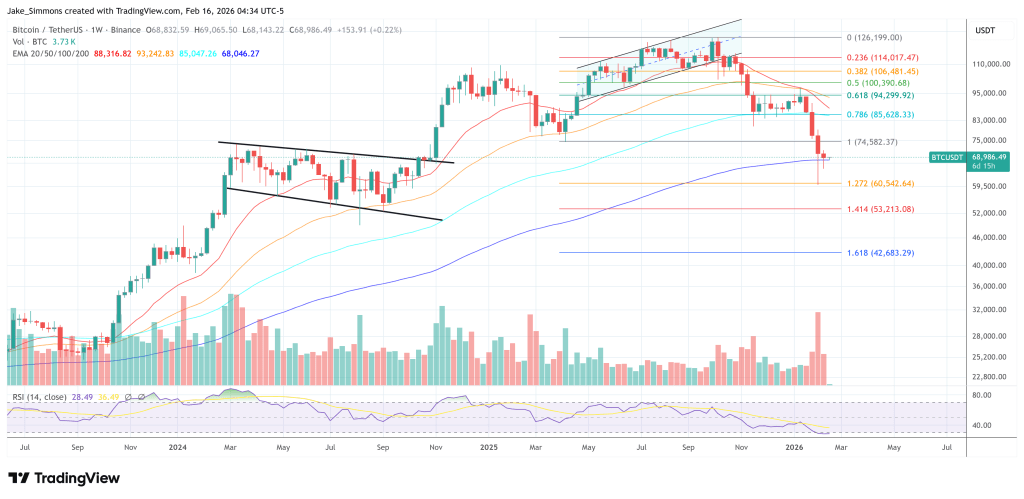
Bitcoin hovers above the 200-week EMA, 1-week chart | Source: BTCUSDT on TradingView.com

Trending Cryptos

Related Questions

QWhat is Ric Edelman's price prediction for Bitcoin by 2030, and what does he call it?

ARic Edelman predicts that it can reach $500,000 by the end of the decade, and he calls this forecast the 'conservative' case.

QWhat is the core assumption behind Edelman's $500,000 Bitcoin calculation?

AThe core assumption is that if global diversified investors allocate just 1% of the estimated $750 trillion global asset pool to Bitcoin, it would result in $7.5 trillion of inflows, driving the price to approximately $500,000 per coin.

QAccording to Edelman, what is the problem with many other bold Bitcoin price predictions?

AHe objects to their lack of transparency, stating that the problem is they are 'opaque' and do not explain the assumptions behind their forecasts.

QBesides the 1% allocation scenario, what other observation did Edelman make about current investor behavior?

AHe observed that investors who are allocating to crypto are already allocating closer to 5% of their assets, not just 1%.

QWhat price range did Edelman suggest for Ethereum, and what was his reasoning for being bullish on it?

AHe suggested Ethereum could reach between $4,000 and $10,000. His bullish reasoning is tied to stablecoin growth, arguing that since almost all stablecoins trade on Ethereum, believing in stablecoins means one must also be a supporter of Ethereum.

Related Reads

XRP Ledger Active Users Approach 200,000

The number of daily active users on the XRP Ledger is approaching 200,000, one of the highest levels in recent months. Despite XRP continuing to trade below key technical resistance, on-chain data shows accelerated network activity, suggesting growing ecosystem usage even as price momentum remains subdued. The increase to roughly 190,800 daily active users has been sustained through late July, marking a significant recovery from levels around 100,000 during the broader market correction. This rise indicates user return driven by sustained engagement rather than just speculative trading. Higher address activity typically reflects broader blockchain adoption and can boost transaction counts, payment volumes, and dApp liquidity—considered healthier indicators than price fluctuations. However, XRP's price has not mirrored this network improvement, currently trading near $1.07 and struggling to break resistance at $1.10. It remains below its 50-day and 100-day moving averages, with a recent attempt to break out of a symmetrical triangle losing momentum. The technical outlook remains mixed; while blockchain activity shows improving fundamentals, price action lacks confirmation of a broader recovery. A decisive break above the 200-day moving average near $1.21 is needed to strengthen the long-term technical outlook. Momentum indicators like the RSI, around 47, show a balanced forecast with reduced selling pressure. In conclusion, XRP Ledger user activity nears a yearly high despite the asset's price being below major technical barriers. Sustained user growth, coupled with a price recovery above key moving averages, could begin to align the technical structure with the strengthening on-chain fundamentals.

cryptonews.ru54m ago

XRP Ledger Active Users Approach 200,000

cryptonews.ru54m ago

ZEC Price Just Surpassed $490 — Here's What Fueled the Rally

ZEC Surges Past $490, Key Drivers Behind the Rally On August 3, the privacy-focused cryptocurrency Zcash (ZEC) surged nearly 5%, climbing over $20 in a six-hour rally to a session high near $494. This move helped ZEC's market cap reclaim $8 billion, solidifying its position as the most valuable privacy coin and marking an almost 8% gain for the month. While benefiting from a broader market uptrend, ZEC's outperformance was driven by significant fundamental catalysts. The primary driver was the integration by privacy infrastructure project Nym of Zcash's new shielded pool, Ironwood. This enables direct, end-to-end private payments in ZEC for network services, a landmark development for privacy-first decentralized finance. The rally coincides with renewed industry focus on privacy as digital assets mature. Industry observers note privacy is becoming the "next frontier," evolving from Bitcoin's proof-of-concept to Ethereum's programmability and Solana's scalability. Commentary highlighted that true privacy, via zero-knowledge (ZK) technology which is now production-ready, was a foundational goal for early crypto pioneers. Further momentum came from Zcash's progress in decentralized governance, launching a retroactive grant funding (RetroPGF-like) program. This shifts treasury fund distribution from closed committees to direct coin holder voting, pioneering a privacy-native funding mechanism. ZEC's surge helped push the total market capitalization of privacy-focused coins above $30 billion. Other notable gainers included NEAR, ZK, and NOCK. However, losses in coins like ZANO, ZBT, and a significant drop in last week's leader COTI partially offset the sector's overall gains.

cryptonews.ru1h ago

ZEC Price Just Surpassed $490 — Here's What Fueled the Rally

cryptonews.ru1h ago

Trading

Spot

Hot Articles

What is $BITCOIN

DIGITAL GOLD ($BITCOIN): A Comprehensive Analysis Introduction to DIGITAL GOLD ($BITCOIN) DIGITAL GOLD ($BITCOIN) is a blockchain-based project operating on the Solana network, which aims to combine the characteristics of traditional precious metals with the innovation of decentralized technologies. While it shares a name with Bitcoin, often referred to as “digital gold” due to its perception as a store of value, DIGITAL GOLD is a separate token designed to create a unique ecosystem within the Web3 landscape. Its goal is to position itself as a viable alternative digital asset, although specifics regarding its applications and functionalities are still developing. What is DIGITAL GOLD ($BITCOIN)? DIGITAL GOLD ($BITCOIN) is a cryptocurrency token explicitly designed for use on the Solana blockchain. In contrast to Bitcoin, which provides a widely recognized value storage role, this token appears to focus on broader applications and characteristics. Notable aspects include: Blockchain Infrastructure: The token is built on the Solana blockchain, known for its capacity to handle high-speed and low-cost transactions. Supply Dynamics: DIGITAL GOLD has a maximum supply capped at 100 quadrillion tokens (100P $BITCOIN), although details regarding its circulating supply are currently undisclosed. Utility: While precise functionalities are not explicitly outlined, there are indications that the token could be utilized for various applications, potentially involving decentralized applications (dApps) or asset tokenization strategies. Who is the Creator of DIGITAL GOLD ($BITCOIN)? At present, the identity of the creators and development team behind DIGITAL GOLD ($BITCOIN) remains unknown. This situation is typical among many innovative projects within the blockchain space, particularly those aligning with decentralized finance and meme coin phenomena. While such anonymity may foster a community-driven culture, it intensifies concerns about governance and accountability. Who are the Investors of DIGITAL GOLD ($BITCOIN)? The available information indicates that DIGITAL GOLD ($BITCOIN) does not have any known institutional backers or prominent venture capital investments. The project seems to operate on a peer-to-peer model focused on community support and adoption rather than traditional funding routes. Its activity and liquidity are primarily situated on decentralized exchanges (DEXs), such as PumpSwap, rather than established centralized trading platforms, further highlighting its grassroots approach. How DIGITAL GOLD ($BITCOIN) Works The operational mechanics of DIGITAL GOLD ($BITCOIN) can be elaborated on based on its blockchain design and network attributes: Consensus Mechanism: By leveraging Solana’s unique proof-of-history (PoH) combined with a proof-of-stake (PoS) model, the project ensures efficient transaction validation contributing to the network's high performance. Tokenomics: While specific deflationary mechanisms have not been extensively detailed, the vast maximum token supply implies that it may cater to microtransactions or niche use cases that are still to be defined. Interoperability: There exists the potential for integration with Solana’s broader ecosystem, including various decentralized finance (DeFi) platforms. However, the details regarding specific integrations remain unspecified. Timeline of Key Events Here is a timeline that highlights significant milestones concerning DIGITAL GOLD ($BITCOIN): 2023: The initial deployment of the token occurs on the Solana blockchain, marked by its contract address. 2024: DIGITAL GOLD gains visibility as it becomes available for trading on decentralized exchanges like PumpSwap, allowing users to trade it against SOL. 2025: The project witnesses sporadic trading activity and potential interest in community-led engagements, although no noteworthy partnerships or technical advancements have been documented as of yet. Critical Analysis Strengths Scalability: The underlying Solana infrastructure supports high transaction volumes, which could enhance the utility of $BITCOIN in various transaction scenarios. Accessibility: The potential low trading price per token could attract retail investors, facilitating wider participation due to fractional ownership opportunities. Risks Lack of Transparency: The absence of publicly known backers, developers, or an audit process may yield skepticism regarding the project's sustainability and trustworthiness. Market Volatility: The trading activity is heavily reliant on speculative behavior, which can result in significant price volatility and uncertainty for investors. Conclusion DIGITAL GOLD ($BITCOIN) emerges as an intriguing yet ambiguous project within the rapidly evolving Solana ecosystem. While it attempts to leverage the “digital gold” narrative, its departure from Bitcoin's established role as a store of value underscores the need for a clearer differentiation of its intended utility and governance structure. Future acceptance and adoption will likely depend on addressing the current opacity and defining its operational and economic strategies more explicitly. Note: This report encompasses synthesised information available as of October 2023, and developments may have transpired beyond the research period.

1.4k Total ViewsPublished 2025.05.13Updated 2025.05.13

What is $BITCOIN

Discussions

Welcome to the HTX Community. Here, you can stay informed about the latest platform developments and gain access to professional market insights. Users' opinions on the price of BTC (BTC) are presented below.

活动图片