Revealed as Soon as Today: The Entire Internet Awaits the 'Version Answer' from the 24-Year-Old 'AI Stock Prodigy'

Odaily星球日报Published on 2026-05-18Last updated on 2026-05-18

Abstract

The online investment community is eagerly awaiting the Q1 2026 13F filing from the "Situational Awareness" fund, led by 24-year-old Leopold Aschenbrenner, known as an "AI stock-picking prodigy." His fund's assets reportedly exploded from $225 million in Q4 2024 to $5.5 billion by Q4 2025, making its quarterly disclosures a major market signal. The filing, due by May 15th, is now three days late. Analysts suggest three possibilities: 1) A routine delay with SEC processing, meaning the report could be published imminently. 2) The fund has applied for "confidential treatment" from the SEC, allowing it to hide new, large positions it is still accumulating—a move that would spark intense speculation. 3) The fund's holdings fell below the $100 million reporting threshold, though this is considered highly unlikely given its recent size. The reason for the delay will become clear within days. If it's a standard delay, the portfolio will be revealed shortly. If it's confidential treatment, the hunt will be on to decipher what major AI-related asset Aschenbrenner is secretly building a position in.

Original | Odaily Planet Daily (@OdailyChina)

Author | Azuma (@azuma_eth)

Remember Leopold Aschenbrenner? The 24-year-old 'AI prodigy' we introduced in the article "SBF's Junior, Who Turned $225 Million into $5.5 Billion in One Year".

Leopold Aschenbrenner worked at FTX's Future Fund in 2022 and stayed with the team until FTX's collapse. In 2024, Leopold Aschenbrenner wrote a 165-page mega-paper titled "Situational Awareness: The Decade Ahead" and in the same year founded a fund of the same name, Situational Awareness LP, where he serves as Chief Investment Officer.

Situational Awareness LP focuses on investment opportunities in the AI industry chain. The fund's publicly disclosed holdings were 'only' $225 million in Q4 2024, but in the Q4 2025 holdings disclosure released this February, this figure had skyrocketed to $5.5 billion. This explosive investment return performance has also made Leopold Aschenbrenner and Situational Awareness LP highly renowned, becoming one of the most watched AI investment trends on the internet.
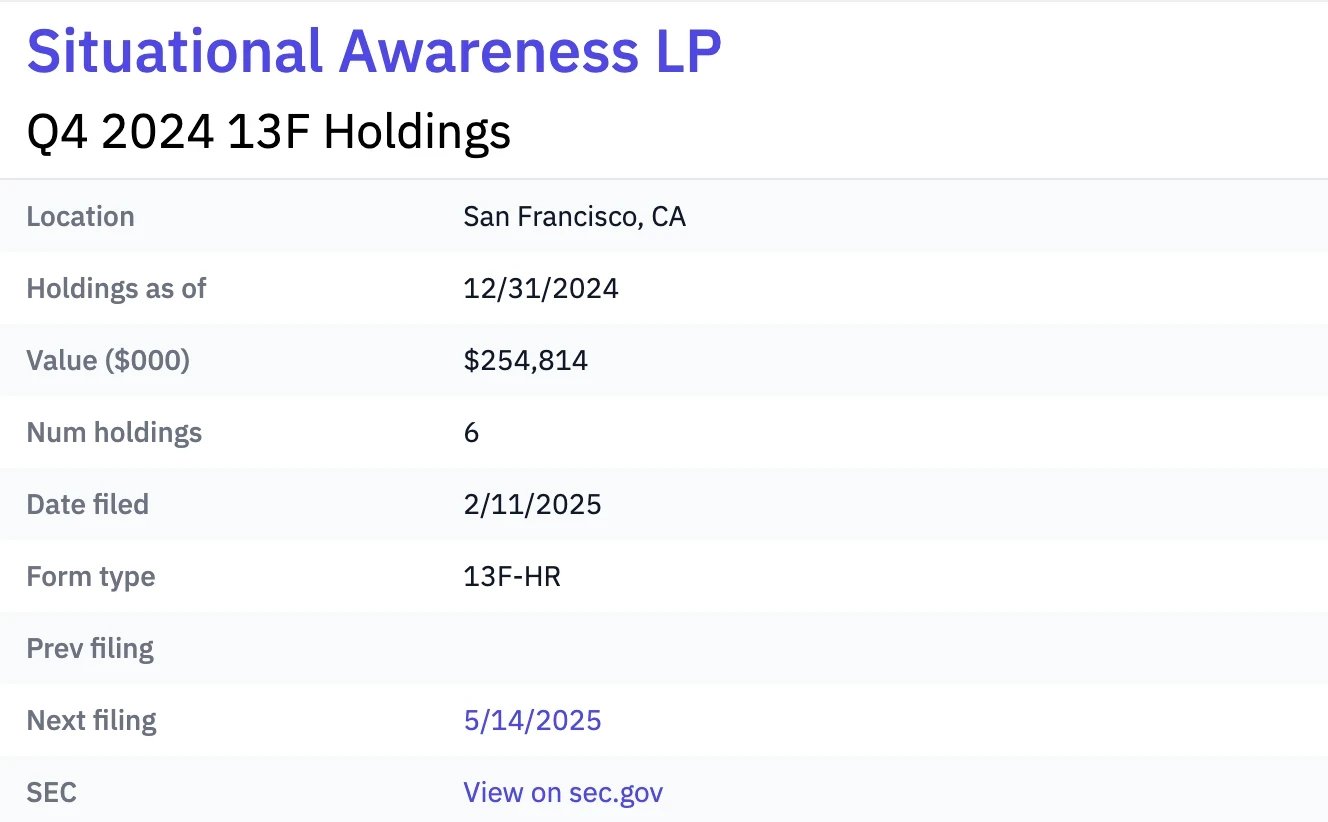
Now, Situational Awareness LP is approaching the critical window for a new round of holdings disclosure (13F). Since last week, the entire internet has been collectively waiting, anticipating the fund's 'version answer' on how to position for AI at present, but as of this writing, Situational Awareness LP's disclosure has still not arrived.

13F refers to the quarterly disclosure documents mandated by the U.S. Securities and Exchange Commission (SEC) for funds with assets under management exceeding $100 million. SEC requires that funds meeting the disclosure threshold must submit this document within 45 days after the end of each calendar quarter. The fund must focus on disclosing its holdings in U.S. listed stocks, call/put options, convertible bonds, and specific ETF positions at the end of the previous quarter.

It is already May 18th, three days past the Q1 2026 disclosure deadline of May 15th. Over the past few days, several sovereign wealth funds, university endowments, and traditional financial institutions have disclosed their Q1 13F holdings reports, but the market is still waiting for Situational Awareness LP's disclosure.

Based on various market analyses, the following three situations may have affected Situational Awareness LP's 13F disclosure progress.

The first possibility is that Situational Awareness LP may have submitted the file to the SEC after 5:30 PM on May 15th itself. Since that day was a Friday, the SEC did not have time to process it, so the document would need to be published on the SEC's website the following Monday before the public can see it.

This is the mainstream view in the market. If this is the case, we are expected to see Situational Awareness LP's 13F filing later today (or tomorrow at the latest).

The second possibility is that Situational Awareness LP applied for confidential treatment from the SEC. This is a legal mechanism provided by the SEC, allowing large funds to delay the public disclosure of their holdings information that is still being accumulated, with delays lasting up to a year in some cases.

Generally, funds apply for confidential treatment for only one reason — they are building a position large enough that if the market learns about it prematurely, it would move the price against them before they finish accumulating. If this is the reason this time, it means Leopold Aschenbrenner is quietly accumulating a significant asset and temporarily does not want the market to know. This would undoubtedly warrant more attention from the market.

The third possibility is almost impossible, which is that Situational Awareness LP significantly reduced its holdings in the past quarter and has dropped its holding size below the 13F disclosure threshold ($100 million). However, considering the fund held $5.5 billion last quarter, this scenario is extremely unlikely.

In summary, we just need to wait patiently for another 1 to 2 days to learn the real reason for Situational Awareness LP's delayed disclosure this time.

If it's the first case, we will bring you an analysis of the changes in holdings as soon as the 13F is released. If it's the second reason, the entire internet will truly be on edge — what exactly is Leopold Aschenbrenner hoarding? That will be the moment for all kinds of investigative experts to shine.

Related Questions

QWho is the main subject of the article and what is his fund called?

AThe main subject is Leopold Aschenbrenner. He is the 24-year-old 'AI stock god' who founded and serves as the Chief Investment Officer of the Situational Awareness LP fund.

QWhat was the growth in Situational Awareness LP's publicly disclosed holdings from Q4 2024 to Q4 2025?

AThe fund's publicly disclosed holdings grew explosively from $225 million in Q4 2024 to $5.5 billion in Q4 2025.

QWhat is a 13F filing, and what triggers the requirement to file it?

AA 13F filing is a mandatory quarterly report required by the U.S. SEC for investment managers with over $100 million in assets under management. It discloses their holdings of U.S. exchange-traded stocks, options, convertible notes, and certain ETFs.

QWhat are the three possible reasons discussed in the article for the delay in Situational Awareness LP's Q1 2026 13F filing?

A1. Late submission on the Friday deadline (May 15th), with SEC processing expected on the following Monday. 2. The fund applied for confidential treatment to hide a large, ongoing position. 3. The fund's holdings fell below the $100 million reporting threshold, which is considered highly unlikely.

QWhy would a fund apply for confidential treatment on a 13F filing, according to the article?

AA fund would apply for confidential treatment to delay public disclosure of a large position they are still accumulating. This prevents the market from moving the price against them before they finish building the position.

Related Reads

STRC Breaks Below $95: Why Does It Continue to Depeg? Is There Default Risk?

"STRC Falls Below $95: Why the Persistent Depegging and Is There Default Risk?" The article discusses the recent decline in the price of STRC, a perpetual preferred stock issued by Strategy (MSTR) designed to trade around a $100 par value. As of publication, STRC traded at $94.65, raising market concerns. STRC is described as a high-yield cash flow product, offering an 11.50% annual dividend paid monthly. Its "preferred" status grants it priority over common stock for dividends and in liquidation. Key reasons cited for the price depegging include: 1. **Bitcoin's Price Drop:** MSTR's assets are heavily tied to Bitcoin (BTC), which fell over 21% from its recent high, pressuring all Strategy-related products. 2. **Competitive Pressure:** Rival Strive Asset Management's similar product, SATA, offers daily dividends and has maintained its $100 par value with a ~13% yield. In response, Strategy has proposed changing STRC's dividend frequency from monthly to bi-weekly, pending shareholder vote. 3. **Technical Selling:** A break below $100 may have triggered algorithmic selling and stop-losses, exacerbating the decline. Regarding default risk, the analysis suggests it is currently low. Strategy founder Michael Saylor confirmed the June 2026 dividend rate remains at 11.50% with no cuts or suspensions. The company's massive reserve of 843,706 BTC provides a significant backstop for its obligations. Industry opinions are mixed. Some analysts view the BTC holdings as reliable support for dividends, while critics like Peter Schiff warn of potential dividend cuts leading to price crashes and lawsuits. Others highlight inflation risk and the company's ability to reduce dividends without a formal default. In summary, STRC's drop is attributed to BTC volatility, competition, and technical factors. While immediate default risk appears contained, the product faces challenges from market conditions and competitive dynamics.

marsbit14m ago

STRC Breaks Below $95: Why Does It Continue to Depeg? Is There Default Risk?

marsbit14m ago

AI Trading Cools, South Korean Stocks Plunge 1.8%, Spot Gold Rises 1%, Bitcoin Dives

A sell-off in AI-related stocks, triggered by Broadcom's disappointing earnings forecast, sent shockwaves through global markets. South Korea's KOSPI led Asia's decline, plunging 1.8% as the risks from concentrated chip stock gains and surging leveraged investments came to the fore. The tech-heavy Nasdaq 100 futures fell 0.5% following Broadcom's 14% after-hours plunge, which signaled a slower-than-expected transition to AI clients. This pullback extended Wall Street's weakness, halting the S&P 500's nine-day rally amid hawkish Fed signals and renewed Middle East tensions. South Korean authorities convened an emergency meeting, pledging "immediate measures" against market volatility and warning of record-high stock margin debt. The adjustment rippled across assets: Bitcoin fell to around $64,000, its lowest since February, while safe-haven gold rose 1% on bargain hunting. Oil prices dipped on Middle East ceasefire news. Market analysts noted the sell-off was driven by profit-taking after massive gains, particularly in chip stocks like Samsung and SK Hynix, which now dominate the KOSPI. Wall Street banks are divided on Korea's outlook, with Goldman Sachs raising its target while Citigroup and others warn of overvaluation and a potential bubble. Bridgewater's Ray Dalio noted that great technological shifts often create bubbles. Meanwhile, Fed officials' hints at potential future rate hikes added to the cautious mood ahead of key U.S. jobs data.

华尔街日报40m ago

AI Trading Cools, South Korean Stocks Plunge 1.8%, Spot Gold Rises 1%, Bitcoin Dives

华尔街日报40m ago

Seeking Alpha's Hot Article: Why Might the U.S. Stock Market Crash in June?

In a recent Seeking Alpha article, financial professor and analyst Damir Tokic argues that the US stock market may be poised for a significant crash in June 2026. The core thesis centers on a "mega-bubble" in equities, particularly within the technology sector, which has driven the S&P 500 to near-record valuations, with a Shiller P/E ratio exceeding 40—a level comparable to the 2000 dot-com bubble. Tokic identifies two primary catalysts for a potential collapse. First, he points to unsustainable market exuberance fueled by what he terms the "Trump Stimulus"—massive AI capital expenditure by tech giants, which he believes is politically driven and cannot last. Second, and more urgently, he highlights the escalating Iran war as a critical threat. The ongoing closure of the Strait of Hormuz has created a severe global energy supply crunch. Strategic petroleum reserves are projected to hit critically low operational levels by June, potentially causing oil prices to spike above $200 per barrel and triggering a severe, supply-driven inflationary shock. This scenario, Tokic warns, would force the Federal Reserve's hand. Despite currently maintaining a dovish bias, the Fed would likely be compelled to officially pivot to a hawkish stance at its June FOMC meeting to combat soaring inflation and bond yields. He contends that such a shift—or even a failure to act, which would destroy Fed credibility—could be the trigger that punctures the market bubble. The resulting downturn, he concludes, could rival the bear markets of 2000 and 2008, advising investors to prepare for a major correction.

marsbit1h ago

Seeking Alpha's Hot Article: Why Might the U.S. Stock Market Crash in June?

marsbit1h ago

Trading

Spot
Futures

Hot Articles

Discussions

Welcome to the HTX Community. Here, you can stay informed about the latest platform developments and gain access to professional market insights. Users' opinions on the price of AI (AI) are presented below.

活动图片