$RAVE TGE Countdown: When Clubbing Becomes On-Chain Economic Behavior, Web3's Breakout Moment Truly Arrives

深潮Published on 2025-12-11Last updated on 2025-12-11

Abstract

RaveDAO, a leading Web3 electronic music event organizer, is emerging as a decentralized global entertainment ecosystem. Having successfully hosted over 20 events worldwide with more than 100,000 participants and 80 million online impressions, it has generated $3 million in revenue in 2025 through diverse streams including ticket sales, sponsorships, and NFT memberships. The project is launching its ecosystem token, $RAVE, to deepen connections among participants, artists, brands, and fans. The token will serve as the economic backbone for a participatory economy, enabling functions such as staking for licensing rights, event payments, governance voting, and community rewards. With a total supply of 1 billion tokens, its distribution is heavily community-focused, and a deflationary mechanism is supported by using a portion of event profits to buy back and burn tokens. RaveDAO distinguishes itself by lowering the barrier to Web3 through seamless user experiences, like effortless NFT ticket minting and fiat payment options, and by building a culturally-driven, open ecosystem. Its expansion plan includes 50 global chapters by 2027. The recent sold-out Genesis NFT membership mint further highlights strong community support as RaveDAO positions itself at the intersection of culture, entertainment, and Web3 adoption.

Author: Deep Tide TechFlow

Introduction

When I say "Web3 has its own Tomorrowland," you surely know I'm talking about RaveDAO.

Tomorrowland spent 20 years, leveraging immersive stages, artistic narratives, and top-tier electronic music, attracting over 400,000 fans annually for offline participation, with its YouTube channel accumulating over 2.2 billion views, and its revenue consistently remaining at the billion-dollar level, making it the pinnacle sample of the traditional entertainment industry.

As the Web3 event with the highest scale, largest participation, best atmosphere, and widest reach, RaveDAO is still in its early stages, yet has already successfully hosted 20+ high-quality events globally, attracting over 100,000 on-site participants, distributing over 70,000 on-chain NFT tickets, achieving 800 million total online exposures, and reporting public revenue of $3 million USD in 2025, including ticket sales, brand and public chain sponsorships, IP licensing and cooperation revenue sharing, as well as NFT and membership systems, demonstrating diversified revenue sources.

Faced with these impressive figures, many exclaim: RaveDAO has achieved the positive revenue that most Web3 projects desperately pursue, solely by organizing events, proving the sustainability of its business model.

But it doesn't stop there.

On November 10, 2025, RaveDAO announced the upcoming launch of its ecosystem token $RAVE, to more closely connect participants, producers, artists, brands, sponsors, fans, and other roles within the ecosystem, and on November 11th, initiated the minting of the Genesis Membership NFT membership card, starting the construction of a verifiable on-chain membership identity system to better reward and empower early participants.

A series of major announcements attracted attention and discussion from industry leaders and KOLs who have participated in its events, while RaveDAO's ambitions and direction for the future have also become clearer:

Music is never just an accelerant for atmosphere, but an efficient medium for quickly establishing deep connections between people;

Web3 is not just technological innovation, but the underlying driving force for achieving a positive ecosystem cycle under the model of incentivized participation and community co-construction;

And RaveDAO is not an event company, but is rapidly growing into an open cultural ecosystem built with entertainment as the driving force, leading the key infrastructure for Web3 to truly move towards implementation and breaking into the mainstream.
Why Are Web3 People All Scrambling for RaveDAO Tickets?

For Web3 folks, getting to know RaveDAO probably happened very naturally.

From 2025 to now, RaveDAO has left its mark in almost every "city where crypto people gather": tickets for each event sell out upon release, venues are packed, social media buzzes with organic posts afterwards, and it was described by the Wall Street Journal as a "typical case of bringing Web3 into reality through entertainment".

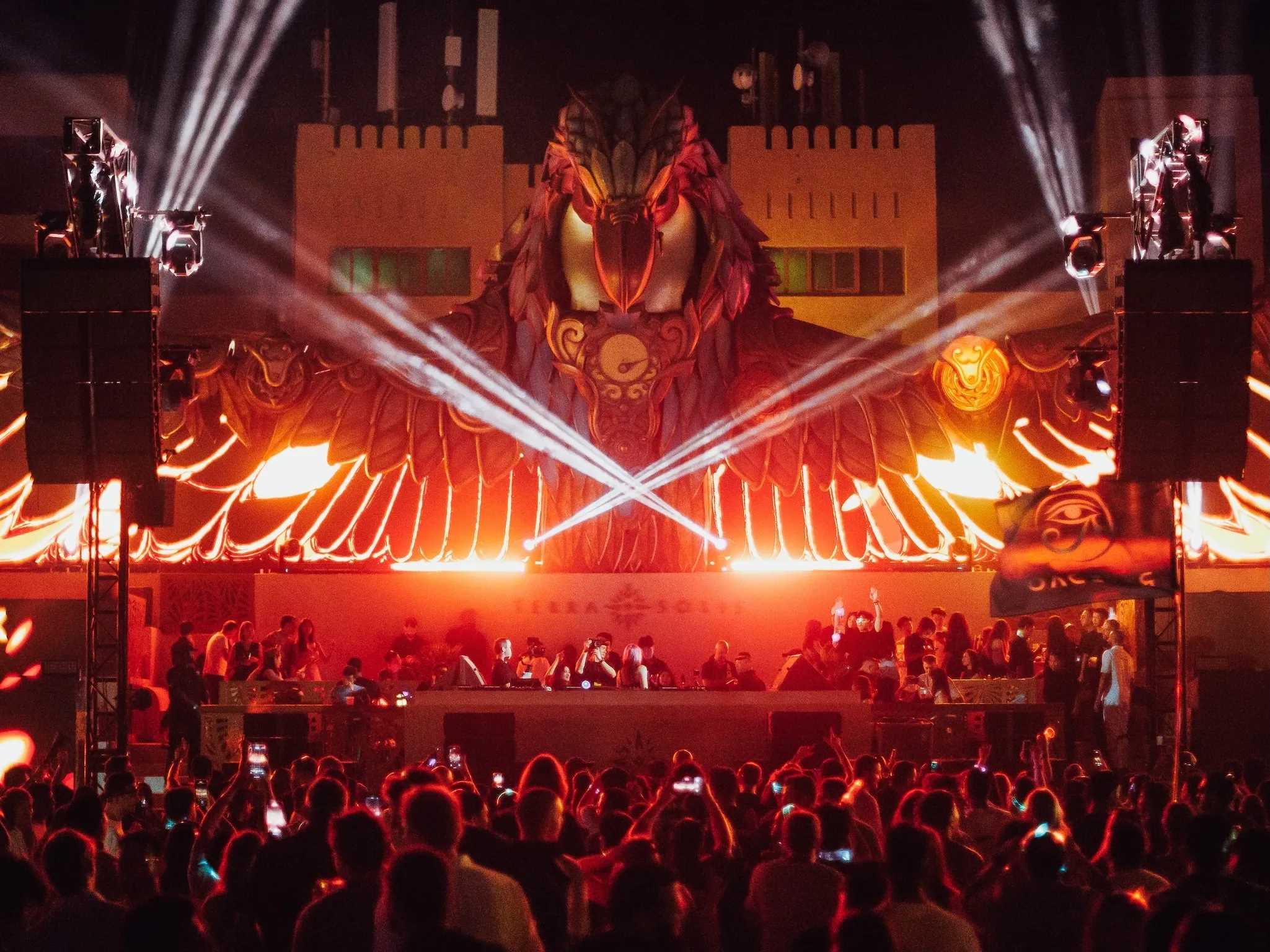
In Dubai, RaveDAO partnered with Tomorrowland's desert branch Terra Solis to set up a Techno night venue in the dreamy complex amidst the sea of sand. The event theme "Female Empowerment and Inclusion" was decided by DAO community voting, with world-class female DJs like Lilly Palmer, Pretty Pink, and Jiayu taking turns on stage, attracting over 4,000 Web3 pioneers and music lovers from around the globe, with related content achieving over 30 million online exposures.

In Korea, RaveDAO joined hands with WLFI to host a grand party blending EDM, K-Pop, and Web3 payments, attracting over 2,000 participants on-site. This event was not only WLFI's first offline event but also the world's first offline application case for USD1, where participants could use USD1 to purchase tickets, book tables, pay for drinks, etc., truly pulling crypto payments from the wallet interface into real-world scenarios.

And in Singapore, many still have fresh memories of the recently concluded ENL1GHT Festival, inviting world-class DJs including Chris Avantgarde, Morten, Doozie, Vintage Culture to collectively take the stage. Over 5,000+ people flooded into the venue, a converted old power plant, that night, with over 200 million online exposures, becoming the most unforgettable night for many during the F1 & TOKEN2049 itinerary.

Beyond this, in Miami, Amsterdam, Brussels, Bangkok, Hong Kong... RaveDAO's event footprint spans major global cities.
Behind the breakout success lies RaveDAO team's极致把控 (ultimate control) over event execution:

From Dubai's desert utopia to Singapore's abandoned power plant, every RaveDAO event location strives to match the event theme, each stage setup is uniquely crafted, presenting a visual feast through art installations, light shows, and极致 stage effects;

From professional sound systems and world-class DJ lineups to carefully curated music libraries, RaveDAO ensures every note has the power to penetrate the heart, providing an极致 auditory experience where every participant quickly gets into the state, embodying "music as an emotional engine";

In the utopia created by lights, music, fine drinks, and food, participants fully immerse themselves, moving their bodies, releasing emotions, expressing views, achieving deeper emotional connections between people through emotional resonance.

Behind the most successful Web3 music festival lies the Web3 team that knows how to "play" the best.

The RaveDAO team is known for being "small but elite," gathering a group of key figures including Crypto OGs, top Web3 investors, and long-time executives from the entertainment industry, which has brought RaveDAO a series of advantages:
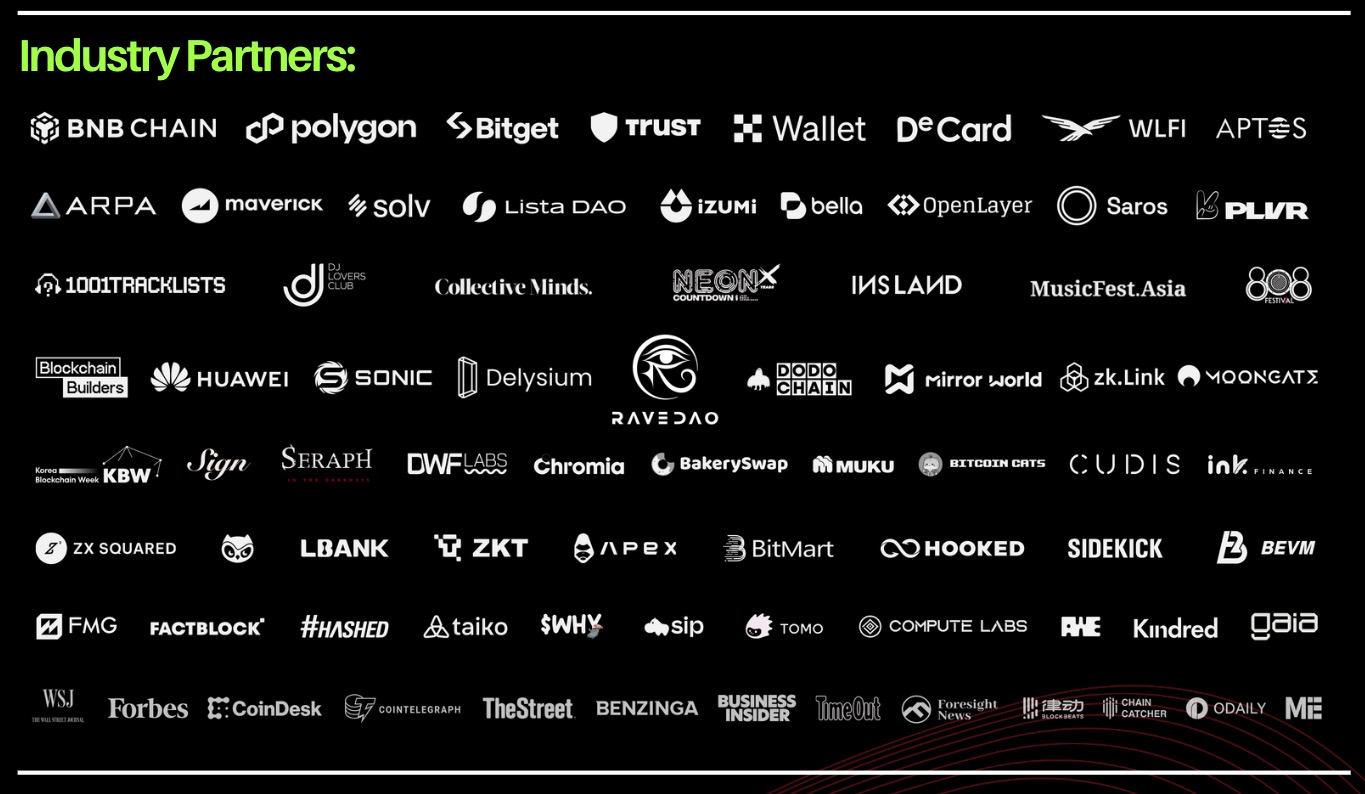
Powerful resource mobilization capability: Partners cover 30+ mainstream entertainment brands, including Tomorrowland Terra Solis, 1001Tracklists, Amsterdam Music Festival, INS Land, etc.; collaborating with over 50 artists, including Vintage Culture, Don Diablo, Chris Avantgarde, Lilly Palmer, MORTEN, Bassjackers, GENESI, and other global DJs; while deeply cooperating with Web3 projects like BNB Chain, WLFI, OKX, Bybit, Bitget, Polygon, Aptos, Base.

Execution capability: Complex venues, international artists, sponsorship systems, multi-chain technical integration, all while ensuring participant experience—this is a hard battle for any execution team. RaveDAO has proven itself with one "flawless event" after another.

Broad and profound industry influence: Project teams, KOLs, and creators are all willing to appear as "participants" at RaveDAO events. This kind of organic spread is far more effective than any marketing campaign.

Simultaneously, the敏锐目光 (keen insight) honed over years in the industry has made the team deeply aware from the very beginning of RaveDAO's birth:

What RaveDAO can do is absolutely not limited to just events.

Culture-Driven Open Ecosystem, Letting Users Experience Web3 Barrier-Free

For a long time, there has been a mismatch in expression between the Web2 and Web3 worlds:

The technological and mechanism advantages of Web3 are often packaged in cold code, obscure whitepapers, and products lacking a sense of scene;

This leads to, for most users, especially Web2 users, Web3 seeming to always remain at the "conceptual" level, not only with high comprehension barriers and difficult interaction operations, but also almost no scenarios in real life to help us truly build a vivid perception of Web3.

This is what we often call Web3's lack of positive externality, i.e., the lack of ability and scenarios for mass adoption.

However, the entertainment and cultural industry, represented by music, is an excellent entry point to help Web2 users better perceive Web3.

On one hand, unlike the cold and obscure nature of technology, the感染力 (infectious power) of culture is immediate, intuitive, and emotional, possessing the power to resonate across regions, countries, languages, and races,更能调动 (more able to mobilize) users' sense of participation, belonging, and enthusiasm for value sharing.

On the other hand, in an era increasingly focused on spiritual world development, people's willingness to pay for culture is becoming more apparent. From music festival tickets to peripheral purchases to art collection, cultural consumption has long become an indispensable part of modern life and is a rapidly developing multi-billion dollar赛道 (sector) in recent years.

Most importantly, under the centralized model, the definition and distribution rights of culture are monopolized by platforms, and people are already tired of passively accepting platform cultural output, while creators are increasingly dissatisfied with profits being monopolized by platforms. The future form of the cultural industry should be more in line with collective will, more encouraging of co-creation, and more focused on fair value distribution, which aligns perfectly with the decentralized spirit of Web3.
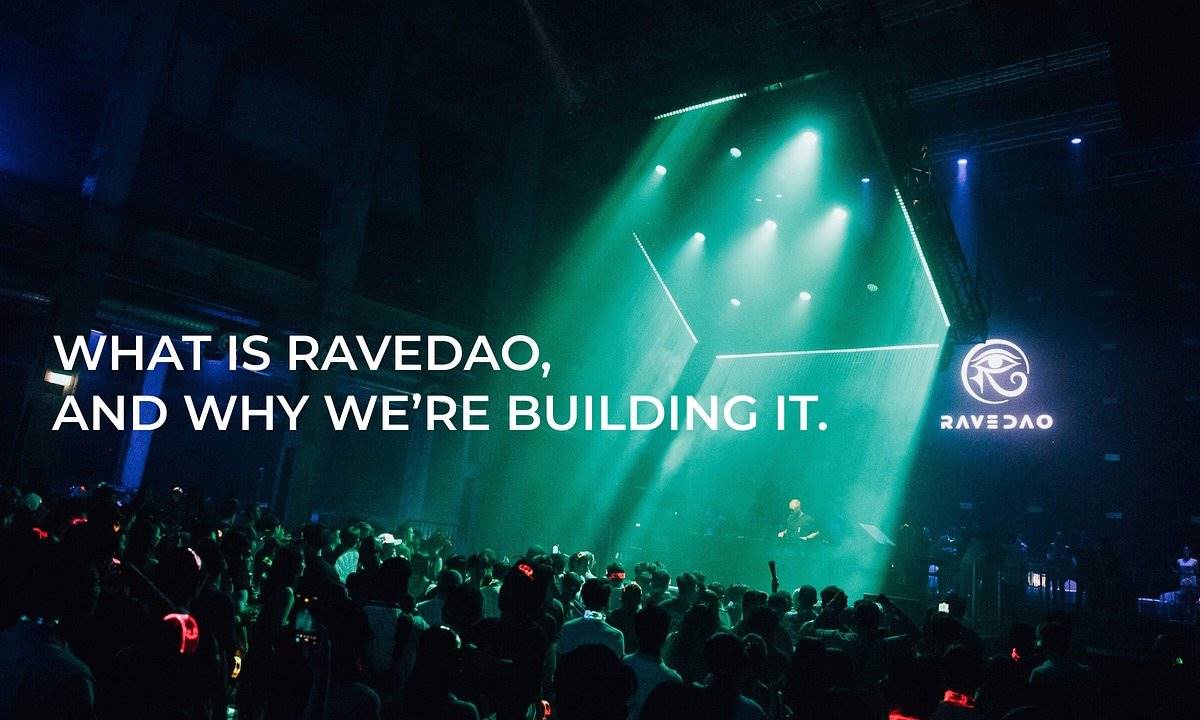
Therefore, when we observe carefully, we can see that RaveDAO has never operated with the mindset of "hosting events," but rather with the logic of "building an ecosystem":

Using culture as the core carrier, decentralization as the main operational form, and Web3 technology to empower products, attracting all relevant parties including audiences, artists, brands, production teams, public chains, wallet projects, payment systems, etc., to co-build an open ecosystem of "real scenarios + culture-driven + incentivized contributions".

As summarized in the RaveDAO whitepaper, RaveDAO integrates three key modules: "a decentralized global entertainment brand, a community-driven cultural network, and an open sandbox for a participation economy," truly merging real-world entertainment with Web3 technology, allowing everyone to participate.

Even when hosting events, RaveDAO adopts a "community governance-driven decentralized brand co-construction" model.

Drawing inspiration from the "TED and TEDx global expansion model," RaveDAO events are divided into two types: RaveDAO flagship events and RaveDAOx community events:

RaveDAO flagship events are planned by the core team, ensuring content and production standards, setting a benchmark for event quality, but the community can participate in decisions regarding event themes, host cities, and charitable distribution of event income through governance voting;

RaveDAOx events are initiated by communities around the world. Each community can apply to use RaveDAO's IP, independently deciding on the venue, lineup, thematic style, and charitable direction, during which the RaveDAO team provides brand standards, promotional resources, and technical support.

It is worth mentioning that RaveDAO event profits have already, through DAO governance decisions, empowered multiple public welfare projects, including funding for 400+ Nepalese cataract patients to regain sight, and supporting 150 meditation and psychological healing projects in Seattle, USA.

Through the linkage between flagship and community events, each event acts like a node, not only achieving brand exposure with higher quality and lower cost but also rapidly building a distributed global entertainment network during global expansion.

Even with ticketing, RaveDAO completes the transition from a "one-time entry pass" to a "continuously enriched Web3 identity system" by introducing an NFT system.

When a user purchases an event ticket, the system immediately mints it into an NFT, permanently existing on the chain. We can think of the NFT as a kind of "on-chain passport," an identity system that can record the owner's entire entertainment journey: every time the user participates in a RaveDAO event, a new stamp is added to the passport, containing information about which city they were in, what event they attended, and in what capacity. As more "visa stamps" are added to the passport, the user's on-chain identity becomes richer and more valuable.

In this way, as more "visa stamps" are added, the user's on-chain identity gradually takes shape, and the user profile becomes clearer. Based on this identity system, RaveDAO's open cultural ecosystem has more space to "do something," such as social connections, precise airdrops of benefits, membership system construction, etc.

Even in letting users enjoy the advantages brought by Web3 technology, RaveDAO pursues "making being on-chain as simple as breathing":

For example, as the first consumer-level scenario case integrating the x402 protocol, RaveDAO is committed to making the entire process of users experiencing x402 payments "seamless": through cooperation with ticketing and data system partner PLVR, users only need to register with an email to automatically generate their first wallet in their life, and besides cryptocurrency payments, it also supports direct payment using Alipay, WeChat, credit cards, or Apple Pay.

After payment is completed, the system automatically mints the NFT ticket, and the wallet address is automatically verified for entry. All the technology is completed in the background, and the front-end experience is as simple as ordinary ticket purchasing. At RaveDAO, technology is no longer a barrier but is hidden within the product, allowing users to enjoy the advantages of Web3 without feeling like they are "going on-chain."
Even with participation, RaveDAO is not "participation ends here," but is building an entertainment-driven "participation economy" cycle.

RaveDAO is open, welcoming anyone to join, and has already attracted over 70,000 users to gather in the ecosystem through breakout events, cultural resonance, lowering barriers, and other initiatives;

Simultaneously, RaveDAO clearly states that "participation" itself has value, it is the basic action of co-building the ecosystem, and RaveDAO is committed to ensuring that every action of participants in the ecosystem, including buying tickets, creating, cooperating, sharing, voting, etc., can be honestly recorded and rewarded. Fair and transparent distribution is not only an important factor in maintaining the healthy operation of the ecosystem but will also further attract participation.

And this is the core mission of the $RAVE token, born as a "proof of participation."

$RAVE: A Key Step in Closing the "Participation Economy" Loop

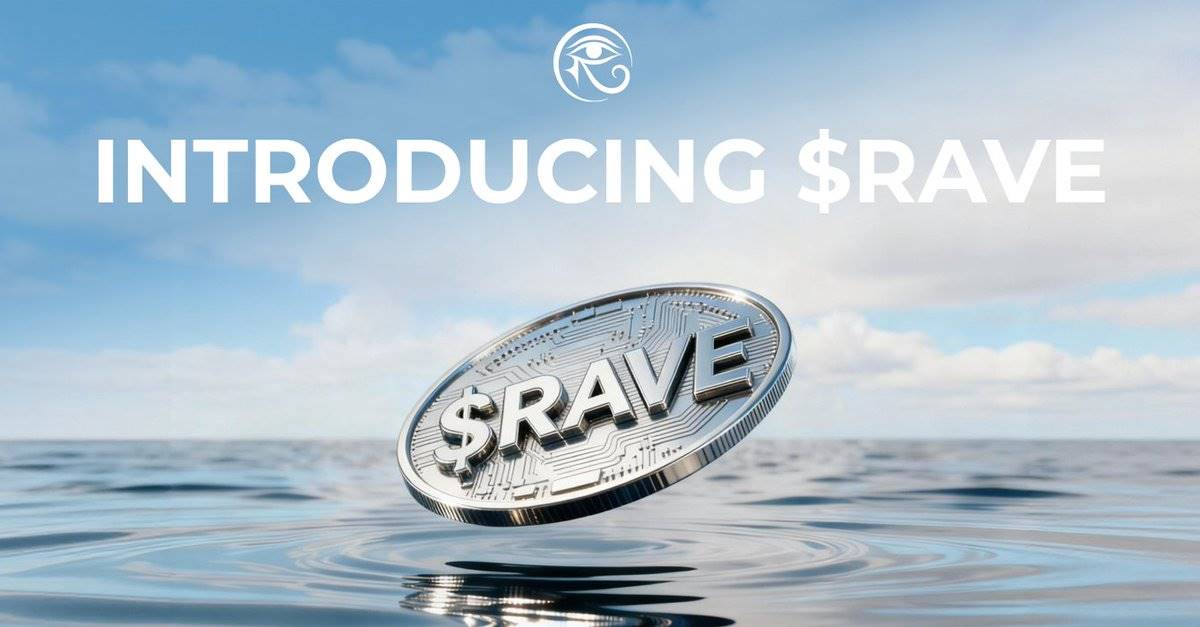
On November 10, 2025, RaveDAO announced the upcoming launch of its ecosystem token $RAVE, aiming to connect artists, organizers, and fans through token economics, promoting a decentralized entertainment ecosystem of "culture as protocol."

The $RAVE token connects every branch, event, creator, and participant in the ecosystem and provides rewards for every contribution, serving as the basic economic unit of RaveDAO's open cultural ecosystem.

As proof of participation, the $RAVE token naturally has rich utility in multiple scenarios within the RaveDAO ecosystem.

In terms of B2B functionality, the $RAVE token can:

  • Staking Authorization: Event organizers stake $RAVE tokens to obtain a franchise for RaveDAO's intellectual property, with operations following global standards inspired by the Ultra Music model.

  • Chapter Launch: Launch new "Road to RaveDAO" chapters through DAO-approved grants.

  • Supplier Qualification Certification: Partners stake $RAVE tokens to become RaveDAO-certified suppliers.

  • Artist and Label Collaboration: Artists stake $RAVE tokens to launch digital collectibles or Web3 collaboration projects under the RaveDAO brand.

In terms of B2C functionality, the $RAVE token can:

  • Stake $RAVE to Unlock Exclusive Benefits: Including VIP levels, artist meet-and-greets, and priority event entry.

  • Digital Collectibles: Participate in limited edition artist releases, collaboration projects, and NFT issuances.

  • Payment: Use $RAVE to purchase tickets, book tables, and for on-site consumption at flagship and chapter events.

  • Community Rewards: Earn $RAVE by participating in content creation, referrals, and interactions.

In terms of DAO governance functionality, the $RAVE token can:

  • Voting Rights: Decide on locations, artist lineups, venue selections, and charitable donation allocations.

  • Chapter Proposals: Submit and vote on proposals for new "Road to RaveDAO" chapter launches.

  • Ecosystem Grants: Directly fund artists, community builders, and partner projects.

Diverse demand from the ecosystem赋予 (endows) the $RAVE token with its underlying value logic, and the "community first" principle in token economic distribution further attracts more users to join the ecosystem, creating more on-chain interactions and continuously empowering the value of the $RAVE token.

According to the introduction, the total supply of $RAVE is 1 billion tokens, adopting a pure community-driven model, emphasizing sustainability and community benefits. The specific allocation rules are as follows:

  • Community 30%: Includes governance grants, incentives, rewards, etc., with a 12-month lock-up period and 36-month linear vesting.

  • Ecosystem 31%: Dedicated to promoting ecosystem construction, partner activities, and infrastructure improvement. 15.03% unlocked at TGE, the remaining 15.97% follows a 12-month lock-up period and 36-month linear vesting.

  • Initial Airdrop 3%: Aims to reward early participants and contributors, 100% unlocked at TGE.

  • Foundation / Grants / Impact Fund 6%: Includes charitable causes and long-term reserve funds, etc., with a 12-month lock-up period and 36-month linear vesting.

  • Team 20%: Aims to reward the founding team, core contributors, strategic advisors, and long-term partners, with a 12-month lock-up period and 36-month linear vesting.

  • Early Supporters 5%: Aims to reward early supporters and partners, with a 12-month lock-up period and 36-month linear vesting.

  • Liquidity Allocation 5%: Aims to ensure smooth market trading, 100% unlocked at TGE.
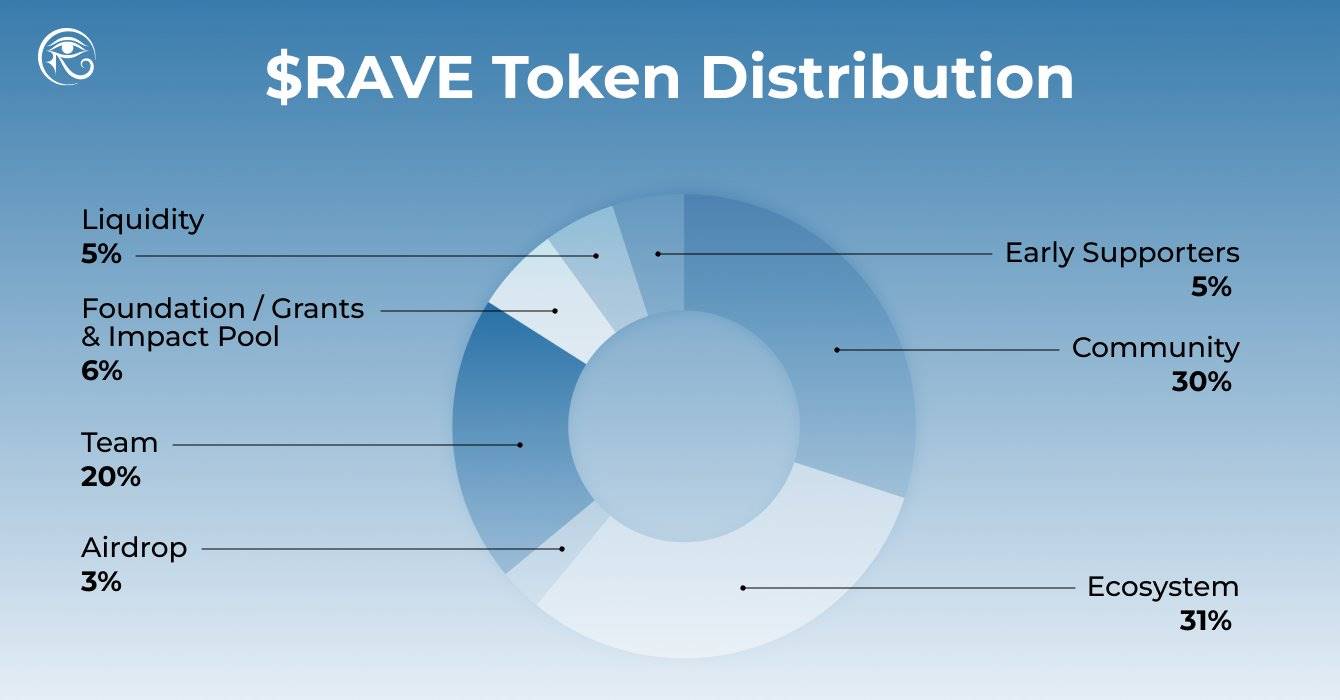
We can see that the 3% airdrop will be 100% unlocked at TGE, while stakeholders like the team and early supporters have a 12-month lock-up period and 36-month linear vesting mechanism, further reflecting the project's determination for long-term construction.

Additionally, we can see that the $RAVE token follows a deflationary model: A portion of event profits will be used to buy back and burn $RAVE.

We know that, based on real scenarios, real demand, and real users, RaveDAO has impressive revenue performance, with公开收入 (public revenue) reaching $3 million USD in 2025, sourced from:

  • Event and Ticketing Revenue: Ticket and beverage sales from global flagship events and various RaveDAOx events;

  • Brand and Ecosystem Cooperation: Strategic sponsorships from partners including BNB Chain, Polygon, Bitget, OKX, Base, Aptos, and DeCard;

  • Derivative Products and IP Licensing: Including brand collaborations, top artist partnerships, and the upcoming Genesis Membership Pass (NFT membership pass).

Based on existing event and cooperation schedules, RaveDAO expects revenue to reach $6 million USD in 2026 and break through $12 million USD in 2027. Positive revenue赋予 (endows) greater token buyback and burn capability, which will further enhance the community's recognition of the $RAVE token's value.

TGE Countdown: Accelerating Global Layout and Ecosystem Implementation

In the moment无限接近 (infinitely close to) TGE, the Genesis Membership NFT minting launched by RaveDAO on November 11th appears particularly noteworthy. The官方 (official) also clearly stated that the RAVE积分 (points) contained in the NFT will be convertible into $RAVE tokens in the future, and holding the NFT automatically enters the holder into the Genesis Rewards global lottery program, with prizes including RAVE airdrop rewards, a Tomorrowland double flight and ticket package (worth $5,000 USD), and a RaveDAO lifetime VIP pass, among others.

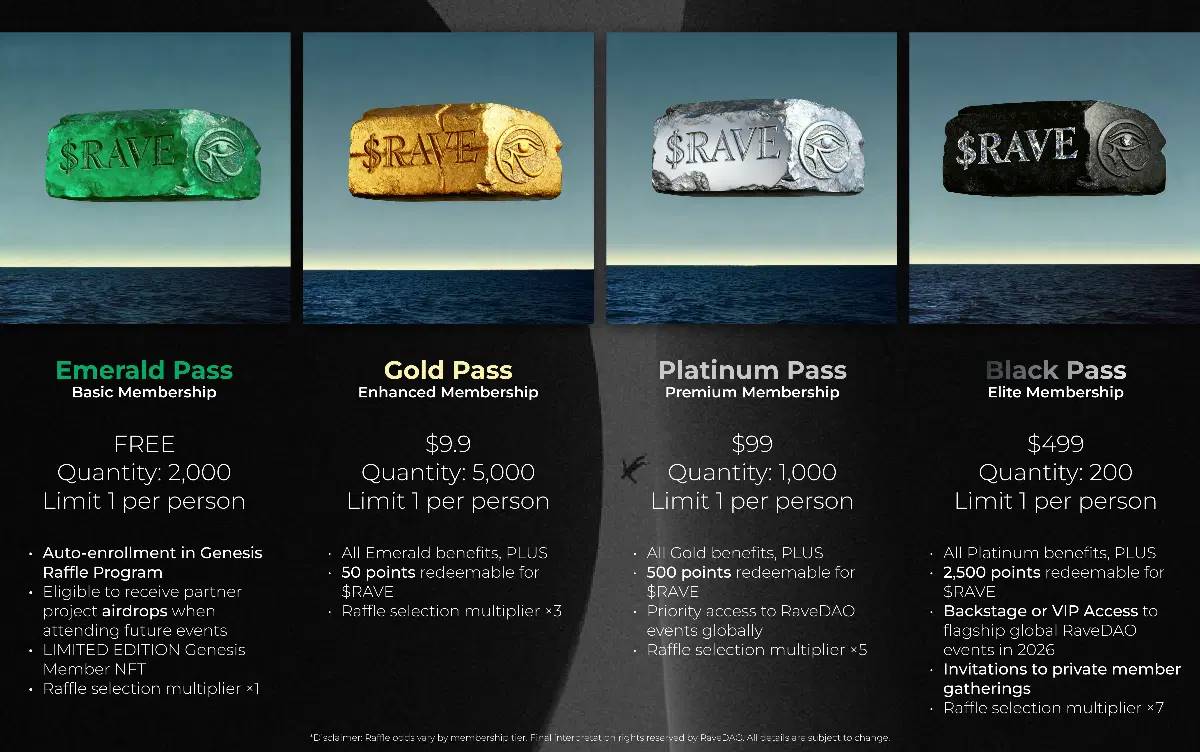
This issuance features four membership tiers:

  • Emerald Pass: Free entry, connect with the global community and participate in the lottery;

  • Gold Pass: Minting price 9.9 U, additionally获得 (obtains) 50 RAVE points, 3x lottery weight, and other benefits;

  • Platinum Pass: Minting price 99 U, additionally获得 (obtains) priority event access, 500 RAVE point reward, 5x lottery weight, and other benefits;

  • Black Pass: Minting price 499 U, additionally获得 (obtains) exclusive backstage/VIP access, invitation to private gatherings, 2500 RAVE point reward, and 7x lottery weight, among other benefits.

The minting activity received热烈反响 (enthusiastic response) upon launch. The Emerald Pass sold out within 11 minutes of release, and currently, all tiers of NFTs are completely sold out.
In addition to NFT minting, early supporters who participated in past RaveDAO events are also highly likely to receive TGE airdrop allocations.

While TGE preparations are in full swing, RaveDAO's ecosystem expansion步伐 (pace) has never stopped. For the upcoming 2026, RaveDAO has defined it as a year moving towards "Globalization × Communityization × Mainstreamization".

For the internal ecosystem: On one hand, RaveDAO will continue to host the RaveDAO flagship event series in multiple cities, continuously accumulating brand reputation and influence, bringing different global cultures on-chain under RaveDAO's lead; on the other hand, it will continue to promote the mature operation of the RaveDAOx model, supporting more community-driven events, attracting more communities, labels, DJs, and creators to become co-builders of RaveDAO. According to the official roadmap, RaveDAO plans to establish 50 chapters globally by 2027, serve over 300,000 participants, and donate a portion of the proceeds to public welfare projects.

Facing the core proposition of "stepping out of Web3," RaveDAO will engage in deeper cooperation with the mainstream entertainment industry: Previously, RaveDAO has successfully co-hosted multiple events with traditional entertainment giants like Tomorrowland, 1001Tracklists, 808 Festival, Collective Minds, INS Land, etc. In the future, RaveDAO will continue and upgrade this cooperation model, allowing RaveDAO to move from the Web3 stage into the core circle of mainstream entertainment. According to official透露 (revelations), RaveDAO will soon announce重磅合作消息 (heavyweight cooperation news) with a global top-tier entertainment group.

As more events are held, RaveDAO's cultural ecosystem influence broadens, and more Web2/Web3 users join the co-construction, the value supported by the $RAVE token will truly achieve efficient operation in a meaningful way:

Consumption generates revenue → Revenue feeds back to the community → Community creates more content → Content drives more consumption

From the desert utopia of Dubai to the abandoned power plant in Singapore, RaveDAO uses the power of culture to prove: Web3 doesn't have to stay in whitepapers and code; it can be震撼人心的音乐 (heart-stirring music),自由的舞步 (free dance steps), and the deep connections established between strangers through emotional resonance.

As TGE approaches, RaveDAO is also about to complete the闭环建设 (closed-loop construction) of its "open cultural ecosystem + participation economy." In this round of community-led Web3 cultural狂欢 (carnival), how $RAVE will change the way value flows and reshape the landscape of the cultural industry is worth持续观察 (continuous observation) by everyone who关注 (cares about) Web3 and the future of culture.

The Web3 cultural party initiated by RaveDAO has opened its doors. Amidst the interweaving of music and lights, the community has already嗅到 (scented) the decentralized spirit within, the free atmosphere, open participation, and fair distribution... The narrative logic is captivating, the implementation and revenue performance are impressive, and the future development space is thought-provoking.

The music is already playing, the story is happening. If you are already attracted by this, why not Rave together with RaveDAO in the next city.

Related Questions

QWhat is the total supply of the $RAVE token and what is its core purpose within the RaveDAO ecosystem?

AThe total supply of the $RAVE token is 1 billion. Its core purpose is to serve as the fundamental economic unit of the RaveDAO open cultural ecosystem, connecting artists, organizers, brands, and fans. It is designed to reward participation, enable governance, and facilitate various utilities like staking for exclusive benefits, payments, and access to digital collectibles.

QHow does RaveDAO's NFT ticketing system transform a simple entry pass into a valuable Web3 identity system?

ARaveDAO's NFT ticketing system transforms a ticket from a one-time entry pass into a persistent and enriching Web3 identity system, often referred to as an 'on-chain passport.' Each event attended adds a new 'visa stamp' to this passport, permanently recording details like the city, event type, and participation role. This creates a rich, verifiable on-chain identity that grows in value and utility, enabling features like social connections, targeted airdrops, and membership perks.

QWhat are the three key modules that RaveDAO combines, according to its whitepaper, to merge real-world entertainment with Web3 technology?

AAccording to its whitepaper, RaveDAO combines three key modules: a decentralized global entertainment brand, a community-driven cultural network, and an open sandbox for a participation-based economy. This fusion integrates real-world entertainment with Web3 technology, allowing everyone to participate.

QWhat is the publicly stated revenue of RaveDAO for 2025, and what are its primary sources of income?

ARaveDAO's publicly stated revenue for 2025 is $3 million. Its primary sources of income include ticket and beverage sales from global flagship and RaveDAOx events, strategic sponsorships from brands and ecosystems (like BNB Chain, Polygon, OKX), and revenue from derivative products and IP licensing, including brand collaborations and NFT membership passes.

QHow does RaveDAO plan to use a portion of its event profits to create a deflationary mechanism for the $RAVE token?

ARaveDAO plans to use a portion of its event profits to buy back $RAVE tokens from the open market and subsequently burn them. This process reduces the total circulating supply of the token, creating a deflationary pressure that can potentially increase the token's value over time, assuming demand remains constant or grows.

Related Reads

How Many Tokens Away Is Yang Zhilin from the 'Moon Chasing the Light'?

The article explores the intense competition between two leading Chinese AI companies, DeepSeek and Kimi (Moon Dark Side), and the mounting pressure on Yang Zhilin, the founder of Kimi. While DeepSeek re-emerged after 15 months of silence with its powerful V4 model—boasting 1.6 trillion parameters and low-cost, long-context capabilities—Kimi has been focusing on long-context processing and multi-agent systems with its K2.6 model. Yang faces a threefold challenge: technological rivalry, commercialization pressure, and investor expectations. Despite Kimi’s high valuation (reaching $18 billion), its revenue heavily relies on a single product with low paid conversion rates, while DeepSeek’s strategic silence and open-source influence have strengthened its market position and valuation prospects, now targeting over $20 billion. Both companies reflect broader trends in China’s AI ecosystem: Kimi aims for global influence through open-source contributions and agent-based advancements, while DeepSeek prioritizes foundational innovation and hardware independence, notably shifting to Huawei’s chips. Their competition is seen as vital for China’s AI progress, with the gap between top Chinese and U.S. models narrowing to just 2.7% on the Elo rating scale. Ultimately, the article argues that this rivalry, though anxiety-inducing for leaders like Zhilin, is essential for driving innovation and solidifying China’s role in the global AI landscape.

marsbit10h ago

How Many Tokens Away Is Yang Zhilin from the 'Moon Chasing the Light'?

marsbit10h ago

Trading

Spot
Futures

Hot Articles

What is SONIC

Sonic: Pioneering the Future of Gaming in Web3 Introduction to Sonic In the ever-evolving landscape of Web3, the gaming industry stands out as one of the most dynamic and promising sectors. At the forefront of this revolution is Sonic, a project designed to amplify the gaming ecosystem on the Solana blockchain. Leveraging cutting-edge technology, Sonic aims to deliver an unparalleled gaming experience by efficiently processing millions of requests per second, ensuring that players enjoy seamless gameplay while maintaining low transaction costs. This article delves into the intricate details of Sonic, exploring its creators, funding sources, operational mechanics, and the timeline of significant events that have shaped its journey. What is Sonic? Sonic is an innovative layer-2 network that operates atop the Solana blockchain, specifically tailored to enhance the existing Solana gaming ecosystem. It accomplishes this through a customised, VM-agnostic game engine paired with a HyperGrid interpreter, facilitating sovereign game economies that roll up back to the Solana platform. The primary goals of Sonic include: Enhanced Gaming Experiences: Sonic is committed to offering lightning-fast on-chain gameplay, allowing players and developers to engage with games at previously unattainable speeds. Atomic Interoperability: This feature enables transactions to be executed within Sonic without the need to redeploy Solana programmes and accounts. This makes the process more efficient and directly benefits from Solana Layer1 services and liquidity. Seamless Deployment: Sonic allows developers to write for Ethereum Virtual Machine (EVM) based systems and execute them on Solana’s SVM infrastructure. This interoperability is crucial for attracting a broader range of dApps and decentralised applications to the platform. Support for Developers: By offering native composable gaming primitives and extensible data types - dining within the Entity-Component-System (ECS) framework - game creators can craft intricate business logic with ease. Overall, Sonic's unique approach not only caters to players but also provides an accessible and low-cost environment for developers to innovate and thrive. Creator of Sonic The information regarding the creator of Sonic is somewhat ambiguous. However, it is known that Sonic's SVM is owned by the company Mirror World. The absence of detailed information about the individuals behind Sonic reflects a common trend in several Web3 projects, where collective efforts and partnerships often overshadow individual contributions. Investors of Sonic Sonic has garnered considerable attention and support from various investors within the crypto and gaming sectors. Notably, the project raised an impressive $12 million during its Series A funding round. The round was led by BITKRAFT Ventures, with other notable investors including Galaxy, Okx Ventures, Interactive, Big Brain Holdings, and Mirana. This financial backing signifies the confidence that investment foundations have in Sonic’s potential to revolutionise the Web3 gaming landscape, further validating its innovative approaches and technologies. How Does Sonic Work? Sonic utilises the HyperGrid framework, a sophisticated parallel processing mechanism that enhances its scalability and customisability. Here are the core features that set Sonic apart: Lightning Speed at Low Costs: Sonic offers one of the fastest on-chain gaming experiences compared to other Layer-1 solutions, powered by the scalability of Solana’s virtual machine (SVM). Atomic Interoperability: Sonic enables transaction execution without redeployment of Solana programmes and accounts, effectively streamlining the interaction between users and the blockchain. EVM Compatibility: Developers can effortlessly migrate decentralised applications from EVM chains to the Solana environment using Sonic’s HyperGrid interpreter, increasing the accessibility and integration of various dApps. Ecosystem Support for Developers: By exposing native composable gaming primitives, Sonic facilitates a sandbox-like environment where developers can experiment and implement business logic, greatly enhancing the overall development experience. Monetisation Infrastructure: Sonic natively supports growth and monetisation efforts, providing frameworks for traffic generation, payments, and settlements, thereby ensuring that gaming projects are not only viable but also sustainable financially. Timeline of Sonic The evolution of Sonic has been marked by several key milestones. Below is a brief timeline highlighting critical events in the project's history: 2022: The Sonic cryptocurrency was officially launched, marking the beginning of its journey in the Web3 gaming arena. 2024: June: Sonic SVM successfully raised $12 million in a Series A funding round. This investment allowed Sonic to further develop its platform and expand its offerings. August: The launch of the Sonic Odyssey testnet provided users with the first opportunity to engage with the platform, offering interactive activities such as collecting rings—a nod to gaming nostalgia. October: SonicX, an innovative crypto game integrated with Solana, made its debut on TikTok, capturing the attention of over 120,000 users within a short span. This integration illustrated Sonic’s commitment to reaching a broader, global audience and showcased the potential of blockchain gaming. Key Points Sonic SVM is a revolutionary layer-2 network on Solana explicitly designed to enhance the GameFi landscape, demonstrating great potential for future development. HyperGrid Framework empowers Sonic by introducing horizontal scaling capabilities, ensuring that the network can handle the demands of Web3 gaming. Integration with Social Platforms: The successful launch of SonicX on TikTok displays Sonic’s strategy to leverage social media platforms to engage users, exponentially increasing the exposure and reach of its projects. Investment Confidence: The substantial funding from BITKRAFT Ventures, among others, emphasizes the robust backing Sonic has, paving the way for its ambitious future. In conclusion, Sonic encapsulates the essence of Web3 gaming innovation, striking a balance between cutting-edge technology, developer-centric tools, and community engagement. As the project continues to evolve, it is poised to redefine the gaming landscape, making it a notable entity for gamers and developers alike. As Sonic moves forward, it will undoubtedly attract greater interest and participation, solidifying its place within the broader narrative of blockchain gaming.

1.1k Total ViewsPublished 2024.04.04Updated 2024.12.03

What is SONIC

What is $S$

Understanding SPERO: A Comprehensive Overview Introduction to SPERO As the landscape of innovation continues to evolve, the emergence of web3 technologies and cryptocurrency projects plays a pivotal role in shaping the digital future. One project that has garnered attention in this dynamic field is SPERO, denoted as SPERO,$$s$. This article aims to gather and present detailed information about SPERO, to help enthusiasts and investors understand its foundations, objectives, and innovations within the web3 and crypto domains. What is SPERO,$$s$? SPERO,$$s$ is a unique project within the crypto space that seeks to leverage the principles of decentralisation and blockchain technology to create an ecosystem that promotes engagement, utility, and financial inclusion. The project is tailored to facilitate peer-to-peer interactions in new ways, providing users with innovative financial solutions and services. At its core, SPERO,$$s$ aims to empower individuals by providing tools and platforms that enhance user experience in the cryptocurrency space. This includes enabling more flexible transaction methods, fostering community-driven initiatives, and creating pathways for financial opportunities through decentralised applications (dApps). The underlying vision of SPERO,$$s$ revolves around inclusiveness, aiming to bridge gaps within traditional finance while harnessing the benefits of blockchain technology. Who is the Creator of SPERO,$$s$? The identity of the creator of SPERO,$$s$ remains somewhat obscure, as there are limited publicly available resources providing detailed background information on its founder(s). This lack of transparency can stem from the project's commitment to decentralisation—an ethos that many web3 projects share, prioritising collective contributions over individual recognition. By centring discussions around the community and its collective goals, SPERO,$$s$ embodies the essence of empowerment without singling out specific individuals. As such, understanding the ethos and mission of SPERO remains more important than identifying a singular creator. Who are the Investors of SPERO,$$s$? SPERO,$$s$ is supported by a diverse array of investors ranging from venture capitalists to angel investors dedicated to fostering innovation in the crypto sector. The focus of these investors generally aligns with SPERO's mission—prioritising projects that promise societal technological advancement, financial inclusivity, and decentralised governance. These investor foundations are typically interested in projects that not only offer innovative products but also contribute positively to the blockchain community and its ecosystems. The backing from these investors reinforces SPERO,$$s$ as a noteworthy contender in the rapidly evolving domain of crypto projects. How Does SPERO,$$s$ Work? SPERO,$$s$ employs a multi-faceted framework that distinguishes it from conventional cryptocurrency projects. Here are some of the key features that underline its uniqueness and innovation: Decentralised Governance: SPERO,$$s$ integrates decentralised governance models, empowering users to participate actively in decision-making processes regarding the project’s future. This approach fosters a sense of ownership and accountability among community members. Token Utility: SPERO,$$s$ utilises its own cryptocurrency token, designed to serve various functions within the ecosystem. These tokens enable transactions, rewards, and the facilitation of services offered on the platform, enhancing overall engagement and utility. Layered Architecture: The technical architecture of SPERO,$$s$ supports modularity and scalability, allowing for seamless integration of additional features and applications as the project evolves. This adaptability is paramount for sustaining relevance in the ever-changing crypto landscape. Community Engagement: The project emphasises community-driven initiatives, employing mechanisms that incentivise collaboration and feedback. By nurturing a strong community, SPERO,$$s$ can better address user needs and adapt to market trends. Focus on Inclusion: By offering low transaction fees and user-friendly interfaces, SPERO,$$s$ aims to attract a diverse user base, including individuals who may not previously have engaged in the crypto space. This commitment to inclusion aligns with its overarching mission of empowerment through accessibility. Timeline of SPERO,$$s$ Understanding a project's history provides crucial insights into its development trajectory and milestones. Below is a suggested timeline mapping significant events in the evolution of SPERO,$$s$: Conceptualisation and Ideation Phase: The initial ideas forming the basis of SPERO,$$s$ were conceived, aligning closely with the principles of decentralisation and community focus within the blockchain industry. Launch of Project Whitepaper: Following the conceptual phase, a comprehensive whitepaper detailing the vision, goals, and technological infrastructure of SPERO,$$s$ was released to garner community interest and feedback. Community Building and Early Engagements: Active outreach efforts were made to build a community of early adopters and potential investors, facilitating discussions around the project’s goals and garnering support. Token Generation Event: SPERO,$$s$ conducted a token generation event (TGE) to distribute its native tokens to early supporters and establish initial liquidity within the ecosystem. Launch of Initial dApp: The first decentralised application (dApp) associated with SPERO,$$s$ went live, allowing users to engage with the platform's core functionalities. Ongoing Development and Partnerships: Continuous updates and enhancements to the project's offerings, including strategic partnerships with other players in the blockchain space, have shaped SPERO,$$s$ into a competitive and evolving player in the crypto market. Conclusion SPERO,$$s$ stands as a testament to the potential of web3 and cryptocurrency to revolutionise financial systems and empower individuals. With a commitment to decentralised governance, community engagement, and innovatively designed functionalities, it paves the way toward a more inclusive financial landscape. As with any investment in the rapidly evolving crypto space, potential investors and users are encouraged to research thoroughly and engage thoughtfully with the ongoing developments within SPERO,$$s$. The project showcases the innovative spirit of the crypto industry, inviting further exploration into its myriad possibilities. While the journey of SPERO,$$s$ is still unfolding, its foundational principles may indeed influence the future of how we interact with technology, finance, and each other in interconnected digital ecosystems.

54 Total ViewsPublished 2024.12.17Updated 2024.12.17

What is $S$

What is AGENT S

Agent S: The Future of Autonomous Interaction in Web3 Introduction In the ever-evolving landscape of Web3 and cryptocurrency, innovations are constantly redefining how individuals interact with digital platforms. One such pioneering project, Agent S, promises to revolutionise human-computer interaction through its open agentic framework. By paving the way for autonomous interactions, Agent S aims to simplify complex tasks, offering transformative applications in artificial intelligence (AI). This detailed exploration will delve into the project's intricacies, its unique features, and the implications for the cryptocurrency domain. What is Agent S? Agent S stands as a groundbreaking open agentic framework, specifically designed to tackle three fundamental challenges in the automation of computer tasks: Acquiring Domain-Specific Knowledge: The framework intelligently learns from various external knowledge sources and internal experiences. This dual approach empowers it to build a rich repository of domain-specific knowledge, enhancing its performance in task execution. Planning Over Long Task Horizons: Agent S employs experience-augmented hierarchical planning, a strategic approach that facilitates efficient breakdown and execution of intricate tasks. This feature significantly enhances its ability to manage multiple subtasks efficiently and effectively. Handling Dynamic, Non-Uniform Interfaces: The project introduces the Agent-Computer Interface (ACI), an innovative solution that enhances the interaction between agents and users. Utilizing Multimodal Large Language Models (MLLMs), Agent S can navigate and manipulate diverse graphical user interfaces seamlessly. Through these pioneering features, Agent S provides a robust framework that addresses the complexities involved in automating human interaction with machines, setting the stage for myriad applications in AI and beyond. Who is the Creator of Agent S? While the concept of Agent S is fundamentally innovative, specific information about its creator remains elusive. The creator is currently unknown, which highlights either the nascent stage of the project or the strategic choice to keep founding members under wraps. Regardless of anonymity, the focus remains on the framework's capabilities and potential. Who are the Investors of Agent S? As Agent S is relatively new in the cryptographic ecosystem, detailed information regarding its investors and financial backers is not explicitly documented. The lack of publicly available insights into the investment foundations or organisations supporting the project raises questions about its funding structure and development roadmap. Understanding the backing is crucial for gauging the project's sustainability and potential market impact. How Does Agent S Work? At the core of Agent S lies cutting-edge technology that enables it to function effectively in diverse settings. Its operational model is built around several key features: Human-like Computer Interaction: The framework offers advanced AI planning, striving to make interactions with computers more intuitive. By mimicking human behaviour in tasks execution, it promises to elevate user experiences. Narrative Memory: Employed to leverage high-level experiences, Agent S utilises narrative memory to keep track of task histories, thereby enhancing its decision-making processes. Episodic Memory: This feature provides users with step-by-step guidance, allowing the framework to offer contextual support as tasks unfold. Support for OpenACI: With the ability to run locally, Agent S allows users to maintain control over their interactions and workflows, aligning with the decentralised ethos of Web3. Easy Integration with External APIs: Its versatility and compatibility with various AI platforms ensure that Agent S can fit seamlessly into existing technological ecosystems, making it an appealing choice for developers and organisations. These functionalities collectively contribute to Agent S's unique position within the crypto space, as it automates complex, multi-step tasks with minimal human intervention. As the project evolves, its potential applications in Web3 could redefine how digital interactions unfold. Timeline of Agent S The development and milestones of Agent S can be encapsulated in a timeline that highlights its significant events: September 27, 2024: The concept of Agent S was launched in a comprehensive research paper titled “An Open Agentic Framework that Uses Computers Like a Human,” showcasing the groundwork for the project. October 10, 2024: The research paper was made publicly available on arXiv, offering an in-depth exploration of the framework and its performance evaluation based on the OSWorld benchmark. October 12, 2024: A video presentation was released, providing a visual insight into the capabilities and features of Agent S, further engaging potential users and investors. These markers in the timeline not only illustrate the progress of Agent S but also indicate its commitment to transparency and community engagement. Key Points About Agent S As the Agent S framework continues to evolve, several key attributes stand out, underscoring its innovative nature and potential: Innovative Framework: Designed to provide an intuitive use of computers akin to human interaction, Agent S brings a novel approach to task automation. Autonomous Interaction: The ability to interact autonomously with computers through GUI signifies a leap towards more intelligent and efficient computing solutions. Complex Task Automation: With its robust methodology, it can automate complex, multi-step tasks, making processes faster and less error-prone. Continuous Improvement: The learning mechanisms enable Agent S to improve from past experiences, continually enhancing its performance and efficacy. Versatility: Its adaptability across different operating environments like OSWorld and WindowsAgentArena ensures that it can serve a broad range of applications. As Agent S positions itself in the Web3 and crypto landscape, its potential to enhance interaction capabilities and automate processes signifies a significant advancement in AI technologies. Through its innovative framework, Agent S exemplifies the future of digital interactions, promising a more seamless and efficient experience for users across various industries. Conclusion Agent S represents a bold leap forward in the marriage of AI and Web3, with the capacity to redefine how we interact with technology. While still in its early stages, the possibilities for its application are vast and compelling. Through its comprehensive framework addressing critical challenges, Agent S aims to bring autonomous interactions to the forefront of the digital experience. As we move deeper into the realms of cryptocurrency and decentralisation, projects like Agent S will undoubtedly play a crucial role in shaping the future of technology and human-computer collaboration.

555 Total ViewsPublished 2025.01.14Updated 2025.01.14

What is AGENT S

Discussions

Welcome to the HTX Community. Here, you can stay informed about the latest platform developments and gain access to professional market insights. Users' opinions on the price of S (S) are presented below.

活动图片