Qubic Launches Dogecoin Mining Phase 3: What It Means For DOGE

bitcoinistPublished on 2026-04-24Last updated on 2026-04-24

Abstract

Qubic has fully transitioned to its Dogecoin-focused mining architecture, marking the start of Phase 3 and removing Monero from its operations. The new system dedicates ASICs entirely to mining Dogecoin (DOGE) while CPUs and GPUs are used to train its AI framework, Aigarth—both running simultaneously at full capacity without alternating. The project claims this model offers higher profitability, reporting a 32% increase in daily earnings compared to traditional DOGE mining pools. Additionally, Qubic uses a circular capital mechanism where mined DOGE is sold to buy back its native token QU, which is then distributed to participants. While Qubic’s current hashrate share remains small (around 0.086%), the shift represents a tangible entry into Dogecoin mining. The focus now is on whether the project can scale its operations and impact DOGE mining landscape meaningfully. At the time of writing, DOGE was trading at $0.09791.

Qubic says it has fully transitioned into its Dogecoin-focused mining architecture, marking the start of “Phase 3” and removing Monero (XMR) from its operational stack. The shift consolidates resources into a dual-track system that simultaneously mines Dogecoin (DOGE) and trains its internal AI framework, Aigarth.

Qubic Fully Shifts From Monero To Dogecoin

The change, announced via X, represents a structural pivot rather than an incremental upgrade. “Phase 3 is live. Qubic has completed the Dogecoin mining migration. XMR is out. The new architecture is in full effect,” the team wrote, outlining a system where ASICs are dedicated entirely to DOGE mining, while CPUs and GPUs are fully allocated to AI training.

Previously, Qubic’s architecture required alternating compute resources between mining and AI workloads. That constraint has now been removed. “No more alternating. No more compromises. Both workstreams running simultaneously at full capacity, for the first time ever,” the team said, framing the upgrade as a step toward full resource utilization.

Central to the model is a circular capital mechanism. According to Qubic, “DOGE mined → sold → QU bought back → distributed to computors. The flywheel is spinning.” The design effectively routes mining output into continuous buy pressure for QU, Qubic’s native unit, while maintaining ongoing DOGE production.

Alongside the architectural rollout, Qubic published initial performance data from Day 1 of Phase 3. Using a sample based on the DG1+ ASIC at 13 GH/s, the team compared returns between its system and traditional mining pools.

“Mining DOGE via Qubic → 10,314,425 Qu’s → $7.94/day. Mining DOGE on traditional pools → 62.31 DOGE → $6.02/day. That’s +$1.92/day. ~32% more profit. Same hardware. Same effort. Completely different outcome.”

For Dogecoin itself, the cleanest reading is that Qubic has become a real, but still relatively small, mining participant. A roughly 0.086% hashrate share (2.1 TH/s vs. 2.44 PH/s) is not enough to reshape network security, block production, or DOGE sell pressure on its own. What it does show is that the migration is no longer theoretical: Qubic has live Scrypt hash on the network, and its model is now exposed to the same test that matters for every miner, whether it can scale.

That makes the next phase less about launch rhetoric and more about trajectory. If Qubic’s DOGE hashrate keeps climbing from here, the story will shift from whether the network entered Dogecoin mining to how quickly it can turn an early foothold into something material for DOGE’s mining landscape.

Before the Dogecoin pivot, Qubic used XMR mining as a live proof-of-concept for its Useful Proof of Work model, showing that network compute could be redirected into external mining and then recycled back into the Qubic economy. Over that run, the project said it climbed as high as 45% of Monero’s global hashrate in one epoch, found 3,496 Monero blocks, and at one stage even carried out a public 51% takeover demonstration.

At press time, DOGE traded at $0.09791.
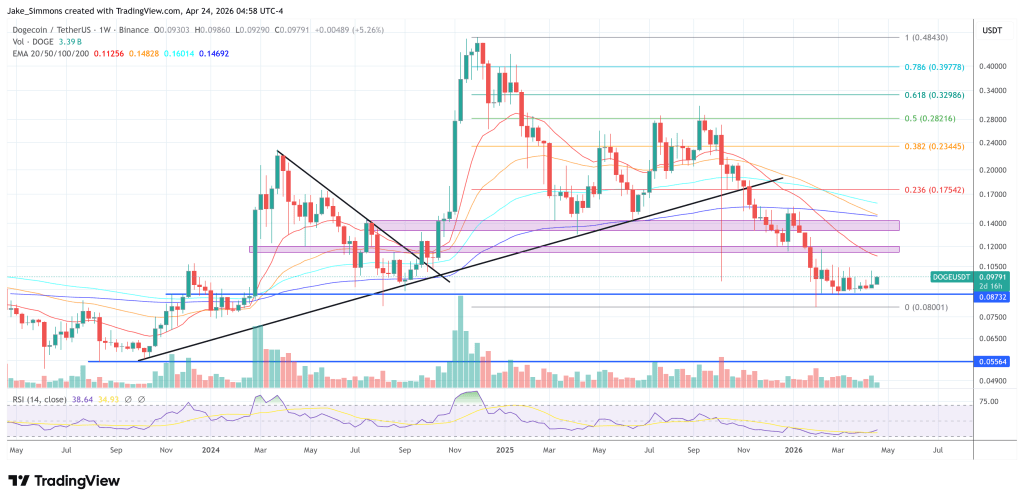
DOGE holds above key support, 1-week chart | Source: DOGEUSDT on TradingView.com

Related Questions

QWhat is the main change Qubic has made in its mining architecture as part of Phase 3?

AQubic has fully transitioned to a Dogecoin-focused mining architecture, removing Monero (XMR) from its operational stack. It now uses ASICs to mine DOGE at 100% capacity while simultaneously using CPUs and GPUs to train its AI, Aigarth, at 100% capacity.

QHow does Qubic's new circular capital mechanism work?

AThe circular capital mechanism works by selling the DOGE that is mined, using the proceeds to buy back Qubic's native token (QU), and then distributing that QU to the network's 'computors'. This creates continuous buy pressure for QU while maintaining DOGE production.

QAccording to the initial performance data, how much more profitable was mining DOGE via Qubic compared to traditional pools?

AAccording to the initial Day 1 sample data, mining DOGE via Qubic was approximately 32% more profitable, yielding $7.94 per day compared to $6.02 per day on traditional pools—a difference of +$1.92 per day using the same hardware.

QWhat was Qubic's previous proof-of-concept before pivoting to Dogecoin, and what did it achieve?

ABefore pivoting to Dogecoin, Qubic used Monero (XMR) mining as a proof-of-concept for its Useful Proof of Work model. It achieved up to 45% of Monero's global hashrate in one epoch, found 3,496 Monero blocks, and even conducted a public 51% takeover demonstration.

QWhat is the significance of Qubic's current hashrate share for the Dogecoin network?

AQubic's current hashrate share of roughly 0.086% (2.1 TH/s vs. the network's 2.44 PH/s) is a real but relatively small contribution. It is not enough to significantly impact network security or block production on its own, but it demonstrates that the migration is operational and the focus is now on whether it can scale its hashrate from this foothold.

Related Reads

GitHub, Transfixed by AI

On the night of February 9th, GitHub suffered a major outage caused by a simple configuration change—reducing a cache refresh interval from 12 to 2 hours—that triggered a cascade of failures. This was not an isolated event, but part of a broader pattern. In early 2026, GitHub experienced at least 8 major incidents, failing to meet its promised 99.9% availability. These outages stemmed from structural issues: explosive growth in load, tight service coupling, and insufficient protection against abnormal traffic. This unprecedented load is driven by AI Agents. In 2025, GitHub handled ~1 billion commits. By 2026, weekly commits reached 275 million, projecting to ~14 billion for the year—a 14x increase. AI tools like Claude Code now contribute 4.5% of all public repository commits, with weekly submissions surging 25x in just three months. AI-generated pull requests jumped from 4 million to 17 million per month in half a year. Unlike human developers, AI Agents work continuously, generating commits at a scale that overwhelms infrastructure designed for human rhythms. The surge also shattered GitHub's business model. Copilot's flat-rate pricing, based on assisting human developers, became unsustainable as Agentic AI sessions consumed resources worth hundreds of dollars for a few dollars in fees. In response, GitHub imposed usage limits and, by June 1st, shifted to a pay-per-use "AI Credits" system. Facing this new reality, GitHub realized a 10x scaling plan was insufficient. It announced a need to *redesign* its architecture for 30x current scale—decoupling services, adding fault isolation, and improving change management to prevent cascading failures. Other platforms like Stripe and AWS are facing similar challenges with AI Agents. Fundamentally, GitHub is transitioning from a human collaboration platform to an "exhaust pipe" for automated AI workflows. Its detailed post-mortem reports aim to maintain trust during this turbulent rebuild. The February outage was not just a technical glitch, but a signal of the software industry's entry into a new, AI-driven era.

marsbit8m ago

GitHub, Transfixed by AI

marsbit8m ago

Both Suffer Massive Losses Exceeding $90 Billion, Which Is in Greater Peril: Strategy or Bitmine?

Facing massive paper losses exceeding $90 billion each amidst a sharp market downturn, "Digital Asset Treasury" (DAT) giants Strategy and Bitmine find themselves in a precarious position, but with different underlying risks. Strategy, heavily invested in Bitcoin (BTC), faces significant financial strain. Its strategy relies heavily on debt, including convertible notes and preferred stock (STRC) requiring substantial dividend payments. With its cash reserves dwindling and BTC offering no staking yield for cash flow, Strategy's high leverage makes it vulnerable. A continued price decline could force asset sales to meet obligations, potentially creating a negative feedback loop. Its market value has already fallen sharply. In contrast, Bitmine, an Ethereum (ETH) holder, appears on firmer financial ground. It primarily funds its purchases through equity offerings (like ATM programs), avoiding debt pressure. It also generates income by staking a large portion of its ETH holdings. While not immune to market drops and shareholder dilution concerns, Bitmine maintains more flexibility, recently announcing a new preferred share offering to raise further capital. The core divergence lies in their financing: Bitmine uses equity (investor money), while Strategy uses debt (borrowed money). Consequently, Bitmine currently faces less immediate liquidity pressure than Strategy, which must navigate the dual challenge of servicing debt/dividends and a declining core asset (BTC) price.

marsbit15m ago

Both Suffer Massive Losses Exceeding $90 Billion, Which Is in Greater Peril: Strategy or Bitmine?

marsbit15m ago

Where the AI Bubble Really Is: Which Layer of Players Are Naked

AI Bubble: Where It Really Is and Who's Swimming Naked This analysis dissects the AI industry not as a single entity but as a five-layer pyramid, arguing that bubbles are concentrated in specific tiers, not uniformly distributed. **Key Distinction from the 2000 Dot-com Bubble:** Unlike 2000, where companies had stock prices before revenue, today's leading AI players have massive, contract-backed revenue driving their valuations. Core infrastructure demand is real, with every GPU running at full capacity for paying customers. **The Five-Layer Pyramid & Bubble Assessment:** * **L0 (Fab/Manufacturing) & Top L4 (Leading AI Apps): NO BUBBLE.** Companies like TSMC, NVIDIA, major cloud providers (Microsoft, Google, Meta, Amazon), and top AI labs have real revenues and orders. Supply is tightly constrained by TSMC's disciplined capacity control and physical limits like power/land for data centers, preventing a supply glut. * **L1 (Memory): BATTLEGROUND.** Sky-high HBM margins could signal a new structural cycle or a classic "boom before bust." The oligopoly of three major players may enforce supply discipline, making this a high-stakes bet. * **L2 (Interconnect/Optical Modules): BUBBLE TERRITORY.** Companies like Lumentum and AAOI have seen stock surges (4-10x) far outpacing revenue growth. This hardware segment has lower physical barriers to expansion than fabs, allowing speculation. It mirrors the 2000 bubble's epicenter—optics. * **L3 (Infrastructure/"GPU Landlords"): VULNERABLE.** GPU leasing companies profit from the current compute shortage but own no long-term moat. Their business model relies on a temporary bottleneck that will ease as big tech expands and new tech (e.g., potential space-based data centers) emerges. * **L4 Long Tail (VC-backed Startups): STRONG BUBBLE SIGNALS.** VC funding concentration in AI is twice that of the 1999 peak. Many startups with little revenue use the valuation logic of successful giants to justify their own, creating high risk of a "valuation crunch" when funding dries up. **Critical Risks to Monitor:** 1. **GPU Depreciation & Accounting:** Companies extending the assumed useful life of GPUs artificially boost profits. The true economic life depends on future generational leaps from NVIDIA. 2. **"GPU Credit" & Off-Balance-Sheet Leverage:** Emerging structures where shell companies borrow to buy GPUs and lease them out (with chipmakers sometimes investing) move debt off major balance sheets. This echoes the "vendor financing" of 2000 and the securitization risks of 2008, though currently small-scale. 3. **TSMC Abandoning Caution:** If the primary supply bottleneck (TSMC's conservative capacity planning) breaks, runaway supply could trigger a bust. 4. **Algorithmic Efficiency Breakthrough:** A major leap in software efficiency could drastically reduce the need for raw compute hardware, undermining the investment thesis. **Conclusion:** The AI boom is expensive and has frothy areas, but its core is underpinned by real demand and physical supply constraints. The bubble risk is layered: most present in optical components, GPU leasing, and the long-tail startup ecosystem, while the foundational chip manufacturing and leading application layers remain relatively solid—for now.

marsbit28m ago

Where the AI Bubble Really Is: Which Layer of Players Are Naked

marsbit28m ago

Trading

Spot
Futures

Hot Articles

What is DOGE M

Doge Matrix ($doge m): The New Breed of Community-Driven Cryptocurrency Introduction In the ever-evolving landscape of cryptocurrency, new projects constantly emerge, each aiming to capture the interest of investors and enthusiasts alike. One of the latest entrants to this domain is Doge Matrix, represented by the ticker symbol $doge m. This project has attracted attention thanks to its roots in the popular meme culture surrounding Dogecoin, establishing its place within the web3 space. This article aims to provide a comprehensive analysis of Doge Matrix, covering its overview, creator, investors, functionality, timeline, and notable aspects. What is Doge Matrix ($doge m)? Doge Matrix is a community-driven cryptocurrency project that seemingly builds upon the widespread appeal of Dogecoin, a digital currency known for its Shiba Inu mascot and its meme origins. While the overarching objectives of Doge Matrix are not extensively defined, it is characterized by a commitment to harnessing community involvement and support. Unlike traditional cryptocurrencies that often emphasize utility or intrinsic value through underlying technologies, Doge Matrix positions itself within a space that embraces the cultural phenomenon of cryptocurrencies, particularly appealing to those who resonate with the ethos of meme-based assets. Drawing on the strengths of the Dogecoin community, Doge Matrix operates as part of a broader ecosystem, inviting participation and engagement from users who share an interest in cryptocurrency and the digital landscape. Who is the Creator of Doge Matrix ($doge m)? The identity of the creator of Doge Matrix remains unknown. This lack of transparency is not an uncommon occurrence in the cryptocurrency space, where some projects are launched without revealing the identities of their founders. The absence of information regarding the founding team can raise questions among potential investors about the project’s accountability and direction. Who are the Investors of Doge Matrix ($doge m)? As it stands, there is no publicly available information detailing the investors or investment foundations that back Doge Matrix. The project appears to rely primarily on community support rather than institutional investment. This model aligns with the community-driven nature of the initiative, fostering an environment where the direction of the project is shaped by its participants rather than being dictated by a select few financial backers. How Does Doge Matrix ($doge m) Work? The specifics regarding the operational mechanisms of Doge Matrix are somewhat vague, reflecting a broader trend of projects in the meme coin space where innovative functionalities are not always clearly articulated. Nonetheless, Doge Matrix seems designed to tap into the existing cryptocurrency ecosystem by encouraging user participation while tapping into the familiar cultural references associated with Dogecoin. Its potentially unique characteristics derive from community interactions rather than technological advancements, emphasizing shared experiences and collaboration among token holders. While the exact innovations have not been explicitly outlined, the project appears to create a space where community members can engage, share ideas, and propel the project's potential forward. Timeline of Doge Matrix ($doge m) Reflecting on the project’s timeline reveals notable events that have defined its journey thus far: November 25, 2024: Doge Matrix reached its all-time high value, marking a significant milestone in its early history. January 1, 2025: Conversely, Doge Matrix hit its all-time low value, illustrating the volatility often associated with cryptocurrencies, especially in the early stages of a project's lifecycle. Ongoing: The project continues to be actively traded and supported by its community, although specific future milestones or objectives have yet to be disclosed. Key Points About Doge Matrix ($doge m) Community Focus At the heart of Doge Matrix is a commitment to community engagement. The project thrives on the premise of collaboration and shared objectives among its members, emphasizing the importance of collective effort. Unlike centralized projects that often have a defined leadership structure, Doge Matrix at present showcases a more fluid approach to governance, where every community member's voice matters. Volatility The cryptocurrency market is notorious for its volatility, and Doge Matrix is no exception. Its price history reflects significant fluctuations between high and low values, which is typical of many new cryptocurrencies but underscores the risks associated with investment in emerging tokens. Lack of Detailed Information One of the most striking features about Doge Matrix is the scarcity of detailed information regarding its technological underpinnings and operational mechanisms. This ambiguity necessitates that potential investors conduct thorough due diligence before engaging with the project. Conclusion In summary, Doge Matrix ($doge m) illustrates a new wave of cryptocurrency projects that lean heavily on community engagement and cultural relevance. While lacking in certain specifics—such as clear leadership, defined objectives, and detailed functionality—the project has managed to generate interest within the crypto community, leveraging the established appeal of meme culture. As with any investment in the cryptocurrency space, understanding the inherent risks and conducting comprehensive research is essential for potential participants. Doge Matrix stands as a reminder of the dynamic, sometimes unpredictable nature of the crypto industry, marked by constant evolution and enthusiasm for community-driven initiatives.

3.6k Total ViewsPublished 2025.02.03Updated 2025.02.03

What is DOGE M

Discussions

Welcome to the HTX Community. Here, you can stay informed about the latest platform developments and gain access to professional market insights. Users' opinions on the price of DOGE (DOGE) are presented below.

活动图片