QCP Capital: Bitcoin Withstands Strategy Sales and Coldcard Hack

cryptonews.ruPublished on 2026-08-07Last updated on 2026-08-07

Abstract

QCP Capital's latest market report highlights Bitcoin's resilience in the face of recent challenges. Despite a large corporate sell-off by Strategy and a significant security breach affecting Coldcard wallets, resulting in losses of over $110 million, BTC recovered from around $62.5K to near $64K without a sustained breakdown. Options market data supports this stability narrative. Short-term implied volatility remains near recent lows, and the demand for downside protection has diminished, as evidenced by a recovery in the 7-day risk reversal metric. Traders have shown a balanced positioning, selling August put options at a $50K strike while selectively buying near-term call options at $65K, indicating cautious optimism rather than panic. Macroeconomic conditions present a mixed picture. U.S. business activity remains strong, but hiring has cooled. Geopolitical tensions in the Strait of Hormuz and developments in Japan's monetary policy and bond yields continue to influence global liquidity and volatility. Overall, QCP concludes the crypto market is demonstrating resilience, absorbing multiple shocks without a clear directional trend emerging. While regulatory clarity in the U.S. faces further delays, the market's ability to withstand recent pressures is seen as a foundational fact for future expectations.

Trading firm QCP Capital published a fresh market report, analyzing how Bitcoin weathered corporate sales, a major security incident, and a tense macroeconomic backdrop. The analysts' main takeaway: the market is demonstrating resilience, not panic, although a clear signal for continued growth is not yet present.

Bad News Without a Crash

According to QCP, Bitcoin recovered from around $62.5k at the start of the week to levels close to $64k. Analysts note that the speed of the move is less important than the fact that the market managed to "digest" along the way.
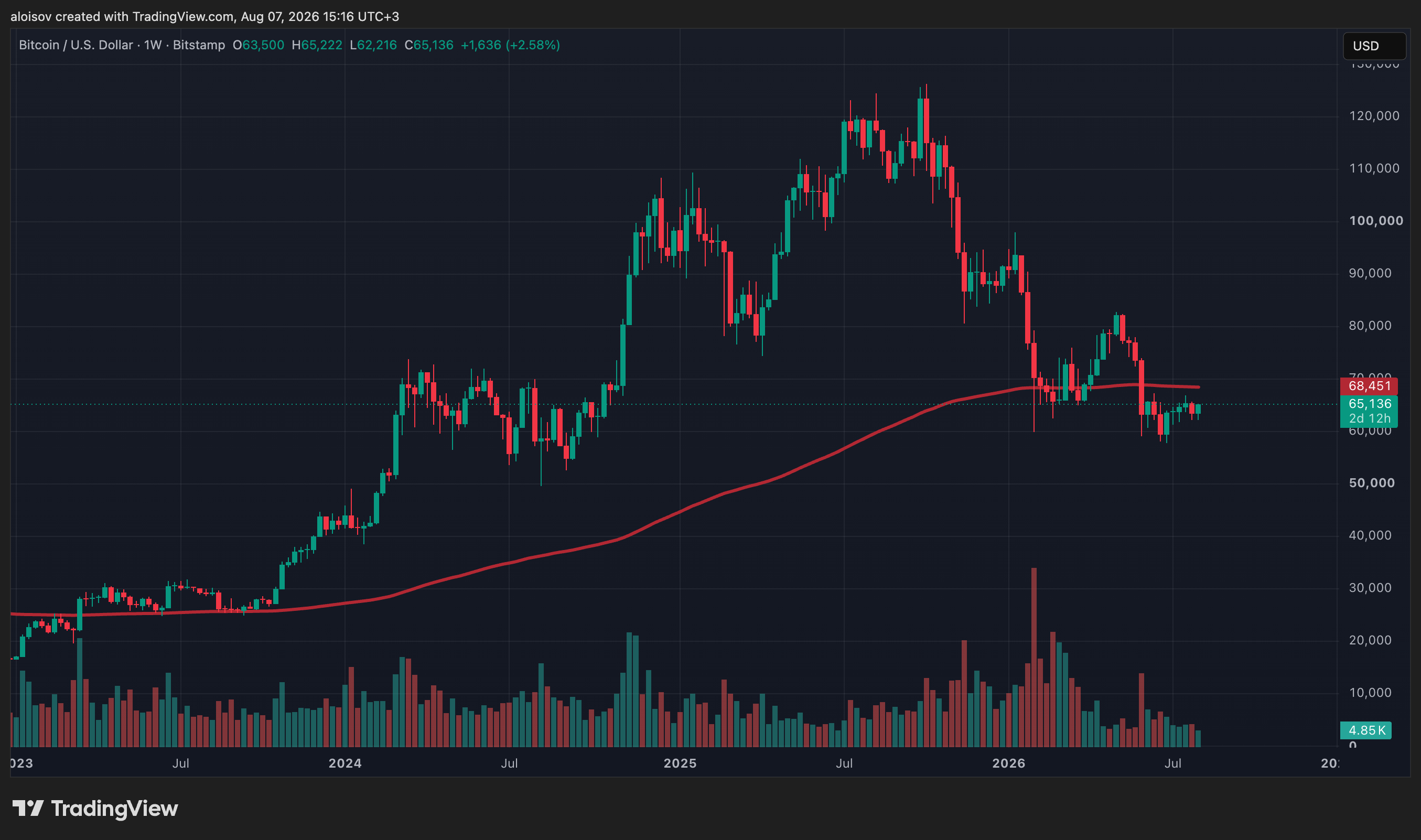
1-week chart of BTC/USD and 200EMA. Source: Bitstamp

Last week, the company Strategy disclosed the sale of 1,638 bitcoins for approximately $104.7 million, while the security incident with Coldcard crypto wallets continued to escalate. According to estimates in the report, losses amounted to around 1,755 bitcoins, or about $110 million, affecting roughly 5,000 wallets as of August 4th. None of these events, QCP emphasizes, led to a sustained breakdown to the downside.

Volatility Refuses to Panic

The options market, as noted by QCP, tells a similar story. According to the firm's Wednesday data, the at-the-money (ATM) implied volatility for 7 and 30 days stood at 28.8 and 32.6 respectively—both figures are at the lower end of recent ranges, while the 90-day volatility remains at 37.1.

The discount for downside protection on the near end of the curve also quickly narrowed: the 7-day 25-delta risk reversal recovered from -7.39 to -2.10. Short-term implied volatility remains slightly above recent realized volatility, whereas on the 90-day horizon it is, conversely, below realized. Trader positioning has become more balanced—notable volumes of put options at the $50k strike expiring in August were sold, while selective demand for near-term call options at the $65k strike was observed concurrently.

The overall message from QCP is simple: despite several crypto-market-specific shocks, options markets are not showing the level of stress recorded during previous sell-offs.

What's Behind Such Trades: The Essence of Options Strategies

The options structures mentioned by QCP are derivative instruments, meaning their value depends on the price of the underlying asset (in this case Bitcoin), not on direct ownership of it.

  1. Selling a put option means a trader receives a premium now but takes on the obligation to buy Bitcoin at a predetermined price (the strike) if the market is below that level at expiration. This is a bet that the price will not fall below a certain level.
  2. Buying a call option, conversely, gives the right (but not the obligation) to buy Bitcoin at a fixed price in the future. The trader pays a premium for this opportunity, betting that the asset will rise above the strike price.
  3. A risk reversal is a combination of a sold put and a bought call (or vice versa) that helps gauge whether the market fears a sharp drop or a sharp rise more.

The advantage of selling puts is immediate income from the premium and the opportunity to buy the asset cheaper if the scenario plays out. The risk is the obligation to acquire Bitcoin at the strike price even if the price falls significantly lower. Buying calls limits the risk to the size of the paid premium but requires the price increase to justify these costs.

The report talks about precisely such a balance: some players were selling puts at the $50k strike expiring in August, betting that the price would not go that low, while another part selectively bought calls at $65k for near terms, counting on moderate growth. According to QCP's assessment, such a combination reflects not panic, but cautious optimism.

The Economy Keeps Growing, Hiring Cools Down

The macroeconomic picture in the US, according to the report, remains mixed. The Institute for Supply Management (ISM) Manufacturing Purchasing Managers' Index (PMI) for July rose to 55.6—the highest reading in over four years—and the services sector also remained in expansion territory at 54.1. However, employment indicators look weaker: the Job Openings and Labor Turnover Survey (JOLTS) number of openings fell to 7.36 million, private sector payrolls according to ADP increased by only 44 thousand, and the ISM Services Employment Index dipped back into contraction territory.

In aggregate, QCP notes, economic activity remains resilient, while the pace of hiring has slowed. At the same time, the wave of layoffs remains relatively subdued, suggesting slower hiring rather than mass job cuts.

Market attention is now focused on July's labor market data (payrolls). A Wall Street Journal survey suggests nonfarm payrolls grew by about 83 thousand, with the unemployment rate holding at 4.2%. Against a backdrop of still-elevated inflation, this data will become another factor in assessing the future trajectory of Fed policy.

The Strait of Hormuz: Uncertainty Persists

Geopolitical tensions also remain elevated. Iran and Oman, according to QCP, have made progress in negotiations on a mechanism for commercial passage through the Strait of Hormuz, but a full opening of the route has not yet occurred. The proposed scheme involves separate sea corridors supervised by Iran and Oman, with issues of transit fees and unhindered passage remaining unresolved.

Concurrently, the report notes, an Iranian parliamentary committee is considering a bill that could restrict passage for vessels linked to countries Tehran considers hostile and impose fines of up to 20% of cargo value for violations. US maritime authorities continue to assess the risk of attacks on commercial shipping in the region as high.

Brent crude oil prices returned above $83 as markets continue to monitor the potential impact of the situation on energy supplies and shipping. The combination of ongoing negotiations and persistent shipping safety concerns makes the Strait of Hormuz a significant source of volatility for several asset classes at once.

Japan Remains the Key Liquidity Theme

The situation in Japan is another important factor for various asset class markets. Attention to the topic intensified after handwritten notes from US Treasury Secretary Scott Bessent indicated a potential $5-10 billion US purchase of yen. The subsequent US intervention was conducted by the Federal Reserve Bank of New York on behalf of the Treasury and—unusually—involved selling euros to buy yen, not selling dollars.

This trade structure is important as it shows the interconnection between currencies, reserve management, and global bond markets. The Bank of Japan still holds about half of all the country's issued government bonds (JGBs), while rising domestic yields have increased the relative attractiveness of Japanese debt after many years of ultra-low rates.

For global markets, the question, as QCP notes, is less about the specific intervention and more about whether the rise in Japanese yields will change the incentives for domestic investors to deploy capital abroad. It is this transmission channel that maintains the significance of the yen and the Japanese government bond market for global duration conditions and liquidity.

Resilience, Not Momentum

For the cryptocurrency market, the price dynamics over the week, according to QCP's assessment, speak more of resilience than a clear directional confirmation of the trend. Bitcoin withstood corporate sales and a major security incident, while near-term options markets show limited demand for panic protection.

At the same time, the macroeconomic backdrop remains uncertain: labor market data, energy prices, US Treasury yields, and funding conditions in Japan continue to affect the overall level of liquidity surrounding digital assets.

The legislative process in the US regarding digital asset market regulation has also moved further along the calendar. The Senate did not complete consideration of the CLARITY Act before the August recess, and the next legislative window will likely shift to September. The document, QCP notes, continues to face procedural hurdles, unresolved ethical provisions, and concerns from regional banks about competition from stablecoins for deposits.

Bottom Line

The legislative process remains active, but the delay reduces regulatory clarity in the short term. As noted by QCP, the situation resembles a calm after a series of storms: the waves have subsided, but the wind capable of setting a new direction has not yet picked up.

The market absorbed several blows at once—from corporate sales to shipping threats—and did not sink. That in itself is a fact around which expectations for further movement are now being built.

end-content

Trending Cryptos

Related Questions

QWhat are the two main negative events that Bitcoin weathered recently according to QCP Capital's report?

AThe two main negative events were: 1) Corporate selling by Strategy, which sold 1,638 bitcoins for approximately $104.7 million, and 2) The Coldcard wallet security incident, estimated to have resulted in losses of about 1,755 bitcoins (around $110 million).

QWhat does the activity in the options market, specifically the selling of puts and buying of calls, indicate about trader sentiment?

AThe activity indicates cautious optimism rather than panic. Selling puts at a $50,000 strike for August shows traders betting the price won't fall that low, while selective buying of calls at a $65,000 strike for near terms reflects expectations for moderate growth.

QHow does QCP characterize the current macroeconomic picture in the US regarding economic activity and employment?

AQCP characterizes it as uneven. Economic activity remains resilient, with the ISM Manufacturing PMI hitting a multi-year high. However, hiring has cooled, shown by a drop in JOLTS job openings and a weak ADP report, though mass layoffs are not evident.

QWhat two geopolitical factors are highlighted by QCP as sources of market volatility?

AThe two geopolitical factors are: 1) The ongoing uncertainty and negotiations regarding commercial passage through the Strait of Hormuz, and 2) The situation in Japan, specifically its impact on global bond yields and liquidity via changes in Japanese investor behavior.

QWhat is the main conclusion of QCP's report regarding Bitcoin's recent price action and market state?

AThe main conclusion is that the market is demonstrating resilience, not panic, and lacks a clear directional signal for a continued rally. Bitcoin absorbed several shocks without a sustained breakdown, but the overall market is in a state of stability rather than strong momentum.

Related Reads

Trading

Spot

Hot Articles

What is $BITCOIN

DIGITAL GOLD ($BITCOIN): A Comprehensive Analysis Introduction to DIGITAL GOLD ($BITCOIN) DIGITAL GOLD ($BITCOIN) is a blockchain-based project operating on the Solana network, which aims to combine the characteristics of traditional precious metals with the innovation of decentralized technologies. While it shares a name with Bitcoin, often referred to as “digital gold” due to its perception as a store of value, DIGITAL GOLD is a separate token designed to create a unique ecosystem within the Web3 landscape. Its goal is to position itself as a viable alternative digital asset, although specifics regarding its applications and functionalities are still developing. What is DIGITAL GOLD ($BITCOIN)? DIGITAL GOLD ($BITCOIN) is a cryptocurrency token explicitly designed for use on the Solana blockchain. In contrast to Bitcoin, which provides a widely recognized value storage role, this token appears to focus on broader applications and characteristics. Notable aspects include: Blockchain Infrastructure: The token is built on the Solana blockchain, known for its capacity to handle high-speed and low-cost transactions. Supply Dynamics: DIGITAL GOLD has a maximum supply capped at 100 quadrillion tokens (100P $BITCOIN), although details regarding its circulating supply are currently undisclosed. Utility: While precise functionalities are not explicitly outlined, there are indications that the token could be utilized for various applications, potentially involving decentralized applications (dApps) or asset tokenization strategies. Who is the Creator of DIGITAL GOLD ($BITCOIN)? At present, the identity of the creators and development team behind DIGITAL GOLD ($BITCOIN) remains unknown. This situation is typical among many innovative projects within the blockchain space, particularly those aligning with decentralized finance and meme coin phenomena. While such anonymity may foster a community-driven culture, it intensifies concerns about governance and accountability. Who are the Investors of DIGITAL GOLD ($BITCOIN)? The available information indicates that DIGITAL GOLD ($BITCOIN) does not have any known institutional backers or prominent venture capital investments. The project seems to operate on a peer-to-peer model focused on community support and adoption rather than traditional funding routes. Its activity and liquidity are primarily situated on decentralized exchanges (DEXs), such as PumpSwap, rather than established centralized trading platforms, further highlighting its grassroots approach. How DIGITAL GOLD ($BITCOIN) Works The operational mechanics of DIGITAL GOLD ($BITCOIN) can be elaborated on based on its blockchain design and network attributes: Consensus Mechanism: By leveraging Solana’s unique proof-of-history (PoH) combined with a proof-of-stake (PoS) model, the project ensures efficient transaction validation contributing to the network's high performance. Tokenomics: While specific deflationary mechanisms have not been extensively detailed, the vast maximum token supply implies that it may cater to microtransactions or niche use cases that are still to be defined. Interoperability: There exists the potential for integration with Solana’s broader ecosystem, including various decentralized finance (DeFi) platforms. However, the details regarding specific integrations remain unspecified. Timeline of Key Events Here is a timeline that highlights significant milestones concerning DIGITAL GOLD ($BITCOIN): 2023: The initial deployment of the token occurs on the Solana blockchain, marked by its contract address. 2024: DIGITAL GOLD gains visibility as it becomes available for trading on decentralized exchanges like PumpSwap, allowing users to trade it against SOL. 2025: The project witnesses sporadic trading activity and potential interest in community-led engagements, although no noteworthy partnerships or technical advancements have been documented as of yet. Critical Analysis Strengths Scalability: The underlying Solana infrastructure supports high transaction volumes, which could enhance the utility of $BITCOIN in various transaction scenarios. Accessibility: The potential low trading price per token could attract retail investors, facilitating wider participation due to fractional ownership opportunities. Risks Lack of Transparency: The absence of publicly known backers, developers, or an audit process may yield skepticism regarding the project's sustainability and trustworthiness. Market Volatility: The trading activity is heavily reliant on speculative behavior, which can result in significant price volatility and uncertainty for investors. Conclusion DIGITAL GOLD ($BITCOIN) emerges as an intriguing yet ambiguous project within the rapidly evolving Solana ecosystem. While it attempts to leverage the “digital gold” narrative, its departure from Bitcoin's established role as a store of value underscores the need for a clearer differentiation of its intended utility and governance structure. Future acceptance and adoption will likely depend on addressing the current opacity and defining its operational and economic strategies more explicitly. Note: This report encompasses synthesised information available as of October 2023, and developments may have transpired beyond the research period.

1.6k Total ViewsPublished 2025.05.13Updated 2025.05.13

What is $BITCOIN

Discussions

Welcome to the HTX Community. Here, you can stay informed about the latest platform developments and gain access to professional market insights. Users' opinions on the price of BTC (BTC) are presented below.

活动图片