Push to End Crypto Staking Double Taxation Gains Momentum in Washington

bitcoinistPublished on 2025-12-23Last updated on 2025-12-23

Abstract

As crypto staking becomes more widespread, U.S. lawmakers are pushing for clearer tax rules to avoid double taxation and simplify compliance. A bipartisan group of 18 House representatives has urged the IRS to update its guidance, arguing that taxing staking rewards only upon sale—rather than at receipt—would better reflect actual economic gains and reduce administrative burdens. They warn that current policies may discourage staking, which is crucial for blockchain security. Additionally, the newly introduced Digital Asset PARITY Act proposes a de minimis exemption for small stablecoin transactions and defers income recognition from staking for up to five years. These efforts reflect a growing consensus in Congress for more coherent crypto tax policies ahead of key 2026 tax changes.

As crypto staking shifts from a niche activity to a mainstream practice, long-standing gaps in U.S. tax policy are coming under closer scrutiny in Washington, with lawmakers warning that unclear and inconsistent rules could discourage participation in blockchain networks and complicate compliance for millions of investors.

Related Reading: Bitcoin Long-Term Holders Stay Resilient, But Profits Haven’t Fully Arrived – Here’s What To Know

With the 2026 tax year nearing, 18 bipartisan House lawmakers have urged the Internal Revenue Service to review staking tax guidance, arguing it results in double taxation, creating administrative burdens and failing to reflect actual economic gains, especially during volatile markets.
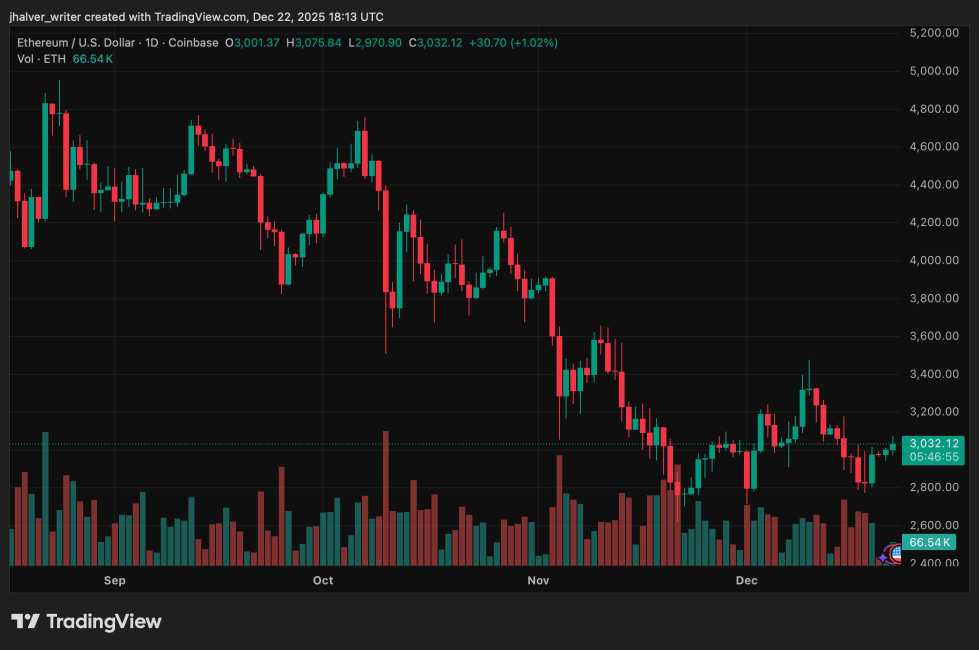
ETH's price trends to the downside on the daily chart. Source: ETHUSD on Tradingview

Lawmakers Press IRS Ahead of 2026

In a letter led by Representative Mike Carey, lawmakers asked whether any administrative barriers stand in the way of updating staking guidance before the end of the year. They argue that taxing rewards only at the point of sale would better capture actual economic gain while reducing reporting complexity.

The group also warned that current rules may discourage staking participation, which plays a critical role in securing proof-of-stake blockchains and maintaining network resilience.

The timing is deliberate. Several tax provisions are set to expire in 2026, and lawmakers want clarity on staking before broader tax debates take precedence. They also noted that prolonged uncertainty could invite unfavorable court rulings that lock in interpretations through precedent rather than policy.

The PARITY Act and Broader Crypto Tax Reform

Alongside the IRS letter, Representatives Steven Horsford and Max Miller have introduced a discussion draft known as the Digital Asset PARITY Act.

The proposal takes a wider view of crypto taxation, including a de minimis exemption for regulated stablecoin payments used in everyday transactions. Small gains or losses from these payments would generally not be taxed, mirroring existing treatment for low-value foreign currency exchanges.

For staking and mining, the PARITY Act stops short of eliminating immediate taxation but proposes allowing taxpayers to defer income recognition for up to five years.

Supporters say this could provide interim relief while lawmakers work toward permanent clarity. The bill also extends wash-sale rules and certain securities tax provisions to actively traded digital assets, aiming to curb abuse without expanding loopholes.

What Comes Next for Crypto Investors

Together, these efforts signal growing consensus in Congress that crypto taxation needs refinement rather than piecemeal fixes. While no changes are guaranteed, the push to address staking double taxation reflects a shift toward more technical, outcome-focused policymaking.

Related Reading: XRP ETFs Attract Global Pension Funds And Insurers, Canary CEO Reveals

For investors and network participants, the next year could determine whether staking remains burdened by uncertainty or moves toward a clearer, more predictable tax framework.

Cover image from ChatGPT, ETHUSD chart from Tradingview

Trending Cryptos

Related Questions

QWhat is the main issue with current U.S. tax policy regarding crypto staking that lawmakers are addressing?

AThe main issue is that current tax rules result in double taxation, create administrative burdens, and fail to reflect actual economic gains, especially during volatile markets.

QHow many bipartisan House lawmakers have urged the IRS to review staking tax guidance ahead of the 2026 tax year?

A18 bipartisan House lawmakers have urged the IRS to review staking tax guidance.

QWhat specific change in taxation timing do lawmakers propose to better capture actual economic gain from staking rewards?

ALawmakers propose taxing staking rewards only at the point of sale, rather than immediately, to better capture actual economic gain and reduce reporting complexity.

QWhat is the name of the proposed draft legislation that addresses broader crypto taxation, including a de minimis exemption for stablecoin payments?

AThe proposed draft legislation is called the Digital Asset PARITY Act.

QHow does the PARITY Act propose to handle income recognition for staking and mining rewards?

AThe PARITY Act proposes allowing taxpayers to defer income recognition from staking and mining rewards for up to five years, providing interim relief while seeking permanent clarity.

Related Reads

Why Bitcoin Holds Above $64,000 After Fed's Hard Pause

**Bitcoin Stabilizes Near $64,000 Following Hawkish Fed Pause** The cryptocurrency market, led by Bitcoin, remained stable around $64,000 despite a volatile reaction to the latest U.S. Federal Reserve meeting. The Fed paused interest rates but signaled a hawkish stance, with three committee members voting for an increase—the highest dissent since 2016. This limits risk appetite but hasn't triggered panic selling. Key market highlights include Bitcoin ETFs seeing a net inflow of $32.1 million, breaking a streak of outflows, while Ethereum ETFs experienced outflows of $18.65 million. Liquidations affected about 90,000 traders. Technically, Bitcoin finds support around $63,000-$63,500, with major resistance near $66,000. While its price is about 49% below its all-time high, institutional demand via ETFs and the absence of mass capitulation support a potential recovery scenario in the second half of the year. Major altcoins showed mixed movements, with Solana attracting capital while Ethereum faced selling pressure despite strong on-chain metrics like a growing staking queue. Regulatory news took a pause as the U.S. Senate delayed the CLARITY Act vote until at least autumn. For the final trading day of July, U.S. inflation and consumer spending data will be crucial. Bitcoin's key levels to watch are $63,000 support and $66,000 resistance. Sustained ETF inflows and Bitcoin holding above $63,000 are seen as positive signs for a potential market recovery later in the year.

cryptonews.ru43m ago

Why Bitcoin Holds Above $64,000 After Fed's Hard Pause

cryptonews.ru43m ago

Trading

Spot

Hot Articles

How to Buy PUSH

Welcome to HTX.com! We've made purchasing Push Protocol (PUSH) simple and convenient. Follow our step-by-step guide to embark on your crypto journey.Step 1: Create Your HTX AccountUse your email or phone number to sign up for a free account on HTX. Experience a hassle-free registration journey and unlock all features.Get My AccountStep 2: Go to Buy Crypto and Choose Your Payment MethodCredit/Debit Card: Use your Visa or Mastercard to buy Push Protocol (PUSH) instantly.Balance: Use funds from your HTX account balance to trade seamlessly.Third Parties: We've added popular payment methods such as Google Pay and Apple Pay to enhance convenience.P2P: Trade directly with other users on HTX.Over-the-Counter (OTC): We offer tailor-made services and competitive exchange rates for traders.Step 3: Store Your Push Protocol (PUSH)After purchasing your Push Protocol (PUSH), store it in your HTX account. Alternatively, you can send it elsewhere via blockchain transfer or use it to trade other cryptocurrencies.Step 4: Trade Push Protocol (PUSH)Easily trade Push Protocol (PUSH) on HTX's spot market. Simply access your account, select your trading pair, execute your trades, and monitor in real-time. We offer a user-friendly experience for both beginners and seasoned traders.

4.1k Total ViewsPublished 2024.03.29Updated 2026.06.02

How to Buy PUSH

Discussions

Welcome to the HTX Community. Here, you can stay informed about the latest platform developments and gain access to professional market insights. Users' opinions on the price of PUSH (PUSH) are presented below.

活动图片













