Push to End Crypto Staking Double Taxation Gains Momentum in Washington

bitcoinistPublished on 2025-12-23Last updated on 2025-12-23

Abstract

As crypto staking becomes more widespread, U.S. lawmakers are pushing for clearer tax rules to avoid double taxation and simplify compliance. A bipartisan group of 18 House representatives has urged the IRS to update its guidance, arguing that taxing staking rewards only upon sale—rather than at receipt—would better reflect actual economic gains and reduce administrative burdens. They warn that current policies may discourage staking, which is crucial for blockchain security. Additionally, the newly introduced Digital Asset PARITY Act proposes a de minimis exemption for small stablecoin transactions and defers income recognition from staking for up to five years. These efforts reflect a growing consensus in Congress for more coherent crypto tax policies ahead of key 2026 tax changes.

As crypto staking shifts from a niche activity to a mainstream practice, long-standing gaps in U.S. tax policy are coming under closer scrutiny in Washington, with lawmakers warning that unclear and inconsistent rules could discourage participation in blockchain networks and complicate compliance for millions of investors.

Related Reading: Bitcoin Long-Term Holders Stay Resilient, But Profits Haven’t Fully Arrived – Here’s What To Know

With the 2026 tax year nearing, 18 bipartisan House lawmakers have urged the Internal Revenue Service to review staking tax guidance, arguing it results in double taxation, creating administrative burdens and failing to reflect actual economic gains, especially during volatile markets.
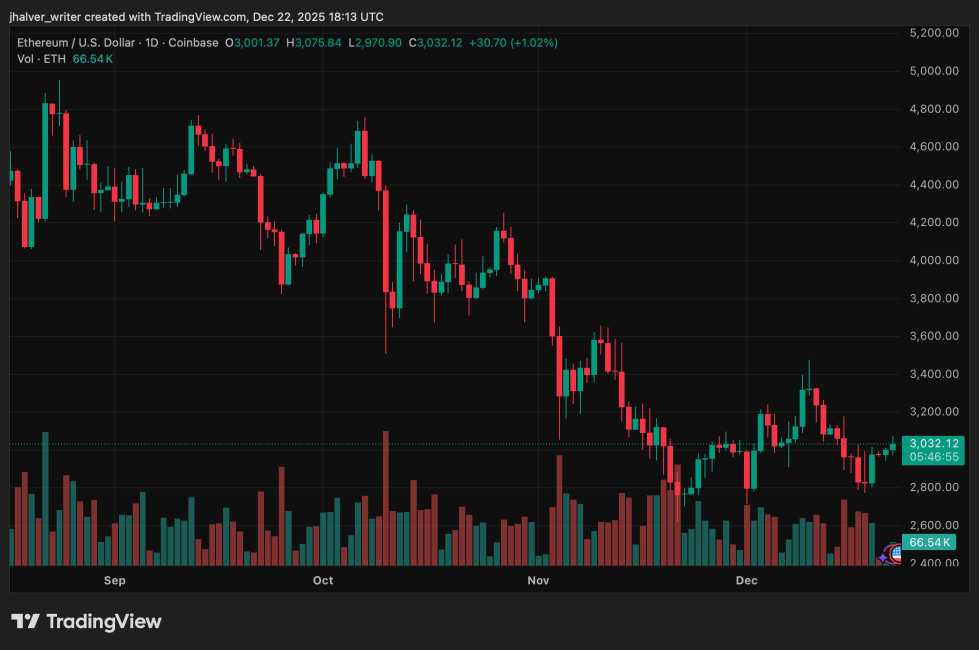
ETH's price trends to the downside on the daily chart. Source: ETHUSD on Tradingview

Lawmakers Press IRS Ahead of 2026

In a letter led by Representative Mike Carey, lawmakers asked whether any administrative barriers stand in the way of updating staking guidance before the end of the year. They argue that taxing rewards only at the point of sale would better capture actual economic gain while reducing reporting complexity.

The group also warned that current rules may discourage staking participation, which plays a critical role in securing proof-of-stake blockchains and maintaining network resilience.

The timing is deliberate. Several tax provisions are set to expire in 2026, and lawmakers want clarity on staking before broader tax debates take precedence. They also noted that prolonged uncertainty could invite unfavorable court rulings that lock in interpretations through precedent rather than policy.

The PARITY Act and Broader Crypto Tax Reform

Alongside the IRS letter, Representatives Steven Horsford and Max Miller have introduced a discussion draft known as the Digital Asset PARITY Act.

The proposal takes a wider view of crypto taxation, including a de minimis exemption for regulated stablecoin payments used in everyday transactions. Small gains or losses from these payments would generally not be taxed, mirroring existing treatment for low-value foreign currency exchanges.

For staking and mining, the PARITY Act stops short of eliminating immediate taxation but proposes allowing taxpayers to defer income recognition for up to five years.

Supporters say this could provide interim relief while lawmakers work toward permanent clarity. The bill also extends wash-sale rules and certain securities tax provisions to actively traded digital assets, aiming to curb abuse without expanding loopholes.

What Comes Next for Crypto Investors

Together, these efforts signal growing consensus in Congress that crypto taxation needs refinement rather than piecemeal fixes. While no changes are guaranteed, the push to address staking double taxation reflects a shift toward more technical, outcome-focused policymaking.

Related Reading: XRP ETFs Attract Global Pension Funds And Insurers, Canary CEO Reveals

For investors and network participants, the next year could determine whether staking remains burdened by uncertainty or moves toward a clearer, more predictable tax framework.

Cover image from ChatGPT, ETHUSD chart from Tradingview

Trending Cryptos

Related Questions

QWhat is the main issue with current U.S. tax policy regarding crypto staking that lawmakers are addressing?

AThe main issue is that current tax rules result in double taxation, create administrative burdens, and fail to reflect actual economic gains, especially during volatile markets.

QHow many bipartisan House lawmakers have urged the IRS to review staking tax guidance ahead of the 2026 tax year?

A18 bipartisan House lawmakers have urged the IRS to review staking tax guidance.

QWhat specific change in taxation timing do lawmakers propose to better capture actual economic gain from staking rewards?

ALawmakers propose taxing staking rewards only at the point of sale, rather than immediately, to better capture actual economic gain and reduce reporting complexity.

QWhat is the name of the proposed draft legislation that addresses broader crypto taxation, including a de minimis exemption for stablecoin payments?

AThe proposed draft legislation is called the Digital Asset PARITY Act.

QHow does the PARITY Act propose to handle income recognition for staking and mining rewards?

AThe PARITY Act proposes allowing taxpayers to defer income recognition from staking and mining rewards for up to five years, providing interim relief while seeking permanent clarity.

Related Reads

From South Korea to the United States: Blue-Collar Jobs Are Becoming Increasingly Popular, Thanks to AI

AI is reshaping the labor market's value proposition. The traditional four-year college degree is losing its appeal as a guaranteed career path, while skilled blue-collar trades like electricians, welders, and plumbers are experiencing historic demand and wage premiums. This shift is driven by dual pressures: AI's displacement of certain white-collar roles and a booming need for physical infrastructure and data center construction. Data confirms the trend. In the U.S., vocational school revenue surged, and a significant portion of recent layoffs are AI-related. Surveys show a majority of Gen Z adults plan to pursue blue-collar work, citing better job security against AI automation. Vocational education interest has exploded recently. Experts cite a psychological shift as younger generations seek tangible, AI-resistant careers and avoid high student debt. In many cases, salaries for skilled trades now match or exceed those requiring a bachelor's degree. In South Korea, semiconductor vocational high schools boast near-total employment, with graduates securing high-paying roles at companies like Samsung. The shortage is structural, exacerbated by a retiring baby boomer workforce and massive infrastructure projects. Companies like JPMorgan Chase, Meta, and Lowe's are investing heavily in training programs. However, overcoming historical stigma and a "perception gap" around trade careers remains a key challenge to closing the talent gap.

marsbit7m ago

From South Korea to the United States: Blue-Collar Jobs Are Becoming Increasingly Popular, Thanks to AI

marsbit7m ago

Qualcomm: AI Hype Subsides, When Will Smartphones Emerge from the Gloom?

Qualcomm reported its Q3 FY2026 results (ending June 2026), with revenue of $9.95B, down 4% YoY but above expectations. Gross margin declined to 53.1%, pressured by rising costs across manufacturing and memory. Key business segments showed mixed performance: Handset revenue fell 19.6% YoY to $5.09B, dragged by an 11% decline in non-Apple Android shipments and weaker high-end mix. Conversely, Automotive revenue surged 61% to $1.59B, and IoT grew 9% to $1.83B. Core operating profit dropped 41% YoY due to margin compression and higher expenses. Management's Q4 FY2026 guidance projects revenue of $9.7B-$10.5B, in line with consensus, but Non-GAAP EPS guidance of $2.05-$2.25 fell short of expectations. Amidst persistent weakness in its core handset market, Qualcomm is pursuing growth in AI, focusing on Edge AI (smartphones, PCs, automotive) and Data Center AI. Its data center strategy includes four pillars: AI accelerators (e.g., AI200), commercial CPUs (Dragonfly C1000), custom silicon, and connectivity solutions. While these initiatives initially boosted its stock, concerns over AI capital expenditure sustainability have since erased those gains. The company targets $5B in data center revenue for FY2027 and $15B for FY2029. The report concludes that with the traditional handset business still under pressure, the data center opportunity is currently viewed as a longer-term option, and a more conservative valuation based on core operations may be warranted until AI contributions materialize.

marsbit11m ago

Qualcomm: AI Hype Subsides, When Will Smartphones Emerge from the Gloom?

marsbit11m ago

From TPU to Self-Evolving Agents: How Jeff Dean Predicts the Next Step in AI

At the 2026 YC Startup School, Jeff Dean outlined his vision for AI's next phase, shifting focus from simply scaling models to building intelligent, autonomous systems. He believes AI's progress is no longer just about creating smarter models, but about integrating them into systems capable of long-term, iterative work, automated experimentation, and continuous learning. This evolution moves the competition from "who has the bigger model" to "who can best organize intelligence." Dean suggests AI capabilities are now comparable to a junior engineer, enabling the automation of complex workflows. However, the true challenge and opportunity lie in managing these AI "workers" at scale. He emphasizes the importance of **context engineering**—structuring tools, memory, and feedback loops—over raw model power. For startups, this means building deep expertise in niche domains where general models currently fail (near 0-1% success rates), leveraging proprietary data, specialized tools, and domain-specific evaluators. A recurring theme is re-examining fundamental constraints. Dean's past work, like moving Google's search index to memory or creating the TPU, stemmed from questioning outdated assumptions about hardware and cost. He sees similar inflection points today, particularly in **specialized inference hardware** to drastically reduce latency and energy consumption for real-time Agent operation. Notably, he points out that in modern AI systems, the dominant cost is often not computation but **data movement**. Reliable, long-running Agents require robust system design, borrowing concepts from distributed computing like checkpointing, state management, and parallel exploration to handle failures and maintain progress over days or weeks. As AI automates execution, the scarcest human skills will shift to **defining clear specifications**, **judging what problems are worth solving** (taste), and designing effective feedback loops. Ultimately, Dean's framework prioritizes understanding the problem deeply, identifying the true bottlenecks, and systematically building closed-loop systems where AI can not only perform tasks but also improve AI itself.

marsbit11m ago

From TPU to Self-Evolving Agents: How Jeff Dean Predicts the Next Step in AI

marsbit11m ago

Trading

Spot

Hot Articles

How to Buy PUSH

Welcome to HTX.com! We've made purchasing Push Protocol (PUSH) simple and convenient. Follow our step-by-step guide to embark on your crypto journey.Step 1: Create Your HTX AccountUse your email or phone number to sign up for a free account on HTX. Experience a hassle-free registration journey and unlock all features.Get My AccountStep 2: Go to Buy Crypto and Choose Your Payment MethodCredit/Debit Card: Use your Visa or Mastercard to buy Push Protocol (PUSH) instantly.Balance: Use funds from your HTX account balance to trade seamlessly.Third Parties: We've added popular payment methods such as Google Pay and Apple Pay to enhance convenience.P2P: Trade directly with other users on HTX.Over-the-Counter (OTC): We offer tailor-made services and competitive exchange rates for traders.Step 3: Store Your Push Protocol (PUSH)After purchasing your Push Protocol (PUSH), store it in your HTX account. Alternatively, you can send it elsewhere via blockchain transfer or use it to trade other cryptocurrencies.Step 4: Trade Push Protocol (PUSH)Easily trade Push Protocol (PUSH) on HTX's spot market. Simply access your account, select your trading pair, execute your trades, and monitor in real-time. We offer a user-friendly experience for both beginners and seasoned traders.

4.1k Total ViewsPublished 2024.03.29Updated 2026.06.02

How to Buy PUSH

Discussions

Welcome to the HTX Community. Here, you can stay informed about the latest platform developments and gain access to professional market insights. Users' opinions on the price of PUSH (PUSH) are presented below.

活动图片













