pump.fun's New Feature Brings 'Black Mirror' Into Reality

marsbitPublished on 2026-06-16Last updated on 2026-06-16

Abstract

The article begins by recounting a dark fictional story from *Black Mirror* (Season 7, Episode 1 "Common People"), where a man is forced to perform humiliating tasks online to pay for his wife's life-sustaining medical subscription. It then draws a parallel to a new real-world feature on the crypto platform pump.fun called "Pump.fun Go," which allows users to post and complete paid bounty tasks. This feature gained mainstream attention, often negatively, through extreme examples. A prominent case involved a bounty of 40 SOL (~$2,600) offered to permanently tattoo "$bountywork" on one's forehead. An Indian man completed the task, stating the money "changed his life," and later earned significantly more from a related meme coin. Another bounty paid 200 SOL (~$14,000) for a "bounty.fun" forehead tattoo, with the participant simply stating, "We need the money." The article highlights how this system can amplify darkness, citing the dev behind $Bountywork who spent thousands on bounties for attention-grabbing stunts like eating bugs or drinking hot sauce for small sums. It compares this to past tragic live-streaming incidents where people harmed themselves for money, noting regulation cannot stop those in desperate need. However, it also points to positive, altruistic bounties that have emerged, such as organizing anti-work rallies in New York, performing random acts of kindness for strangers, organizing community food drives, or even helping an elderly person cross the street....

Black Mirror Season 7, Episode 1, "Common People," tells this story:

Mike, a welder, and Amanda, a teacher, are a loving couple trying to conceive. Unfortunately, Amanda is diagnosed with an inoperable brain tumor.

Tech company Rivermind offers a solution: replace the damaged parts with synthetic brain tissue. The surgery is free, but Amanda's life thereafter will depend on the company's servers, with a monthly subscription fee of $300. With no other choice, Mike signs the agreement.
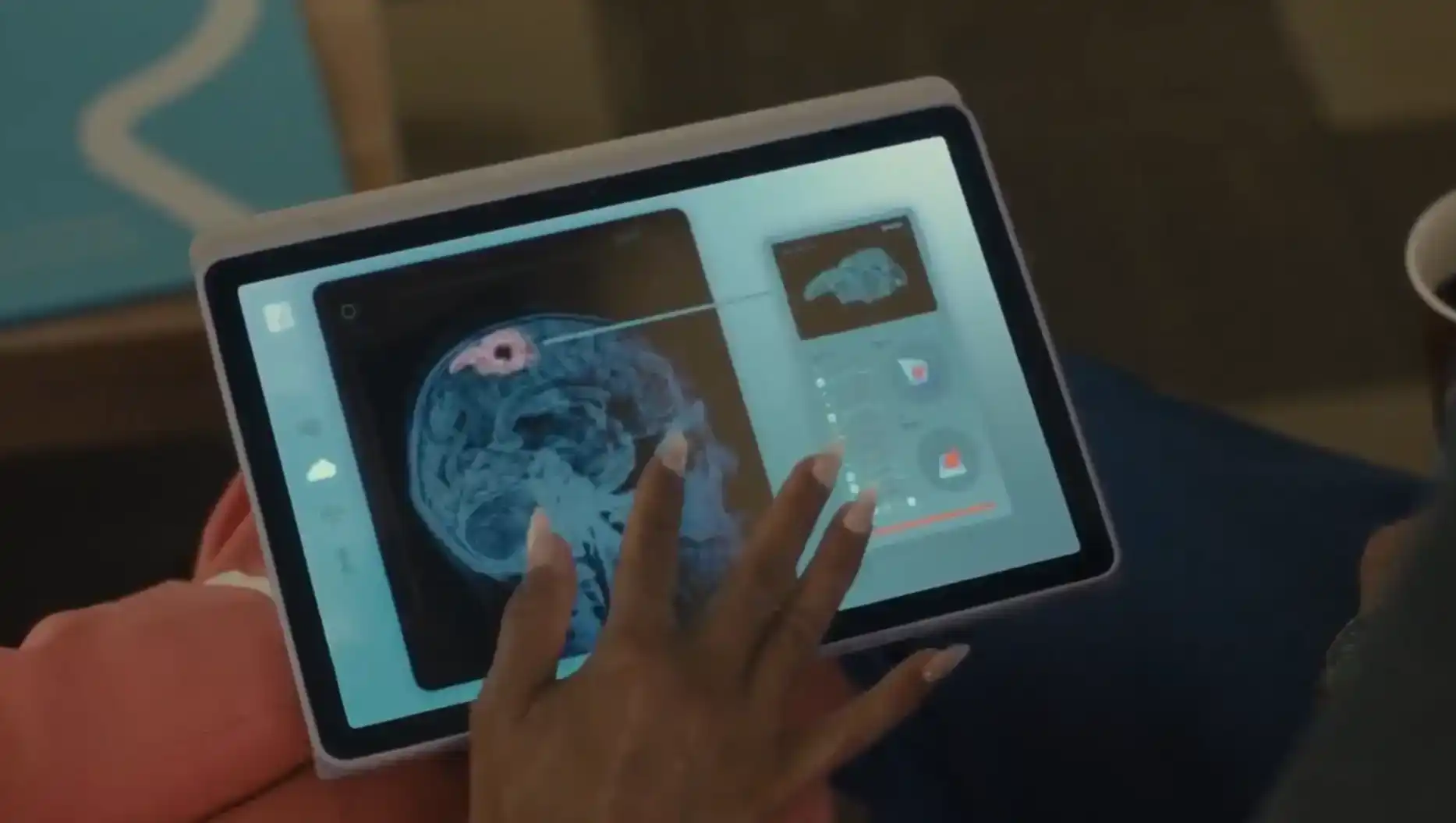
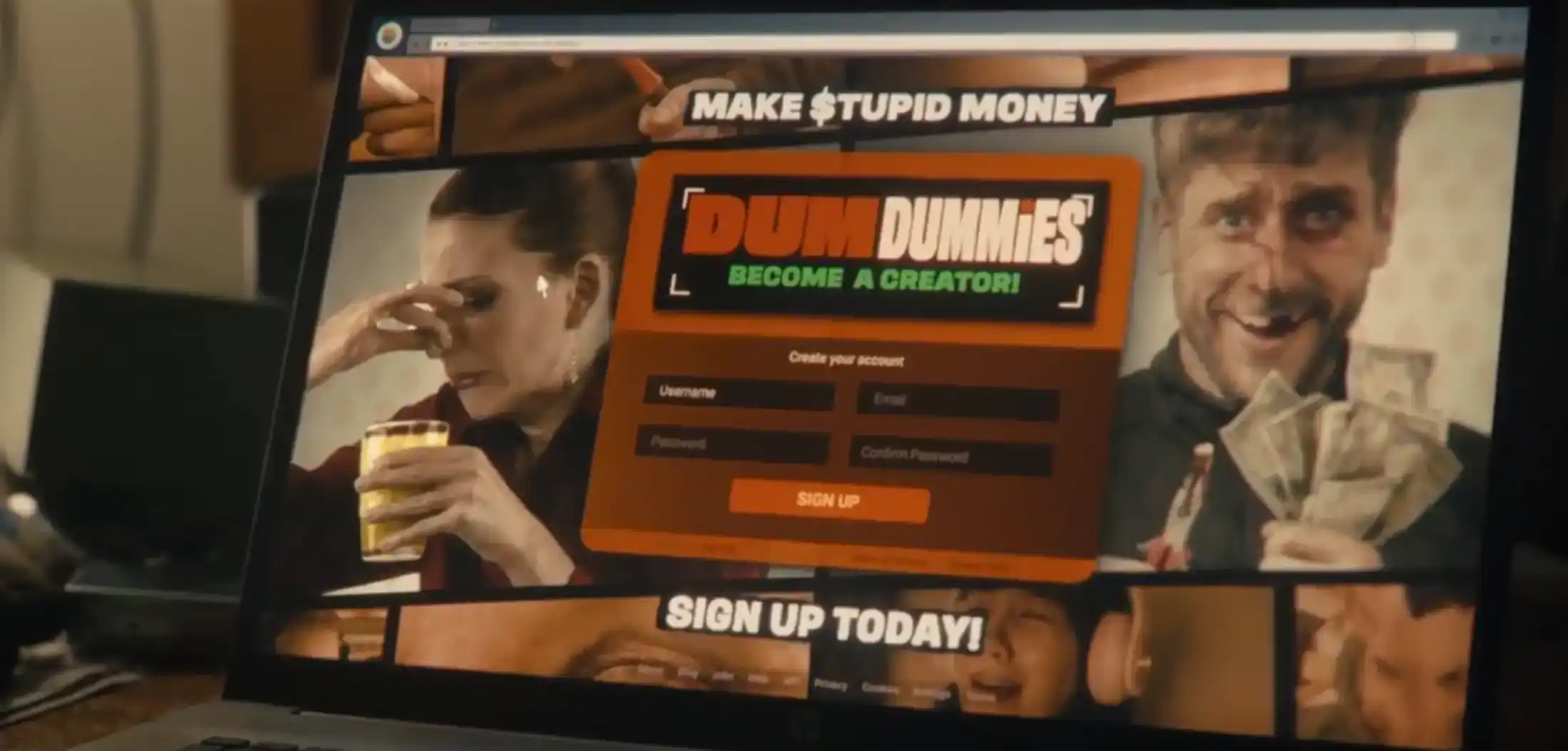
However, the subscription fees keep rising, and when Amanda is conscious, advertisements are involuntarily inserted. To secretly raise money, Mike starts live-streaming on the "Dum Dummies" platform—a website where viewers pay to instruct streamers to perform various humiliating tasks.
When exposed by a colleague, Mike loses his job, and the couple is plunged into despair.

A year later, Mike can no longer afford the premium service that maintains his wife's life. Amanda sleeps 16 hours a day, and her occasional awakenings are only to broadcast ads. Mike uses his last savings to buy 30 minutes of the premium package, allowing Amanda to leave her final words in brief peace.

When the time expires, Mike personally ends Amanda's life. The final shot freezes on the still-live laptop screen, with Mike holding a box cutter, walking into the darkness.

Being forced to sell one's dignity for the right to survive is the aspect that feels most chilling and oppressive in this episode. Therefore, when pump.fun launched a new feature called "Pump.fun Go" earlier this month, many couldn't help but think of this episode.

The story of Black Mirror is not far from our lives; it has even entered them.

$2,600 Is the Price of a Forehead Tattoo

The new pump.fun GO feature allows anyone to post paid bounty tasks on pump.fun.

This did attract the attention of mainstream media, but unfortunately, it touched the public in a negative light yet again.

$Bountywork, a token whose market cap once approached $2.5 million at its peak. Its developer, @ayushquantt, focused on continuously posting new tasks on pump.fun to generate hype for this token.

He succeeded—by offering a bounty of 40 SOL (approximately $2,600) for someone to tattoo $bountywork on their forehead.

An Indian man actually got the tattoo:
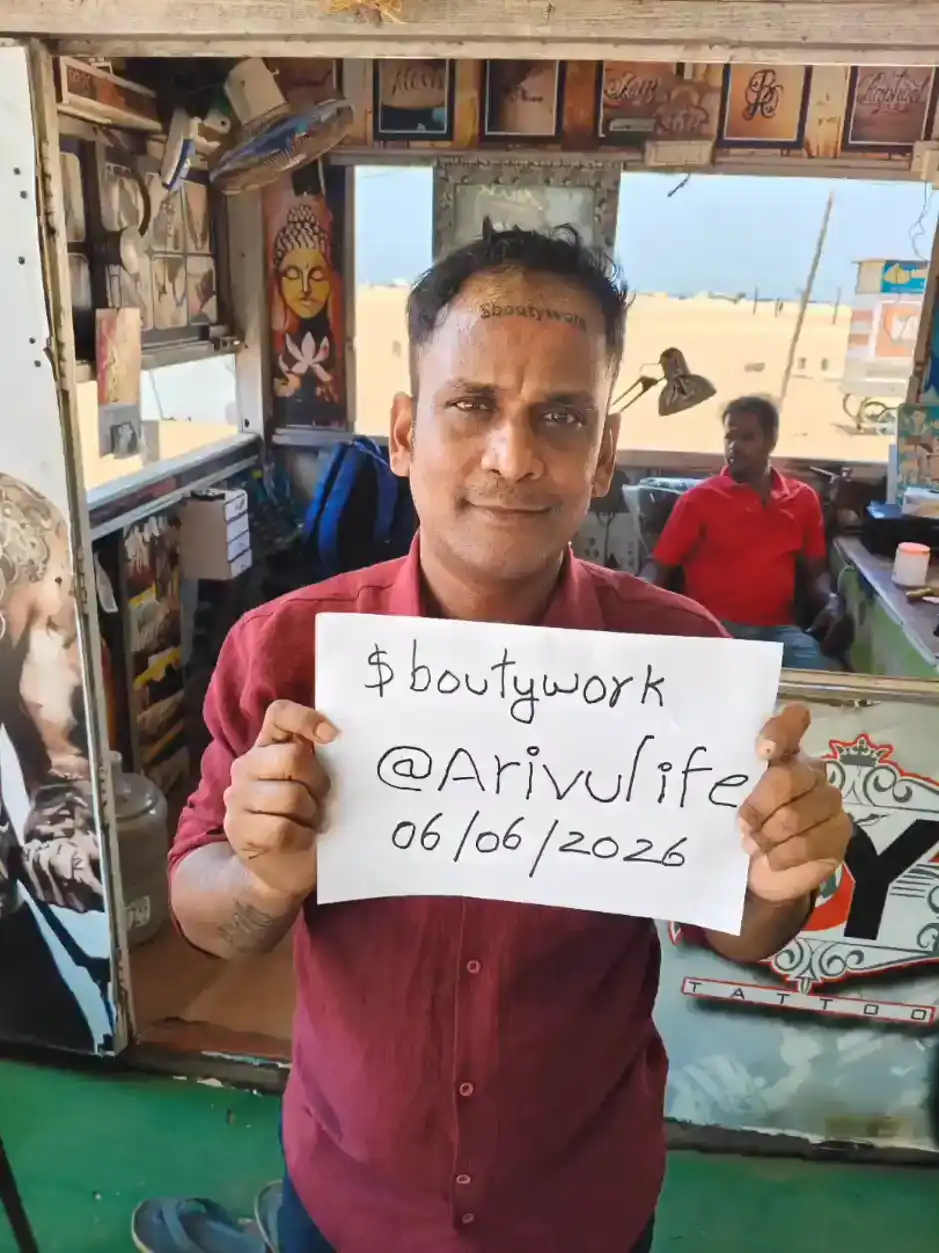
When submitting the full video of his tattooing process for bounty approval, he wrote in his remarks:

"Getting a permanent tattoo on the forehead, which will last a lifetime, is not an easy decision. The process itself was painful. It bled, and I had to endure the discomfort to complete it."

But his submission was rejected by the bounty poster due to a typo in the description—missing an 'n', writing the ticker as $boutywork. And this Indian man had precisely followed the requirements as described.

So, the next day, he went back to add a tattoo of the letter 'n':
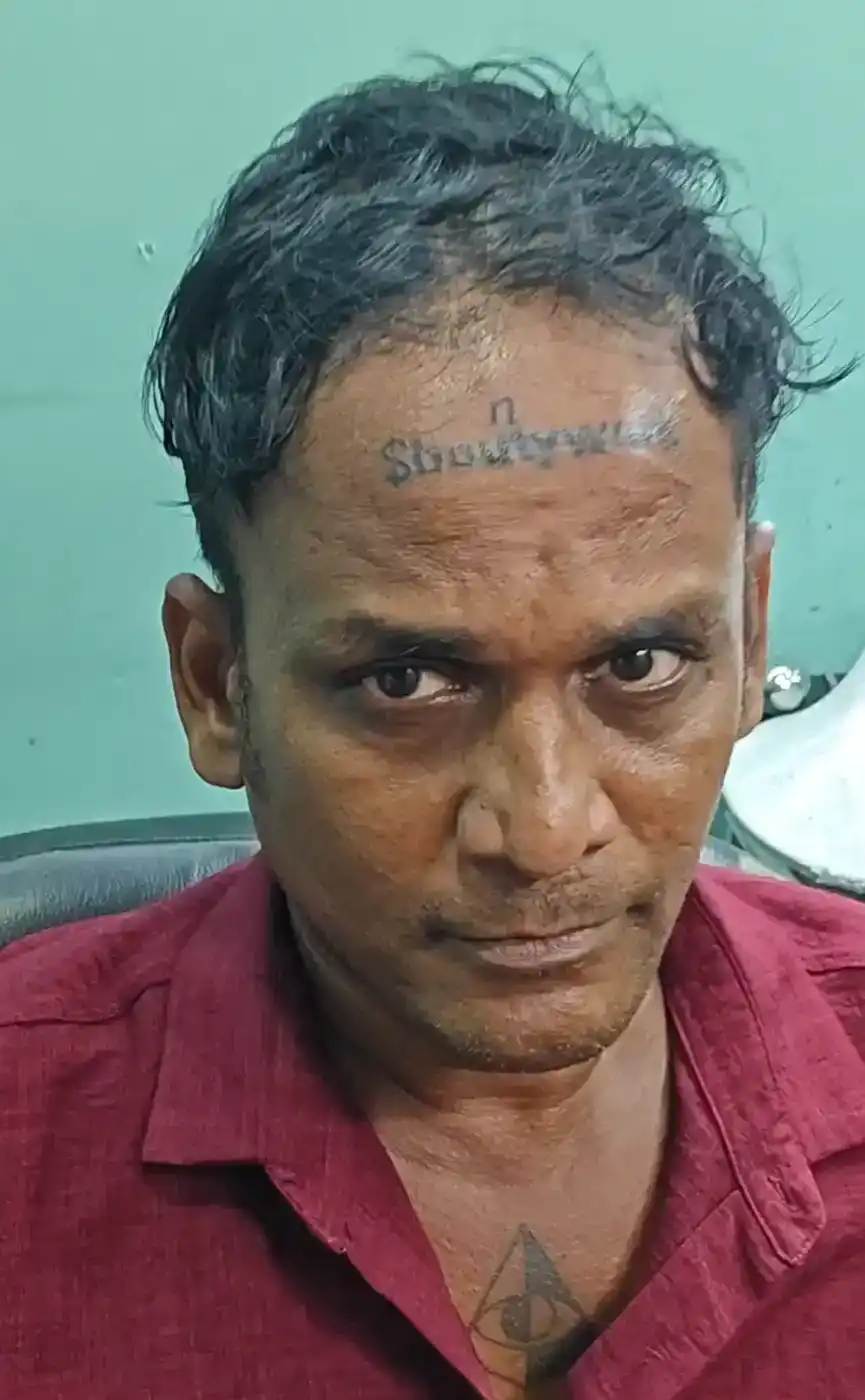
This time, he successfully received the bounty. $2,600 is the price of a forehead tattoo. He said this money changed his life.

But he earned far more than just that $2,600. After his initial bounty approval request was rejected, someone sent him a token called $boutywork, using the incorrect tattoo as the new token's name.

Because the incident had enough traction, this token accumulated over $5 million in trading volume. The creator's revenue from transaction fees was given to him, so he ended up earning about $48,000 in total.

And this wasn't even the highest single bounty earned for completing a tattoo task on pump.fun. Another bounty task posted by @Perporseful, also requiring a forehead tattoo with "bounty.fun," was completed on the same day it was posted. The person eventually received a bounty of 200 SOL (approximately $14,000).
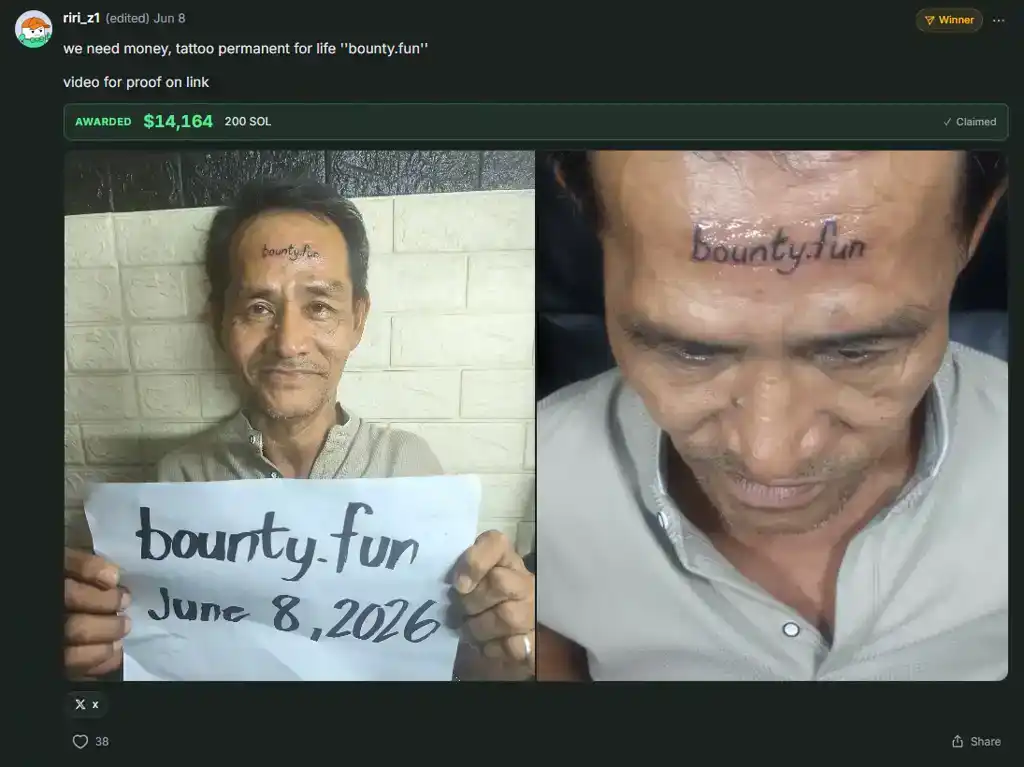
When submitting his tattoo proof for bounty approval, his remark was simple:

"We need money."

Priced Freedom Easily Amplifies Darkness

The hype around the Indian man's forehead tattoo has faded, and $boutywork has basically gone to zero. But the $Bountywork developer is still posting new bounties, trying to replicate this "success." For example, making someone wear a $Bountywork shirt and eat 3 bugs on camera.

Even though the bounty is only 2.5 SOL (about $178), not particularly generous, in the face of "We need money," this is hardly a challenge:

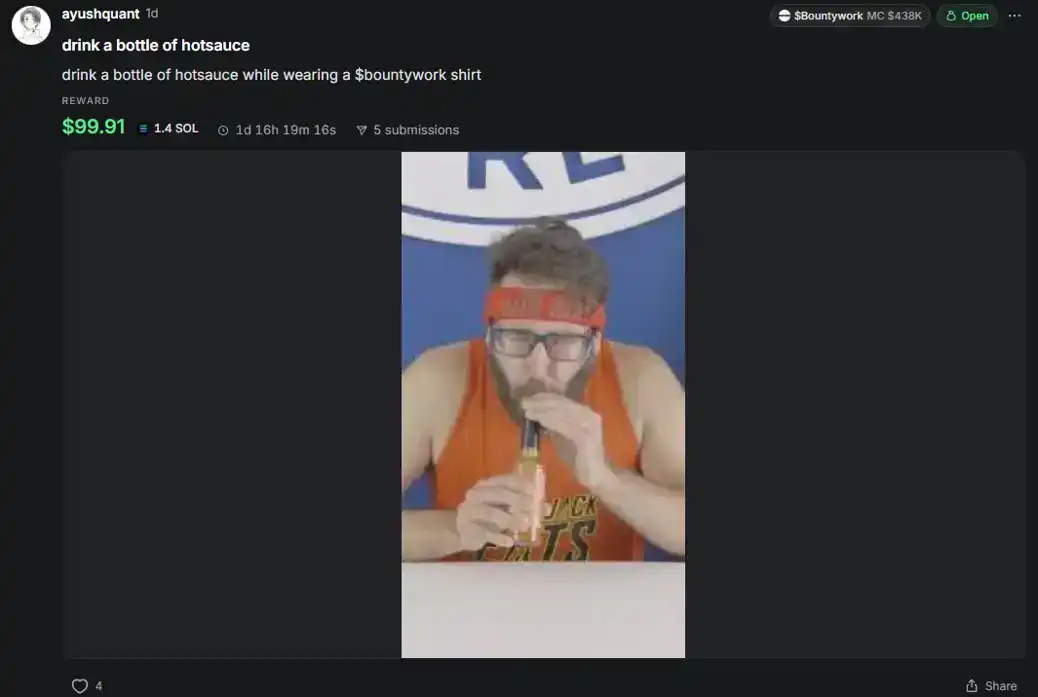
To continuously generate traffic for the $Bountywork token, @ayushquantt has spent $4,500 on various bounties. Besides the bug-eating challenge, there's also one like wearing a $Bountywork shirt and drinking a bottle of hot sauce for a bounty of 1.4 SOL (about $100):
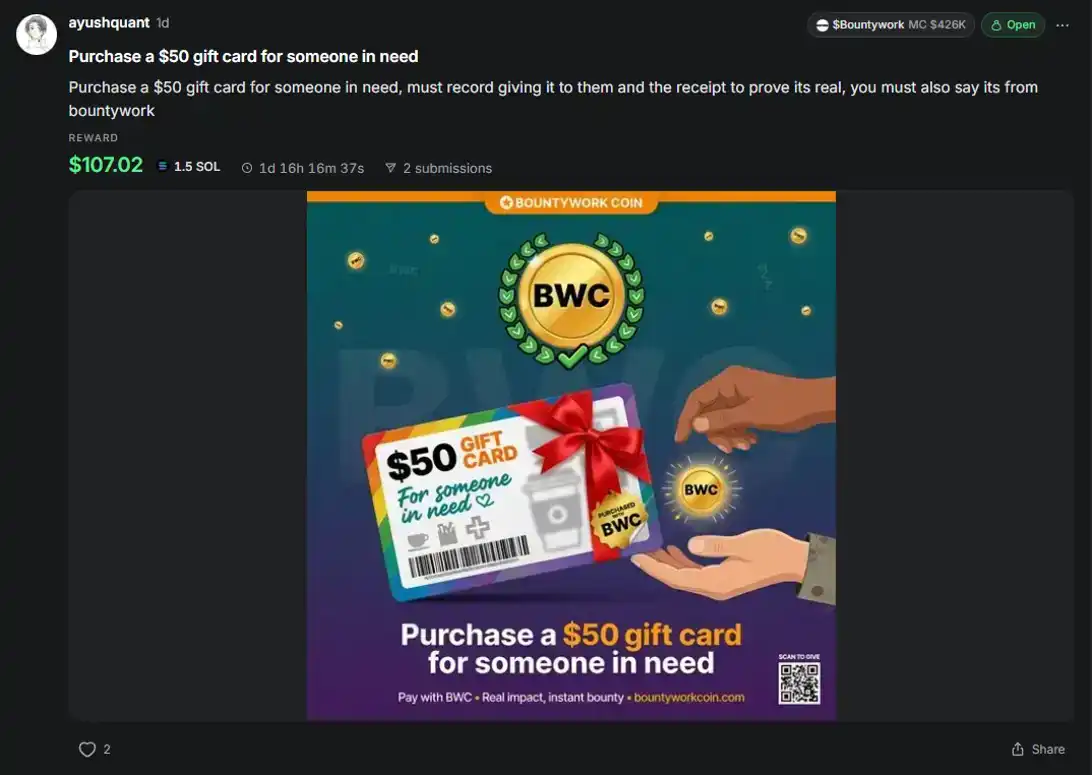
But he has also posted some relatively normal or even heartwarming bounty tasks. For example, gifting a $50 gift card in the name of $Bountywork to someone in need, with a bounty of 1.5 SOL (about $107):
It's difficult to judge the morality of such actions or even the new pump.fun feature. What's very obvious is that gifting a $50 gift card to someone in need barely creates a ripple in terms of traffic, but eating bugs or drinking hot sauce on camera is much more likely to gain attention.

I don't think this means "in an era where traffic equals money, we have all become slaves to traffic." Freedom often reveals itself in a raw, naked form; it's just that you and I have been 'protected' too well. We wouldn't get a forehead tattoo for $2,600 simply because we can still endure monthly salaries of a few thousand, venting our dissatisfaction with work and overtime in group chats and short video apps.

The Black Mirror episode mentioned at the beginning has long entered real life. During the 'wild west' era of live streaming, LiaoLiao Voice was once a popular platform. On December 31, 2018, a streamer with the online name "Da Fei," persuaded by the chat room host Wang and egged on by viewers, consumed a large amount of alcohol again and died of sudden cardiac arrest while out after drinking. In the three months before the incident, "Da Fei" had been live-streaming drinking every day, often drinking alcohol or soybean oil to earn tips.

In one of "Da Fei's" past live streams, he once said after drinking that he couldn't take it anymore and started convulsing. At that time, viewers in the chat room were still egging him on, "Pour what you vomited on your head, add another $300."

Others shouted, "LiaoLiao is finally going to have a death." Unexpectedly, it eventually came true.

Even in 2023-2024, with live streaming regulations becoming more mature, we can still find many cases of deaths due to excessive drinking during PK battles or binge-eating in mukbang streams.

"Desperate for fame," "Why go to such lengths for money?"—these are the final legacies these streamers leave for the internet, topics for after-dinner chatter, gradually disappearing into the massive daily data updates of the internet. Regulatory norms can indeed curb the excessive commodification of people by money, but ultimately cannot stop those on pump.fun who are willing to tattoo their faces for a few thousand dollars.

Because they really need the money.

Light in the Darkness

Although many bounties on pump.fun resemble Black Mirror or the dark web, you can also find some interesting and heartwarming things.

Organize a gathering in New York for people resisting work, promoting "Work is a scam," bounty $15,865. This is the kind of event that energizes a wage slave like me:
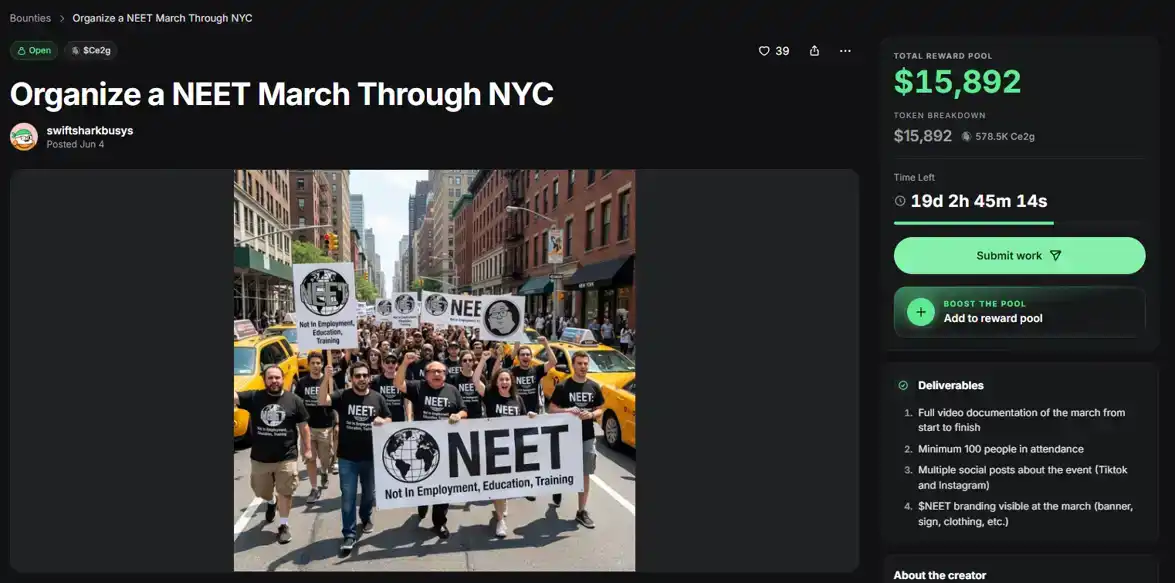
The $neet community has previously self-organized two offline "No Work Gatherings" in the US. If this bounty is completed, it will be the third.

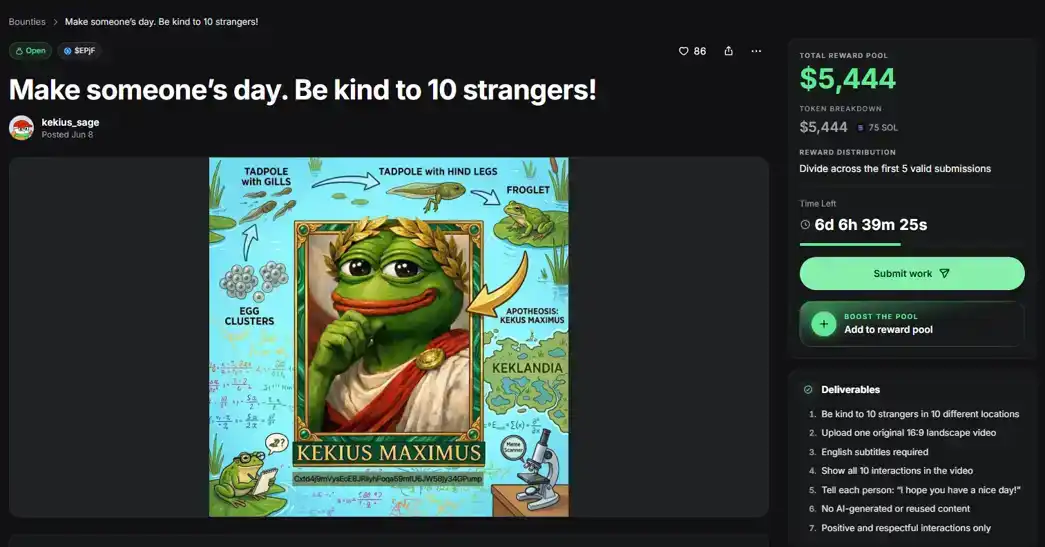
Show kindness to 10 strangers to make their day better. The bounty poster did not specify the method—treat them to a meal, give them flowers, books, buy them coffee, tell them to have a good day. The five best videos each receive a $1,000 bounty:
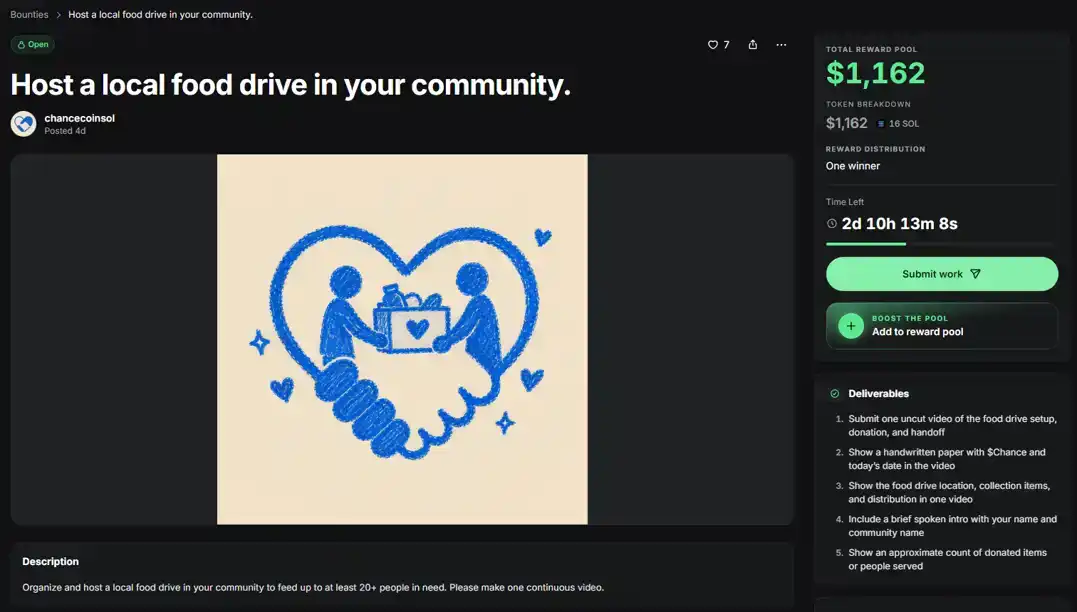
Organize a charity food donation in your local community, providing food to at least 20 people in need, bounty $1,161:
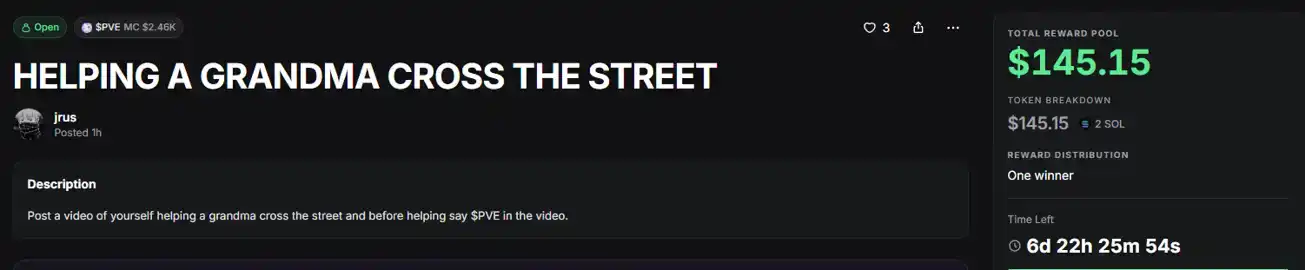
There's even one for helping an old lady cross the street, bounty $145:
The world is vast and full of wonders. We cannot escape the darkness; we can only hope for more light.


Trending Cryptos

Related Questions

QWhat is the core function of the new 'Pump.fun Go' feature mentioned in the article, and what real-world phenomenon does it draw a parallel to?

AThe 'Pump.fun Go' feature allows anyone to post and complete paid bounty tasks on the pump.fun platform. The article draws a parallel to the fictional dystopian reality presented in the Black Mirror episode 'Common People', where people are forced to trade their dignity for survival, as well as to real-world extreme live-streaming phenomena where individuals perform degrading or dangerous acts for money.

QAccording to the article, how much money did the Indian man earn in total from the '$bountywork' tattoo incident, and what were the sources?

AThe Indian man earned a total of approximately $48,000. This came from two sources: the initial 40 SOL (around $2,600) bounty for tattooing the correct '$Bountywork' on his forehead, and the creator fees from trading a separate meme coin named '$boutywork' (the incorrect spelling) that was launched based on the incident's viral attention.

QBeyond shock-value stunts like tattooing and eating insects, what are some examples of positive or socially beneficial bounty tasks found on pump.fun mentioned in the article?

AExamples of positive bounty tasks mentioned include: organizing a rally in New York for people rejecting work; performing acts of kindness for 10 strangers; organizing a community food donation for at least 20 people in need; and helping an elderly person cross the street.

QWhat real-life tragedy from the early days of live streaming does the article reference to illustrate that the 'Black Mirror' scenario is not just fiction?

AThe article references the 2018 case of a streamer nicknamed 'Da Fei' on the 'Liaoliao' platform. He frequently livestreamed heavy drinking to earn tips and eventually died of alcohol poisoning after being egged on by his audience and the chat room host.

QWhat is the article's implied critique regarding why some people are willing to perform extreme acts for relatively small bounties on platforms like pump.fun?

AThe article implies that the primary driver is genuine financial desperation, encapsulated in the simple submission note 'We need the money.' It suggests that societal judgment often overlooks this underlying economic necessity, framing such acts merely as a quest for fame or a sign of being 'crazy for attention,' when for some, it's a matter of survival.

Related Reads

Analyzing the Impact of AI on Economic Growth and Productivity

**Title: Analyzing AI's Impact on Economic Growth and Productivity** This article examines three contrasting views on AI's influence on economic growth and productivity. **The Optimistic View** posits that AI, especially through automating R&D ("recursive self-improvement"), could dramatically accelerate growth, even triggering a technological "singularity" with explosive, potentially infinite, economic expansion. **The Moderate/Mainstream View** acknowledges AI's productivity benefits but emphasizes significant real-world constraints that could limit its impact. These include: limited cost savings per task, structural ceilings on which jobs and industries are "exposed" to AI, adoption bottlenecks (e.g., compute, energy, regulatory hurdles), and the "weak link" effect where non-automatable tasks cap overall gains. Consequently, the realized AI dividend may be far lower than optimistic projections, with estimates typically ranging from 0.1% to 1.3% annual productivity growth. **The Pessimistic View** stems from two strands. The first aligns with the moderate view but applies extremely conservative assumptions about task exposure and efficiency gains, yielding minimal projected impact. The second introduces a demand-side critique: if AI primarily replaces rather than augments labor, it could depress labor's share of income, weaken consumer demand, and create a "demand trap" that ultimately stifles growth, unless offset by redistribution policies. **The authors' assessment** is nuanced: * **Short-term (1-2 years):** AI will support growth primarily through investment spending, not significant productivity gains. * **Medium-term (3-5 years):** Three potential paths emerge based on AI demand and bottleneck severity: 1. **"Optimistic Path":** High demand, few bottlenecks. Rapid productivity gains but risk of major job displacement and social conflict without redistribution. 2. **"Moderate Path" (most likely):** High demand but significant, surmountable bottlenecks. Leads to moderate productivity gains, financial market volatility (K-shaped returns), and sectoral job losses. 3. **"Pessimistic Path":** Low demand or severe bottlenecks. Minimal productivity and growth impact, triggering financial market corrections but allowing a smoother societal transition with less labor disruption. * **Long-term:** AI holds potential for a major productivity revolution and prosperity. The conclusion stresses that no path is smooth. Technologically "optimistic" outcomes could be socially detrimental, while "pessimistic" technological diffusion might be more socially stable. Policymakers must monitor developments and prepare balanced responses to manage economic, financial, and social sustainability.

marsbit4m ago

Analyzing the Impact of AI on Economic Growth and Productivity

marsbit4m ago

The New Cold War is a Tech Stock War

The New Cold War is a Tech Stock War The article argues that the contemporary geopolitical and economic rivalry between the US and China represents a "New Cold War," but one fundamentally fought through technology and financial markets, not physical barriers or conventional trade. Historically, US dominance was secured through financial systems. The Soviet Union, reliant on the rigid "Transferable Ruble," was ultimately undermined by its dependency on the US dollar for oil trade. Later, Japan's semiconductor challenge was countered not just by tariffs (e.g., Plaza Accord, 301 investigations) but by binding it to US Treasury bonds. China presents a more complex, "embedded" challenger. While it holds vast dollar reserves and US debt like Japan, its industrial base is stronger and more diversified than the Soviet Union's. Surviving the initial 2018 trade war phase, the conflict has evolved into a "tech-financial war." The core battlefield is now the stock market. US tech stocks (AI, semiconductors) are treated as sovereign assets, buoyed by bipartisan national will. China is pushing to strengthen its own financial markets to convert industrial strength into financial power and fund its tech ambitions. Companies like ChangXin (semiconductors), Moonshot AI, and DJI compete not just for market share but as financial proxies for their respective systems. The new paradigm is moving from globally efficient monopolies (Apple, Google) towards companies that achieve monopolistic profits within their respective geopolitical spheres. This competition over "pricing power" and financial valuation in segmented markets defines the current era, making the stock market the primary arena for this tech-centric struggle.

marsbit13m ago

The New Cold War is a Tech Stock War

marsbit13m ago

RWA Weekly: Ten European Financial Institutions Establish Tokenized Asset Cooperative; Ondo Launches New Execution Network Ondo Network

RWA Weekly: European Banks Form Tokenized Asset Cooperative; Ondo Launches New Execution Network Ondo Network Covering July 24-31, 2026, the RWA sector saw a steady on-chain total value locked (TVL) of $36.8 billion, with holder count hitting a record high. However, stablecoin transfer volumes fell sharply (~30%), indicating low on-chain settlement demand. Key regulatory moves include South Korea advancing stablecoin legislation and a push to scrap crypto taxes, Kenya lowering capital requirements for stablecoin issuers, and Zimbabwe approving seven projects for its crypto sandbox. In project developments, BIS-led Project Agorá successfully tested cross-border payments with tokenized funds across six currencies. Ten major European financial institutions formed the RL1 blockchain cooperative to build tokenized asset infrastructure. Other notable updates: Aviva launched a tokenized dollar liquidity fund on XRPL, POSCO International tokenized commercial invoices on Injective, and a Brazilian farmer used tokenized cattle as collateral for a loan. Additional progress includes BNY Mellon migrating its core transfer agent operations to blockchain, Securitize gaining SEC investment advisor registration, and Tether’s compliant stablecoin USA₮ launching on Celo. Ondo Finance introduced Ondo Network, a new execution layer focused on speed and privacy, moving away from its initial chain plans. An analysis highlights that despite the growing scale of on-chain RWAs (~$32B), approximately 90% remain underutilized in DeFi, pointing to a critical challenge in unlocking liquidity and fostering real-world application beyond mere issuance.

marsbit13m ago

RWA Weekly: Ten European Financial Institutions Establish Tokenized Asset Cooperative; Ondo Launches New Execution Network Ondo Network

marsbit13m ago

South Korean Stock Market Sees Sharp Rebound After Forceful De-leveraging, SK Hynix Rises 30%

On July 31, South Korean stocks staged a historic rebound. The benchmark KOSPI index surged 18.27%, with chipmaker SK Hynix hitting a 30% gain limit. This followed a brutal, near-40% decline in the KOSPI over the previous month, driven largely by a deleveraging spiral involving leveraged ETFs. Analysts attributed the sharp sell-off to structural liquidity issues rather than deteriorating corporate fundamentals. The rally was triggered by a confluence of positive catalysts. Firstly, strong earnings from U.S. cloud giants Microsoft and Amazon alleviated fears of an "AI bubble burst," boosting global tech sentiment. Secondly, SK Group Chairman Chey Tae-won made a rare personal purchase of SK Hynix shares, seen as a strong vote of confidence. Thirdly, the South Korean government announced a 20 trillion won ($139 billion) AI investment fund. In response to the market turmoil, South Korean regulators are tightening controls on leveraged ETFs, admitting oversight shortcomings. Measures include raising minimum cash保证金 requirements for散户 investors and suspending new product launches. While the rebound signals eased liquidity pressure, analysts note deep structural issues remain. The market's future stability is seen as dependent on global tech capital expenditure trends and memory chip price cycles, with some viewing the surge as a technical correction rather than a definitive trend reversal.

marsbit34m ago

South Korean Stock Market Sees Sharp Rebound After Forceful De-leveraging, SK Hynix Rises 30%

marsbit34m ago

Trading

Spot

Hot Articles

How to Buy PEOPLE

Welcome to HTX.com! We've made purchasing ConstitutionDAO (PEOPLE) simple and convenient. Follow our step-by-step guide to embark on your crypto journey.Step 1: Create Your HTX AccountUse your email or phone number to sign up for a free account on HTX. Experience a hassle-free registration journey and unlock all features.Get My AccountStep 2: Go to Buy Crypto and Choose Your Payment MethodCredit/Debit Card: Use your Visa or Mastercard to buy ConstitutionDAO (PEOPLE) instantly.Balance: Use funds from your HTX account balance to trade seamlessly.Third Parties: We've added popular payment methods such as Google Pay and Apple Pay to enhance convenience.P2P: Trade directly with other users on HTX.Over-the-Counter (OTC): We offer tailor-made services and competitive exchange rates for traders.Step 3: Store Your ConstitutionDAO (PEOPLE)After purchasing your ConstitutionDAO (PEOPLE), store it in your HTX account. Alternatively, you can send it elsewhere via blockchain transfer or use it to trade other cryptocurrencies.Step 4: Trade ConstitutionDAO (PEOPLE)Easily trade ConstitutionDAO (PEOPLE) on HTX's spot market. Simply access your account, select your trading pair, execute your trades, and monitor in real-time. We offer a user-friendly experience for both beginners and seasoned traders.

7.7k Total ViewsPublished 2024.03.29Updated 2026.06.02

How to Buy PEOPLE

Discussions

Welcome to the HTX Community. Here, you can stay informed about the latest platform developments and gain access to professional market insights. Users' opinions on the price of PEOPLE (PEOPLE) are presented below.

活动图片