Over the past nine months, the realized hashrate of a group of public bitcoin miners, excluding Bitdeer, has fallen by 21.2%. Such estimates are provided by MinerWeekly.
The aggregate indicator decreased from 368.3 EH/s in the fourth quarter of 2025 to 319.0 EH/s in the second quarter of 2026.
Analysts from the magazine claim that first cryptocurrency mining companies are reducing capacity to relocate it to AI and HPC infrastructure.
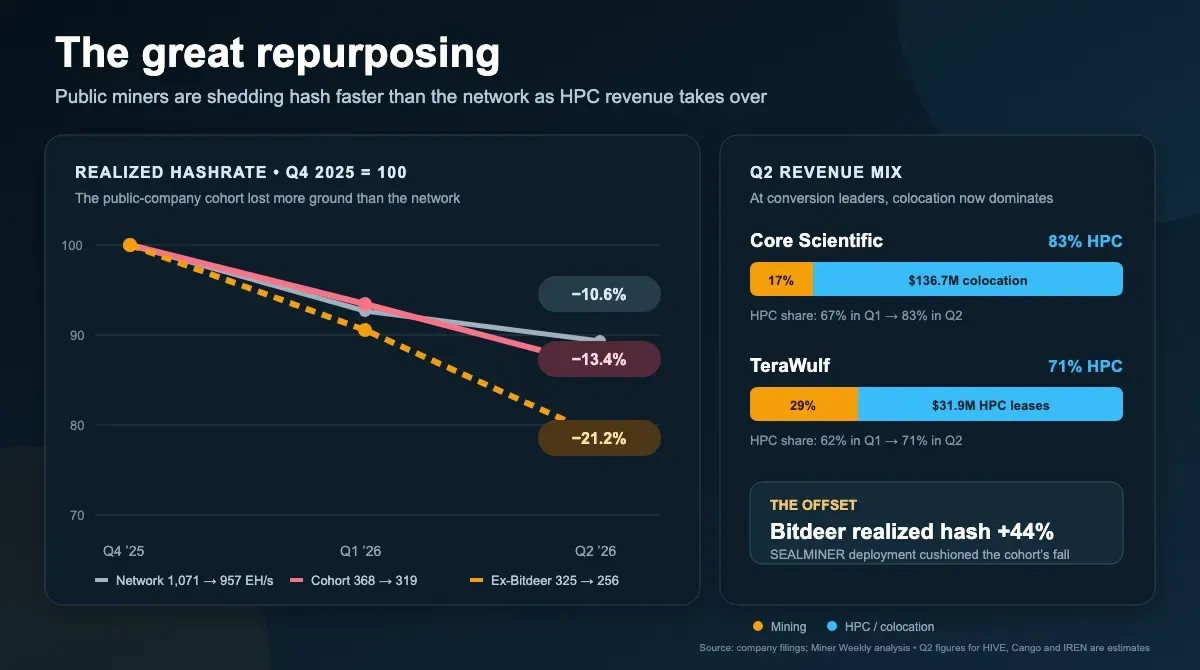
The indicators of the Bitcoin network itself have declined more gently. The average quarterly hashrate was 1,071 EH/s in Q4 2025, 993 EH/s in Q1 2026, and 957 EH/s in Q2.
The total decrease reached only 10.6%. Bitdeer provides the key divergence.
MinerWeekly noted that some companies were winding down mining faster than others could increase capacity.
Bitdeer, on the contrary, compensated for the shortfalls: its realized hashrate increased by 44% — to 63 EH/s.
Reasons for the Decline
The authors associate the shift with growing revenue from colocation and computational infrastructure for AI. In the second quarter, Core Scientific received $136.7 million from additional placements compared to $27.5 million from bitcoin mining.
TeraWulf's revenue from HPC leasing reached $31.9 million (71% of the total), while mining brought in $12.8 million.
The transition looks weaker for other miners. Riot Platforms reported $23.2 million in revenue from data centers against $113.7 million from mining. Bitdeer received $14 million from cloud AI services and $197.1 million from mining-related areas.
Hut 8 and MARA indicated a smaller contribution from computational services, while Cipher and Keel Infrastructure have not yet recorded revenue from HPC.
Experts characterized the current downturn as an effect of weak mining economics and competition for capital and electricity from AI loads.
MinerWeekly recalled that after the mining ban in China in June 2021, the network's hashrate briefly fell to 57.5 EH/s and almost recovered by December.
Recall that in August 2026, bitcoin miners' revenue from fees fell to a 10-year low.
Capitulation or Evolution: Why Miners Are Betting on Artificial Intelligence