Polymarket Faces New Roadblock As Dutch Regulator Bans Prediction Activity — Details

bitcoinistPublished on 2026-02-22Last updated on 2026-02-22

Abstract

Polymarket's Dutch operations, under the entity Adventure One, have been ordered to cease all activities by the Netherlands Gambling Authority (Ksa) for offering unlicensed prediction markets, which the regulator classifies as illegal gambling. The platform faces potential fines of up to $840,000 per week for non-compliance. This action is the latest regulatory challenge for Polymarket, creating a conflict between US federal approval and state-level scrutiny. The news coincides with a recent parliamentary proposal in the Netherlands to introduce a controversial 36% tax on unrealized gains from cryptocurrencies and other investments, a move critics warn could drive investors out of the country.

According to recent reports, the Dutch arm of the prediction markets platform Polymarket has been asked to cease its activities in the Netherlands. This order comes as the latest regulatory blow dealt to the prediction market platform in recent weeks.

Dutch Regulator Threatens Polymarket With $840,000 Fine

In a notice dated Tuesday, February 17, the Netherlands Gambling Authority ordered Polymarket’s Dutch arm, Adventure One, to “cease its activities immediately” or risk incurring up to $840,000 in fines per week. According to the Dutch regulator, Adventure One offered illegal bets, including on the local elections, to residents without a license.

While prediction markets do not particularly fall into the traditional gambling category, the Netherlands Gambling Authority has classified them as betting. The regulator revealed that it contacted Polymarket about its activities on the Dutch market, but have seen no corrective action or response from the prediction markets company.

Netherlands Gambling Authority’s director of licensing and supervision, Ella Seijsener, said in the notice:

Prediction markets are on the rise, including in the Netherlands. These types of companies offer bets that are not permitted in our market under any circumstances, not even by license holders. Besides the social risks of these kinds of predictions (for example, the potential influence on elections), we conclude that this constitutes illegal gambling. Anyone without a Ksa license has no business in our market. This also applies to these new gambling platforms.

This restriction in the Netherlands marks the latest stumbling block for Polymarket in terms of regulation over the past few months. Despite receiving approvals from the United States Commodity Futures Trading Commission (CFTC), individual state authorities have placed significant scrutiny on the activities of prediction market platforms.

This has led to an issue of jurisdiction, as the CFTC chair criticized the state-level scrutiny which undermines their federal authority over prediction markets.

Dutch Unrealized Gains Tax On Crypto Rolls On

This crackdown on prediction markets comes just a week after the Dutch House of Representatives advanced a proposal to introduce a 36% capital gains tax on most liquid investments, including cryptocurrencies. This controversial bill, if passed, would see profits made from interest-bearing financial instruments, equity investments, cryptocurrencies, and savings accounts be subject to tax, whether realized or not.

The proposal of this capital gains tax led to interesting reactions, with several crypto analysts noting that the legislation will drive investors out of the Netherlands. “To be honest, the fact that there’s the unrealized gains tax for Bitcoin in the Netherlands is the dumbest thing I’ve seen in a long time. The amount of people willing to flee the country is going to be bananas,” analyst Michaël van de Poppe said on X.
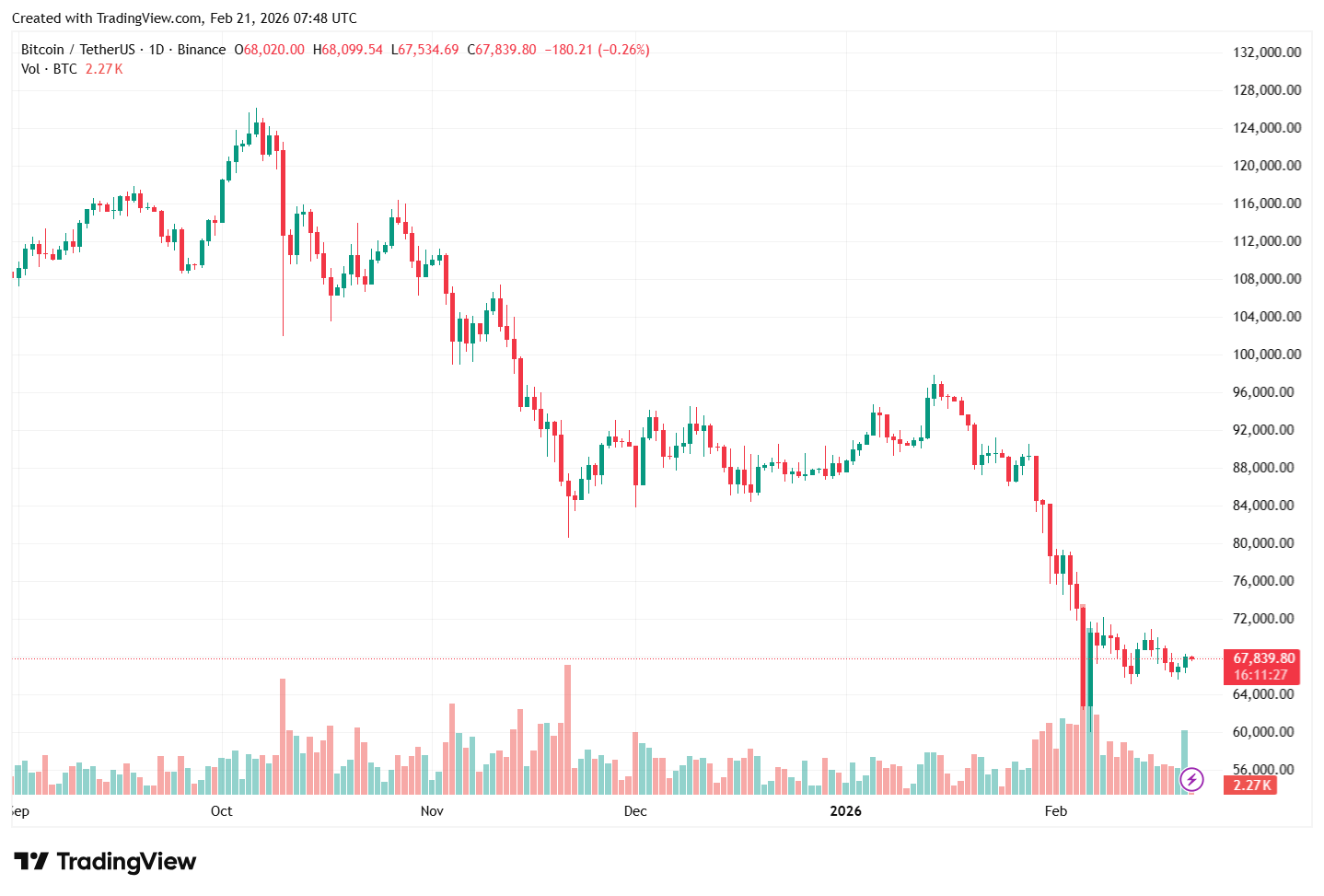
The price of BTC on the daily timeframe | Source: BTCUSDT chart on TradingView


Related Questions

QWhat action did the Dutch Gambling Authority take against Polymarket's Dutch arm, Adventure One?

AThe Dutch Gambling Authority ordered Adventure One to cease its activities immediately or face fines of up to $840,000 per week.

QWhat was the primary reason given by the Dutch regulator for banning Polymarket's activities?

AThe regulator classified Polymarket's prediction markets as illegal gambling, stating they offered bets that are not permitted in the Dutch market without a license, including on events like local elections.

QHow did the director of licensing, Ella Seijsener, justify the crackdown on prediction markets?

AElla Seijsener stated that prediction markets offer illegal bets, pose social risks such as potential influence on elections, and constitute illegal gambling that requires a license to operate in the Netherlands.

QWhat recent tax proposal in the Netherlands has also impacted the crypto space?

AThe Dutch House of Representatives advanced a proposal to introduce a 36% capital gains tax on most liquid investments, including cryptocurrencies, taxing both realized and unrealized gains.

QWhat concern did crypto analyst Michaël van de Poppe raise about the proposed Dutch tax on unrealized crypto gains?

AMichaël van de Poppe called the tax 'the dumbest thing I’ve seen in a long time' and predicted that it would cause a significant number of people to flee the country.

Related Reads

MoneyGram: Why Did We Launch Our Own Stablecoin?

MoneyGram, a global leader in cross-border remittances for over 80 years, has launched its own stablecoin, MGUSD. The initiative aims to evolve from single-transaction services to becoming a more integral part of users' financial lives. By allowing customers to hold a stable US dollar balance within the MoneyGram app, MGUSD enables not only remittances but also everyday spending, currency exchange, cash access, and future financial services. Targeting the billions globally who face challenges like currency volatility or lack of bank accounts, MGUSD leverages Stellar blockchain technology with a self-custody wallet architecture. This gives users control over their assets while providing a secure, compliant experience through a trusted brand. The approach focuses on solving existing customer pain points within MoneyGram's established network, rather than competing for broad crypto market liquidity. A key advantage is MoneyGram's hybrid model, combining digital services with the world's largest physical network for crypto-to-cash conversions. The stablecoin also modernizes the company's internal infrastructure, streamlining treasury management and partner settlements, with annual forex volume via stablecoins already reaching $2 billion. The project was delivered in about a year, driven by a reorganization into agile, cross-functional teams that operate with startup-like speed while leveraging decades of institutional expertise. Partners include Stablecoin (issuance), Crossmint (wallet APIs), Fireblocks (enterprise treasury), m0 (smart contracts), and the Stellar network. MoneyGram emphasizes that enhancing direct consumer offerings strengthens its partner ecosystem. The future direction is clear: to provide users worldwide with stable value storage, better financial tools, and greater control over their funds through a trusted, existing network.

Foresight News35m ago

MoneyGram: Why Did We Launch Our Own Stablecoin?

Foresight News35m ago

BIP-110 Controversy Intensifies: Bitcoin May Face Its Most Divisive Hard Fork Battle in Years

Bitcoin is approaching a critical block height of 961,632, which could activate the controversial BIP-110 proposal. This proposal aims to restrict the amount of non-financial data, such as inscriptions and other large data payloads, within Bitcoin transactions. Supporters, including some node operators and Bitcoin purists, argue that BIP-110 is necessary to preserve Bitcoin's core function as a monetary settlement layer by reducing network congestion and node operational burdens caused by non-essential data. They frame it as a correction to keep the network true to its original purpose. However, critics, including prominent figures like Blockstream's Adam Back and developer Jameson Lopp, warn that the proposal's implementation mechanism is dangerously flawed. They highlight that its low 55% miner signaling threshold, coupled with a contentious enforcement mechanism allowing nodes to unilaterally reject non-compliant blocks, significantly increases the risk of a chain split. Opponents argue this sets a dangerous precedent for transaction censorship, undermines Bitcoin's protocol neutrality, and creates excessive uncertainty for developers and businesses, especially since the rule is proposed as a temporary one-year measure. Market analysts, such as those from Bitfinex, suggest a full-scale network split is unlikely due to a lack of broad economic consensus. Major mining pools remain neutral, and adoption of the new rules is minimal. They view the situation more as a governance stress test. The primary risk is operational disruption: if a minority chain persists, major exchanges and custodians may need to temporarily suspend Bitcoin deposits and withdrawals to manage security and liquidity, potentially unsettling newer institutional investors. While BIP-110 is not expected to succeed in overtaking the main chain, its approach has ignited a significant debate about Bitcoin's governance, core values, and resilience.

Foresight News1h ago

BIP-110 Controversy Intensifies: Bitcoin May Face Its Most Divisive Hard Fork Battle in Years

Foresight News1h ago

Crypto Market Makers Are Collectively Seeking Change as Money Becomes Harder to Earn

**Summary: Crypto Market Makers Adapt as Margins Shrink** Leading crypto market maker GSR exemplifies a broader industry shift, moving beyond traditional market-making to become a full-service "Web3 investment bank." Its recent strategic acquisitions—including an SEC-registered broker-dealer, rebranded as GSR Securities—and purchases of token advisory firms aim to create an integrated platform covering token design, fundraising, listing, liquidity provision, and asset management. This includes launching an ETF and investing in tokenization platforms like Libeara, backed by a strategic investment from Standard Chartered's SC Ventures. This transformation is not unique to GSR. Other major players like Keyrock, B2C2, Wintermute, and DWF Labs are also expanding geographically, pursuing regulatory licenses (especially under frameworks like MiCA in the EU), and diversifying into over-the-counter (OTC) trading, asset management, and real-world asset tokenization. The driving force behind this collective pivot is a rapidly changing market. Profits from traditional altcoin market-making are declining due to fewer viable projects, reduced client budgets, increased competition, and smarter, more demanding clients. Simultaneously, regulatory pressures are mounting, making compliance a baseline cost. Extreme market events further expose teams lacking robust risk controls. Consequently, the crypto market-making business model is evolving from one reliant on information asymmetry and volatility to a more institutionalized, regulated, and service-diverse industry. Survival now depends on building systemic capabilities beyond mere liquidity provision.

marsbit2h ago

Crypto Market Makers Are Collectively Seeking Change as Money Becomes Harder to Earn

marsbit2h ago

Trading

Spot
Futures
活动图片




