Polygon Labs announces second round of 2026 layoffs as it targets profitability in 2027

ambcryptoPublished on 2026-07-16Last updated on 2026-07-16

Abstract

On July 16, 2026, Polygon Labs CEO Marc Boiron announced the company's second round of layoffs for the year. This move, described as "difficult, but necessary," is part of a strategic shift to transition into a "blockchain-enabled payments company" as it finalizes its acquisition of Coinme. These layoffs mark the fourth workforce reduction since February 2023, following earlier cuts of 60 staff after the $250 million acquisitions of Coinme and Sequence in January 2026. The restructuring aims to support the vision for the Polygon Open Stack, focusing on enabling seamless on-chain money transfers. Polygon Labs clarified its distinction from the Polygon Foundation, which handles network upgrades and the ecosystem. Meanwhile, the native token POL has struggled, down approximately 94% from its all-time high and 56% from a January peak. While some technical indicators showed short-term buying pressure in July, a sustained price recovery is contingent on increased network utility and organic token demand, requiring a move above $0.095 to shift the longer-term bearish trend.

On Thursday, July 16, Polygon Labs [POL] CEO Marc Boiron announced the second round of layoffs for 2026.

Polygon was in the final stages of completing the Coinme acquisition, and this move will help transition the blockchain company towards a “blockchain-enabled payments company”, the CEO wrote in a post on X.
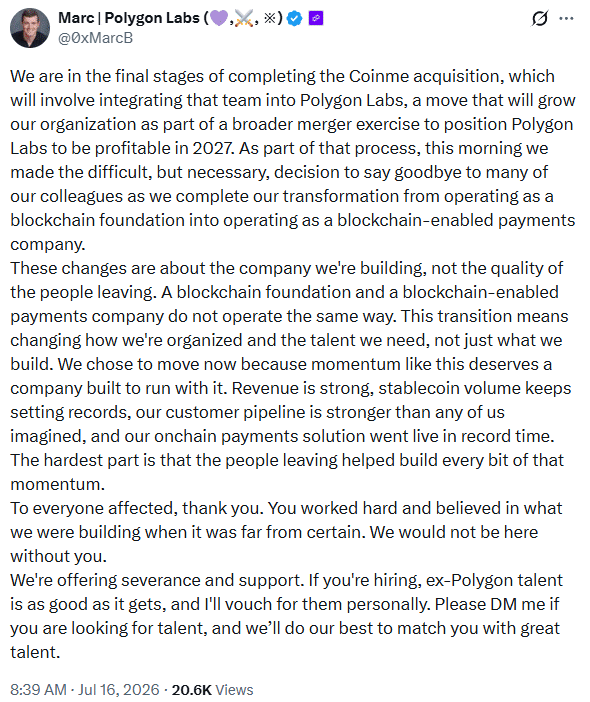
Source: Marc Boiron on X

Hence, the “difficult, but necessary” decision to let people go was made. This was the company’s fourth wave of reductions dating back to February 2023.

Coinme, the crypto exchange, and Sequence, the wallet infrastructure firm, were acquired for $250 million in January 2026. Layoffs of 60 staff members back then had been because the company was pivoting to a payment focused blockchain. They were part of restructuring after the acquisitions, a spokesperson had said.

The vision for the Polygon Open Stack is to enable seamless money transfers onchain, explaining the need for these acquisitions and their integrations.

Specific figures were not shared for Thursday’s layoffs.

The path ahead for POL

It was reported that a Polygon representative observed that the Polygon Labs and Polygon Foundation were legally and structurally distinct entities. The acquisitions and commercial vision of the former has been laid out.

Meanwhile, the Foundation is tasked with network upgrades, treasury, and ecosystem. POL, the network’s native token, was down nearly 94% from its all-time highs. Its holders have no equity and no claim in Polygon Labs’ future profits.

As such, the token’s bearish price action could be set to continue in the long-run, unless network utility picks up, creating more demand and forcing more token burns through the deflationary mechanic.
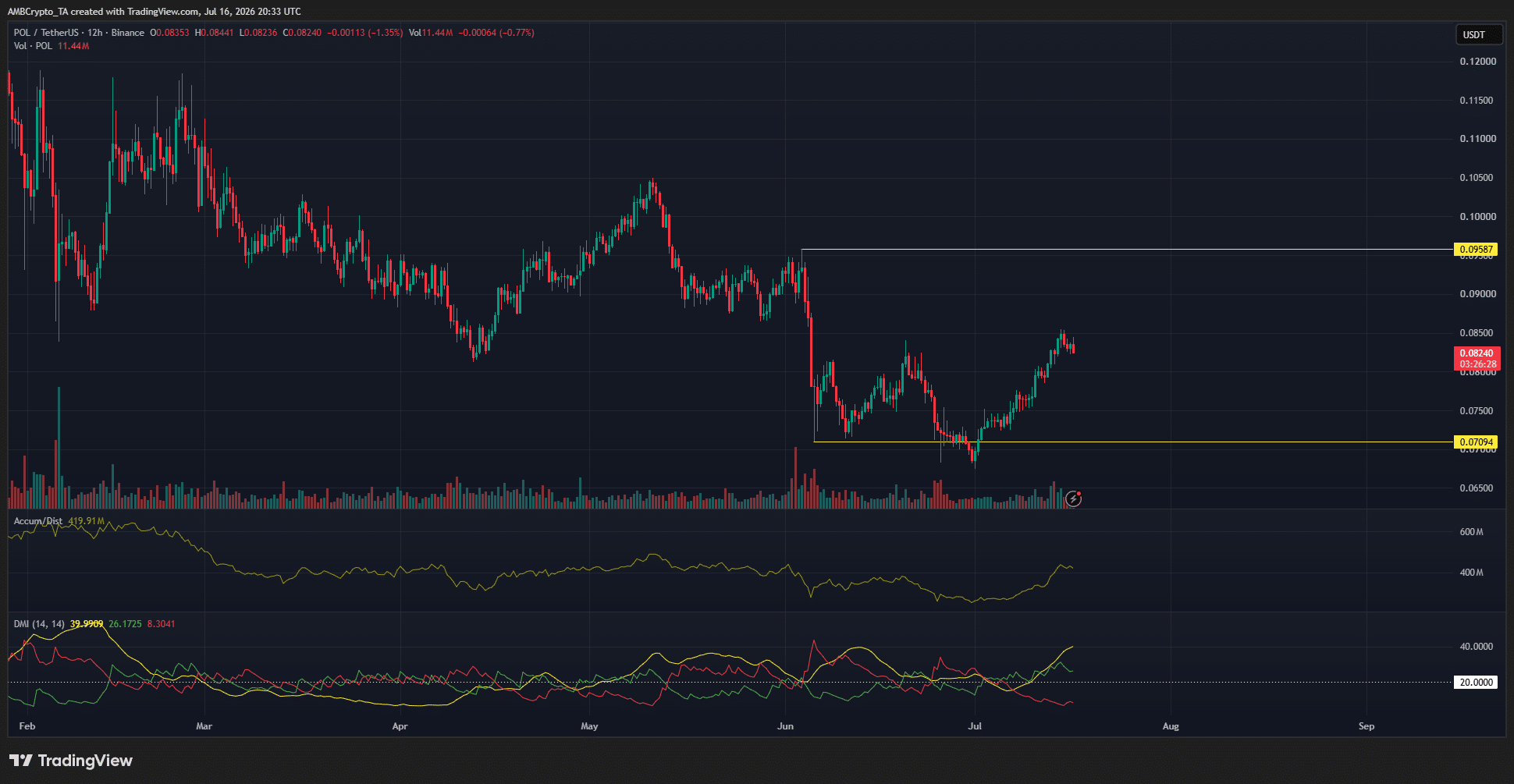
Source: POL/USDT on TradingView

The A/D indicator signaled buying pressure in July, and the DMI showed an uptrend in progress. Yet, the technical indicators did not capture the longer-term downtrend.

POL was down 56% since making a high of $0.186 in January earlier this year. The gains in July were not enough to shift the trend bullishly. A price move beyond $0.095 is needed.

Beyond the price action of the past six weeks, increased network usage and organic POL demand is needed to drive its recovery.


Final Summary

  • Polygon Labs CEO Marc Boiron announced the second round of layoffs for 2026, as the firm moved to finalize the Coinme acquisition.
  • The Polygon Open Money Stack vision envisioned as a seamless, global, blockchain-based payments platform.


Related Questions

QWhat was the main reason provided by Polygon Labs CEO for the second round of layoffs in 2026?

AThe main reason was to help transition the blockchain company towards becoming a 'blockchain-enabled payments company' as it finalizes the Coinme acquisition.

QWhich two companies did Polygon acquire for $250 million in January 2026, and how many staff were laid off at that time?

APolygon acquired the crypto exchange Coinme and the wallet infrastructure firm Sequence for $250 million, and laid off 60 staff members as part of restructuring after the acquisitions.

QWhat is the stated vision for the Polygon Open Stack, and how does it relate to the recent acquisitions?

AThe vision for the Polygon Open Stack is to enable seamless money transfers onchain. This vision explains the need for the acquisitions of Coinme and Sequence and their subsequent integrations to build a global, blockchain-based payments platform.

QAccording to the article, what are the key distinctions between Polygon Labs and the Polygon Foundation?

APolygon Labs and the Polygon Foundation are legally and structurally distinct entities. Polygon Labs handles acquisitions and commercial vision, while the Polygon Foundation is tasked with network upgrades, treasury management, and ecosystem development.

QWhat does the article identify as a necessary condition for reversing POL's long-term bearish price trend?

ATo reverse POL's long-term bearish trend, the article states that increased network utility, creating more organic POL demand, and forcing more token burns through the deflationary mechanic are needed.

Related Reads

Thanks to Dice Rolls, Bitcoin Keys Are Stored Offline, But Not Everyone Will Do It

The article discusses using dice rolls to generate secure Bitcoin wallet seeds, providing entropy independent of potentially flawed hardware random number generators. It explains that each fair dice roll offers about 2.585 bits of entropy, with around 50 rolls needed for a standard 12-word seed phrase and 99+ recommended for higher security. This method gained attention after a vulnerability was revealed in some Coldcard hardware wallets, where a faulty firmware RNG (dating back to 2021) compromised generated keys. The analysis notes that while a dice-generated main seed was safe from this specific flaw, other Coldcard functions (like creating paper wallets, backup keys, or passwords) could still be vulnerable if they used the defective RNG. The piece argues that while dice-based entropy is technically robust, the manual process is error-prone, tedious, and unrealistic for most new users, who might make mistakes in recording or inputting rolls. It concludes that while manual entropy generation should remain an option for advanced users, the long-term goal is to develop reliable, user-friendly hardware and software that securely generates randomness without requiring specialized knowledge. Coldcard users are advised to check their firmware version and replace any secondary secrets (like paper wallet keys) created with vulnerable devices, while also considering multi-signature setups with devices from different manufacturers for added security.

cryptonews.ru4h ago

Thanks to Dice Rolls, Bitcoin Keys Are Stored Offline, But Not Everyone Will Do It

cryptonews.ru4h ago

Trading

Spot
活动图片



