Perspective: The current AI supercycle will last 15 years, but most are still buying stocks in the first FOMO stage

marsbitPublished on 2026-05-09Last updated on 2026-05-09

Abstract

This article outlines a 15-year AI supercycle, segmented into four investment stages. It argues that while most investors are still focused on the first stage, smart money is already moving to the third. **Stage 1: The Foundation (2023-2025) - Priced In** The semiconductor layer (e.g., NVIDIA, AMD) is complete. While growth continues, the historic entry opportunity is over as risk/reward has compressed. **Stage 2: The Build-Out (2025-2027) - In Progress** This phase involves building the necessary physical infrastructure: power/utilities (CEG), cooling (VRT), networking (ANET), and nuclear SMRs (OKLO, SMR). Significant upside remains, but obvious names have already moved. **Stage 3: The Asymmetric Bet (2026-2028) - Positioning Window** AI moves into the physical world. Key areas include robotics/autonomy (Tesla Optimus), space/defense/drones (Rocket Lab, LUNR), and critical materials. This stage presents the best asymmetric risk/reward and is where positioning should occur now. **Stage 4: The Endgame (2028+) - Software Dominance** The mega-cap cloud platforms (Microsoft, Alphabet, Amazon, Meta), with their massive capital expenditure, will build the AI software layer and AGI infrastructure, aiming to win the entire cycle. **Core Conclusion:** The cycle is confirmed in Stage 2. Stage 3 (robotics, space, defense, nuclear SMRs) is where capital is currently rotating for maximum opportunity, while the majority of investors are expected to be 12 months behind this shift.

Author: Rand Group (@cryptorand)

Compiled by: Deep Tide TechFlow

Deep Tide Intro: Crypto KOL Rand Group breaks down the AI supercycle into four stages, from chips to infrastructure to robots to platform software, marking the core targets and risk-reward ratios for each stage. His judgment is: Stage 1 (Semiconductors) is over, Stage 2 (Power/Cooling/Networks) is being priced, and the true asymmetric opportunity lies in Stage 3 — robotics, space, defense, nuclear energy.
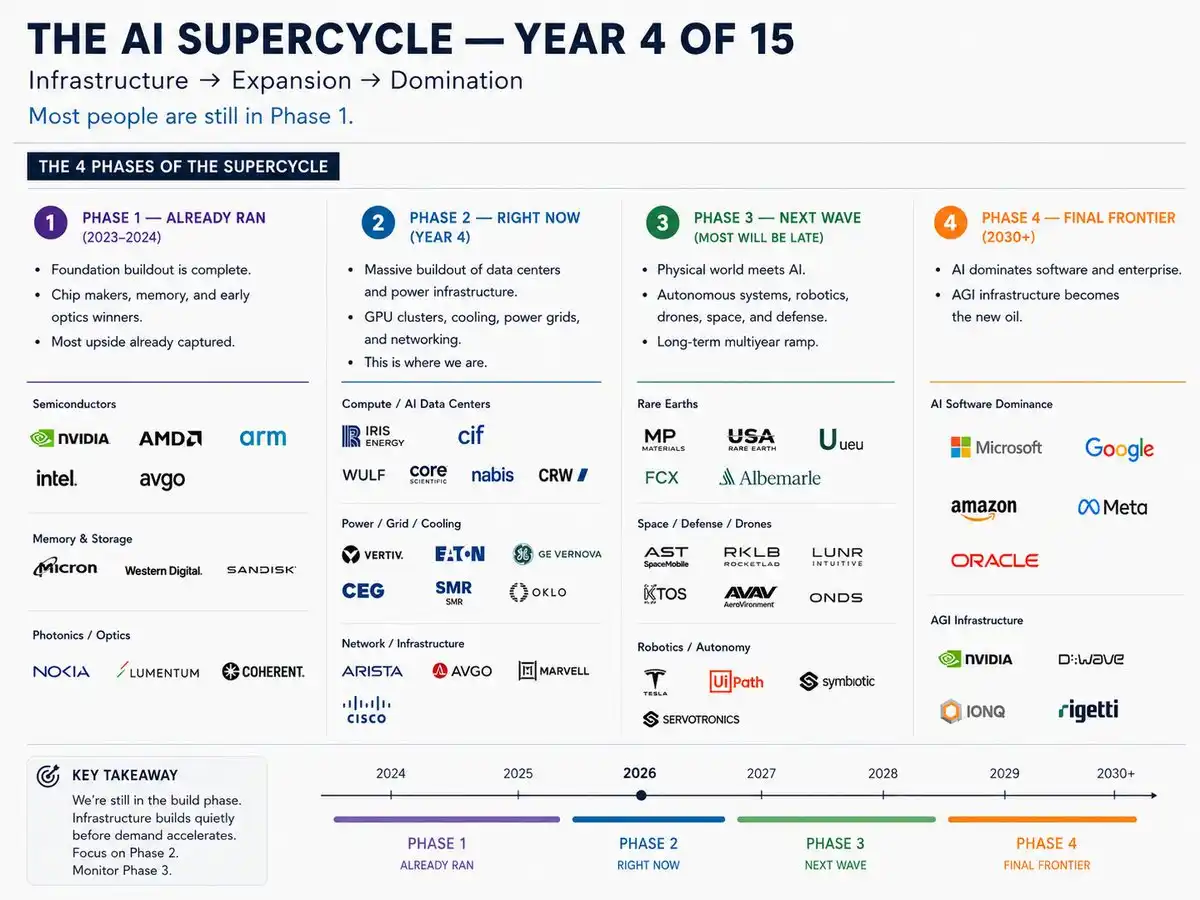
The AI supercycle will last 15 years. This is year three.

Most investors are still buying Stage 1 stocks, but smart money is already rotating into Stage 3.

I've broken the entire cycle into four stages, with the most important tickers labeled for each.

The AI supercycle is the biggest investment theme of this generation. Bigger than mobile internet, bigger than cloud computing. A 15-year structural shift that will reshape every industry in the global economy. Hyperscale cloud providers just committed $725 billion in capex for 2026, nearly double last year's. Microsoft, Google, Amazon, Meta — each over $100 billion individually.

This is not speculation.

🔴 Stage 1: Over (2023-2025)

The foundation layer is complete. AMD was up 78% in 2025, NVDA up 39%, Intel just delivered a blowout Q1, pushing the Philadelphia Semiconductor Index above 10,000 for the first time. Chips still drive every stage, but the historic entry opportunity is gone; the risk-reward has compressed.

Tickers: NVDA, AMD, ARM, INTC, AVGO, MU, GLW

Sectors: Semiconductors, Memory, Photonics/Optics

Status: Foundation complete, still growing, but priced in.

🟡 Stage 2: Buildout Peak (2025-2027)

The stage most investors are just waking up to. CEG acquiring Calpine to become the largest private U.S. power producer at 55 GW. GEV up over 200% in a year. VRT co-designing cooling for NVIDIA's Rubin architecture. GLW up 74% YTD on fiber demand. Nuclear SMR is the biggest dark horse — OKLO, SMR, BWXT are laying direct power lines for data centers.

Still upside, but the most obvious names have moved.

Tickers: CEG, GEV, VRT, VST, TLN, ANET, GLW, MOD, EQIX, OKLO, SMR, BWXT, NNE

Sectors: Power/Grid, Cooling, Networking, Nuclear SMR Buildout Peak

Note: Nuclear SMR is the hidden major opportunity.

🟡 Stage 3: Positioning Window (2026-2028)

The stage where AI leaves the data center and enters the physical world. Most will be late.

Tesla is converting its Fremont factory into an Optimus robot production line — $25 billion capex, targeting mass production in H2 2026. Rocket Lab posted a record $602M revenue, backlog at $1.85B. LUNR up 47% YTD with $943M in contracts. KTOS's Valkyrie drone selected by the Marine Corps.

The positioning window is open now.

Tickers: TSLA, RKLB, LUNR, KTOS, AVAV, PATH, ISRG, MP, FCX, ALB, ASTS

Sectors: Robotics/Autonomy, Space/Defense/Drones, Rare Earths

Judgment: The asymmetric risk-reward is here.

🟢 Stage 4: Endgame (2028+)

The endgame. Microsoft capex $190B, Alphabet $190B, Amazon $200B, Meta $145B. Google Cloud backlog exceeds $460B. They are building AI software dominance and AGI infrastructure. Quantum computing is early, but IONQ and D-Wave are laying the groundwork.

The platforms controlling the software layer win the entire supercycle.

Tickers: MSFT, GOOGL, AMZN, META, ORCL, IONQ

Sectors: AI Software Dominance, AGI Infrastructure, Decade-long thesis

Strategy: Buy the dips.

Key Conclusions

  • Stage 2 is confirmed (hyperscale $725B capex)
  • Stage 3 is where smart money is positioning — robotics, space, defense, nuclear
  • SMR is the core trade from 2026 to 2028
  • Most will rotate into these names 12 months late

A 15-year supercycle. Not a single trade. Stage 1 is over, Stage 2 is being priced, Stage 3 is where you should be.


Related Questions

QAccording to the article, what is the author's view on the duration and current stage of the AI supercycle?

AThe author believes the AI supercycle will last 15 years and is currently in its third year. The first stage (2023-2025) is already over, the second stage (2025-2027) is in progress, and the third stage (2026-2028) is where the most asymmetric opportunities lie.

QWhat sectors or 'stages' does the author identify as having the best asymmetric risk/reward opportunity right now?

AThe author identifies the third stage as having the best asymmetric risk/reward opportunity. This stage includes robotics/autonomous systems, space/defense/drones, and rare earths, with specific mentions of companies like Tesla, Rocket Lab, and Intuitive Machines.

QWhich specific sector within the 'construction boom' (second stage) is highlighted as a major hidden opportunity?

AWithin the second stage (the construction boom), the author highlights nuclear energy, specifically Small Modular Reactors (SMRs), as the major hidden opportunity. Companies mentioned include Oklo, NuScale Power (SMR), and BWX Technologies.

QWhat key metric is cited as evidence confirming the transition to the second stage of the AI supercycle?

AThe author cites the $725 billion in committed capital expenditure for 2026 by hyperscale cloud providers (Microsoft, Google, Amazon, Meta) as the key metric confirming the transition to the second stage. This amount is nearly double that of the previous year.

QWhat does the author suggest is the strategy for investing in the 'Endgame' (fourth stage) companies?

AFor the 'Endgame' or fourth stage companies (like Microsoft, Alphabet, Amazon, Meta), which control the AI software platform, the author's suggested strategy is to 'buy the dips,' indicating a long-term, patient accumulation approach.

Related Reads

Why Did Zhipu Surge Nearly 30% in a Single Day?

"Global AI Model Unicorn" Zhipu's stock surged nearly 30% in a single day, reaching a new market cap high. The catalyst was the launch of its GLM-5.1-highspeed API, boasting a generation speed of **400 tokens per second**, setting a new global benchmark. This speed, roughly 3-5 times faster than industry leaders like OpenAI's GPT-4o and Anthropic's Claude, is achieved **without compromising the full-scale model's capabilities**. In the era of AI Agents requiring dozens of self-calls, such latency reduction is critical, transforming speed from a system metric into a determinant of intelligence limits. The breakthrough stems from a three-layer technical overhaul: 1. **TileRT Inference Engine**: Compiles the entire model into a continuous, always-on computation pipeline using "Warp Specialization," minimizing GPU idle time by having different processor groups handle data loading, computation, and communication in parallel. 2. **Heterogeneous Parallelism for MLA**: To efficiently run the GLM-5.1 model using the MLA attention mechanism, TileRT employs a heterogeneous strategy. One GPU handles sparse indexing/routing, while the others perform dense computation, optimizing for MLA's unique workflow. 3. **ZCube Network Architecture**: Replaces the standard Spine-Leaf (ROFT) network topology with a flat, dual-group interconnect. This design creates a single optimal path between any two GPUs, eliminating network congestion at scale and reducing latency. The business impact is significant: a 15% increase in cluster throughput (free extra capacity), a 40.6% reduction in tail latency (improved stability), and a one-third cut in networking hardware costs. Long-term, this innovation challenges the dominance of NVIDIA's integrated hardware-software stack (GPU+NVLink+InfiniBand), potentially benefiting manufacturers of high-density Leaf switches and optical modules while lowering the software barrier for domestic AI chips like Huawei's Ascend. The innovation proves that more can be achieved with the same compute, reshaping the infrastructure beyond just GPUs.

marsbit1h ago

Why Did Zhipu Surge Nearly 30% in a Single Day?

marsbit1h ago

Bidding Farewell to the 'Gray Gambling Game'! Polymarket Charges into the Compliance Track—How Will This Impact the Entire Crypto Industry?

From Gray to Regulated: How Polymarket’s Compliance Journey Reshapes Crypto The evolution of Polymarket, a decentralized prediction market platform, illustrates a critical trend in crypto: innovative, high-value sectors ultimately integrate into regulatory frameworks. Founded in 2020, Polymarket quickly gained traction by leveraging low-cost Layer 2 blockchain technology for event-based trading, notably during the 2024 US presidential election where its markets outperformed traditional polls. However, its "build first, comply later" approach led to a 2022 CFTC enforcement action, resulting in a $1.4 million fine and a ban from the US market. A pivotal shift occurred in 2025 under a new US administration. Polymarket strategically acquired CFTC-licensed derivatives exchange QCX for $112 million, securing a regulated pathway back into the US. This move coincided with a regulatory reversal, as the CFTC withdrew a prior proposal to ban political event contracts. The platform’s successful "regulatory acquisition" strategy, avoiding a lengthy independent licensing process, highlights a viable compliance path for crypto-native projects. Its journey from regulatory target to a CFTC-recognized entity—bolstered by a major data partnership and investment from Intercontinental Exchange (ICE)—signals the maturation of prediction markets from a "crypto novelty" into acknowledged financial infrastructure. The story underscores that genuine utility provides negotiating power with regulators and that embracing compliance does not necessarily mean sacrificing core technological advantages.

marsbit1h ago

Bidding Farewell to the 'Gray Gambling Game'! Polymarket Charges into the Compliance Track—How Will This Impact the Entire Crypto Industry?

marsbit1h ago

Trading

Spot
Futures

Hot Articles

Discussions

Welcome to the HTX Community. Here, you can stay informed about the latest platform developments and gain access to professional market insights. Users' opinions on the price of AI (AI) are presented below.

活动图片














